9.1 Verifying Trigonometric Identities and Using Trigonometric Identities to Simplify Trigonometric Expressions
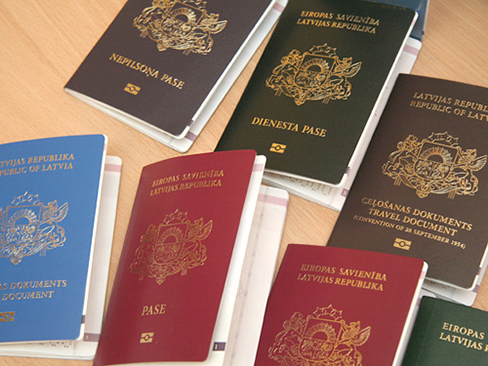
Figure 1 International passports and travel documents
In espionage movies, we see international spies with multiple passports, each claiming a different identity. However, we know that each of those passports represents the same person. The trigonometric identities act in a similar manner to multiple passports—there are many ways to represent the same trigonometric expression. Just as a spy will choose an Italian passport when traveling to Italy, we choose the identity that applies to the given scenario when solving a trigonometric equation.
In this section, we will begin an examination of the fundamental trigonometric identities, including how we can verify them and how we can use them to simplify trigonometric expressions.
9.1.1 Verifying the Fundamental Trigonometric Identities
Identities enable us to simplify complicated expressions. They are the basic tools of trigonometry used in solving trigonometric equations, just as factoring, finding common denominators, and using special formulas are the basic tools of solving algebraic equations. In fact, we use algebraic techniques constantly to simplify trigonometric expressions. Basic properties and formulas of algebra, such as the difference of squares formula and the perfect squares formula, will simplify the work involved with trigonometric expressions and equations. We already know that all of the trigonometric functions are related because they all are defined in terms of the unit circle. Consequently, any trigonometric identity can be written in many ways.
To verify the trigonometric identities, we usually start with the more complicated side of the equation and essentially rewrite the expression until it has been transformed into the same expression as the other side of the equation. Sometimes we have to factor expressions, expand expressions, find common denominators, or use other algebraic strategies to obtain the desired result. In this first section, we will work with the fundamental identities: the Pythagorean identities, the even-odd identities, the reciprocal identities, and the quotient identities.
We will begin with the Pythagorean identities (see Table 1), which are equations involving trigonometric functions based on the properties of a right triangle. We have already seen and used the first of these identifies, but now we will also use additional identities.
| Pythagorean Identities | ||
|---|---|---|
| \(\sin^{2}\theta + \cos^{2}\theta = 1\) | \(1 + \cot^{2}\theta = \csc^{2}\theta\) | \(1 + \tan^{2}\theta = \sec^{2}\theta\) |
Table 1
The second and third identities can be obtained by manipulating the first. The identity \(1 + \cot^{2}\theta = \csc^{2}\theta\) is found by rewriting the left side of the equation in terms of sine and cosine.
Prove: \(1 + \cot^{2}\theta = \csc^{2}\theta\)
\[\begin{array}{cclc} {1 + \cot^{2}\theta} & = & \left( {1 + \frac{\cos^{2}\theta}{\sin^{2}\theta}} \right) & {\qquad\text{Rewrite~the~left~side}.} \\ & = & {\left( \frac{\sin^{2}\theta}{\sin^{2}\theta} \right) + \left( \frac{\cos^{2}\theta}{\sin^{2}\theta} \right)} & {\qquad\text{Write~both~terms~with~the~common~denominator}.} \\ & = & \frac{\sin^{2}\theta + \cos^{2}\theta}{\sin^{2}\theta} & \\ & = & \frac{1}{\sin^{2}\theta} & \\ & = & {\csc^{2}\theta} & \end{array}\]
Similarly, \(1 + \tan^{2}\theta = \sec^{2}\theta\) can be obtained by rewriting the left side of this identity in terms of sine and cosine. This gives
\[\begin{array}{cclc} {1 + \tan^{2}\theta} & = & {1 + \left( \frac{\sin\;\theta}{\cos\;\theta} \right)^{2}} & {\quad\text{Rewrite~left~side}.} \\ & = & {\left( \frac{\cos\;\theta}{\cos\;\theta} \right)^{2} + \left( \frac{\sin\;\theta}{\cos\;\theta} \right)^{2}} & {\quad\text{Write~both~terms~with~the~common~denominator}.} \\ & = & \frac{\cos^{2}\;\theta + \sin^{2}\;\theta}{\cos^{2}\;\theta} & \\ & = & \frac{1}{\cos^{2}\;\theta} & \\ & = & {\sec^{2}\;\theta} & \end{array}\]
Recall that we determined which trigonometric functions are odd and which are even. The next set of fundamental identities is the set of even-odd identities. The even-odd identities relate the value of a trigonometric function at a given angle to the value of the function at the opposite angle. (See Table 2).
| Even-Odd Identities | ||
|---|---|---|
| \(\begin{array}{l} {\tan( - \theta) = - \tan\;\theta} \\ {\cot( - \theta) = - \cot\;\theta} \end{array}\) | \(\begin{array}{l} {\sin( - \theta) = - \sin\;\theta} \\ {\csc( - \theta) = - \csc\;\theta} \end{array}\) | \(\begin{array}{l} {\cos( - \theta) = \cos\;\theta} \\ {\sec( - \theta) = \sec\;\theta} \end{array}\) |
Table 2
Recall that an odd function is one in which \(f\left. \operatorname{(-}x \right)\operatorname{=\ -}f(x)\) for all \(x\) in the domain of \(f.\) The sine function is an odd function because \(\sin\left( {- \theta} \right) = - \sin\;\theta.\) The graph of an odd function is symmetric about the origin. For example, consider corresponding inputs of \(\frac{\pi}{2}\) and \(- \frac{\pi}{2}.\) The output of \(\sin\left( \frac{\pi}{2} \right)\) is opposite the output of \(\sin\left( {- \frac{\pi}{2}} \right).\) Thus,
\[\begin{matrix} {\sin\left( \frac{\pi}{2} \right)} & = & 1 \\ & \text{and} & \\ {\sin\left( {- \frac{\pi}{2}} \right)} & = & {- \sin\left( \frac{\pi}{2} \right)} \\ & = & -1 \end{matrix}\]
This is shown in Figure 2.
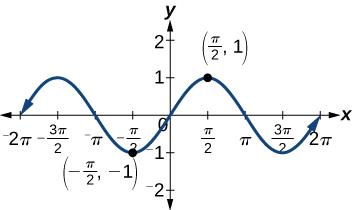
Figure 2 Graph of \(y = \sin\;\theta\)
Recall that an even function is one in which
\[f\left( {- x} \right) = f(x)\text{~for~all~}x\text{~in~the~domain~of~}f\]
The graph of an even function is symmetric about the \(y\)-axis. The cosine function is an even function because \(\cos( - \theta) = \cos\;\theta.\) For example, consider corresponding inputs \(\frac{\pi}{4}\) and \(- \frac{\pi}{4}.\) The output of \(\cos\left( \frac{\pi}{4} \right)\) is the same as the output of \(\cos\left( {- \frac{\pi}{4}} \right).\) Thus,
\[\begin{array}{ccl} {\cos\left( {- \frac{\pi}{4}} \right)} & = & {\cos\left( \frac{\pi}{4} \right)} \\ & \approx & 0.707 \end{array}\]
See Figure 3.
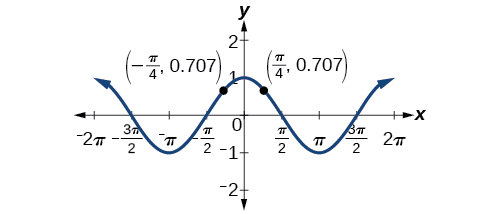
Figure 3 Graph of \(y = \cos\;\theta\)
For all \(\theta\) in the domain of the sine and cosine functions, respectively, we can state the following:
- Since \(\sin\left. \operatorname{(-}\theta \right) = -\sin\;\theta,\) sine is an odd function.
- Since, \(\cos\left. \operatorname{(-}\theta \right) = \cos\;\theta,\) cosine is an even function.
The other even-odd identities follow from the even and odd nature of the sine and cosine functions. For example, consider the tangent identity, \(\tan\left. \operatorname{(-}\theta \right) = {-tan}\;\theta.\) We can interpret the tangent of a negative angle as \(\tan\left. \operatorname{(-}\theta \right) = \frac{\sin\left( {- \theta} \right)}{\cos\left. \operatorname{(-}\theta \right)} = \frac{- \sin\;\theta}{\cos\;\theta} = - \tan\;\theta.\) Tangent is therefore an odd function, which means that \(\tan\left( {- \theta} \right) = - \tan(\theta)\) for all \(\theta\) in the domain of the tangent function.
The cotangent identity, \(\cot\left( {- \theta} \right) = - \cot\;\theta,\) also follows from the sine and cosine identities. We can interpret the cotangent of a negative angle as \(\cot\left( {- \theta} \right) = \frac{\cos\left( {- \theta} \right)}{\sin\left( {- \theta} \right)} = \frac{\cos\;\theta}{- \sin\;\theta} = - \cot\;\theta.\) Cotangent is therefore an odd function, which means that \(\cot\left( {- \theta} \right) = - \cot(\theta)\) for all \(\theta\) in the domain of the cotangent function.
The cosecant function is the reciprocal of the sine function, which means that the cosecant of a negative angle will be interpreted as \(\csc\left( {- \theta} \right) = \frac{1}{\sin\left( {- \theta} \right)} = \frac{1}{- \sin\;\theta} = - \csc\;\theta.\) The cosecant function is therefore odd.
Finally, the secant function is the reciprocal of the cosine function, and the secant of a negative angle is interpreted as \(\sec\left( {- \theta} \right) = \frac{1}{\cos\left( {- \theta} \right)} = \frac{1}{\cos\;\theta} = \sec\;\theta.\) The secant function is therefore even.
To sum up, only two of the trigonometric functions, cosine and secant, are even. The other four functions are odd, verifying the even-odd identities.
The next set of fundamental identities is the set of reciprocal identities, which, as their name implies, relate trigonometric functions that are reciprocals of each other. See Table 3. Recall that we first encountered these identities when defining trigonometric functions from right angles in Right Triangle Trigonometry.
| Reciprocal Identities | |
|---|---|
| \(\sin\;\theta = \frac{1}{\csc\;\theta}\) | \(\csc\;\theta = \frac{1}{\sin\;\theta}\) |
| \(\cos\;\theta = \frac{1}{\sec\;\theta}\) | \(\sec\;\theta = \frac{1}{\cos\;\theta}\) |
| \(\tan\;\theta = \frac{1}{\cot\;\theta}\) | \(\cot\;\theta = \frac{1}{\tan\;\theta}\) |
Table 3
The final set of identities is the set of quotient identities, which define relationships among certain trigonometric functions and can be very helpful in verifying other identities. See Table 4.
| Quotient Identities | |
|---|---|
| \(\tan\;\theta = \frac{\sin\;\theta}{\cos\;\theta}\) | \(\cot\;\theta = \frac{\cos\;\theta}{\sin\;\theta}\) |
Table 4
The reciprocal and quotient identities are derived from the definitions of the basic trigonometric functions.
Graph both sides of the identity \(\cot\;\theta = \frac{1}{\tan\;\theta}.\) In other words, on the graphing calculator, graph \(y = \cot\;\theta\) and \(y = \frac{1}{\tan\;\theta}.\)
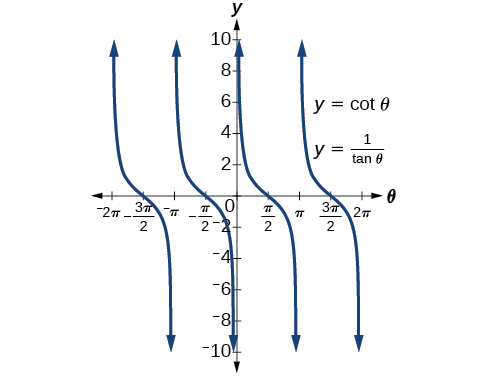
We see only one graph because both expressions generate the same image. One is on top of the other. This is a good way to confirm an identity verified with analytical means. If both expressions give the same graph, then they are most likely identities.
9.1.2 Using Algebra to Simplify Trigonometric Expressions
We have seen that algebra is very important in verifying trigonometric identities, but it is just as critical in simplifying trigonometric expressions before solving. Being familiar with the basic properties and formulas of algebra, such as the difference of squares formula, the perfect square formula, or substitution, will simplify the work involved with trigonometric expressions and equations.
For example, the equation \(\left( {\sin\; x + 1} \right)\left( {\sin\; x - 1} \right) = 0\) resembles the equation \(\left( {x + 1} \right)\left( {x - 1} \right) = 0,\) which uses the factored form of the difference of squares. Using algebra makes finding a solution straightforward and familiar. We can set each factor equal to zero and solve. This is one example of recognizing algebraic patterns in trigonometric expressions or equations.
Another example is the difference of squares formula, \(a^{2} - b^{2} = \left( {a - b} \right)\left( {a + b} \right),\) which is widely used in many areas other than mathematics, such as engineering, architecture, and physics. We can also create our own identities by continually expanding an expression and making the appropriate substitutions. Using algebraic properties and formulas makes many trigonometric equations easier to understand and solve.
Section Exercises
Verbal
1. We know \(g(x) = \cos\; x\) is an even function, and \(f(x) = \sin\; x\) and \(h(x) = \tan\; x\) are odd functions. What about \(G(x) = \cos^{2}x,F(x) = \sin^{2}x,\) and \(H(x) = \tan^{2}x?\) Are they even, odd, or neither? Why?
Solution (click to reveal)
All three functions, \(F\),\(G\), and \(H\), are even.
This is because \(F\left( {- x} \right) = \sin\left( {- x} \right)\sin\left( {- x} \right) = \left( {- \sin\; x} \right)\left( {- \sin\; x} \right) = \sin^{2}x = F(x)\),\(G\left( {- x} \right) = \cos\left( {- x} \right)\cos\left( {- x} \right) = \cos\; x\cos\; x = \cos^{2}x = G(x)\) and \(H\left( {- x} \right) = \tan\left( {- x} \right)\tan\left( {- x} \right) = \left( {- \tan\; x} \right)\left( {- \tan\; x} \right) = \tan^{2}x = H(x).\)
2. Examine the graph of \(f(x) = \sec\; x\) on the interval \(\lbrack - \pi,\pi\rbrack.\) How can we tell whether the function is even or odd by only observing the graph of \(f(x) = \sec\; x?\)
3. After examining the reciprocal identity for \(\sec\; t,\) explain why the function is undefined at certain points.
Solution (click to reveal)
When \(\cos\; t = 0,\) then \(\sec\; t = \frac{1}{0},\) which is undefined.
4. All of the Pythagorean identities are related. Describe how to manipulate the equations to get from \(\sin^{2}t + \cos^{2}t = 1\) to the other forms.
Algebraic
For the following exercises, use the fundamental identities to fully simplify the expression.
5. \(\sin\; x\;\cos\; x\;\sec\; x\)
Solution (click to reveal)
\(\sin\; x\)
6. \(\sin(-x)\;\cos(-x)\;\csc(-x)\)
7. \(\tan\; x\;\sin\; x + \sec\; x\;\cos^{2}x\)
Solution (click to reveal)
\(\sec\; x\)
8. \(\csc\; x + \cos\; x\;\cot(-x)\)
9. \(\frac{\cot\; t + \tan\; t}{\sec( - t)}\)
Solution (click to reveal)
\(\csc\; t\)
10. \(3\;\sin^{3}\; t\;\csc\; t + \cos^{2}\; t + 2\;\cos( - t)\cos\; t\)
11. \(-\tan(-x)\cot(-x)\)
Solution (click to reveal)
\(-1\)
12. \(\frac{-\sin(-x)\cos\; x\;\sec\; x\;\csc\; x\;\tan\; x}{\cot\; x}\)
13. \(\frac{1 + \tan^{2}\theta}{\csc^{2}\theta} + \sin^{2}\theta + \frac{1}{\sec^{2}\theta}\)
Solution (click to reveal)
\(\sec^{2}x\)
14. \(\left( {\frac{\tan\; x}{\csc^{2}x} + \frac{\tan\; x}{\sec^{2}x}} \right)\left( \frac{1 + \tan\; x}{1 + \cot\; x} \right) - \frac{1}{\cos^{2}x}\)
15. \(\frac{1 - \cos^{2}\; x}{\tan^{2}\; x} + 2\;\sin^{2}\; x\)
Solution (click to reveal)
\(\sin^{2}x + 1\)
For the following exercises, simplify the first trigonometric expression by writing the simplified form in terms of the second expression.
16. \(\frac{\tan\; x + \cot\; x}{\csc\; x};\;\cos\; x\)
17. \(\frac{\sec\; x + \csc\; x}{1 + \tan\; x};\;\sin\; x\)
Solution (click to reveal)
\(\frac{1}{\sin\; x}\)
18. \(\frac{\cos\; x}{1 + \sin\; x} + \tan\; x;\;\cos\; x\)
19. \(\frac{1}{\sin\; x\cos\; x} - \cot\; x;\;\cot\; x\)
Solution (click to reveal)
\(\frac{1}{\cot\; x}\)
20. \(\frac{1}{1 - \cos\; x} - \frac{\cos\; x}{1 + \cos\; x};\;\csc\; x\)
21. \(\left( {\sec\; x + \csc\; x} \right)\left( {\sin\; x + \cos\; x} \right) - 2 - \cot\; x;\;\tan\; x\)
Solution (click to reveal)
\(\tan\; x\)
22. \(\frac{1}{\csc\; x - \sin\; x};\;\sec\; x\text{~and~}\tan\; x\)
23. \(\frac{1 - \sin\; x}{1 + \sin\; x} - \frac{1 + \sin\; x}{1 - \sin\; x};\;\sec\; x\text{~and~}\tan\; x\)
Solution (click to reveal)
\(- 4\sec\; x\tan\; x\)
24. \(\tan\; x;\;\sec\; x\)
25. \(\sec\; x;\;\cot\; x\)
Solution (click to reveal)
\(\pm \sqrt{\frac{1}{\cot^{2}x} + 1}\)
26. \(\sec\; x;\;\sin\; x\)
27. \(\cot\; x;\;\sin\; x\)
Solution (click to reveal)
\(\frac{\pm \sqrt{1 - \sin^{2}x}}{\sin\; x}\)
28. \(\cot\; x;\;\csc\; x\)
For the following exercises, verify the identity.
29. \(\cos\; x - \cos^{3}x = \cos\; x\;\sin^{2}\; x\)
Solution (click to reveal)
Answers will vary. Sample proof:
\(\begin{array}{ccl} {\cos\; x - \cos^{3}x} & = & {\cos\; x\left( 1 - \cos^{2}x \right)} \\ & = & {\cos\; x\sin^{2}x} \end{array}\)
30. \(\cos\; x\left( {\tan\; x - \sec\left( {- x} \right)} \right) = \sin\; x - 1\)
31. \(\frac{1 + \sin^{2}x}{\cos^{2}x} = \frac{1}{\cos^{2}x} + \frac{\sin^{2}x}{\cos^{2}x} = 1 + 2\;\tan^{2}x\)
Solution (click to reveal)
Answers will vary. Sample proof:
\(\frac{1 + \sin^{2}x}{\cos^{2}x} = \frac{1}{\cos^{2}x} + \frac{\sin^{2}x}{\cos^{2}x} = \sec^{2}x + \tan^{2}x = \tan^{2}x + 1 + \tan^{2}x = 1 + 2\tan^{2}x\)
32. \(\left( {\sin\; x + \cos\; x} \right)^{2} = 1 + 2\;\sin\; x\cos\; x\)
33. \(\cos^{2}x - \tan^{2}x = 2 - \sin^{2}x - \sec^{2}x\)
Solution (click to reveal)
Answers will vary. Sample proof:
\(\cos^{2}x - \tan^{2}x = 1 - \sin^{2}x - \left( {\sec^{2}x - 1} \right) = 1 - \sin^{2}x - \sec^{2}x + 1 = 2 - \sin^{2}x - \sec^{2}x\)
Extensions
For the following exercises, prove or disprove the identity.
34. \(\frac{1}{1 + \cos\; x} - \frac{1}{1 - \cos( - x)} = - 2\;\cot\; x\;\csc\; x\)
35. \(\csc^{2}x\left( {1 + \sin^{2}x} \right) = \cot^{2}x\)
Solution (click to reveal)
False
36. \(\left( \frac{\sec^{2}( - x) - \tan^{2}x}{\tan\; x} \right)\left( \frac{2 + 2\;\tan\; x}{2 + 2\;\cot\; x} \right) - 2\;\sin^{2}x = \cos\; 2x\)
37. \(\frac{\tan\; x}{\sec\; x}\sin\left( {- x} \right) = \cos^{2}x\)
Solution (click to reveal)
False
38. \(\frac{\sec\left( {- x} \right)}{\tan\; x + \cot\; x} = - \sin\left( {- x} \right)\)
39. \(\frac{1 + \sin\; x}{\cos\; x} = \frac{\cos\; x}{1 + \sin\left( {- x} \right)}\)
Solution (click to reveal)
Proved with negative and Pythagorean identities
For the following exercises, determine whether the identity is true or false. If false, find an appropriate equivalent expression.
40. \(\frac{\cos^{2}\theta - \sin^{2}\theta}{1 - \tan^{2}\theta} = \sin^{2}\theta\)
41. \(3\;\sin^{2}\theta + 4\;\cos^{2}\theta = 3 + \cos^{2}\theta\)
Solution (click to reveal)
True \(3\;\sin^{2}\theta + 4\;\cos^{2}\theta = 3\;\sin^{2}\theta + 3\;\cos^{2}\theta + \cos^{2}\theta = 3\left( {\sin^{2}\theta + \cos^{2}\theta} \right) + \cos^{2}\theta = 3 + \cos^{2}\theta\)
42. \(\frac{\sec\;\theta + \tan\;\theta}{\cot\;\theta + \cos\;\theta} = \sec^{2}\theta\)