Chapter Review
Key Terms
Addition Principle — if one event can occur in \(m\) ways and a second event with no common outcomes can occur in \(n\) ways, then the first or second event can occur in \(m + n\) ways
annuity — an investment in which the purchaser makes a sequence of periodic, equal payments
arithmetic sequence — a sequence in which the difference between any two consecutive terms is a constant
arithmetic series — the sum of the terms in an arithmetic sequence
binomial coefficient — the number of ways to chooser objects from \(n\) objects where order does not matter; equivalent to \(C(n,r),\) denoted \(\begin{pmatrix} n \\ r \end{pmatrix}\)
binomial expansion — the result of expanding \({(x + y)}^{n}\) by multiplying
Binomial Theorem — a formula that can be used to expand any binomial
combination — a selection of objects in which order does not matter
common difference — the difference between any two consecutive terms in an arithmetic sequence
common ratio — the ratio between any two consecutive terms in a geometric sequence
complement of an event — the set of outcomes in the sample space that are not in the event \(E\)
diverge — a series is said to diverge if the sum is not a real number
event — any subset of a sample space
experiment — an activity with an observable result
explicit formula — a formula that defines each term of a sequence in terms of its position in the sequence
finite sequence — a function whose domain consists of a finite subset of the positive integers \(\left\{ 1,2,\ldots n \right\}\) for some positive integer \(n\)
Fundamental Counting Principle — if one event can occur in \(m\) ways and a second event can occur in \(n\) ways after the first event has occurred, then the two events can occur in \(m \times n\) ways; also known as the Multiplication Principle
geometric sequence — a sequence in which the ratio of a term to a previous term is a constant
geometric series — the sum of the terms in a geometric sequence
index of summation — in summation notation, the variable used in the explicit formula for the terms of a series and written below the sigma with the lower limit of summation
infinite sequence — a function whose domain is the set of positive integers
infinite series — the sum of the terms in an infinite sequence
lower limit of summation — the number used in the explicit formula to find the first term in a series
Multiplication Principle — if one event can occur in \(m\) ways and a second event can occur in \(n\) ways after the first event has occurred, then the two events can occur in \(m \times n\) ways; also known as the Fundamental Counting Principle
mutually exclusive events — events that have no outcomes in common
n factorial — the product of all the positive integers from 1 to \(n\)
nth partial sum — the sum of the first \(n\) terms of a sequence
nth term of a sequence — a formula for the general term of a sequence
outcomes — the possible results of an experiment
permutation — a selection of objects in which order matters
probability — a number from 0 to 1 indicating the likelihood of an event
probability model — a mathematical description of an experiment listing all possible outcomes and their associated probabilities
recursive formula — a formula that defines each term of a sequence using previous term(s)
sample space — the set of all possible outcomes of an experiment
sequence — a function whose domain is a subset of the positive integers
series — the sum of the terms in a sequence
summation notation — a notation for series using the Greek letter sigma; it includes an explicit formula and specifies the first and last terms in the series
term — a number in a sequence
union of two events — the event that occurs if either or both events occur
upper limit of summation — the number used in the explicit formula to find the last term in a series
Key Equations
| Formula for a factorial | \(\begin{array}{l} {0! = 1} \\ {1! = 1} \\ {n! = n\left( {n - 1} \right)\left( {n - 2} \right)\cdots(2)(1)\text{,~for~}n \geq 2} \end{array}\) |
| recursive formula for nth term of an arithmetic sequence | \(a_{n} = {a_{n - 1} + d},{n \geq 2}\) |
| explicit formula for nth term of an arithmetic sequence | \(\begin{array}{l} {a_{n} = a_{1} + d(n - 1)} \end{array}\) |
| recursive formula for \(nth\) term of a geometric sequence | \(a_{n} = ra_{n - 1},n \geq 2\) |
| explicit formula for \(nth\) term of a geometric sequence | \(a_{n} = a_{1}r^{n - 1}\) |
| sum of the first \(n\) terms of an arithmetic series | \(S_{n} = \frac{n(a_{1} + a_{n})}{2}\) |
| sum of the first \(n\) terms of a geometric series | \(S_{n} = \frac{a_{1}(1 - r^{n})}{1 - r},r \neq 1\) |
| sum of an infinite geometric series with \(–1 < r < \mspace{9mu} 1\) | \(S_{n} = \frac{a_{1}}{1 - r},r \neq 1\) |
| number of permutations of \(n\) distinct objects taken \(r\) at a time | \(P(n,r) = \frac{n!}{(n - r)!}\) |
| number of combinations of \(n\) distinct objects taken \(r\) at a time | \(C(n,r) = \frac{n!}{r!(n - r)!}\) |
| number of permutations of \(n\) non-distinct objects | \(\frac{n!}{r_{1}!r_{2}!\ldots r_{k}!}\) |
| Binomial Theorem | \({(x + y)}^{n} = {\sum\limits_{k - 0}^{n}\begin{pmatrix} n \\ k \end{pmatrix}}x^{n - k}y^{k}\) |
| \((r + 1)th\) term of a binomial expansion | \(\begin{pmatrix} n \\ r \end{pmatrix}x^{n - r}y^{r}\) |
| probability of an event with equally likely outcomes | \(P(E) = \frac{n(E)}{n(S)}\) |
| probability of the union of two events | \(P(E \cup F) = P(E) + P(F) - P(E \cap F)\) |
| probability of the union of mutually exclusive events | \(P(E \cup F) = P(E) + P(F)\) |
| probability of the complement of an event | \(P(E') = 1 - P(E)\) |
Key Concepts
13.1 Sequences and Their Notations
- A sequence is a list of numbers, called terms, written in a specific order.
- Explicit formulas define each term of a sequence using the position of the term. See Example 1, Example 2, and Example 3.
- An explicit formula for the \(n\text{th}\) term of a sequence can be written by analyzing the pattern of several terms. See Example 4.
- Recursive formulas define each term of a sequence using previous terms.
- Recursive formulas must state the initial term, or terms, of a sequence.
- A set of terms can be written by using a recursive formula. See Example 5 and Example 6.
- A factorial is a mathematical operation that can be defined recursively.
- The factorial of \(n\) is the product of all integers from 1 to \(n\) See Example 7.
13.2 Arithmetic Sequences
- An arithmetic sequence is a sequence where the difference between any two consecutive terms is a constant.
- The constant between two consecutive terms is called the common difference.
- The common difference is the number added to any one term of an arithmetic sequence that generates the subsequent term. See Example 1.
- The terms of an arithmetic sequence can be found by beginning with the initial term and adding the common difference repeatedly. See Example 2 and Example 3.
- A recursive formula for an arithmetic sequence with common difference \(d\) is given by \(a_{n} = a_{n - 1} + d,n \geq 2.\) See Example 4.
- As with any recursive formula, the initial term of the sequence must be given.
- An explicit formula for an arithmetic sequence with common difference \(d\) is given by \(a_{n} = a_{1} + d(n - 1).\) See Example 5.
- An explicit formula can be used to find the number of terms in a sequence. See Example 6.
- In application problems, we sometimes alter the explicit formula slightly to \(a_{n} = a_{0} + dn.\) See Example 7.
13.3 Geometric Sequences
- A geometric sequence is a sequence in which the ratio between any two consecutive terms is a constant.
- The constant ratio between two consecutive terms is called the common ratio.
- The common ratio can be found by dividing any term in the sequence by the previous term. See Example 1.
- The terms of a geometric sequence can be found by beginning with the first term and multiplying by the common ratio repeatedly. See Example 2 and Example 4.
- A recursive formula for a geometric sequence with common ratio \(r\) is given by \(a_{n} = ra_{n–1}\) for \(n \geq 2\) .
- As with any recursive formula, the initial term of the sequence must be given. See Example 3.
- An explicit formula for a geometric sequence with common ratio \(r\) is given by \(a_{n} = a_{1}r^{n–1}.\) See Example 5.
- In application problems, we sometimes alter the explicit formula slightly to \(a_{n} = a_{0}r^{n}.\) See Example 6.
13.4 Series and Their Notations
- The sum of the terms in a sequence is called a series.
- A common notation for series is called summation notation, which uses the Greek letter sigma to represent the sum. See Example 1.
- The sum of the terms in an arithmetic sequence is called an arithmetic series.
- The sum of the first \(n\) terms of an arithmetic series can be found using a formula. See Example 2 and Example 3.
- The sum of the terms in a geometric sequence is called a geometric series.
- The sum of the first \(n\) terms of a geometric series can be found using a formula. See Example 4 and Example 5.
- The sum of an infinite series exists if the series is geometric with \(–1 < r < 1.\)
- If the sum of an infinite series exists, it can be found using a formula. See Example 6, Example 7, and Example 8.
- An annuity is an account into which the investor makes a series of regularly scheduled payments. The value of an annuity can be found using geometric series. See Example 9.
13.5 Counting Principles
- If one event can occur in \(m\) ways and a second event with no common outcomes can occur in \(n\) ways, then the first or second event can occur in \(m + n\) ways. See Example 1.
- If one event can occur in \(m\) ways and a second event can occur in \(n\) ways after the first event has occurred, then the two events can occur in \(m \times n\) ways. See Example 2.
- A permutation is an ordering of \(n\) objects.
- If we have a set of \(n\) objects and we want to choose \(r\) objects from the set in order, we write \(P(n,r).\)
- Permutation problems can be solved using the Multiplication Principle or the formula for \(P(n,r).\) See Example 3 and Example 4.
- A selection of objects where the order does not matter is a combination.
- Given \(n\) distinct objects, the number of ways to select \(r\) objects from the set is \(\text{C}(n,r)\) and can be found using a formula. See Example 5.
- A set containing \(n\) distinct objects has \(2^{n}\) subsets. See Example 6.
- For counting problems involving non-distinct objects, we need to divide to avoid counting duplicate permutations. See Example 7.
13.6 Binomial Theorem
- \(\begin{pmatrix} n \\ r \end{pmatrix}\) is called a binomial coefficient and is equal to \(C(n,r).\) See Example 1.
- The Binomial Theorem allows us to expand binomials without multiplying. See Example 2.
- We can find a given term of a binomial expansion without fully expanding the binomial. See Example 3.
13.7 Probability
- Probability is always a number between 0 and 1, where 0 means an event is impossible and 1 means an event is certain.
- The probabilities in a probability model must sum to 1. See Example 1.
- When the outcomes of an experiment are all equally likely, we can find the probability of an event by dividing the number of outcomes in the event by the total number of outcomes in the sample space for the experiment. See Example 2.
- To find the probability of the union of two events, we add the probabilities of the two events and subtract the probability that both events occur simultaneously. See Example 3.
- To find the probability of the union of two mutually exclusive events, we add the probabilities of each of the events. See Example 4.
- The probability of the complement of an event is the difference between 1 and the probability that the event occurs. See Example 5.
- In some probability problems, we need to use permutations and combinations to find the number of elements in events and sample spaces. See Example 6.
Chapter Review Exercises
Sequences and Their Notations
1. Write the first four terms of the sequence defined by the recursive formula \(a_{1} = 2,\mspace{9mu} a_{n} = a_{n - 1} + n.\)
Solution (click to reveal)
\(2,4,7,11\)
2. Evaluate \(\frac{6!}{(5 - 3)!3!}.\)
3. Write the first four terms of the sequence defined by the explicit formula \(a_{n} = 10^{n} + 3.\)
Solution (click to reveal)
\(13,103,1003,10003\)
4. Write the first four terms of the sequence defined by the explicit formula \(a_{n} = \frac{n!}{n(n + 1)}.\)
Arithmetic Sequences
5. Is the sequence \(\frac{4}{7},\frac{47}{21},\frac{82}{21},\frac{39}{7},\;...\) arithmetic? If so, find the common difference.
Solution (click to reveal)
The sequence is arithmetic. The common difference is \(d = \frac{5}{3}.\)
6. Is the sequence \(2,4,8,16,\mspace{9mu}...\) arithmetic? If so, find the common difference.
7. An arithmetic sequence has the first term \(a_{1} = 18\) and common difference \(d = - 8.\) What are the first five terms?
Solution (click to reveal)
\(18,10,2, - 6, - 14\)
8. An arithmetic sequence has terms \(a_{3} = 11.7\) and \(a_{8} = - 14.6.\) What is the first term?
9. Write a recursive formula for the arithmetic sequence \(- 20\text{,} - 10,0\text{,}10\text{,…}\)
Solution (click to reveal)
\(a_{1} = - 20,\mspace{9mu} a_{n} = a_{n - 1} + 10\)
10. Write a recursive formula for the arithmetic sequence \(0,\mspace{9mu} - \frac{1}{2},\mspace{9mu} - 1,\mspace{9mu} - \frac{3}{2},\ldots,\) and then find the 31st term.
11. Write an explicit formula for the arithmetic sequence \(\frac{7}{8},\mspace{9mu}\frac{29}{24},\mspace{9mu}\frac{37}{24},\mspace{9mu}\frac{15}{8},\ldots\)
Solution (click to reveal)
\(a_{n} = \frac{1}{3}n + \frac{13}{24}\)
12. How many terms are in the finite arithmetic sequence \(12,20,28,\ldots,172?\)
Geometric Sequences
13. Find the common ratio for the geometric sequence \(2.5,\mspace{9mu} 5,\mspace{9mu} 10,\mspace{9mu} 20,\ldots\)
Solution (click to reveal)
\(r = 2\)
14. Is the sequence 4, 16, 28, 40 … geometric? If so find the common ratio. If not, explain why.
15. A geometric sequence has terms \(a_{7} = 16\text{,}384\) and \(a_{9} = 262\text{,}144\). What are the first five terms?
Solution (click to reveal)
4, 16, 64, 256, 1024
16. A geometric sequence has the first term \(a_{1}\text{=} - 3\) and common ratio \(r = \frac{1}{2}.\) What is the 8th term?
17. What are the first five terms of the geometric sequence \(a_{1} = 3,\mspace{9mu} a_{n} = 4 \cdot a_{n - 1}?\)
Solution (click to reveal)
\(3,\mspace{9mu} 12,\mspace{9mu} 48,\mspace{9mu} 192,\mspace{9mu} 768\)
18. Write a recursive formula for the geometric sequence \(1,\mspace{9mu}\frac{1}{3},\mspace{9mu}\frac{1}{9},\mspace{9mu}\frac{1}{27},\ldots\)
19. Write an explicit formula for the geometric sequence \(- \frac{1}{5},\mspace{9mu} - \frac{1}{15},\mspace{9mu} - \frac{1}{45},\mspace{9mu} - \frac{1}{135},\ldots\)
Solution (click to reveal)
\(a_{n} = - \frac{1}{5} \cdot \left( \frac{1}{3} \right)^{n - 1}\)
20. How many terms are in the finite geometric sequence \(- 5,~ - \frac{5}{3},~ - \frac{5}{9},\ldots,~ - \frac{5}{59\text{,}049}?\)
Series and Their Notations
21. Use summation notation to write the sum of terms \(\frac{1}{2}m + 5\) from \(m = 0\) to \(m = 5.\)
Solution (click to reveal)
\(\sum\limits_{m = 0}^{5}{\left( {\frac{1}{2}m + 5} \right).}\)
22. Use summation notation to write the sum that results from adding the number \(13\) twenty times.
23. Use the formula for the sum of the first \(n\) terms of an arithmetic series to find the sum of the first eleven terms of the arithmetic series 2.5, 4, 5.5, … .
Solution (click to reveal)
\(S_{11} = 110\)
24. A ladder has \(15\) tapered rungs, the lengths of which increase by a common difference. The first rung is 5 inches long, and the last rung is 20 inches long. What is the sum of the lengths of the rungs?
25. Use the formula for the sum of the first \(n\) terms of a geometric series to find \(S_{9}\) for the series \(12,\mspace{7mu} 6,\mspace{7mu} 3,\mspace{7mu}\frac{3}{2},\ldots\)
Solution (click to reveal)
\(S_{9} \approx 23.95\)
26. The fees for the first three years of a hunting club membership are given in Table 4. If fees continue to rise at the same rate, how much will the total cost be for the first ten years of membership?
| Year | Membership Fees |
|---|---|
| 1 | $1500 |
| 2 | $1950 |
| 3 | $2535 |
Table 4
27. Find the sum of the infinite geometric series \(\sum\limits_{k = 1}^{\infty}45 \cdot {( - \frac{1}{3})}^{k - 1}.\)
Solution (click to reveal)
\(S = \frac{135}{4}\)
28. A ball has a bounce-back ratio of \(\frac{3}{5}\) the height of the previous bounce. Write a series representing the total distance traveled by the ball, assuming it was initially dropped from a height of 5 feet. What is the total distance? (Hint: the total distance the ball travels on each bounce is the sum of the heights of the rise and the fall.)
29. Alejandro deposits $80 of his monthly earnings into an annuity that earns 6.25% annual interest, compounded monthly. How much money will he have saved after 5 years?
Solution (click to reveal)
$5,617.61
30. The twins Hoa and Binh both opened retirement accounts on their 21st birthday. Hoa deposits $4,800.00 each year, earning 5.5% annual interest, compounded monthly. Binh deposits $3,600.00 each year, earning 8.5% annual interest, compounded monthly. Which twin will earn the most interest by the time they are \(55\) years old? How much more?
Counting Principles
31. How many ways are there to choose a number from the set \(\left\{ - 10\text{,} - 6\text{,}4\text{,}10\text{,}12\text{,}18\text{,}24\text{,}32 \right\}\) that is divisible by either \(4\) or \(6?\)
Solution (click to reveal)
6
32. In a group of \(20\) musicians, \(12\) play piano, \(7\) play trumpet, and \(2\) play both piano and trumpet. How many musicians play either piano or trumpet?
33. How many ways are there to construct a 4-digit code if numbers can be repeated?
Solution (click to reveal)
\(10^{4} = 10\text{,}000\)
34. A palette of water color paints has 3 shades of green, 3 shades of blue, 2 shades of red, 2 shades of yellow, and 1 shade of black. How many ways are there to choose one shade of each color?
35. Calculate \(P\left( {18,4} \right).\)
Solution (click to reveal)
\(P(18,4) = 73\text{,}440\)
36. In a group of \(5\) first-year, \(10\) second-year, \(3\) third-year, and \(2\) fourth-year students, how many ways can a president, vice president, and treasurer be elected?
37. Calculate \(C\left( {15,6} \right).\)
Solution (click to reveal)
\(C\left( {15,6} \right) = 5005\)
38. A coffee shop has 7 Guatemalan roasts, 4 Cuban roasts, and 10 Costa Rican roasts. How many ways can the shop choose 2 Guatemalan, 2 Cuban, and 3 Costa Rican roasts for a coffee tasting event?
39. How many subsets does the set \(\left\{ {1,\mspace{9mu} 3,\mspace{9mu} 5,\mspace{9mu}\ldots,\mspace{9mu} 99} \right\}\) have?
Solution (click to reveal)
\(2^{50} = 1.13 \times 10^{15}\)
40. A day spa charges a basic day rate that includes use of a sauna, pool, and showers. For an extra charge, guests can choose from the following additional services: massage, body scrub, manicure, pedicure, facial, and straight-razor shave. How many ways are there to order additional services at the day spa?
41. How many distinct ways can the word DEADWOOD be arranged?
Solution (click to reveal)
\(\frac{8!}{3!2!} = 3360\)
42. How many distinct rearrangements of the letters of the word DEADWOOD are there if the arrangement must begin and end with the letter D?
Binomial Theorem
43. Evaluate the binomial coefficient \(\begin{pmatrix} 23 \\ 8 \end{pmatrix}.\)
Solution (click to reveal)
\(490\text{,}314\)
44. Use the Binomial Theorem to expand \(\left( {3x + \frac{1}{2}y} \right)^{6}.\)
45. Use the Binomial Theorem to write the first three terms of \(\left( {2a + b} \right)^{17}.\)
Solution (click to reveal)
\(131\text{,}072a^{17}\text{+}1\text{,}114\text{,}112a^{16}b\text{+}4\text{,}456\text{,}448a^{15}b^{2}\)
46. Find the fourth term of \(\left( {3a^{2} - 2b} \right)^{11}\) without fully expanding the binomial.
Probability
For the following exercises, assume two die are rolled.
47. Construct a table showing the sample space.
Solution (click to reveal)
| 1 | 2 | 3 | 4 | 5 | 6 | |
| 1 | 1,1 | 1,2 | 1,3 | 1,4 | 1,5 | 1,6 |
| 2 | 2,1 | 2,2 | 2,3 | 2,4 | 2,5 | 2,6 |
| 3 | 3,1 | 3,2 | 3,3 | 3,4 | 3,5 | 3,6 |
| 4 | 4,1 | 4,2 | 4,3 | 4,4 | 4,5 | 4,6 |
| 5 | 5,1 | 5,2 | 5,3 | 5,4 | 5,5 | 5,6 |
| 6 | 6,1 | 6,2 | 6,3 | 6,4 | 6,5 | 6,6 |
48. What is the probability that a roll includes a \(2?\)
49. What is the probability of rolling a pair?
Solution (click to reveal)
\(\frac{1}{6}\)
50. What is the probability that a roll includes a 2 or results in a pair?
51. What is the probability that a roll doesn’t include a 2 or result in a pair?
Solution (click to reveal)
\(\frac{5}{9}\)
52. What is the probability of rolling a 5 or a 6?
53. What is the probability that a roll includes neither a 5 nor a 6?
Solution (click to reveal)
\(\frac{4}{9}\)
For the following exercises, use the following data: An elementary school survey found that 350 of the 500 students preferred soda to milk. Suppose 8 children from the school are attending a birthday party. (Show calculations and round to the nearest tenth of a percent.)
54. What is the percent chance that all the children attending the party prefer soda?
55. What is the percent chance that at least one of the children attending the party prefers milk?
Solution (click to reveal)
\(1 - \frac{C\left( {350,8} \right)}{C\left( {500,8} \right)} \approx 94.4\%\)
56. What is the percent chance that exactly 3 of the children attending the party prefer soda?
57. What is the percent chance that exactly 3 of the children attending the party prefer milk?
Solution (click to reveal)
\(\frac{C\left( {150,3} \right)C\left( {350,5} \right)}{C\left( {500,8} \right)} \approx 25.6\%\)
Practice Test
1. Write the first four terms of the sequence defined by the recursive formula \(a = –14,\operatorname{}a_{n} = \frac{2 + a_{n–1}}{2}.\)
Solution (click to reveal)
\(- 14, - 6, - 2,0\)
2. Write the first four terms of the sequence defined by the explicit formula \(a_{n} = \frac{n^{2}–n–1}{n!}.\)
3. Is the sequence \(0.3,\mspace{7mu} 1.2,\mspace{7mu} 2.1,\mspace{7mu} 3,\ldots\) arithmetic? If so find the common difference.
Solution (click to reveal)
The sequence is arithmetic. The common difference is \(d = 0.9.\)
4. An arithmetic sequence has the first term \(a_{1} = - 4\) and common difference \(d = –\frac{4}{3}.\) What is the 6th term?
5. Write a recursive formula for the arithmetic sequence \(- 2,\mspace{7mu} - \frac{7}{2},\mspace{7mu} - 5,\mspace{7mu} - \frac{13}{2},\ldots\) and then find the 22nd term.
Solution (click to reveal)
\(a_{1} = - 2,\mspace{7mu} a_{n} = a_{n - 1} - \frac{3}{2};\mspace{7mu} a_{22} = - \frac{67}{2}\)
6. Write an explicit formula for the arithmetic sequence \(15.6,\mspace{7mu} 15,\mspace{7mu} 14.4,\mspace{7mu} 13.8,\ldots\) and then find the 32nd term.
7. Is the sequence \(- 2\text{,} - 1\text{,} - \frac{1}{2}\text{,} - \frac{1}{4}\text{,}\ldots\) geometric? If so find the common ratio. If not, explain why.
Solution (click to reveal)
The sequence is geometric. The common ratio is \(r = \frac{1}{2}.\)
8. What is the 11th term of the geometric sequence \(- 1.5, - 3, - 6, - 12,\ldots?\)
9. Write a recursive formula for the geometric sequence \(\operatorname{}1,\mspace{7mu} - \frac{1}{2},\mspace{7mu}\frac{1}{4},\mspace{7mu} - \frac{1}{8},\ldots\)
Solution (click to reveal)
\(a_{1} = 1,\mspace{7mu} a_{n} = - \frac{1}{2} \cdot a_{n}{}_{- 1}\)
10. Write an explicit formula for the geometric sequence \(4,\mspace{7mu} - \frac{4}{3},\mspace{7mu}\frac{4}{9},\mspace{7mu} - \frac{4}{27},\ldots\)
11. Use summation notation to write the sum of terms \(3k^{2} - \frac{5}{6}k\) from \(k = - 3\) to \(k = 15.\)
Solution (click to reveal)
\(\sum\limits_{k = - 3}^{15}\left( {3k^{2} - \frac{5}{6}k} \right)\)
12. A community baseball stadium has 10 seats in the first row, 13 seats in the second row, 16 seats in the third row, and so on. There are 56 rows in all. What is the seating capacity of the stadium?
13. Use the formula for the sum of the first \(n\) terms of a geometric series to find \(\sum\limits_{k = 1}^{7}{- 0.2 \cdot \left( {- 5} \right)^{k - 1}.}\)
Solution (click to reveal)
\(S_{7} = - 2604.2\)
14. Find the sum of the infinite geometric series \({\sum\limits_{k = 1}^{\infty}{\frac{1}{3} \cdot \left( {- \frac{1}{5}} \right)^{k - 1}}}.\)
15. Ramla deposits $3,600 into a retirement fund each year. The fund earns 7.5% annual interest, compounded monthly. If she opened her account when she was 20 years old, how much will she have by the time she’s 55? How much of that amount was interest earned?
Solution (click to reveal)
Total in account: \(\text{\$}634,261.20;\) Interest earned: \(\text{\$}508{,}261.20\)
16. In a competition of 50 professional ballroom dancers, 22 compete in the fox-trot competition, 18 compete in the tango competition, and 6 compete in both the fox-trot and tango competitions. How many dancers compete in the fox-trot or tango competitions?
17. A buyer of a new sedan can custom order the car by choosing from 5 different exterior colors, 3 different interior colors, 2 sound systems, 3 motor designs, and either manual or automatic transmission. How many choices does the buyer have?
Solution (click to reveal)
\(5 \times 3 \times 2 \times 3 \times 2 = 180\)
18. To allocate annual bonuses, a manager must choose his top four employees and rank them first to fourth. In how many ways can he create the “Top-Four” list out of the 32 employees?
19. A music group needs to choose 3 songs to play at the annual Battle of the Bands. How many ways can they choose their set if they have 15 songs to pick from?
Solution (click to reveal)
\(C\left( {15,3} \right) = 455\)
20. A self-serve frozen yogurt shop has 8 candy toppings and 4 fruit toppings to choose from. How many ways are there to top a frozen yogurt?
21. How many distinct ways can the word EVANESCENCE be arranged if the anagram must end with the letter E?
Solution (click to reveal)
\(\frac{10!}{2!3!2!} = 151\text{,}200\)
22. Use the Binomial Theorem to expand \(\left( {\frac{3}{2}x - \frac{1}{2}y} \right)^{5}.\)
23. Find the seventh term of \(\left( {x^{2} - \frac{1}{2}} \right)^{13}\) without fully expanding the binomial.
Solution (click to reveal)
\(\frac{429x^{14}}{16}\)
For the following exercises, use the spinner in .
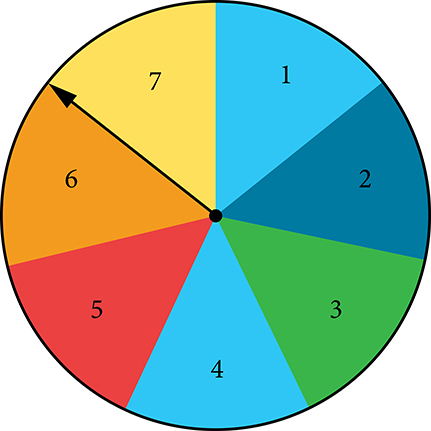
24. Construct a probability model showing each possible outcome and its associated probability. (Use the first letter for colors.)
25. What is the probability of landing on an odd number?
Solution (click to reveal)
\(\frac{4}{7}\)
26. What is the probability of landing on blue?
27. What is the probability of landing on blue or an odd number?
Solution (click to reveal)
\(\frac{5}{7}\)
28. What is the probability of landing on anything other than blue or an odd number?
29. A bowl of candy holds 16 peppermint, 14 butterscotch, and 10 strawberry flavored candies. Suppose a person grabs a handful of 7 candies. What is the percent chance that exactly 3 are butterscotch? (Show calculations and round to the nearest tenth of a percent.)
Solution (click to reveal)
\(\frac{C\left( {14,3} \right)C\left( {26,4} \right)}{C\left( {40,7} \right)} \approx 29.2\%\)