2.2 Linear Equations in One Variable
Caroline is a full-time college student planning a spring break vacation. To earn enough money for the trip, she has taken a part-time job at the local bank that pays $15.00/hr, and she opened a savings account with an initial deposit of $400 on January 15. She arranged for direct deposit of her payroll checks. If spring break begins March 20 and the trip will cost approximately $2,500, how many hours will she have to work to earn enough to pay for her vacation? If she can only work 4 hours per day, how many days per week will she have to work? How many weeks will it take? In this section, we will investigate problems like this and others, which generate graphs like the line in Figure 1.
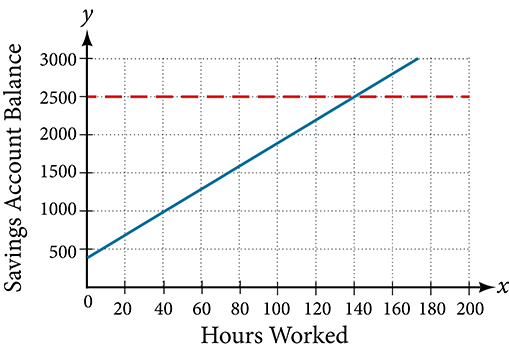
Figure 1
2.2.1 Solving Linear Equations in One Variable
A linear equation is an equation of a straight line, written in one variable. The only power of the variable is 1. Linear equations in one variable may take the form \(ax + b = 0\) and are solved using basic algebraic operations.
We begin by classifying linear equations in one variable as one of three types: identity, conditional, or inconsistent. An identity equation is true for all values of the variable. Here is an example of an identity equation.
\[3x = 2x + x\]
The solution set consists of all values that make the equation true. For this equation, the solution set is all real numbers because any real number substituted for \(x\) will make the equation true.
A conditional equation is true for only some values of the variable. For example, if we are to solve the equation \(5x + 2 = 3x - 6,\) we have the following:
\[\begin{array}{rcl} {5x + 2} & = & {3x - 6} \\ {2x} & = & -8 \\ x & = & -4 \end{array}\]
The solution set consists of one number: \(\left\{ {- 4} \right\}.\) It is the only solution and, therefore, we have solved a conditional equation.
An inconsistent equation results in a false statement. For example, if we are to solve \(5x - 15 = 5\left( {x - 4} \right),\) we have the following:
\[\begin{array}{rclc} {5x - 15} & = & {5x - 20} & \\ {5x - 15 - 5x} & = & {5x - 20 - 5x} & {\qquad\text{Subtract~}5x\mspace{9mu}\text{from~both~sides}.} \\ -15 & \neq & -20 & {\qquad\text{False~statement}} \end{array}\]
Indeed, \(-15 \neq \mspace{9mu}-20.\) There is no solution because this is an inconsistent equation.
Solving linear equations in one variable involves the fundamental properties of equality and basic algebraic operations. A brief review of those operations follows.
2.2.2 Solving a Rational Equation
In this section, we look at rational equations that, after some manipulation, result in a linear equation. If an equation contains at least one rational expression, it is a considered a rational equation.
Recall that a rational number is the ratio of two numbers, such as \(\frac{2}{3}\) or \(\frac{7}{2}.\) A rational expression is the ratio, or quotient, of two polynomials. Here are three examples.
\[\frac{x + 1}{x^{2} - 4},\mspace{9mu}\frac{1}{x - 3},\mspace{9mu}\text{or}\mspace{9mu}\frac{4}{x^{2} + x - 2}\]
Rational equations have a variable in the denominator in at least one of the terms. Our goal is to perform algebraic operations so that the variables appear in the numerator. In fact, we will eliminate all denominators by multiplying both sides of the equation by the least common denominator (LCD).
Finding the LCD is identifying an expression that contains the highest power of all of the factors in all of the denominators. We do this because when the equation is multiplied by the LCD, the common factors in the LCD and in each denominator will equal one and will cancel out.
A common mistake made when solving rational equations involves finding the LCD when one of the denominators is a binomial—two terms added or subtracted—such as \(\left( {x + 1} \right).\) Always consider a binomial as an individual factor—the terms cannot be separated. For example, suppose a problem has three terms and the denominators are \(x,\) \(x - 1,\) and \(3x - 3.\) First, factor all denominators. We then have \(x,\) \((x - 1),\) and \(3(x - 1)\) as the denominators. (Note the parentheses placed around the second denominator.) Only the last two denominators have a common factor of \((x - 1).\) The \(x\) in the first denominator is separate from the \(x\) in the \((x - 1)\) denominators. An effective way to remember this is to write factored and binomial denominators in parentheses, and consider each parentheses as a separate unit or a separate factor. The LCD in this instance is found by multiplying together the \(x,\) one factor of \(\left( {x - 1} \right),\) and the 3. Thus, the LCD is the following:
\[x\left( {x - 1} \right)3 = 3x\left( {x - 1} \right)\]
So, both sides of the equation would be multiplied by \(3x\left( {x - 1} \right).\) Leave the LCD in factored form, as this makes it easier to see how each denominator in the problem cancels out.
Another example is a problem with two denominators, such as \(x\) and \(x^{2} + 2x.\) Once the second denominator is factored as \(x^{2} + 2x = x\left( {x + 2} \right),\) there is a common factor of \(x\) in both denominators and the LCD is \(x\left( {x + 2} \right).\)
Sometimes we have a rational equation in the form of a proportion; that is, when one fraction equals another fraction and there are no other terms in the equation.
\[\frac{a}{b} = \frac{c}{d}\]
We can use another method of solving the equation without finding the LCD: cross-multiplication. We multiply terms by crossing over the equal sign.

Multiply \(a(d)\) and \(b(c),\) which results in \(ad = bc.\)
Any solution that makes a denominator in the original expression equal zero must be excluded from the possibilities.
2.2.3 Finding a Linear Equation
Perhaps the most familiar form of a linear equation is the slope-intercept form, written as \(y = mx + b,\) where \(m = \text{slope}\) and \(b = y\text{-intercept}\text{.}\) Let us begin with the slope.
The Slope of a Line
The slope of a line refers to the ratio of the vertical change in \(y\) over the horizontal change in \(x\) between any two points on a line. It indicates the direction in which a line slants as well as its steepness. Slope is sometimes described as rise over run.
\[m = \frac{y_{2} - y_{1}}{x_{2} - x_{1}}\]
If the slope is positive, the line slants upward to the right. If the slope is negative, the line slants downward to the right. As the absolute value of the slope increases, the line becomes steeper. Some examples are shown in Figure 2. The lines indicate the following slopes: \(m = -3,\) \(m = 2,\) and \(m = \frac{1}{3}.\)
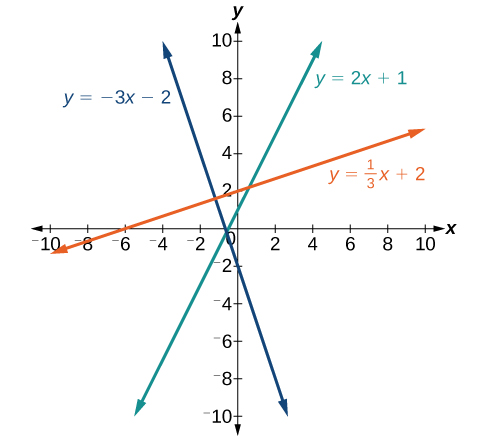
Figure 2
The Point-Slope Formula
Given the slope and one point on a line, we can find the equation of the line using the point-slope formula.
\[y - y_{1} = m\left( {x - x_{1}} \right)\]
This is an important formula, as it will be used in other areas of college algebra and often in calculus to find the equation of a tangent line. We need only one point and the slope of the line to use the formula. After substituting the slope and the coordinates of one point into the formula, we simplify it and write it in slope-intercept form.
Standard Form of a Line
Another way that we can represent the equation of a line is in standard form. Standard form is given as
\[Ax + By = C\]
where \(A,\) \(B,\) and \(C\) are integers. The \(x\)- and \(y\)-terms are on one side of the equal sign and the constant term is on the other side.
Vertical and Horizontal Lines
The equations of vertical and horizontal lines do not require any of the preceding formulas, although we can use the formulas to prove that the equations are correct. The equation of a vertical line is given as
\[x = c\]
where c is a constant. The slope of a vertical line is undefined, and regardless of the \(y\)-value of any point on the line, the \(x\)-coordinate of the point will be \(c\).
Suppose that we want to find the equation of a line containing the following points: \(\left( {-3,-5} \right),\left( {-3,1} \right),\left( {-3,3} \right),\) and \(\left( {-3,5} \right).\) First, we will find the slope.
\[m = \frac{5 - 3}{- 3 - (-3)} = \frac{2}{0}\]
Zero in the denominator means that the slope is undefined and, therefore, we cannot use the point-slope formula. However, we can plot the points. Notice that all of the \(x\)-coordinates are the same and we find a vertical line through \(x = -3.\) See Figure 3.
The equation of a horizontal line is given as
\[y = c\]
where c is a constant. The slope of a horizontal line is zero, and for any \(x\)-value of a point on the line, the \(y\)-coordinate will be \(c\).
Suppose we want to find the equation of a line that contains the following set of points: \(\left( {-2,-2} \right),\left( {0,-2} \right),\left( {3,-2} \right),\) and \(\left( {5,-2} \right).\) We can use the point-slope formula. First, we find the slope using any two points on the line.
\[\begin{array}{ccl} m & = & \frac{-2 - (-2)}{0 - (-2)} \\ & = & \frac{0}{2} \\ & = & 0 \end{array}\]
Use any point for \(\left( {x_{1},y_{1}} \right)\) in the formula, or use the \(y\)-intercept.
\[\begin{array}{rcl} {y - (-2)} & = & {0(x - 3)} \\ {y + 2} & = & 0 \\ y & = & -2 \end{array}\]
The graph is a horizontal line through \(y = -2.\) Notice that all of the \(y\)-coordinates are the same. See Figure 3.
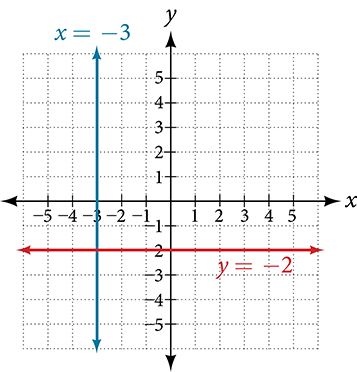
Figure 3 The line \(x\) = −3 is a vertical line. The line \(y\) = −2 is a horizontal line.
2.2.4 Determining Whether Graphs of Lines are Parallel or Perpendicular
Parallel lines have the same slope and different \(y\)-intercepts. Lines that are parallel to each other will never intersect. For example, Figure 4 shows the graphs of various lines with the same slope, \(m = 2.\)
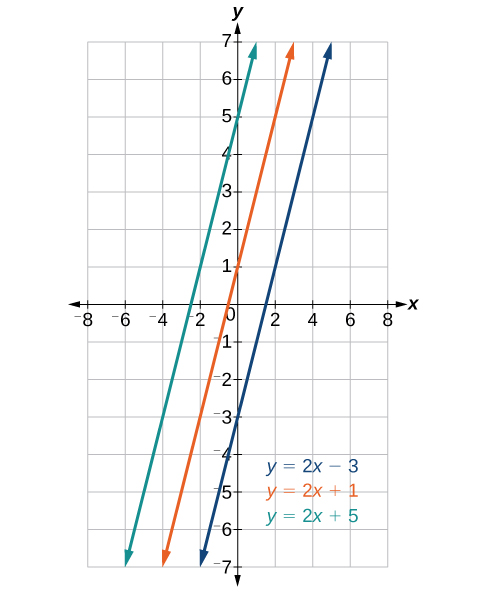
Figure 4 Parallel lines
All of the lines shown in the graph are parallel because they have the same slope and different \(y\)-intercepts.
Lines that are perpendicular intersect to form a \(90{^\circ}\) -angle. The slope of one line is the negative reciprocal of the other. We can show that two lines are perpendicular if the product of the two slopes is \(-1:m_{1} \cdot m_{2} = -1.\) For example, Figure 5 shows the graph of two perpendicular lines. One line has a slope of 3; the other line has a slope of \(- \frac{1}{3}.\)
\[\begin{array}{rcl} {m_{1} \cdot m_{2}} & = & -1 \\ {3 \cdot \left( {- \frac{1}{3}} \right)} & = & -1 \end{array}\]
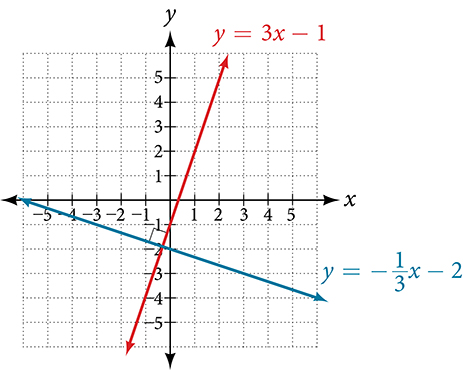
Figure 5 Perpendicular lines
Graph the equations of the given lines, and state whether they are parallel, perpendicular, or neither: \(3y = - 4x + 3\) and \(3x - 4y = 8.\)
Solution (click to reveal)
The first thing we want to do is rewrite the equations so that both equations are in slope-intercept form.
First equation:
\[\begin{array}{rcl} {3y} & = & {-4x + 3} \\ y & = & {- \frac{4}{3}x + 1} \end{array}\]
Second equation:
\[\begin{array}{rcl} {3x - 4y} & = & 8 \\ {-4y} & = & {\operatorname{}-3x + 8} \\ y & = & {\frac{3}{4}x - 2} \end{array}\]
See the graph of both lines in Figure 6
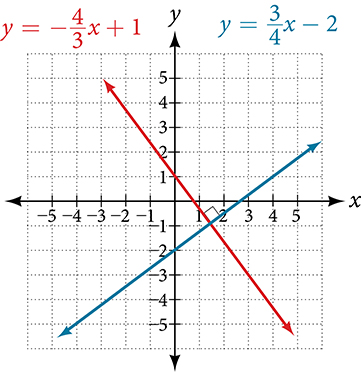
Figure 6
From the graph, we can see that the lines appear perpendicular, but we must compare the slopes.
\[\begin{array}{rcl} m_{1} & = & {- \frac{4}{3}} \\ m_{2} & = & \frac{3}{4} \\ {m_{1} \cdot m_{2}} & = & {\left( {- \frac{4}{3}} \right)\left( \frac{3}{4} \right) = -1} \end{array}\]
The slopes are negative reciprocals of each other, confirming that the lines are perpendicular.
Graph the two lines and determine whether they are parallel, perpendicular, or neither: \(2y - x = 10\) and \(2y = x + 4.\)
Solution (click to reveal)
Parallel lines: equations are written in slope-intercept form.
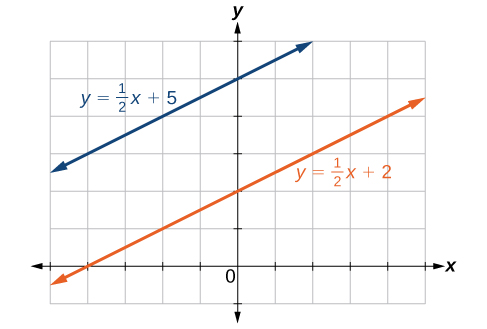
2.2.5 Writing the Equations of Lines Parallel or Perpendicular to a Given Line
As we have learned, determining whether two lines are parallel or perpendicular is a matter of finding the slopes. To write the equation of a line parallel or perpendicular to another line, we follow the same principles as we do for finding the equation of any line. After finding the slope, use the point-slope formula to write the equation of the new line.
Write the equation of line parallel to a \(5x + 3y = 1\) and passing through the point \(\left( {3,5} \right).\)
Solution (click to reveal)
First, we will write the equation in slope-intercept form to find the slope.
\[\begin{array}{rcl} {5x + 3y} & = & 1 \\ {3y} & = & {–5x + 1} \\ y & = & {- \frac{5}{3}x + \frac{1}{3}} \end{array}\]
The slope is \(m = - \frac{5}{3}.\) The \(y\)-intercept is \(\frac{1}{3},\) but that really does not enter into our problem, as the only thing we need for two lines to be parallel is the same slope. The one exception is that if the \(y\)-intercepts are the same, then the two lines are the same line. The next step is to use this slope and the given point with the point-slope formula.
\[\begin{array}{rcl} {y - 5} & = & {- \frac{5}{3}(x - 3)} \\ {y - 5} & = & {- \frac{5}{3}x + 5} \\ y & = & {- \frac{5}{3}x + 10} \end{array}\]
The equation of the line is \(y = - \frac{5}{3}x + 10.\) See Figure 7.
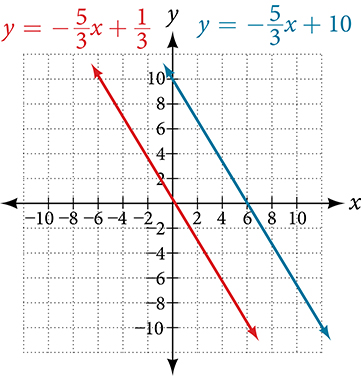
Figure 7
Section Exercises
Verbal
1. What does it mean when we say that two lines are parallel?
Solution (click to reveal)
It means they have the same slope.
2. What is the relationship between the slopes of perpendicular lines (assuming neither is horizontal nor vertical)?
3. How do we recognize when an equation, for example \(y = 4x + 3,\) will be a straight line (linear) when graphed?
Solution (click to reveal)
The exponent of the \(x\) variable is 1. It is called a first-degree equation.
4. What does it mean when we say that a linear equation is inconsistent?
5. When solving the following equation:
\(\frac{2}{x - 5} = \frac{4}{x + 1}\)
explain why we must exclude \(x = 5\) and \(x = -1\) as possible solutions from the solution set.
Solution (click to reveal)
If we insert either value into the equation, they make an expression in the equation undefined (zero in the denominator).
Algebraic
For the following exercises, solve the equation for \(x.\)
6. \(7x + 2 = 3x - 9\)
7. \(4x - 3 = 5\)
Solution (click to reveal)
\(x = 2\)
8. \(3(x + 2) - 12 = 5(x + 1)\)
9. \(12 - 5(x + 3) = 2x - 5\)
Solution (click to reveal)
\(x = \frac{2}{7}\)
10. \(\frac{1}{2} - \frac{1}{3}x = \frac{4}{3}\)
11. \(\frac{x}{3} - \frac{3}{4} = \frac{2x + 3}{12}\)
Solution (click to reveal)
\(x = 6\)
12. \(\frac{2}{3}x + \frac{1}{2} = \frac{31}{6}\)
13. \(3(2x - 1) + x = 5x + 3\)
Solution (click to reveal)
\(x = 3\)
14. \(\frac{2x}{3} - \frac{3}{4} = \frac{x}{6} + \frac{21}{4}\)
15. \(\frac{x + 2}{4} - \frac{x - 1}{3} = 2\)
Solution (click to reveal)
\(x = -14\)
For the following exercises, solve each rational equation for \(x.\) State all \(x\)-values that are excluded from the solution set.
16. \(\frac{3}{x} - \frac{1}{3} = \frac{1}{6}\)
17. \(2 - \frac{3}{x + 4} = \frac{x + 2}{x + 4}\)
Solution (click to reveal)
\(x \neq -4;\) \(x = -3\)
18. \(\frac{3}{x - 2} = \frac{1}{x - 1} + \frac{7}{(x - 1)(x - 2)}\)
19. \(\frac{3x}{x - 1} + 2 = \frac{3}{x - 1}\)
Solution (click to reveal)
\(x \neq 1;\) when we solve this we get \(x = 1,\) which is excluded, therefore NO solution
20. \(\frac{5}{x + 1} + \frac{1}{x - 3} = \frac{- 6}{x^{2} - 2x - 3}\)
21. \(\frac{1}{x} = \frac{1}{5} + \frac{3}{2x}\)
Solution (click to reveal)
\(x \neq 0;\) \(x = - \frac{5}{2}\)
For the following exercises, find the equation of the line using the point-slope formula. Write all the final equations using the slope-intercept form.
22. \(\left( {0,3} \right)\) with a slope of \(\frac{2}{3}\)
23. \(\left( {1,2} \right)\) with a slope of \(- \frac{4}{5}\)
Solution (click to reveal)
\(y = - \frac{4}{5}x + \frac{14}{5}\)
24. \(x\)-intercept is 1, and \(\left( {-2,6} \right)\)
25. \(y\)-intercept is 2, and \(\left( {4,-1} \right)\)
Solution (click to reveal)
\(y = - \frac{3}{4}x + 2\)
26. \((-3,10)\) and \((5,-6)\)
27. \(\left( {1,3} \right)\mspace{9mu}\text{~and~~}\left( {5,5} \right)\)
Solution (click to reveal)
\(y = \frac{1}{2}x + \frac{5}{2}\)
28. parallel to \(y = 2x + 5\) and passes through the point \(\left( {4,3} \right)\)
29. perpendicular to \(\text{3}y = x - 4\) and passes through the point \(\left( {-2,1} \right)\) .
Solution (click to reveal)
\(y = -3x - 5\)
For the following exercises, find the equation of the line using the given information.
30. \(\left( {- 2,0} \right)\) and \(\left( {-2,5} \right)\)
31. \(\left( {1,7} \right)\) and \(\left( {3,7} \right)\)
Solution (click to reveal)
\(y = 7\)
32. The slope is undefined and it passes through the point \(\left( {2,3} \right).\)
33. The slope equals zero and it passes through the point \(\left( {1,-4} \right).\)
Solution (click to reveal)
\(y = -4\)
34. The slope is \(\frac{3}{4}\) and it passes through the point \((1,4)\).
35. \((–1,3)\) and \((4,–5)\)
Solution (click to reveal)
\(8x + 5y = 7\)
Graphical
For the following exercises, graph the pair of equations on the same axes, and state whether they are parallel, perpendicular, or neither.
36. \(\begin{array}{l} {y = 2x + 7} \\ {y = - \frac{1}{2}x - 4} \end{array}\)
37. \(\begin{array}{l} {3x - 2y = 5} \\ {6y - 9x = 6} \end{array}\)
Solution (click to reveal)
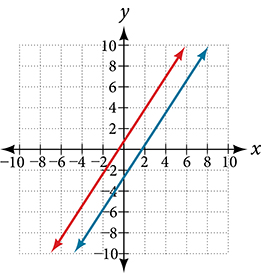
Parallel
38. \(\begin{array}{l} {y = \frac{3x + 1}{4}} \\ {y = 3x + 2} \end{array}\)
39. \(\begin{array}{l} {x = 4} \\ {y = -3} \end{array}\)
Solution (click to reveal)
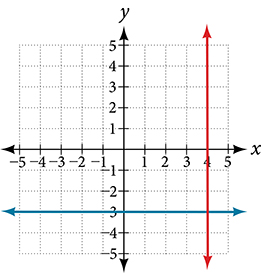
Perpendicular
Numeric
For the following exercises, find the slope of the line that passes through the given points.
40. \(\left( {5,4} \right)\) and \(\left( {7,9} \right)\)
41. \(\left( {-3,2} \right)\) and \(\left( {4,-7} \right)\)
Solution (click to reveal)
\(m = - \frac{9}{7}\)
42. \(\left( {-5,4} \right)\) and \(\left( {2,4} \right)\)
43. \(\left( {-1,-2} \right)\) and \(\left( {3,4} \right)\)
Solution (click to reveal)
\(m = \frac{3}{2}\)
44. \(\left( {3,3} \right)\) and \(\left( {3,-2} \right)\)
For the following exercises, find the slope of the lines that pass through each pair of points and determine whether the lines are parallel or perpendicular.
45. \(\begin{array}{l} {\left( {-1,3} \right)\mspace{9mu}\text{~and~~}\left( {5,1} \right)} \\ {\left( {-2,3} \right)\mspace{9mu}\text{~and~~}\left( {0,9} \right)} \end{array}\)
Solution (click to reveal)
\(m_{1} = - \frac{1}{3},\quad m_{2} = 3;\quad\text{Perpendicular}\text{.}\)
46. \(\begin{array}{l} {\left( {2,5} \right)\mspace{9mu}\text{~and~~}\left( {5,9} \right)} \\ {\left( {-1,-1} \right)\mspace{9mu}\text{~and~~}\left( {2,3} \right)} \end{array}\)
Technology
For the following exercises, express the equations in slope intercept form (rounding each number to the thousandths place). Enter this into a graphing calculator as Y1, then adjust the ymin and ymax values for your window to include where the \(y\)-intercept occurs. State your ymin and ymax values.
47. \(0.537x - 2.19y = 100\)
Solution (click to reveal)
\(y = 0.245x - 45.662.\) Answers may vary. \(y_{\text{min}} = -50,\mspace{9mu} y_{\text{max}} = -40\)
48. \(4{,}500x - 200y = 9{,}528\)
49. \(\frac{200 - 30y}{x} = 70\)
Solution (click to reveal)
\(y = - 2.333x + 6.667.\) Answers may vary. \(y_{\min} = -10,~y_{\max} = 10\)
Extensions
50. Starting with the point-slope formula \(y - y_{1} = m\left( x - x_{1} \right),\) solve this expression for \(x\) in terms of \(x_{1},y,y_{1},\) and \(m\).
51. Starting with the standard form of an equation \(Ax + By = C\) solve this expression for \(y\) in terms of \(A,B,C\) and \(x\). Then put the expression in slope-intercept form.
Solution (click to reveal)
\(y = - \frac{A}{B}x + \frac{C}{B}\)
52. Use the above derived formula to put the following standard equation in slope intercept form: \(7x - 5y = 25.\)
53. Given that the following coordinates are the vertices of a rectangle, prove that this truly is a rectangle by showing the slopes of the sides that meet are perpendicular.
\((–1,1),(2,0),(3,3)\) and \((0,4)\)
Solution (click to reveal)
\(\begin{array}{l} {\text{The~slope~for~}(-1,1)\mspace{9mu}\text{to~}(0,4)\mspace{9mu}\text{is~}3.} \\ {\text{The~slope~for~}(-1,1)\mspace{9mu}\text{to~}(2,0)\mspace{9mu}\text{is~}\frac{- 1}{3}.} \\ {\text{The~slope~for~}(2,0)\mspace{9mu}\text{to~}(3,3)\mspace{9mu}\text{is~}3.} \\ {\text{The~slope~for~}(0,4)\mspace{9mu}\text{to~}(3,3)\mspace{9mu}\text{is~}\frac{- 1}{3}.} \end{array}\)
Yes they are perpendicular.
54. Find the slopes of the diagonals in the previous exercise. Are they perpendicular?
Real-World Applications
55. The slope for a wheelchair ramp for a home has to be \(\frac{1}{12}.\) If the vertical distance from the ground to the door bottom is 2.5 ft, find the distance the ramp has to extend from the home in order to comply with the needed slope.
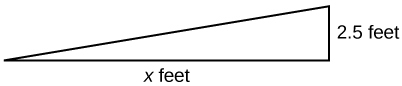
Solution (click to reveal)
30 ft
56. If the profit equation for a small business selling \(x\) number of item one and \(y\) number of item two is \(p = 3x + 4y,\) find the \(y\) value when \(p = \text{\$}453\mspace{9mu}\text{and~~}x = 75.\)
For the following exercises, use this scenario: The cost of renting a car is $45/wk plus $0.25/mi traveled during that week. An equation to represent the cost would be \(y = 45 + .25x,\) where \(x\) is the number of miles traveled.
57. What is your cost if you travel 50 mi?
Solution (click to reveal)
$57.50
58. If your cost were \(\text{\$}63.75,\) how many miles were you charged for traveling?
59. Suppose you have a maximum of $100 to spend for the car rental. What would be the maximum number of miles you could travel?
Solution (click to reveal)
220 mi