1.3 Radicals and Rational Exponents
A hardware store sells 16-ft ladders and 24-ft ladders. A window is located 12 feet above the ground. A ladder needs to be purchased that will reach the window from a point on the ground 5 feet from the building. To find out the length of ladder needed, we can draw a right triangle as shown in Figure 1, and use the Pythagorean Theorem.
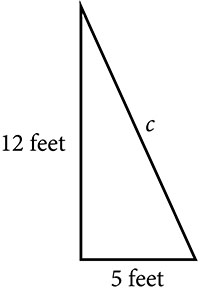
Figure 1
\[\begin{array}{rcl} {a^{2} + b^{2}} & = & c^{2} \\ {5^{2} + 12^{2}} & = & c^{2} \\ 169 & = & c^{2} \end{array}\]
Now, we need to find out the length that, when squared, is 169, to determine which ladder to choose. In other words, we need to find a square root. In this section, we will investigate methods of finding solutions to problems such as this one.
1.3.1 Evaluating Square Roots
When the square root of a number is squared, the result is the original number. Since \(4^{2} = 16,\) the square root of \(16\) is \(4.\) The square root function is the inverse of the squaring function just as subtraction is the inverse of addition. To undo squaring, we take the square root.
In general terms, if \(a\) is a positive real number, then the square root of \(a\) is a number that, when multiplied by itself, gives \(a.\) The square root could be positive or negative because multiplying two negative numbers gives a positive number. The principal square root is the nonnegative number that when multiplied by itself equals \(a.\) The square root obtained using a calculator is the principal square root.
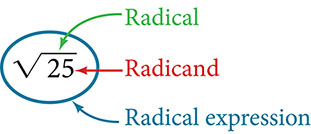
The principal square root of \(a\) is written as \(\sqrt{a}.\) The symbol is called a radical, the term under the symbol is called the radicand, and the entire expression is called a radical expression.
1.3.2 Using the Product Rule to Simplify Square Roots
To simplify a square root, we rewrite it such that there are no perfect squares in the radicand. There are several properties of square roots that allow us to simplify complicated radical expressions. The first rule we will look at is the product rule for simplifying square roots, which allows us to separate the square root of a product of two numbers into the product of two separate rational expressions. For instance, we can rewrite \(\sqrt{15}\) as \(\sqrt{3} \cdot \sqrt{5}.\) We can also use the product rule to express the product of multiple radical expressions as a single radical expression.
1.3.3 Using the Quotient Rule to Simplify Square Roots
Just as we can rewrite the square root of a product as a product of square roots, so too can we rewrite the square root of a quotient as a quotient of square roots, using the quotient rule for simplifying square roots. It can be helpful to separate the numerator and denominator of a fraction under a radical so that we can take their square roots separately. We can rewrite \(\sqrt{\frac{5}{2}}\) as \(\frac{\sqrt{5}}{\sqrt{2}}.\)
1.3.4 Adding and Subtracting Square Roots
We can add or subtract radical expressions only when they have the same radicand and when they have the same radical type such as square roots. For example, the sum of \(\sqrt{2}\) and \(3\sqrt{2}\) is \(4\sqrt{2}.\) However, it is often possible to simplify radical expressions, and that may change the radicand. The radical expression \(\sqrt{18}\) can be written with a \(2\) in the radicand, as \(3\sqrt{2},\) so \(\sqrt{2} + \sqrt{18} = \sqrt{2} + 3\sqrt{2} = 4\sqrt{2}.\)
1.3.5 Rationalizing Denominators
When an expression involving square root radicals is written in simplest form, it will not contain a radical in the denominator. We can remove radicals from the denominators of fractions using a process called rationalizing the denominator.
We know that multiplying by 1 does not change the value of an expression. We use this property of multiplication to change expressions that contain radicals in the denominator. To remove radicals from the denominators of fractions, multiply by the form of 1 that will eliminate the radical.
For a denominator containing a single term, multiply by the radical in the denominator over itself. In other words, if the denominator is \(b\sqrt{c},\) multiply by \(\frac{\sqrt{c}}{\sqrt{c}}.\)
For a denominator containing the sum or difference of a rational and an irrational term, multiply the numerator and denominator by the conjugate of the denominator, which is found by changing the sign of the radical portion of the denominator. If the denominator is \(a + b\sqrt{c},\) then the conjugate is \(a - b\sqrt{c}.\)
1.3.6 Using Rational Roots
Although square roots are the most common rational roots, we can also find cube roots, 4th roots, 5th roots, and more. Just as the square root function is the inverse of the squaring function, these roots are the inverse of their respective power functions. These functions can be useful when we need to determine the number that, when raised to a certain power, gives a certain number.
Understanding \(n\)th Roots
Suppose we know that \(a^{3} = 8.\) We want to find what number raised to the 3rd power is equal to 8. Since \(2^{3} = 8,\) we say that 2 is the cube root of 8.
The \(n\)th root of \(a\) is a number that, when raised to the \(n\)th power, gives \(a.\) For example, \(-3\) is the 5th root of \(-243\) because \({(-3)}^{5} = -243.\) If \(a\) is a real number with at least one \(n\)th root, then the principal \(\mathbf{n}\)th root of \(a\) is the number with the same sign as \(a\) that, when raised to the \(n\)th power, equals \(a.\)
The principal \(n\)th root of \(a\) is written as \(\sqrt[n]{a},\) where \(n\) is a positive integer greater than or equal to 2. In the radical expression, \(n\) is called the index of the radical.
Using Rational Exponents
Radical expressions can also be written without using the radical symbol. We can use rational (fractional) exponents. The index must be a positive integer. If the index \(n\) is even, then \(a\) cannot be negative.
\[a^{\frac{1}{n}} = \sqrt[n]{a}\]
We can also have rational exponents with numerators other than 1. In these cases, the exponent must be a fraction in lowest terms. We raise the base to a power and take an \(n\)th root. The numerator tells us the power and the denominator tells us the root.
\[a^{\frac{m}{n}} = \left( \sqrt[n]{a} \right)^{m} = \sqrt[n]{a^{m}}\]
All of the properties of exponents that we learned for integer exponents also hold for rational exponents.
Section Exercises
Verbal
1. What does it mean when a radical does not have an index? Is the expression equal to the radicand? Explain.
Solution (click to reveal)
When there is no index, it is assumed to be 2 or the square root. The expression would only be equal to the radicand if the index were 1.
2. Where would radicals come in the order of operations? Explain why.
3. Every number will have two square roots. What is the principal square root?
Solution (click to reveal)
The principal square root is the nonnegative root of the number.
4. Can a radical with a negative radicand have a real square root? Why or why not?
Numeric
For the following exercises, simplify each expression.
5. \(\sqrt{256}\)
Solution (click to reveal)
16
6. \(\sqrt{\sqrt{256}}\)
7. \(\sqrt{4\left( {9 + 16} \right)}\)
Solution (click to reveal)
10
8. \(\sqrt{289} - \sqrt{121}\)
9. \(\sqrt{196}\)
Solution (click to reveal)
14
10. \(\sqrt{1}\)
11. \(\sqrt{98}\)
Solution (click to reveal)
\(7\sqrt{2}\)
12. \(\sqrt{\frac{27}{64}}\)
13. \(\sqrt{\frac{81}{5}}\)
Solution (click to reveal)
\(\frac{9\sqrt{5}}{5}\)
14. \(\sqrt{800}\)
15. \(\sqrt{169} + \sqrt{144}\)
Solution (click to reveal)
25
16. \(\sqrt{\frac{8}{50}}\)
17. \(\frac{18}{\sqrt{162}}\)
Solution (click to reveal)
\(\sqrt{2}\)
18. \(\sqrt{192}\)
19. \(14\sqrt{6} - 6\sqrt{24}\)
Solution (click to reveal)
\(2\sqrt{6}\)
20. \(15\sqrt{5} + 7\sqrt{45}\)
21. \(\sqrt{150}\)
Solution (click to reveal)
\(5\sqrt{6}\)
22. \(\sqrt{\frac{96}{100}}\)
23. \(\left( \sqrt{42} \right)\left( \sqrt{30} \right)\)
Solution (click to reveal)
\(6\sqrt{35}\)
24. \(12\sqrt{3} - 4\sqrt{75}\)
25. \(\sqrt{\frac{4}{225}}\)
Solution (click to reveal)
\(\frac{2}{15}\)
26. \(\sqrt{\frac{405}{324}}\)
27. \(\sqrt{\frac{360}{361}}\)
Solution (click to reveal)
\(\frac{6\sqrt{10}}{19}\)
28. \(\frac{5}{1 + \sqrt{3}}\)
29. \(\frac{8}{1 - \sqrt{17}}\)
Solution (click to reveal)
\(- \frac{1 + \sqrt{17}}{2}\)
30. \(\sqrt[4]{16}\)
31. \(\sqrt[3]{128} + 3\sqrt[3]{2}\)
Solution (click to reveal)
\(7\sqrt[3]{2}\)
32. \(\sqrt[5]{\frac{-32}{243}}\)
33. \(\frac{15\sqrt[4]{125}}{\sqrt[4]{5}}\)
Solution (click to reveal)
\(15\sqrt{5}\)
34. \(3\sqrt[3]{-432} + \sqrt[3]{16}\)
Algebraic
For the following exercises, simplify each expression.
35. \(\sqrt{400x^{4}}\)
Solution (click to reveal)
\(20x^{2}\)
36. \(\sqrt{4y^{2}}\)
37. \(\sqrt{49p}\)
Solution (click to reveal)
\(7\sqrt{p}\)
38. \(\left( {144p^{2}q^{6}} \right)^{\frac{1}{2}}\)
39. \(m^{\frac{5}{2}}\sqrt{289}\)
Solution (click to reveal)
\(17m^{2}\sqrt{m}\)
40. \(9\sqrt{3m^{2}} + \sqrt{27}\)
41. \(3\sqrt{ab^{2}} - b\sqrt{a}\)
Solution (click to reveal)
\(2b\sqrt{a}\)
42. \(\frac{4\sqrt{2n}}{\sqrt{16n^{4}}}\)
43. \(\sqrt{\frac{225x^{3}}{49x}}\)
Solution (click to reveal)
\(\frac{15x}{7}\)
44. \(3\sqrt{44z} + \sqrt{99z}\)
45. \(\sqrt{50y^{8}}\)
Solution (click to reveal)
\(5y^{4}\sqrt{2}\)
46. \(\sqrt{490bc^{2}}\)
47. \(\sqrt{\frac{32}{14d}}\)
Solution (click to reveal)
\(\frac{4\sqrt{7d}}{7d}\)
48. \(q^{\frac{3}{2}}\sqrt{63p}\)
49. \(\frac{\sqrt{8}}{1 - \sqrt{3x}}\)
Solution (click to reveal)
\(\frac{2\sqrt{2} + 2\sqrt{6x}}{1-3x}\)
50. \(\sqrt{\frac{20}{121d^{4}}}\)
51. \(w^{\frac{3}{2}}\sqrt{32} - w^{\frac{3}{2}}\sqrt{50}\)
Solution (click to reveal)
\(- w\sqrt{2w}\)
52. \(\sqrt{108x^{4}} + \sqrt{27x^{4}}\)
53. \(\frac{\sqrt{12x}}{2 + 2\sqrt{3}}\)
Solution (click to reveal)
\(\frac{3\sqrt{x} - \sqrt{3x}}{2}\)
54. \(\sqrt{147k^{3}}\)
55. \(\sqrt{125n^{10}}\)
Solution (click to reveal)
\(5n^{5}\sqrt{5}\)
56. \(\sqrt{\frac{42q}{36q^{3}}}\)
57. \(\sqrt{\frac{81m}{361m^{2}}}\)
Solution (click to reveal)
\(\frac{9\sqrt{m}}{19m}\)
58. \(\sqrt{72c} - 2\sqrt{2c}\)
59. \(\sqrt{\frac{144}{324d^{2}}}\)
Solution (click to reveal)
\(\frac{2}{3d}\)
60. \(\sqrt[3]{24x^{6}} + \sqrt[3]{81x^{6}}\)
61. \(\sqrt[4]{\frac{162x^{6}}{16x^{4}}}\)
Solution (click to reveal)
\(\frac{3\sqrt[4]{2x^{2}}}{2}\)
62. \(\sqrt[3]{64y}\)
63. \(\sqrt[3]{128z^{3}} - \sqrt[3]{-16z^{3}}\)
Solution (click to reveal)
\(6z\sqrt[3]{2}\)
64. \(\sqrt[5]{1{,}024c^{10}}\)
Real-World Applications
65. A guy wire for a suspension bridge runs from the ground diagonally to the top of the closest pylon to make a triangle. We can use the Pythagorean Theorem to find the length of guy wire needed. The square of the distance between the wire on the ground and the pylon on the ground is 90,000 feet. The square of the height of the pylon is 160,000 feet. So the length of the guy wire can be found by evaluating \(\sqrt{90{,}000 + 160{,}000}.\) What is the length of the guy wire?
Solution (click to reveal)
500 feet
66. A car accelerates at a rate of \(6 - \frac{\sqrt{4}}{\sqrt{t}}{\mspace{9mu}\text{m/s}}^{2}\) where \(t\) is the time in seconds after the car moves from rest. Simplify the expression.
Extensions
For the following exercises, simplify each expression.
67. \(\frac{\sqrt{8} - \sqrt{16}}{4 - \sqrt{2}} - 2^{\frac{1}{2}}\)
Solution (click to reveal)
\(\frac{-5\sqrt{2}-6}{7}\)
68. \(\frac{4^{\frac{3}{2}} - 16^{\frac{3}{2}}}{8^{\frac{1}{3}}}\)
69. \(\frac{\sqrt{mn^{3}}}{a^{2}\sqrt{c^{-3}}} \cdot \frac{a^{-7}n^{-2}}{\sqrt{m^{2}c^{4}}}\)
Solution (click to reveal)
\(\frac{\sqrt{mnc}}{a^{9}cmn}\)
70. \(\frac{a}{a - \sqrt{c}}\)
71. \(\frac{x\sqrt{64y} + 4\sqrt{y}}{\sqrt{128y}}\)
Solution (click to reveal)
\(\frac{2x + 1}{2\sqrt{2}}\)
72. \(\left( \frac{\sqrt{250x^{2}}}{\sqrt{100b^{3}}} \right)\left( \frac{7\sqrt{b}}{\sqrt{125x}} \right)\)
73. \(\sqrt{\frac{\sqrt[3]{64} + \sqrt[4]{256}}{\sqrt{64} + \sqrt{256}}}\)
Solution (click to reveal)
\(\frac{\sqrt{3}}{3}\)