13.3 Geometric Sequences
Many jobs offer an annual cost-of-living increase to keep salaries consistent with inflation. Suppose, for example, a recent college graduate finds a position as a sales manager earning an annual salary of $26,000. He is promised a 2% cost of living increase each year. His annual salary in any given year can be found by multiplying his salary from the previous year by 102%. His salary will be $26,520 after one year; $27,050.40 after two years; $27,591.41 after three years; and so on. When a salary increases by a constant rate each year, the salary grows by a constant factor. In this section, we will review sequences that grow in this way.
13.3.1 Finding Common Ratios
The yearly salary values described form a geometric sequence because they change by a constant factor each year. Each term of a geometric sequence increases or decreases by a constant factor called the common ratio. The sequence below is an example of a geometric sequence because each term increases by a constant factor of 6. Multiplying any term of the sequence by the common ratio 6 generates the subsequent term.

Is the sequence geometric? If so, find the common ratio.
ⓐ \(1\text{,}\mspace{9mu} 2\text{,}\mspace{9mu} 4\text{,}\mspace{9mu} 8\text{,}\mspace{9mu} 16\text{,}\mspace{9mu}...\)
ⓑ \(48\text{,}\mspace{9mu} 12\text{,}\mspace{9mu} 4\text{,~}2\text{,}\mspace{9mu}...\)
Solution (click to reveal)
Divide each term by the previous term to determine whether a common ratio exists.
ⓐ \(\begin{array}{llllllllll} {\frac{2}{1} = 2} & & & {\frac{4}{2} = 2} & & & {\frac{8}{4} = 2} & & & {\frac{16}{8} = 2} \end{array}\) The sequence is geometric because there is a common ratio. The common ratio is 2.
ⓑ \(\begin{array}{lllllll} {\frac{12}{48} = \frac{1}{4}} & & & {\frac{4}{12} = \frac{1}{3}} & & & {\frac{2}{4} = \frac{1}{2}} \end{array}\) The sequence is not geometric because there is not a common ratio.
The graph of each sequence is shown in Figure 1. It seems from the graphs that both (a) and (b) appear have the form of the graph of an exponential function in this viewing window. However, we know that (a) is geometric and so this interpretation holds, but (b) is not.
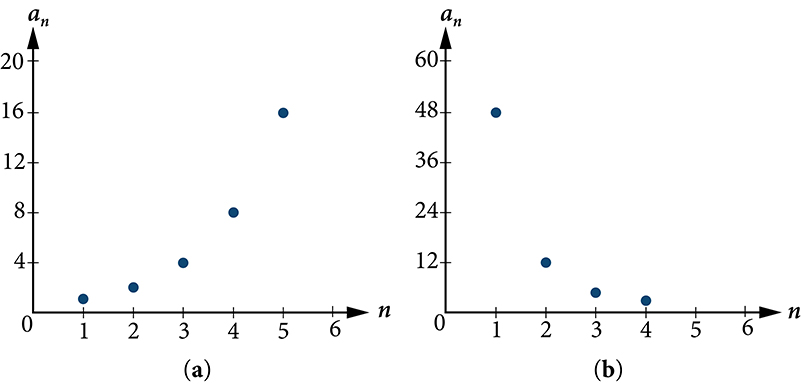
Figure 1
13.3.2 Writing Terms of Geometric Sequences
Now that we can identify a geometric sequence, we will learn how to find the terms of a geometric sequence if we are given the first term and the common ratio. The terms of a geometric sequence can be found by beginning with the first term and multiplying by the common ratio repeatedly. For instance, if the first term of a geometric sequence is \(a_{1} = - 2\) and the common ratio is \(r = 4,\) we can find subsequent terms by multiplying \(- 2 \cdot 4\) to get \(- 8\) then multiplying the result \(- 8 \cdot 4\) to get \(- 32\) and so on.
\[\begin{array}{l} {a_{1} = - 2} \\ {a_{2} = ( - 2 \cdot 4) = - 8} \\ {a_{3} = ( - 8 \cdot 4) = - 32} \\ {a_{4} = ( - 32 \cdot 4) = - 128} \end{array}\]
The first four terms are \(\left\{ –2\text{,~}–8\text{,~}–32\text{,~}–128 \right\}.\)
13.3.3 Using Recursive Formulas for Geometric Sequences
A recursive formula allows us to find any term of a geometric sequence by using the previous term. Each term is the product of the common ratio and the previous term. For example, suppose the common ratio is 9. Then each term is nine times the previous term. As with any recursive formula, the initial term must be given.
Write a recursive formula for the following geometric sequence.
\[\left\{ 6\text{,~}9\text{,~}13.5\text{,~}20.25\text{,~}... \right\}\]
Solution (click to reveal)
The first term is given as 6. The common ratio can be found by dividing the second term by the first term.
\[r = \frac{9}{6} = 1.5\]
Substitute the common ratio into the recursive formula for geometric sequences and define \(a_{1}.\)
\[\begin{array}{l} {a_{n} = ra_{n - 1}} \\ {a_{n} = 1.5a_{n - 1}\mspace{9mu}\text{for~}n \geq 2} \\ {a_{1} = 6} \end{array}\]
The sequence of data points follows an exponential pattern. The common ratio is also the base of an exponential function as shown in Figure 2
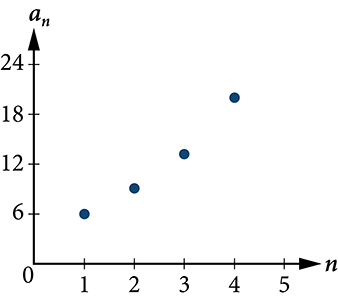
Figure 2
13.3.4 Using Explicit Formulas for Geometric Sequences
Because a geometric sequence is an exponential function whose domain is the set of positive integers, and the common ratio is the base of the function, we can write explicit formulas that allow us to find particular terms.
\[a_{n} = a_{1}r^{n - 1}\]
Let’s take a look at the sequence \(\left\{ 18\text{,~}36\text{,~}72\text{,~}144\text{,~}288\text{,~}... \right\}.\) This is a geometric sequence with a common ratio of 2 and an exponential function with a base of 2. An explicit formula for this sequence is
\[a_{n} = 18 \cdot 2^{n - 1}\]
The graph of the sequence is shown in Figure 3.
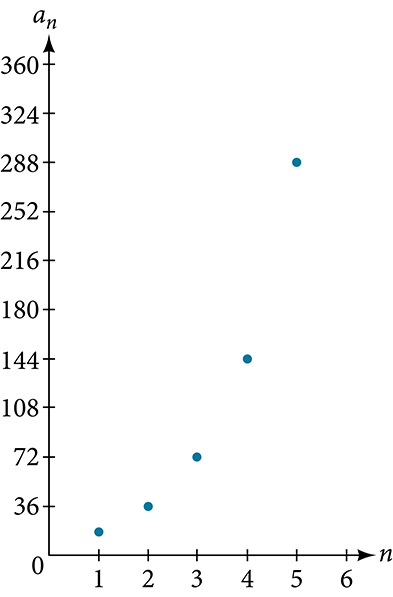
Figure 3
Write an explicit formula for the \(n\text{th}\) term of the following geometric sequence.
\[\left\{ 2\text{,~}10\text{,~}50\text{,~}250\text{,~}... \right\}\]
Solution (click to reveal)
The first term is 2. The common ratio can be found by dividing the second term by the first term.
\[\frac{10}{2} = 5\]
The common ratio is 5. Substitute the common ratio and the first term of the sequence into the formula.
\[\begin{array}{l} {a_{n} = a_{1}r^{(n - 1)}} \\ {a_{n} = 2 \cdot 5^{n - 1}} \end{array}\]
The graph of this sequence in Figure 4 shows an exponential pattern.
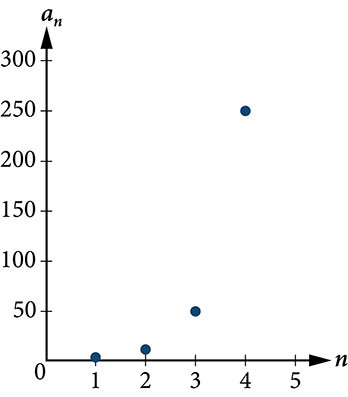
Figure 4
13.3.5 Solving Application Problems with Geometric Sequences
In real-world scenarios involving geometric sequences, we may need to use an initial term of \(a_{0}\) instead of \(a_{1}.\) In these problems, we can alter the explicit formula slightly by using the following formula:
\[a_{n} = a_{0}r^{n}\]
Section Exercises
Verbal
1. What is a geometric sequence?
Solution (click to reveal)
A sequence in which the ratio between any two consecutive terms is constant.
2. How is the common ratio of a geometric sequence found?
3. What is the procedure for determining whether a sequence is geometric?
Solution (click to reveal)
Divide each term in a sequence by the preceding term. If the resulting quotients are equal, then the sequence is geometric.
4. What is the difference between an arithmetic sequence and a geometric sequence?
5. Describe how exponential functions and geometric sequences are similar. How are they different?
Solution (click to reveal)
Both geometric sequences and exponential functions have a constant ratio. However, their domains are not the same. Exponential functions are defined for all real numbers, and geometric sequences are defined only for positive integers. Another difference is that the base of a geometric sequence (the common ratio) can be negative, but the base of an exponential function must be positive.
Algebraic
For the following exercises, find the common ratio for the geometric sequence.
6. \(1,3,9,27,81,...\)
7. \(- 0.125,0.25, - 0.5,1, - 2,...\)
Solution (click to reveal)
The common ratio is \(- 2\)
8. \(- 2, - \frac{1}{2}, - \frac{1}{8}, - \frac{1}{32}, - \frac{1}{128},...\)
For the following exercises, determine whether the sequence is geometric. If so, find the common ratio.
9. \(- 6, - 12, - 24, - 48, - 96,...\)
Solution (click to reveal)
The sequence is geometric. The common ratio is 2.
10. \(5,5.2,5.4,5.6,5.8,...\)
11. \(- 1,\frac{1}{2}, - \frac{1}{4},\frac{1}{8}, - \frac{1}{16},...\)
Solution (click to reveal)
The sequence is geometric. The common ratio is \(- \frac{1}{2}.\)
12. \(6,8,11,15,20,...\)
13. \(0.8,4,20,100,500,...\)
Solution (click to reveal)
The sequence is geometric. The common ratio is \(5.\)
For the following exercises, write the first five terms of the geometric sequence, given the first term and common ratio.
14. \(\begin{matrix} {a_{1} = 8,} & {r = 0.3} \end{matrix}\)
15. \(\begin{matrix} {a_{1} = 5,} & {r = \frac{1}{5}} \end{matrix}\)
Solution (click to reveal)
\(5,1,\frac{1}{5},\frac{1}{25},\frac{1}{125}\)
For the following exercises, write the first five terms of the geometric sequence, given any two terms.
16. \(\begin{matrix} {a_{7} = 64,} & a_{10} \end{matrix} = 512\)
17. \(\begin{matrix} {a_{6} = 25,} & a_{8} \end{matrix} = 6.25\)
Solution (click to reveal)
\(800,400,200,100,50\)
For the following exercises, find the specified term for the geometric sequence, given the first term and common ratio.
18. The first term is \(2,\) and the common ratio is \(3.\) Find the 5th term.
19. The first term is 16 and the common ratio is \(- \frac{1}{3}.\) Find the 4th term.
Solution (click to reveal)
\(a_{4} = - \frac{16}{27}\)
For the following exercises, find the specified term for the geometric sequence, given the first four terms.
20. \(a_{n} = \left\{ {- 1,2, - 4,8,...} \right\}.\) Find \(a_{12}.\)
21. \(a_{n} = \left\{ {- 2,\frac{2}{3}, - \frac{2}{9},\frac{2}{27},...} \right\}.\) Find \(a_{7}.\)
Solution (click to reveal)
\(a_{7} = - \frac{2}{729}\)
For the following exercises, write the first five terms of the geometric sequence.
22. \(\begin{matrix} {a_{1} = - 486,} & {a_{n} = - \frac{1}{3}} \end{matrix}a_{n - 1}\)
23. \(\begin{matrix} {a_{1} = 7,} & {a_{n} = 0.2a_{n - 1}} \end{matrix}\)
Solution (click to reveal)
\(7,1.4,0.28,0.056,0.0112\)
For the following exercises, write a recursive formula for each geometric sequence.
24. \(a_{n} = \left\{ {- 1,5, - 25{,}125,...} \right\}\)
25. \(a_{n} = \left\{ {- 32, - 16, - 8, - 4,...} \right\}\)
Solution (click to reveal)
\(\begin{matrix} {a{{}_{1}^{} =} - 32,} & {a_{n} = \frac{1}{2}a_{n - 1}} \end{matrix}\)
26. \(a_{n} = \left\{ {14,56,224,896,...} \right\}\)
27. \(a_{n} = \left\{ {10, - 3,0.9, - 0.27,...} \right\}\)
Solution (click to reveal)
\(\begin{matrix} {a_{1} = 10,} & {a_{n} = - 0.3a_{n - 1}} \end{matrix}\)
28. \(a_{n} = \left\{ {0.61,1.83,5.49,16.47,...} \right\}\)
29. \(a_{n} = \left\{ {\frac{3}{5},\frac{1}{10},\frac{1}{60},\frac{1}{360},...} \right\}\)
Solution (click to reveal)
\(\begin{matrix} {a_{1} = \frac{3}{5},} & {a_{n} = \frac{1}{6}a_{n - 1}} \end{matrix}\)
30. \(a_{n} = \left\{ {- 2,\frac{4}{3}, - \frac{8}{9},\frac{16}{27},...} \right\}\)
31. \(a_{n} = \left\{ {\frac{1}{512}, - \frac{1}{128},\frac{1}{32}, - \frac{1}{8},...} \right\}\)
Solution (click to reveal)
\(a_{1} = \frac{1}{512},a_{n} = - 4a_{n - 1}\)
For the following exercises, write the first five terms of the geometric sequence.
32. \(a_{n} = - 4 \cdot 5^{n - 1}\)
33. \(a_{n} = 12 \cdot \left( {- \frac{1}{2}} \right)^{n - 1}\)
Solution (click to reveal)
\(12, - 6,3, - \frac{3}{2},\frac{3}{4}\)
For the following exercises, write an explicit formula for each geometric sequence.
34. \(a_{n} = \left\{ {- 2, - 4, - 8, - 16,...} \right\}\)
35. \(a_{n} = \left\{ {1,3,9,27,...} \right\}\)
Solution (click to reveal)
\(a_{n} = 3^{n - 1}\)
36. \(a_{n} = \left\{ {- 4, - 12, - 36, - 108,...} \right\}\)
37. \(a_{n} = \left\{ {0.8, - 4,20, - 100,...} \right\}\)
Solution (click to reveal)
\(a_{n} = 0.8 \cdot {( - 5)}^{n - 1}\)
38. \(a_{n} = \left\{ - 1.25, - 5, - 20, - 80,... \right\}\)
39. \(a_{n} = \left\{ {- 1, - \frac{4}{5}, - \frac{16}{25}, - \frac{64}{125},...} \right\}\)
Solution (click to reveal)
\(a_{n} = - \left( \frac{4}{5} \right)^{n - 1}\)
40. \(a_{n} = \left\{ {2,\frac{1}{3},\frac{1}{18},\frac{1}{108},...} \right\}\)
41. \(a_{n} = \left\{ {3, - 1,\frac{1}{3}, - \frac{1}{9},...} \right\}\)
Solution (click to reveal)
\(a_{n} = 3 \cdot \left( {- \frac{1}{3}} \right)^{n - 1}\)
For the following exercises, find the specified term for the geometric sequence given.
42. Let \(a_{1} = 4,\) \(a_{n} = - 3a_{n - 1}.\) Find \(a_{8}.\)
43. Let \(a_{n} = - \left( {- \frac{1}{3}} \right)^{n - 1}.\) Find \(a_{12}.\)
Solution (click to reveal)
\(a_{12} = \frac{1}{177{,}147}\)
For the following exercises, find the number of terms in the given finite geometric sequence.
44. \(a_{n} = \left\{ {- 1,3, - 9,...,2187} \right\}\)
45. \(a_{n} = \left\{ {2,1,\frac{1}{2},...,\frac{1}{1024}} \right\}\)
Solution (click to reveal)
There are \(12\) terms in the sequence.
Graphical
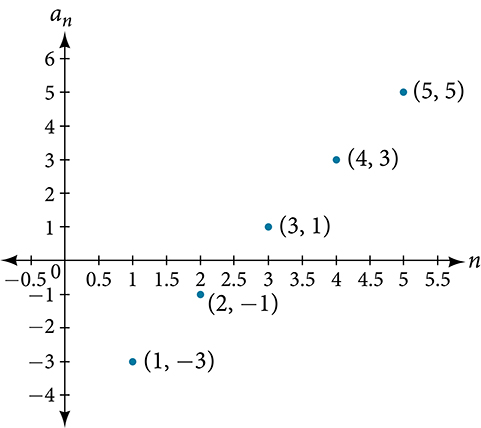
For the following exercises, determine whether the graph shown represents a geometric sequence.
46.
47.
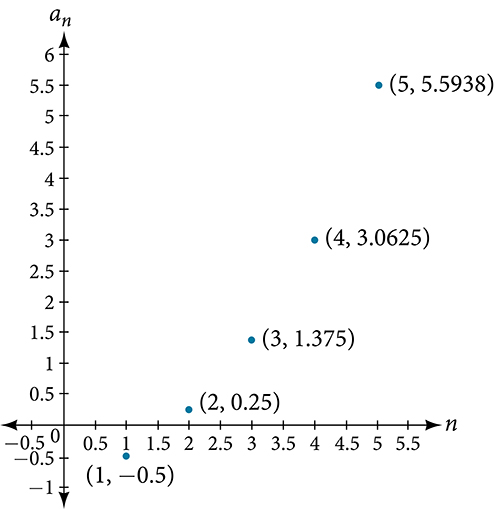
Solution (click to reveal)
The graph does not represent a geometric sequence.
For the following exercises, use the information provided to graph the first five terms of the geometric sequence.
48. \(\begin{matrix} {a_{1} = 1,} & {r = \frac{1}{2}} \end{matrix}\)
49. \(\begin{matrix} {a_{1} = 3,} & {a_{n} = 2a_{n - 1}} \end{matrix}\)
Solution (click to reveal)
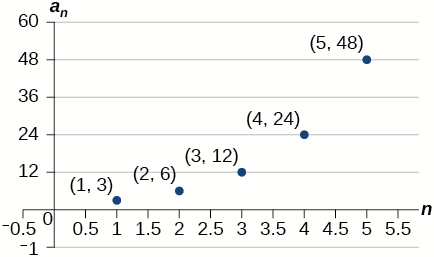
50. \(a_{n} = 27 \cdot 0.3^{n - 1}\)
Extensions
51. Use recursive formulas to give two examples of geometric sequences whose 3rd terms are \(200.\)
Solution (click to reveal)
Answers will vary. Examples: \(\begin{matrix} {a_{1} = 800,} & {a_{n} = 0.5a} \end{matrix}_{n - 1}\) and \(\begin{matrix} {a_{1} = 12.5,} & {a_{n} = 4a} \end{matrix}_{n - 1}\)
52. Use explicit formulas to give two examples of geometric sequences whose 7th terms are \(1024.\)
53. Find the 5th term of the geometric sequence \(\left\{ b,4b,16b,... \right\}.\)
Solution (click to reveal)
\(a_{5} = 256b\)
54. Find the 7th term of the geometric sequence \(\left\{ 64a( - b),32a( - 3b),16a( - 9b),... \right\}.\)
55. At which term does the sequence \(\left\{ 10,12,14.4,17.28,\mspace{9mu}... \right\}\) exceed \(100?\)
Solution (click to reveal)
The sequence exceeds \(100\) at the 14th term, \(a_{14} \approx 107.\)
56. At which term does the sequence \(\left\{ {\frac{1}{2187},\frac{1}{729},\frac{1}{243},\frac{1}{81}\mspace{9mu}...} \right\}\) begin to have integer values?
57. For which term does the geometric sequence \(a_{{}_{n}} = - 36\left( \frac{2}{3} \right)^{n - 1}\) first have a non-integer value?
Solution (click to reveal)
\(a_{4} = - \frac{32}{3}\) is the first non-integer value
58. Use the recursive formula to write a geometric sequence whose common ratio is an integer. Show the first four terms, and then find the 10th term.
59. Use the explicit formula to write a geometric sequence whose common ratio is a decimal number between 0 and 1. Show the first 4 terms, and then find the 8th term.
Solution (click to reveal)
Answers will vary. Example: Explicit formula with a decimal common ratio: \(a_{n} = 400 \cdot 0.5^{n - 1};\) First 4 terms: \(\begin{matrix} {400,200,100,50;} & {a_{8} = 3.125} \end{matrix}\)
60. Is it possible for a sequence to be both arithmetic and geometric? If so, give an example.