Chapter Review
Key Terms
angle of rotation — an acute angle formed by a set of axes rotated from the Cartesian plane where, if \(\cot\left( {2\theta} \right) > 0,\) then \(\theta\) is between \((0{^\circ},45{^\circ});\) if \(\cot(2\theta) < 0,\) then \(\theta\) is between \((45{^\circ},90{^\circ});\) and if \(\cot\left( {2\theta} \right) = 0,\) then \(\theta = 45{^\circ}\)
center of a hyperbola — the midpoint of both the transverse and conjugate axes of a hyperbola
center of an ellipse — the midpoint of both the major and minor axes
conic section — any shape resulting from the intersection of a right circular cone with a plane
conjugate axis — the axis of a hyperbola that is perpendicular to the transverse axis and has the co-vertices as its endpoints
degenerate conic sections — any of the possible shapes formed when a plane intersects a double cone through the apex. Types of degenerate conic sections include a point, a line, and intersecting lines.
directrix — a line perpendicular to the axis of symmetry of a parabola; a line such that the ratio of the distance between the points on the conic and the focus to the distance to the directrix is constant
eccentricity — the ratio of the distances from a point \(P\) on the graph to the focus \(F\) and to the directrix \(D\) represented by \(e = \frac{PF}{PD},\) where \(e\) is a positive real number
ellipse — the set of all points \(\left( {x,y} \right)\) in a plane such that the sum of their distances from two fixed points is a constant
foci — plural of focus
focus (of a parabola) — a fixed point in the interior of a parabola that lies on the axis of symmetry
focus (of an ellipse) — one of the two fixed points on the major axis of an ellipse such that the sum of the distances from these points to any point \(\left( {x,y} \right)\) on the ellipse is a constant
hyperbola — the set of all points \(\left( {x,y} \right)\) in a plane such that the difference of the distances between \(\left( {x,y} \right)\) and the foci is a positive constant
latus rectum — the line segment that passes through the focus of a parabola parallel to the directrix, with endpoints on the parabola
major axis — the longer of the two axes of an ellipse
minor axis — the shorter of the two axes of an ellipse
nondegenerate conic section — a shape formed by the intersection of a plane with a double right cone such that the plane does not pass through the apex; nondegenerate conics include circles, ellipses, hyperbolas, and parabolas
parabola — the set of all points \(\left( {x,y} \right)\) in a plane that are the same distance from a fixed line, called the directrix, and a fixed point (the focus) not on the directrix
polar equation — an equation of a curve in polar coordinates \(r\mspace{9mu}\) and \(\theta\)
transverse axis — the axis of a hyperbola that includes the foci and has the vertices as its endpoints
Key Equations
| Horizontal ellipse, center at origin | \(\frac{x^{2}}{a^{2}} + \frac{y^{2}}{b^{2}} = 1,\mspace{9mu} a > b\) |
| Vertical ellipse, center at origin | \(\frac{x^{2}}{b^{2}} + \frac{y^{2}}{a^{2}} = 1,\mspace{9mu} a > b\) |
| Horizontal ellipse, center \((h,k)\) | \(\frac{\left( {x - h} \right)^{2}}{a^{2}} + \frac{\left( {y - k} \right)^{2}}{b^{2}} = 1,\mspace{9mu} a > b\) |
| Vertical ellipse, center \((h,k)\) | \(\frac{\left( {x - h} \right)^{2}}{b^{2}} + \frac{\left( {y - k} \right)^{2}}{a^{2}} = 1,\mspace{9mu} a > b\) |
| Hyperbola, center at origin, transverse axis on \(x\)-axis | \(\frac{x^{2}}{a^{2}} - \frac{y^{2}}{b^{2}} = 1\) |
| Hyperbola, center at origin, transverse axis on \(y\)-axis | \(\frac{y^{2}}{a^{2}} - \frac{x^{2}}{b^{2}} = 1\) |
| Hyperbola, center at \((h,k),\) transverse axis parallel to \(x\)-axis | \(\frac{\left( {x - h} \right)^{2}}{a^{2}} - \frac{\left( {y - k} \right)^{2}}{b^{2}} = 1\) |
| Hyperbola, center at \((h,k),\) transverse axis parallel to \(y\)-axis | \(\frac{\left( {y - k} \right)^{2}}{a^{2}} - \frac{\left( {x - h} \right)^{2}}{b^{2}} = 1\) |
| Parabola, vertex at origin, axis of symmetry on \(x\)-axis | \(y^{2} = 4px\) |
| Parabola, vertex at origin, axis of symmetry on \(y\)-axis | \(x^{2} = 4py\) |
| Parabola, vertex at \((h,k),\) axis of symmetry on \(x\)-axis | \(\left( {y - k} \right)^{2} = 4p\left( {x - h} \right)\) |
| Parabola, vertex at \((h,k),\) axis of symmetry on \(y\)-axis | \(\left( {x - h} \right)^{2} = 4p\left( {y - k} \right)\) |
| General Form equation of a conic section | \(Ax^{2} + Bxy + Cy^{2} + Dx + Ey + F = 0\) |
| Rotation of a conic section | \(\begin{array}{l} {x = x'\cos\mspace{9mu}\theta - y'\sin\mspace{9mu}\theta} \\ {y = x'\sin\mspace{9mu}\theta + y'\cos\mspace{9mu}\theta} \end{array}\) |
| Angle of rotation | \(\theta,\text{where~}\cot\left( {2\theta} \right) = \frac{A - C}{B}\) |
Key Concepts
12.1 The Ellipse
- An ellipse is the set of all points \(\left( {x,y} \right)\) in a plane such that the sum of their distances from two fixed points is a constant. Each fixed point is called a focus (plural: foci).
- When given the coordinates of the foci and vertices of an ellipse, we can write the equation of the ellipse in standard form. See Example 1 and Example 2.
- When given an equation for an ellipse centered at the origin in standard form, we can identify its vertices, co-vertices, foci, and the lengths and positions of the major and minor axes in order to graph the ellipse. See Example 3 and Example 4.
- When given the equation for an ellipse centered at some point other than the origin, we can identify its key features and graph the ellipse. See Example 5 and Example 6.
- Real-world situations can be modeled using the standard equations of ellipses and then evaluated to find key features, such as lengths of axes and distance between foci. See Example 7.
12.2 The Hyperbola
- A hyperbola is the set of all points \(\left( {x,y} \right)\) in a plane such that the difference of the distances between \(\left( {x,y} \right)\) and the foci is a positive constant.
- The standard form of a hyperbola can be used to locate its vertices and foci. See Example 1.
- When given the coordinates of the foci and vertices of a hyperbola, we can write the equation of the hyperbola in standard form. See Example 2 and Example 3.
- When given an equation for a hyperbola, we can identify its vertices, co-vertices, foci, asymptotes, and lengths and positions of the transverse and conjugate axes in order to graph the hyperbola. See Example 4 and Example 5.
- Real-world situations can be modeled using the standard equations of hyperbolas. For instance, given the dimensions of a natural draft cooling tower, we can find a hyperbolic equation that models its sides. See Example 6.
12.3 The Parabola
- A parabola is the set of all points \(\left( {x,y} \right)\) in a plane that are the same distance from a fixed line, called the directrix, and a fixed point (the focus) not on the directrix.
- The standard form of a parabola with vertex \(\left( {0,0} \right)\) and the \(x\)-axis as its axis of symmetry can be used to graph the parabola. If \(p > 0,\) the parabola opens right. If \(p < 0,\) the parabola opens left. See Example 1.
- The standard form of a parabola with vertex \(\left( {0,0} \right)\) and the \(y\)-axis as its axis of symmetry can be used to graph the parabola. If \(p > 0,\) the parabola opens up. If \(p < 0,\) the parabola opens down. See Example 2.
- When given the focus and directrix of a parabola, we can write its equation in standard form. See Example 3.
- The standard form of a parabola with vertex \(\left( {h,k} \right)\) and axis of symmetry parallel to the \(x\)-axis can be used to graph the parabola. If \(p > 0,\) the parabola opens right. If \(p < 0,\) the parabola opens left. See Example 4.
- The standard form of a parabola with vertex \(\left( {h,k} \right)\) and axis of symmetry parallel to the \(y\)-axis can be used to graph the parabola. If \(p > 0,\) the parabola opens up. If \(p < 0,\) the parabola opens down. See Example 5.
- Real-world situations can be modeled using the standard equations of parabolas. For instance, given the diameter and focus of a cross-section of a parabolic reflector, we can find an equation that models its sides. See Example 6.
12.4 Rotation of Axes
- Four basic shapes can result from the intersection of a plane with a pair of right circular cones connected tail to tail. They include an ellipse, a circle, a hyperbola, and a parabola.
- A nondegenerate conic section has the general form \(Ax^{2} + Bxy + Cy^{2} + Dx + Ey + F = 0\) where \(A,B\) and \(C\) are not all zero. The values of \(A,B,\) and \(C\) determine the type of conic. See Example 1.
- Equations of conic sections with an \(xy\) term have been rotated about the origin. See Example 2.
- The general form can be transformed into an equation in the \(x'\) and \(y'\) coordinate system without the \(x'y'\) term. See Example 3 and Example 4.
- An expression is described as invariant if it remains unchanged after rotating. Because the discriminant is invariant, observing it enables us to identify the conic section. See Example 5.
12.5 Conic Sections in Polar Coordinates
- Any conic may be determined by a single focus, the corresponding eccentricity, and the directrix. We can also define a conic in terms of a fixed point, the focus \(P(r,\theta)\) at the pole, and a line, the directrix, which is perpendicular to the polar axis.
- A conic is the set of all points \(e = \frac{PF}{PD},\) where eccentricity \(e\) is a positive real number. Each conic may be written in terms of its polar equation. See Example 1.
- The polar equations of conics can be graphed. See Example 2, Example 3, and Example 4.
- Conics can be defined in terms of a focus, a directrix, and eccentricity. See Example 5 and Example 6.
- We can use the identities \(r = \sqrt{x^{2} + y^{2}},x = r\mspace{9mu}\cos\mspace{7mu}\theta,\) and \(y = r\mspace{9mu}\sin\mspace{7mu}\theta\) to convert the equation for a conic from polar to rectangular form. See Example 7.
Chapter Review Exercises
The Ellipse
For the following exercises, write the equation of the ellipse in standard form. Then identify the center, vertices, and foci.
1. \(\frac{x^{2}}{25} + \frac{y^{2}}{64} = 1\)
Solution (click to reveal)
\(\frac{x^{2}}{5^{2}} + \frac{y^{2}}{8^{2}} = 1;\) center: \(\left( {0,0} \right);\) vertices: \(\left( {5,0} \right),\left( {-5,0} \right),\left( {0,8} \right),\left( {0, - 8} \right);\) foci: \(\left( {0,\sqrt{39}} \right),\left( {0, - \sqrt{39}} \right)\)
2. \(\frac{{(x - 2)}^{2}}{100} + \frac{\left( {y + 3} \right)^{2}}{36} = 1\)
3. \(9x^{2} + y^{2} + 54x - 4y + 76 = 0\)
Solution (click to reveal)
\(\frac{{(x + 3)}^{2}}{1^{2}} + \frac{{(y - 2)}^{2}}{3^{2}} = 1\mspace{9mu}\mspace{9mu}( - 3,2);\mspace{9mu}\mspace{9mu}( - 2,2),( - 4,2),( - 3,5),( - 3, - 1);\mspace{9mu}\mspace{9mu}\left( {- 3,2 + 2\sqrt{2}} \right),\left( {- 3,2 - 2\sqrt{2}} \right)\)
4. \(9x^{2} + 36y^{2} - 36x + 72y + 36 = 0\)
For the following exercises, graph the ellipse, noting center, vertices, and foci.
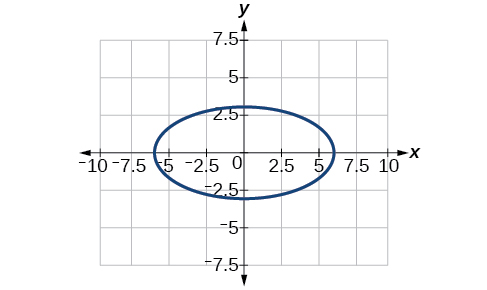
5. \(\frac{x^{2}}{36} + \frac{y^{2}}{9} = 1\)
Solution (click to reveal)
center: \(\left( {0,0} \right);\) vertices: \(\left( {6,0} \right),\left( {-6,0} \right),\left( {0,3} \right),\left( {0,-3} \right);\) foci: \(\left( {3\sqrt{3},0} \right),\left( {- 3\sqrt{3},0} \right)\)
6. \(\frac{{(x - 4)}^{2}}{25} + \frac{\left( {y + 3} \right)^{2}}{49} = 1\)
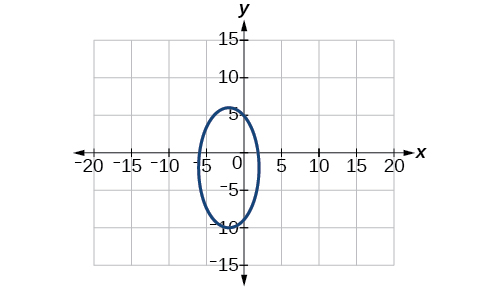
7. \(4x^{2} + y^{2} + 16x + 4y - 44 = 0\)
Solution (click to reveal)
center: \(\left( {-2,-2} \right);\) vertices: \(\left( {2,-2} \right),\left( {-6,-2} \right),\left( {-2,6} \right),\left( {-2,-10} \right);\) foci: \(\left( {-2,-2 + 4\sqrt{3},} \right),\left( {-2,-2-4\sqrt{3}} \right)\)
8. \(2x^{2} + 3y^{2} - 20x + 12y + 38 = 0\)
For the following exercises, use the given information to find the equation for the ellipse.
9. Center at \(\left( {0,0} \right),\) focus at \(\left( {3,0} \right),\) vertex at \(\left( {-5,0} \right)\)
Solution (click to reveal)
\(\frac{x^{2}}{25} + \frac{y^{2}}{16} = 1\)
10. Center at \(\left( {2,-2} \right),\) vertex at \(\left( {7,-2} \right),\) focus at \(\left( {4,-2} \right)\)
11. A whispering gallery is to be constructed such that the foci are located 35 feet from the center. If the length of the gallery is to be 100 feet, what should the height of the ceiling be?
Solution (click to reveal)
Approximately 35.71 feet
The Hyperbola
For the following exercises, write the equation of the hyperbola in standard form. Then give the center, vertices, and foci.
12. \(\frac{x^{2}}{81} - \frac{y^{2}}{9} = 1\)
13. \(\frac{\left( {y + 1} \right)^{2}}{16} - \frac{\left( {x - 4} \right)^{2}}{36} = 1\)
Solution (click to reveal)
\(\frac{\left( {y + 1} \right)^{2}}{4^{2}} - \frac{\left( {x - 4} \right)^{2}}{6^{2}} = 1;\) center: \(\left( {4,-1} \right);\) vertices: \(\left( {4,3} \right),\left( {4,-5} \right);\) foci: \(\left( {4,-1 + 2\sqrt{13}} \right),\left( {4,-1 - 2\sqrt{13}} \right)\)
14. \(9y^{2} - 4x^{2} + 54y - 16x + 29 = 0\)
15. \(3x^{2} - y^{2} - 12x - 6y - 9 = 0\)
Solution (click to reveal)
\(\frac{\left( {x - 2} \right)^{2}}{2^{2}} - \frac{\left( {y + 3} \right)^{2}}{\left( {2\sqrt{3}} \right)^{2}} = 1;\) center: \(\left( {2,-3} \right);\) vertices: \(\left( {4,-3} \right),\left( {0,-3} \right);\) foci: \(\left( {6,-3} \right),\left( {-2,-3} \right)\)
For the following exercises, graph the hyperbola, labeling vertices and foci.
16. \(\frac{x^{2}}{9} - \frac{y^{2}}{16} = 1\)
17. \(\frac{\left( {y - 1} \right)^{2}}{49} - \frac{\left( {x + 1} \right)^{2}}{4} = 1\)
Solution (click to reveal)
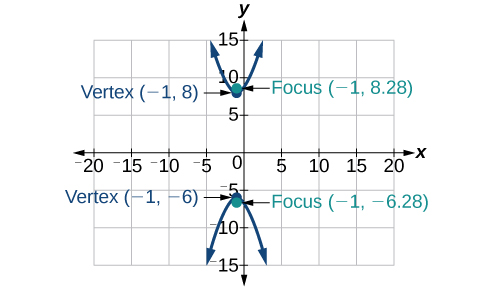
18. \(x^{2} - 4y^{2} + 6x + 32y - 91 = 0\)
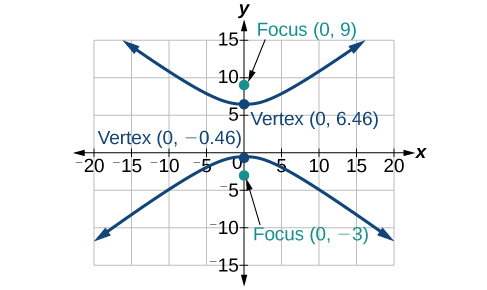
19. \(2y^{2} - x^{2} - 12y - 6 = 0\)
Solution (click to reveal)
For the following exercises, find the equation of the hyperbola.
20. Center at \(\left( {0,0} \right),\) vertex at \(\left( {0,4} \right),\) focus at \(\left( {0,-6} \right)\)
21. Foci at \(\left( {3,7} \right)\) and \(\left( {7,7} \right),\) vertex at \(\left( {6,7} \right)\)
Solution (click to reveal)
\(\frac{\left( {x - 5} \right)^{2}}{1} - \frac{\left( {y - 7} \right)^{2}}{3} = 1\)
The Parabola
For the following exercises, write the equation of the parabola in standard form. Then give the vertex, focus, and directrix.
22. \(y^{2} = 12x\)
23. \(\left( {x + 2} \right)^{2} = \frac{1}{2}\left( {y - 1} \right)\)
Solution (click to reveal)
\(\left( {x + 2} \right)^{2} = \frac{1}{2}\left( {y - 1} \right);\) vertex: \(\left( {-2,1} \right);\) focus: \(\left( {-2,\frac{9}{8}} \right);\) directrix: \(y = \frac{7}{8}\)
24. \(y^{2} - 6y - 6x - 3 = 0\)
25. \(x^{2} + 10x - y + 23 = 0\)
Solution (click to reveal)
\(\left( {x + 5} \right)^{2} = \left( {y + 2} \right);\) vertex: \(\left( {- 5, - 2} \right);\) focus: \(\left( {- 5, - \frac{7}{4}} \right);\) directrix: \(y = - \frac{9}{4}\)
For the following exercises, graph the parabola, labeling vertex, focus, and directrix.
26. \(x^{2} + 4y = 0\)
27. \(\left( {y - 1} \right)^{2} = \frac{1}{2}\left( {x + 3} \right)\)
Solution (click to reveal)
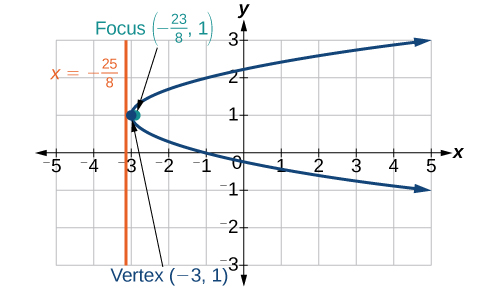
28. \(x^{2} - 8x - 10y + 46 = 0\)
29. \(2y^{2} + 12y + 6x + 15 = 0\)
Solution (click to reveal)
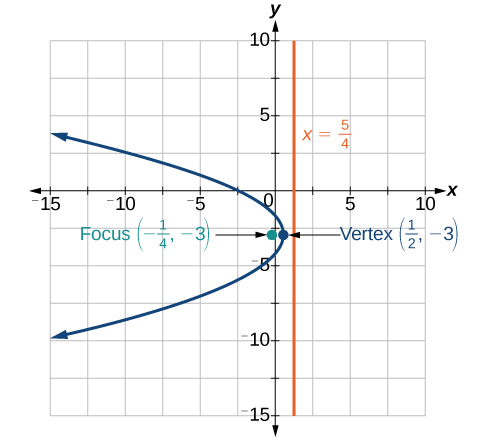
For the following exercises, write the equation of the parabola using the given information.
30. Focus at \(\left( {-4,0} \right);\) directrix is \(x = 4\)
31. Focus at \(\left( {2,\frac{9}{8}} \right);\) directrix is \(y = \frac{7}{8}\)
Solution (click to reveal)
\(\left( {x - 2} \right)^{2} = \left( \frac{1}{2} \right)\left( {y - 1} \right)\)
32. A cable TV receiving dish is the shape of a paraboloid of revolution. Find the location of the receiver, which is placed at the focus, if the dish is 5 feet across at its opening and 1.5 feet deep.
Rotation of Axes
For the following exercises, determine which of the conic sections is represented.
33. \(16x^{2} + 24xy + 9y^{2} + 24x - 60y - 60 = 0\)
Solution (click to reveal)
\(B^{2} - 4AC = 0,\) parabola
34. \(4x^{2} + 14xy + 5y^{2} + 18x - 6y + 30 = 0\)
35. \(4x^{2} + xy + 2y^{2} + 8x - 26y + 9 = 0\)
Solution (click to reveal)
\(B^{2} - 4AC = - 31 < 0,\) ellipse
For the following exercises, determine the angle \(\theta\) that will eliminate the \(xy\) term, and write the corresponding equation without the \(xy\) term.
36. \(x^{2} + 4xy - 2y^{2} - 6 = 0\)
37. \(x^{2} - xy + y^{2} - 6 = 0\)
Solution (click to reveal)
\(\theta = 45^{\circ},{x'}^{2} + 3{y'}^{2} - 12 = 0\)
For the following exercises, graph the equation relative to the \(x'y'\) system in which the equation has no \(x'y'\) term.
38. \(9x^{2} - 24xy + 16y^{2} - 80x - 60y + 100 = 0\)
39. \(x^{2} - xy + y^{2} - 2 = 0\)
Solution (click to reveal)
\(\theta = 45^{\circ}\)
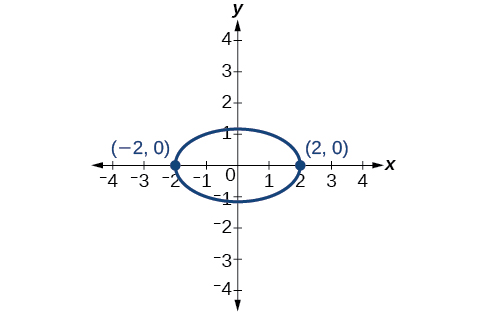
40. \(6x^{2} + 24xy - y^{2} - 12x + 26y + 11 = 0\)
Conic Sections in Polar Coordinates
For the following exercises, given the polar equation of the conic with focus at the origin, identify the eccentricity and directrix.
41. \(r = \frac{10}{1 - 5\mspace{9mu}\cos\mspace{7mu}\theta}\)
Solution (click to reveal)
Hyperbola with \(e = 5\) and directrix \(2\) units to the left of the pole.
42. \(r = \frac{6}{3 + 2\mspace{9mu}\cos\mspace{7mu}\theta}\)
43. \(r = \frac{1}{4 + 3\mspace{9mu}\sin\mspace{7mu}\theta}\)
Solution (click to reveal)
Ellipse with \(e = \frac{3}{4}\) and directrix \(\frac{1}{3}\) unit above the pole.
44. \(r = \frac{3}{5 - 5\mspace{9mu}\sin\mspace{7mu}\theta}\)
For the following exercises, graph the conic given in polar form. If it is a parabola, label the vertex, focus, and directrix. If it is an ellipse or a hyperbola, label the vertices and foci.
45. \(r = \frac{3}{1 - \sin\mspace{7mu}\theta}\)
Solution (click to reveal)
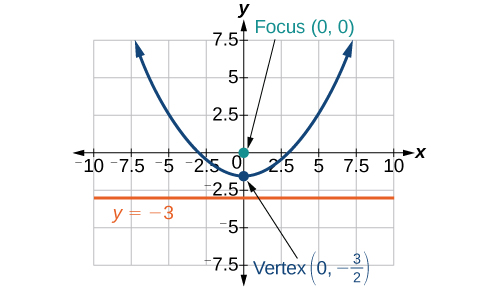
46. \(r = \frac{8}{4 + 3\mspace{9mu}\sin\mspace{7mu}\theta}\)
47. \(r = \frac{10}{4 + 5\mspace{9mu}\cos\mspace{7mu}\theta}\)
Solution (click to reveal)
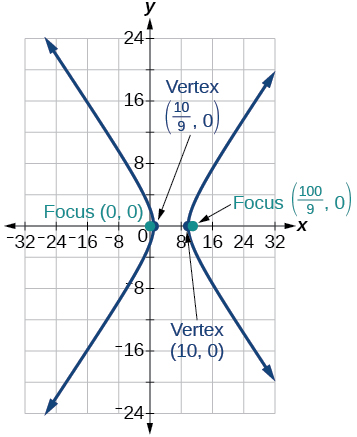
48. \(r = \frac{9}{3 - 6\mspace{9mu}\cos\mspace{7mu}\theta}\)
For the following exercises, given information about the graph of a conic with focus at the origin, find the equation in polar form.
49. Directrix is \(x = 3\) and eccentricity \(e = 1\)
Solution (click to reveal)
\(r = \frac{3}{1 + \cos\mspace{7mu}~\theta}\)
50. Directrix is \(y = -2\) and eccentricity \(e = 4\)
Practice Test
For the following exercises, write the equation in standard form and state the center, vertices, and foci.
1. \(\frac{x^{2}}{9} + \frac{y^{2}}{4} = 1\)
Solution (click to reveal)
\(\frac{x^{2}}{3^{2}} + \frac{y^{2}}{2^{2}} = 1;\) center: \(\left( {0,0} \right);\) vertices: \(\left( {3,0} \right),\left( {–3,0} \right),\left( {0,2} \right),\left( {0,-2} \right);\) foci: \(\left( {\sqrt{5},0} \right),\left( {- \sqrt{5},0} \right)\)
2. \(9y^{2} + 16x^{2} - 36y + 32x - 92 = 0\)
For the following exercises, sketch the graph, identifying the center, vertices, and foci.
3. \(\frac{\left( {x - 3} \right)^{2}}{64} + \frac{\left( {y - 2} \right)^{2}}{36} = 1\)
Solution (click to reveal)
center: \(\left( {3,2} \right);\) vertices: \(\left( {11,2} \right),\left( {-5,2} \right),\left( {3,8} \right),\left( {3,-4} \right);\) foci: \(\left( {3 + 2\sqrt{7},2} \right),\left( {3 - 2\sqrt{7},2} \right)\)
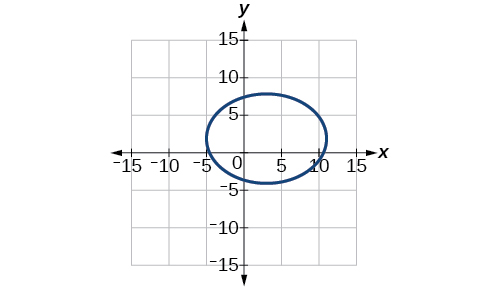
4. \(2x^{2} + y^{2} + 8x - 6y - 7 = 0\)
5. Write the standard form equation of an ellipse with a center at \(\left( {1,2} \right),\) vertex at \(\left( {7,2} \right),\) and focus at \(\left( {4,2}\operatorname{).} \right.\)
Solution (click to reveal)
\(\frac{\left( {x - 1} \right)^{2}}{36} + \frac{\left( {y - 2} \right)^{2}}{27} = 1\)
6. A whispering gallery is to be constructed with a length of 150 feet. If the foci are to be located 20 feet away from the wall, how high should the ceiling be?
For the following exercises, write the equation of the hyperbola in standard form, and give the center, vertices, foci, and asymptotes.
7. \(\frac{x^{2}}{49} - \frac{y^{2}}{81} = 1\)
Solution (click to reveal)
\(\frac{x^{2}}{7^{2}} - \frac{y^{2}}{9^{2}} = 1;\) center: \(\left( {0,0} \right);\) vertices \(\left( {7,0} \right),\left( {-7,0} \right);\) foci: \(\left( {\sqrt{130},0} \right),\left( {- \sqrt{130},0} \right);\) asymptotes: \(y = \pm \frac{9}{7}x\)
8. \(16y^{2} - 9x^{2} + 128y + 112 = 0\)
For the following exercises, graph the hyperbola, noting its center, vertices, and foci. State the equations of the asymptotes.
9. \(\frac{\left( {x - 3} \right)^{2}}{25} - \frac{\left( {y + 3} \right)^{2}}{1} = 1\)
Solution (click to reveal)
center: \(\left( {3,-3} \right);\) vertices: \(\left( {8,-3} \right),\left( {-2,-3} \right);\) foci: \(\left( {3 + \sqrt{26},-3} \right),\left( {3 - \sqrt{26},-3} \right);\) asymptotes: \(y = \pm \frac{1}{5}(x - 3) - 3\)
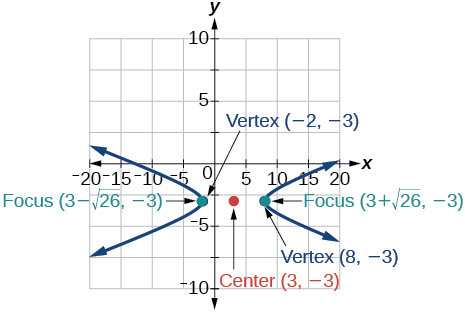
10. \(y^{2} - x^{2} + 4y - 4x - 18 = 0\)
11. Write the standard form equation of a hyperbola with foci at \(\left( {1,0} \right)\) and \(\left( {1,6} \right),\) and a vertex at \(\left( {1,2} \right).\)
Solution (click to reveal)
\(\frac{\left( {y - 3} \right)^{2}}{1} - \frac{\left( {x - 1} \right)^{2}}{8} = 1\)
For the following exercises, write the equation of the parabola in standard form, and give the vertex, focus, and equation of the directrix.
12. \(y^{2} + 10x = 0\)
13. \(3x^{2} - 12x - y + 11 = 0\)
Solution (click to reveal)
\(\left( {x - 2} \right)^{2} = \frac{1}{3}\left( {y + 1} \right);\) vertex: \(\left( {2,-1} \right);\) focus: \(\left( {2, - \frac{11}{12}} \right);\) directrix: \(y = - \frac{13}{12}\)
For the following exercises, graph the parabola, labeling the vertex, focus, and directrix.
14. \(\left( {x - 1} \right)^{2} = -4\left( {y + 3} \right)\)
15. \(y^{2} + 8x - 8y + 40 = 0\)
Solution (click to reveal)
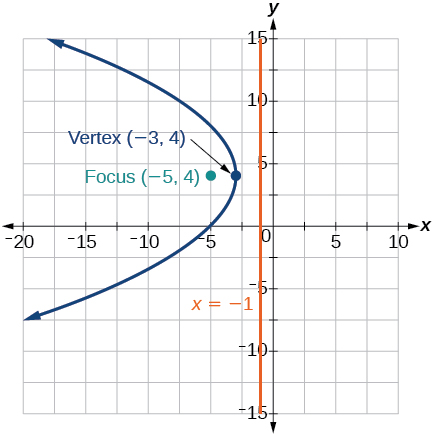
16. Write the equation of a parabola with a focus at \(\left( {2,3} \right)\) and directrix \(y = -1.\)
17. A searchlight is shaped like a paraboloid of revolution. If the light source is located 1.5 feet from the base along the axis of symmetry, and the depth of the searchlight is 3 feet, what should the width of the opening be?
Solution (click to reveal)
Approximately \(8.49\) feet
For the following exercises, determine which conic section is represented by the given equation, and then determine the angle \(\theta\) that will eliminate the \(xy\) term.
18. \(3x^{2} - 2xy + 3y^{2} = 4\)
19. \(x^{2} + 4xy + 4y^{2} + 6x - 8y = 0\)
Solution (click to reveal)
parabola; \(\theta \approx 63.4^{\circ}\)
For the following exercises, rewrite in the \(x'y'\) system without the \(x'y'\) term, and graph the rotated graph.
20. \(11x^{2} + 10\sqrt{3}xy + y^{2} = 4\)
21. \(16x^{2} + 24xy + 9y^{2} - 125x = 0\)
Solution (click to reveal)
\({x'}^{2} - 4x' + 3y' = 0\)
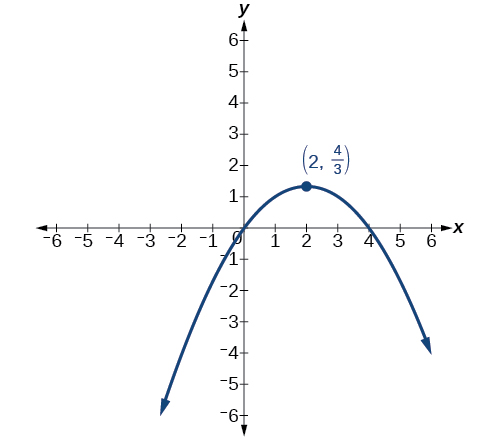
For the following exercises, identify the conic with focus at the origin, and then give the directrix and eccentricity.
22. \(r = \frac{3}{2 - \sin\mspace{7mu}\theta}\)
23. \(r = \frac{5}{4 + 6\mspace{9mu}\cos\mspace{7mu}\theta}\)
Solution (click to reveal)
Hyperbola with \(e = \frac{3}{2},\) and directrix \(\frac{5}{6}\) units to the right of the pole.
For the following exercises, graph the given conic section. If it is a parabola, label vertex, focus, and directrix. If it is an ellipse or a hyperbola, label vertices and foci.
24. \(r = \frac{12}{4 - 8\mspace{9mu}\sin\mspace{7mu}\theta}\)
25. \(r = \frac{2}{4 + 4\mspace{9mu}\sin\mspace{7mu}\theta}\)
Solution (click to reveal)
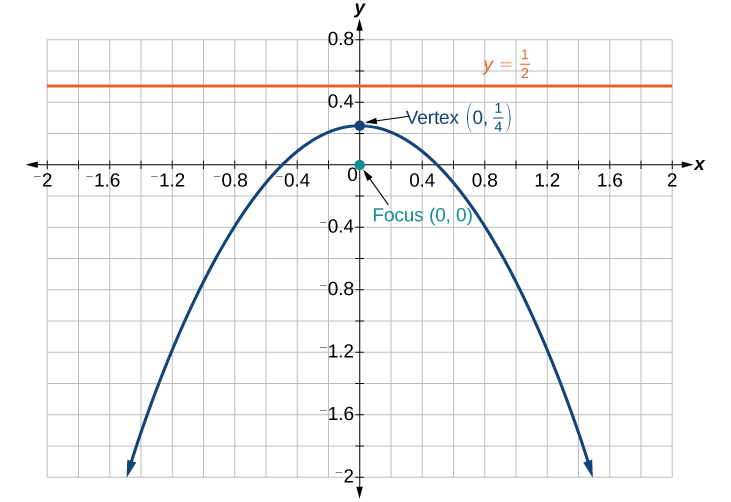
26. Find a polar equation of the conic with focus at the origin, eccentricity of \(e = 2,\) and directrix: \(x = 3.\)