13.2 Arithmetic Sequences
Companies often make large purchases, such as computers and vehicles, for business use. The book-value of these supplies decreases each year for tax purposes. This decrease in value is called depreciation. One method of calculating depreciation is straight-line depreciation, in which the value of the asset decreases by the same amount each year.
As an example, consider a woman who starts a small contracting business. She purchases a new truck for $25,000. After five years, she estimates that she will be able to sell the truck for $8,000. The loss in value of the truck will therefore be $17,000, which is $3,400 per year for five years. The truck will be worth $21,600 after the first year; $18,200 after two years; $14,800 after three years; $11,400 after four years; and $8,000 at the end of five years. In this section, we will consider specific kinds of sequences that will allow us to calculate depreciation, such as the truck’s value.
13.2.1 Finding Common Differences
The values of the truck in the example are said to form an arithmetic sequence because they change by a constant amount each year. Each term increases or decreases by the same constant value called the common difference of the sequence. For this sequence, the common difference is –3,400.

The sequence below is another example of an arithmetic sequence. In this case, the constant difference is 3. You can choose any term of the sequence, and add 3 to find the subsequent term.

Is each sequence arithmetic? If so, find the common difference.
ⓐ \(\left\{ 1,2,4,8,16,... \right\}\) ⓑ \(\left\{ - 3,1,5,9,13,... \right\}\)
Solution (click to reveal)
Subtract each term from the subsequent term to determine whether a common difference exists.
ⓐ The sequence is not arithmetic because there is no common difference. 
ⓑ The sequence is arithmetic because there is a common difference. The common difference is 4. 
The graph of each of these sequences is shown in Figure 1. We can see from the graphs that, although both sequences show growth, \(a\) is not linear whereas \(b\) is linear. Arithmetic sequences have a constant rate of change so their graphs will always be points on a line.
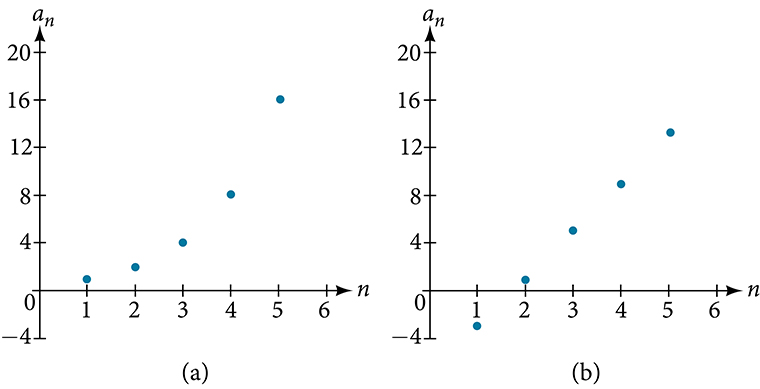
Figure 1
13.2.2 Writing Terms of Arithmetic Sequences
Now that we can recognize an arithmetic sequence, we will find the terms if we are given the first term and the common difference. The terms can be found by beginning with the first term and adding the common difference repeatedly. In addition, any term can also be found by plugging in the values of \(n\) and \(d\) into formula below.
\[a_{n} = a_{1} + (n - 1)d\]
Write the first five terms of the arithmetic sequence with \(a_{1} = 17\) and \(d = - 3\) .
Solution (click to reveal)
Adding \(- 3\) is the same as subtracting 3. Beginning with the first term, subtract 3 from each term to find the next term.
The first five terms are \(\left\{ 17,\mspace{9mu} 14,\mspace{9mu} 11,\mspace{9mu} 8,\mspace{9mu} 5 \right\}\)
As expected, the graph of the sequence consists of points on a line as shown in Figure 2.
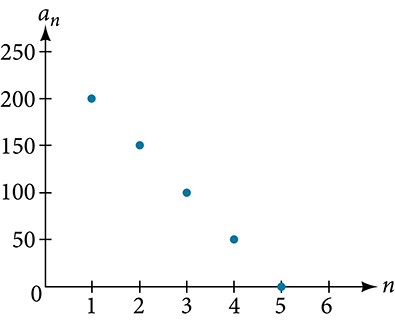
Figure 2
13.2.3 Using Recursive Formulas for Arithmetic Sequences
Some arithmetic sequences are defined in terms of the previous term using a recursive formula. The formula provides an algebraic rule for determining the terms of the sequence. A recursive formula allows us to find any term of an arithmetic sequence using a function of the preceding term. Each term is the sum of the previous term and the common difference. For example, if the common difference is 5, then each term is the previous term plus 5. As with any recursive formula, the first term must be given.
\[\begin{array}{lllll} {a_{n} = a_{n - 1} + d} & & & & {n \geq 2} \end{array}\]
Write a recursive formula for the arithmetic sequence.
\[\left\{ - 18\text{,~} - 7\text{,~}4\text{,~}15\text{,~}26\text{,~…} \right\}\]
Solution (click to reveal)
The first term is given as \(-18\) . The common difference can be found by subtracting the first term from the second term.
\[d = -7 - (-18) = 11\]
Substitute the initial term and the common difference into the recursive formula for arithmetic sequences.
\[\begin{array}{l} {a_{1} = - 18} \\ {a_{n} = a_{n - 1} + 11,\mspace{9mu}\text{for~}n \geq 2} \end{array}\]
We see that the common difference is the slope of the line formed when we graph the terms of the sequence, as shown in Figure 3. The growth pattern of the sequence shows the constant difference of 11 units.
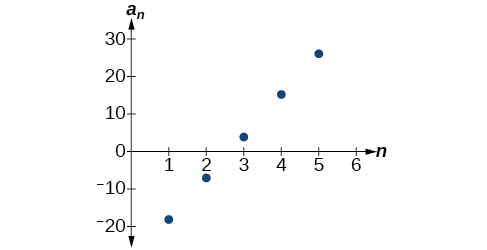
Figure 3
13.2.4 Using Explicit Formulas for Arithmetic Sequences
We can think of an arithmetic sequence as a function on the domain of the natural numbers; it is a linear function because it has a constant rate of change. The common difference is the constant rate of change, or the slope of the function. We can construct the linear function if we know the slope and the vertical intercept.
\[a_{n} = a_{1} + d(n - 1)\]
To find the \(y\)-intercept of the function, we can subtract the common difference from the first term of the sequence. Consider the following sequence.

The common difference is \(- 50\) , so the sequence represents a linear function with a slope of \(- 50\) . To find the \(y\) -intercept, we subtract \(- 50\) from \(200:\mspace{9mu} 200 - ( - 50) = 200 + 50 = 250\) . You can also find the \(y\) -intercept by graphing the function and determining where a line that connects the points would intersect the vertical axis. The graph is shown in Figure 4.
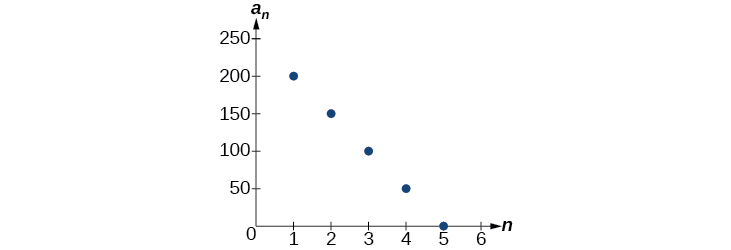
Figure 4
Recall the slope-intercept form of a line is \(y = mx + b.\) When dealing with sequences, we use \(a_{n}\) in place of \(y\) and \(n\) in place of \(x.\) If we know the slope and vertical intercept of the function, we can substitute them for \(m\) and \(b\) in the slope-intercept form of a line. Substituting \(- 50\) for the slope and \(250\) for the vertical intercept, we get the following equation:
\[a_{n} = - 50n + 250\]
We do not need to find the vertical intercept to write an explicit formula for an arithmetic sequence. Another explicit formula for this sequence is \(a_{n} = 200 - 50(n - 1)\) , which simplifies to \(a_{n} = - 50n + 250.\)
Write an explicit formula for the arithmetic sequence.
\[\left\{ 2\text{,~}12\text{,~}22\text{,~}32\text{,~}42\text{,~…} \right\}\]
Solution (click to reveal)
The common difference can be found by subtracting the first term from the second term.
\[\begin{array}{ll} d & {= a_{2} - a_{1}} \\ & {= 12 - 2} \\ & {= 10} \end{array}\]
The common difference is 10. Substitute the common difference and the first term of the sequence into the formula and simplify.
\[\begin{array}{l} {a_{n} = 2 + 10(n - 1)} \\ {a_{n} = 10n - 8} \end{array}\]
The graph of this sequence, represented in Figure 5, shows a slope of 10 and a vertical intercept of \(- 8\) .
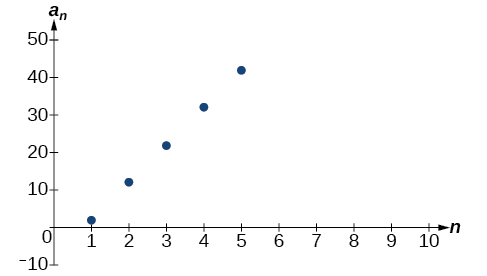
Figure 5
Finding the Number of Terms in a Finite Arithmetic Sequence
Explicit formulas can be used to determine the number of terms in a finite arithmetic sequence. We need to find the common difference, and then determine how many times the common difference must be added to the first term to obtain the final term of the sequence.
Solving Application Problems with Arithmetic Sequences
In many application problems, it often makes sense to use an initial term of \(a_{0}\) instead of \(a_{1}.\) In these problems, we alter the explicit formula slightly to account for the difference in initial terms. We use the following formula:
\[a_{n} = a_{0} + dn\]
Section Exercises
Verbal
1. What is an arithmetic sequence?
Solution (click to reveal)
A sequence where each successive term of the sequence increases (or decreases) by a constant value.
2. How is the common difference of an arithmetic sequence found?
3. How do we determine whether a sequence is arithmetic?
Solution (click to reveal)
We find whether the difference between all consecutive terms is the same. This is the same as saying that the sequence has a common difference.
4. What are the main differences between using a recursive formula and using an explicit formula to describe an arithmetic sequence?
5. Describe how linear functions and arithmetic sequences are similar. How are they different?
Solution (click to reveal)
Both arithmetic sequences and linear functions have a constant rate of change. They are different because their domains are not the same; linear functions are defined for all real numbers, and arithmetic sequences are defined for natural numbers or a subset of the natural numbers.
Algebraic
For the following exercises, find the common difference for the arithmetic sequence provided.
6. \(\left\{ 5,11,17,23,29,... \right\}\)
7. \(\left\{ {0,\frac{1}{2},1,\frac{3}{2},2,...} \right\}\)
Solution (click to reveal)
The common difference is \(\frac{1}{2}\)
For the following exercises, determine whether the sequence is arithmetic. If so find the common difference.
8. \(\left\{ 11.4,9.3,7.2,5.1,3,... \right\}\)
9. \(\left\{ 4,16,64,256,1024,... \right\}\)
Solution (click to reveal)
The sequence is not arithmetic because \(16 - 4 \neq 64 - 16.\)
For the following exercises, write the first five terms of the arithmetic sequence given the first term and common difference.
10. \(a_{1} = -25\) , \(d = -9\)
11. \(a_{1} = 0\) , \(d = \frac{2}{3}\)
Solution (click to reveal)
\(0,\mspace{9mu}\frac{2}{3},\mspace{9mu}\frac{4}{3},\mspace{9mu} 2,\mspace{9mu}\frac{8}{3}\)
For the following exercises, write the first five terms of the arithmetic series given two terms.
12. \(a_{1} = 17,\mspace{9mu} a_{7} = - 31\)
13. \(a_{13} = - 60,\mspace{9mu} a_{33} = - 160\)
Solution (click to reveal)
\(0, - 5, - 10, - 15, - 20\)
For the following exercises, find the specified term for the arithmetic sequence given the first term and common difference.
14. First term is 3, common difference is 4, find the 5th term.
15. First term is 4, common difference is 5, find the 4th term.
Solution (click to reveal)
\(a_{4} = 19\)
16. First term is 5, common difference is 6, find the 8th term.
17. First term is 6, common difference is 7, find the 6th term.
Solution (click to reveal)
\(a_{6} = 41\)
18. First term is 7, common difference is 8, find the 7th term.
For the following exercises, find the first term given two terms from an arithmetic sequence.
19. Find the first term or \(a_{1}\) of an arithmetic sequence if \(a_{6} = 12\) and \(a_{14} = 28.\)
Solution (click to reveal)
\(a_{1} = 2\)
20. Find the first term or \(a_{1}\) of an arithmetic sequence if \(a_{7} = 21\) and \(a_{15} = 42.\)
21. Find the first term or \(a_{1}\) of an arithmetic sequence if \(a_{8} = 40\) and \(a_{23} = 115.\)
Solution (click to reveal)
\(a_{1} = 5\)
22. Find the first term or \(a_{1}\) of an arithmetic sequence if \(a_{9} = 54\) and \(a_{17} = 102.\)
23. Find the first term or \(a_{1}\) of an arithmetic sequence if \(a_{11} = 11\) and \(a_{21} = 16.\)
Solution (click to reveal)
\(a_{1} = 6\)
For the following exercises, find the specified term given two terms from an arithmetic sequence.
24. \(a_{1} = 33\) and \(a_{7} = - 15.\) Find \(a_{4}.\)
25. \(a_{3} = - 17.1\) and \(a_{10} = - 15.7.\) Find \(a_{21}.\)
Solution (click to reveal)
\(a_{21} = - 13.5\)
For the following exercises, use the recursive formula to write the first five terms of the arithmetic sequence.
26. \(a_{1} = 39;\mspace{9mu} a_{n} = a_{n - 1} - 3\)
27. \(a_{1} = - 19;\mspace{9mu} a_{n} = a_{n - 1} - 1.4\)
Solution (click to reveal)
\(- 19, - 20.4, - 21.8, - 23.2, - 24.6\)
For the following exercises, write a recursive formula for each arithmetic sequence.
28. \(a = \left\{ {40,60,80,...} \right\}\)
29. \(a = \left\{ 17,26,35,... \right\}\)
Solution (click to reveal)
\(\begin{array}{ll} {a_{1} = 17;~a_{n} = a_{n - 1} + 9} & {n \geq 2} \end{array}\)
30. \(a = \left\{ - 1,2,5,... \right\}\)
31. \(a = \left\{ 12,17,22,... \right\}\)
Solution (click to reveal)
\(\begin{array}{ll} {a_{1} = 12;~a_{n} = a_{n - 1} + 5} & {n \geq 2} \end{array}\)
32. \(a = \left\{ - 15, - 7,1,... \right\}\)
33. \(a = \left\{ 8.9,10.3,11.7,... \right\}\)
Solution (click to reveal)
\(\begin{array}{ll} {a_{1} = 8.9;~a_{n} = a_{n - 1} + 1.4} & {n \geq 2} \end{array}\)
34. \(a = \left\{ - 0.52, - 1.02, - 1.52,... \right\}\)
35. \(a = \left\{ {\frac{1}{5},\frac{9}{20},\frac{7}{10},...} \right\}\)
Solution (click to reveal)
\(\begin{array}{ll} {a_{1} = \frac{1}{5};~a_{n} = a_{n - 1} + \frac{1}{4}} & {n \geq 2} \end{array}\)
36. \(a = \left\{ {- \frac{1}{2}, - \frac{5}{4}, - 2,...} \right\}\)
37. \(a = \left\{ {\frac{1}{6}, - \frac{11}{12}, - 2,...} \right\}\)
Solution (click to reveal)
\(\begin{array}{ll} {{}_{1} = \frac{1}{6};~a_{n} = a_{n - 1} - \frac{13}{12}} & {n \geq 2} \end{array}\)
For the following exercises, write a recursive formula for the given arithmetic sequence, and then find the specified term.
38. \(a = \left\{ 7\text{,~}4\text{,~}1\text{,~}... \right\};\) Find the 17th term.
39. \(a = \left\{ 4\text{,~}11\text{,~}18\text{,~}... \right\};\) Find the 14th term.
Solution (click to reveal)
\(a_{1} = 4;\mspace{9mu} a_{n} = a_{n - 1} + 7;\mspace{9mu} a_{14} = 95\)
40. \(a = \left\{ 2\text{,~}6\text{,~}10\text{,~}... \right\};\) Find the 12th term.
For the following exercises, use the explicit formula to write the first five terms of the arithmetic sequence.
41. \(a_{n} = 24 - 4n\)
Solution (click to reveal)
First five terms: \(20,16,12,8,4.\)
42. \(a_{n} = \frac{1}{2}n - \frac{1}{2}\)
For the following exercises, write an explicit formula for each arithmetic sequence.
43. \(a = \left\{ 3,5,7,... \right\}\)
Solution (click to reveal)
\(a_{n} = 1 + 2n\)
44. \(a = \left\{ 32,24,16,... \right\}\)
45. \(a = \left\{ - 5\text{,~}95\text{,~}195\text{,~}... \right\}\)
Solution (click to reveal)
\(a_{n} = - 105 + 100n\)
46. \(a = \left\{ -17\text{,~}-217\text{,~}-417\text{,}... \right\}\)
47. \(a = \left\{ 1.8\text{,~}3.6\text{,~}5.4\text{,~}... \right\}\)
Solution (click to reveal)
\(a_{n} = 1.8n\)
48. \(a = \left\{ -18.1,-16.2,-14.3,... \right\}\)
49. \(a = \left\{ 15.8,18.5,21.2,... \right\}\)
Solution (click to reveal)
\(a_{n} = 13.1 + 2.7n\)
50. \(a = \left\{ {\frac{1}{3}, - \frac{4}{3},-3\text{,~}...} \right\}\)
51. \(a = \left\{ {0,\frac{1}{3},\frac{2}{3},...} \right\}\)
Solution (click to reveal)
\(a_{n} = \frac{1}{3}n - \frac{1}{3}\)
52. \(a = \left\{ {- 5, - \frac{10}{3}, - \frac{5}{3},\ldots} \right\}\)
For the following exercises, find the number of terms in the given finite arithmetic sequence.
53. \(a = \left\{ 3\text{,} - 4\text{,} - 11\text{,~}...\text{,} - 60 \right\}\)
Solution (click to reveal)
There are 10 terms in the sequence.
54. \(a = \left\{ 1.2,1.4,1.6,...,3.8 \right\}\)
55. \(a = \left\{ {\frac{1}{2},2,\frac{7}{2},...,8} \right\}\)
Solution (click to reveal)
There are 6 terms in the sequence.
Graphical
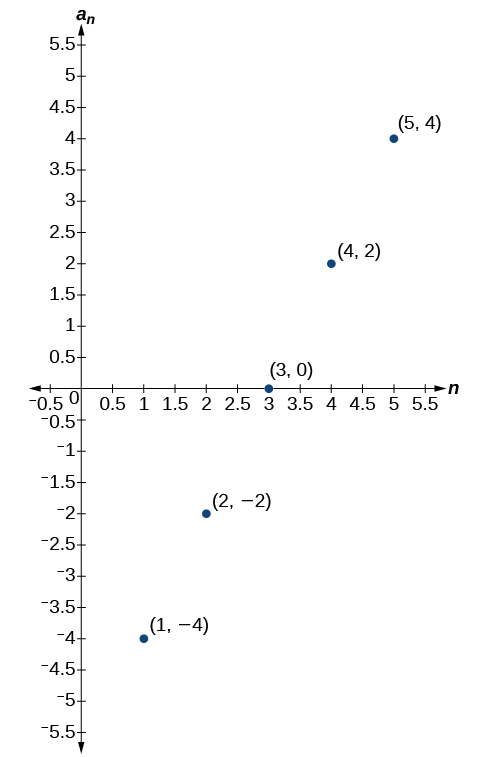
For the following exercises, determine whether the graph shown represents an arithmetic sequence.
56.
57.
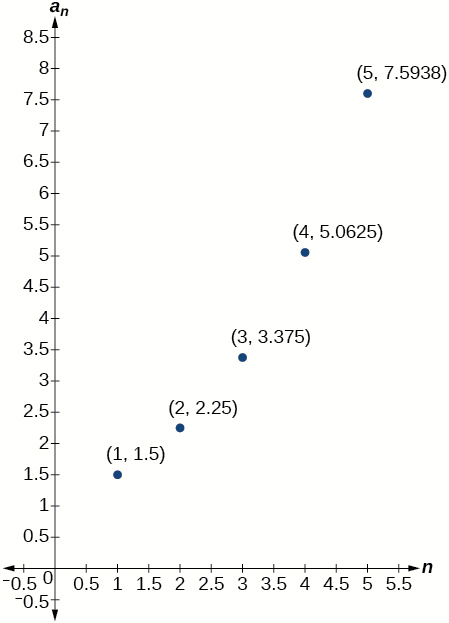
Solution (click to reveal)
The graph does not represent an arithmetic sequence.
For the following exercises, use the information provided to graph the first 5 terms of the arithmetic sequence.
58. \(a_{1} = 0,d = 4\)
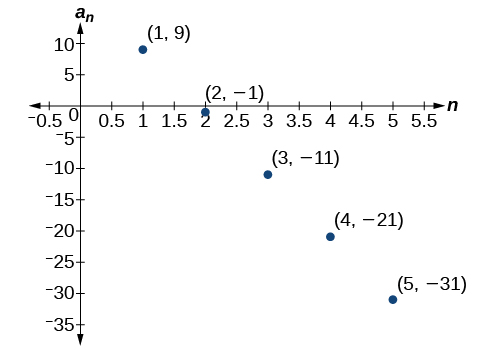
59. \(a_{1} = 9;a_{n} = a_{n - 1} - 10\)
Solution (click to reveal)
60. \(a_{n} = - 12 + 5n\)
Technology
For the following exercises, follow the steps to work with the arithmetic sequence \(a_{n} = 3n - 2\) using a graphing calculator:
Press [MODE] - Select SEQ in the fourth line - Select DOT in the fifth line - Press [ENTER]
Press [Y=] - \(n\text{Min}\) is the first counting number for the sequence. Set \(n\text{Min} = 1\) - \(u(n)\) is the pattern for the sequence. Set \(u(n) = 3n - 2\) - \(u(n\text{Min)}\) is the first number in the sequence. Set \(u(n\text{Min)} = 1\)
Press [2ND] then [WINDOW] to go to TBLSET - Set \(\text{TblStart} = 1\) - Set \(\Delta\text{Tbl} = 1\) - Set Indpnt: Auto and Depend: Auto
Press [2ND] then [GRAPH] to go to the TABLE
61. What are the first seven terms shown in the column with the heading \(u(n)\text{?}\)
Solution (click to reveal)
\(1,4,7,10,13,16,19\)
62. Use the scroll-down arrow to scroll to \(n = 50.\) What value is given for \(u(n)\text{?}\)
63. Press [WINDOW]. Set \(n\text{Min} = 1\), \(n\text{Max} = 5\), \(x\text{Min} = 0\), \(x\text{Max} = 6\), \(y\text{Min} = - 1\), and \(y\text{Max} = 14.\) Then press [GRAPH]. Graph the sequence as it appears on the graphing calculator.
Solution (click to reveal)
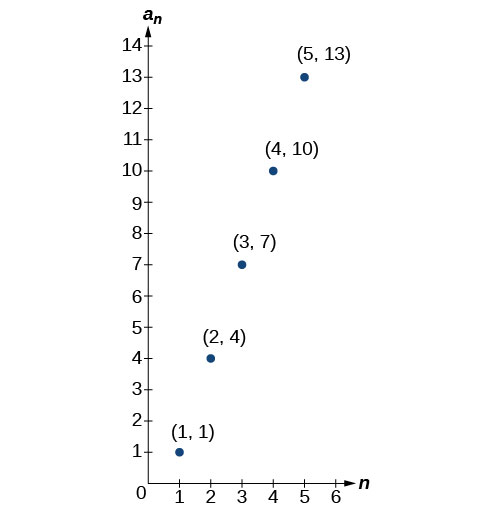
For the following exercises, follow the steps given above to work with the arithmetic sequence \(a_{n} = \frac{1}{2}n + 5\) using a graphing calculator.
64. What are the first seven terms shown in the column with the heading \(u(n)\) in the TABLE feature?
65. Graph the sequence as it appears on the graphing calculator. Be sure to adjust the WINDOW settings as needed.
Solution (click to reveal)
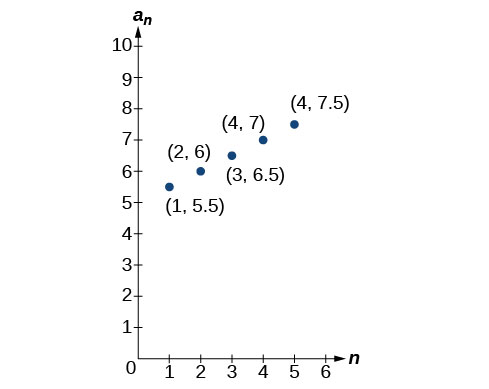
Extensions
66. Give two examples of arithmetic sequences whose 4th terms are \(9.\)
67. Give two examples of arithmetic sequences whose 10th terms are \(206.\)
Solution (click to reveal)
Answers will vary. Examples: \(a_{n} = 20.6n\) and \(a_{n} = 2 + 20.4{n.}\)
68. Find the 5th term of the arithmetic sequence \(\left\{ 9b,5b,b,\ldots \right\}.\)
69. Find the 11th term of the arithmetic sequence \(\left\{ 3a - 2b,a + 2b, - a + 6b\ldots \right\}.\)
Solution (click to reveal)
\(a_{11} = - 17a + 38b\)
70. At which term does the sequence \(\left\{ 5.4,14.5,23.6,... \right\}\) exceed 151?
71. At which term does the sequence \(\left\{ {\frac{17}{3},\frac{31}{6},\frac{14}{3},...} \right\}\) begin to have negative values?
Solution (click to reveal)
The sequence begins to have negative values at the 13th term, \(a_{13} = - \frac{1}{3}\)
72. For which terms does the finite arithmetic sequence \(\left\{ {\frac{5}{2},\frac{19}{8},\frac{9}{4},...,\frac{1}{8}} \right\}\) have integer values?
73. Write an arithmetic sequence using a recursive formula. Show the first 4 terms, and then find the 31st term.
Solution (click to reveal)
Answers will vary. Check to see that the sequence is arithmetic. Example: Recursive formula: \(a_{1} = 3,a_{n} = a_{n - 1} - 3.\) First 4 terms: \(\begin{array}{ll} {3,0, - 3, - 6} & {a_{31} = - 87} \end{array}\)
74. Write an arithmetic sequence using an explicit formula. Show the first 4 terms, and then find the 28th term.