Chapter Review
Key Terms
absolute value equation — an equation in which the variable appears in absolute value bars, typically with two solutions, one accounting for the positive expression and one for the negative expression
area — in square units, the area formula used in this section is used to find the area of any two-dimensional rectangular region: \(A = LW\)
Cartesian coordinate system — a grid system designed with perpendicular axes invented by René Descartes
completing the square — a process for solving quadratic equations in which terms are added to or subtracted from both sides of the equation in order to make one side a perfect square
complex conjugate — a complex number containing the same terms as another complex number, but with the opposite operator. Multiplying a complex number by its conjugate yields a real number.
complex number — the sum of a real number and an imaginary number; the standard form is \(a + bi,\) where a is the real part and \(b\) is the complex part.
complex plane — the coordinate plane in which the horizontal axis represents the real component of a complex number, and the vertical axis represents the imaginary component, labeled \(i\).
compound inequality — a problem or a statement that includes two inequalities
conditional equation — an equation that is true for some values of the variable
discriminant — the expression under the radical in the quadratic formula that indicates the nature of the solutions, real or complex, rational or irrational, single or double roots.
distance formula — a formula that can be used to find the length of a line segment if the endpoints are known
equation in two variables — a mathematical statement, typically written in x and \(y\), in which two expressions are equal
equations in quadratic form — equations with a power other than 2 but with a middle term with an exponent that is one-half the exponent of the leading term
extraneous solutions — any solutions obtained that are not valid in the original equation
graph in two variables — the graph of an equation in two variables, which is always shown in two variables in the two-dimensional plane
identity equation — an equation that is true for all values of the variable
imaginary number — the square root of \(-1\) : \(i = \sqrt{-1}.\)
inconsistent equation — an equation producing a false result
intercepts — the points at which the graph of an equation crosses the \(x\)-axis and the \(y\)-axis
interval — an interval describes a set of numbers within which a solution falls
interval notation — a mathematical statement that describes a solution set and uses parentheses or brackets to indicate where an interval begins and ends
linear equation — an algebraic equation in which each term is either a constant or the product of a constant and the first power of a variable
linear inequality — similar to a linear equation except that the solutions will include sets of numbers
midpoint formula — a formula to find the point that divides a line segment into two parts of equal length
ordered pair — a pair of numbers indicating horizontal displacement and vertical displacement from the origin; also known as a coordinate pair, \(\left( {x,y} \right)\)
origin — the point where the two axes cross in the center of the plane, described by the ordered pair \(\left( {0,0} \right)\)
perimeter — in linear units, the perimeter formula is used to find the linear measurement, or outside length and width, around a two-dimensional regular object; for a rectangle: \(P = 2L + 2W\)
polynomial equation — an equation containing a string of terms including numerical coefficients and variables raised to whole-number exponents
Pythagorean Theorem — a theorem that states the relationship among the lengths of the sides of a right triangle, used to solve right triangle problems
quadrant — one quarter of the coordinate plane, created when the axes divide the plane into four sections
quadratic equation — an equation containing a second-degree polynomial; can be solved using multiple methods
quadratic formula — a formula that will solve all quadratic equations
radical equation — an equation containing at least one radical term where the variable is part of the radicand
rational equation — an equation consisting of a fraction of polynomials
slope — the change in \(y\)-values over the change in \(x\)-values
solution set — the set of all solutions to an equation
square root property — one of the methods used to solve a quadratic equation, in which the \(x^{2}\) term is isolated so that the square root of both sides of the equation can be taken to solve for \(x\)
volume — in cubic units, the volume measurement includes length, width, and depth: \(V = LWH\)
\(\mathbf{x}\)-axis — the common name of the horizontal axis on a coordinate plane; a number line increasing from left to right
\(\mathbf{x}\)-coordinate — the first coordinate of an ordered pair, representing the horizontal displacement and direction from the origin
\(\mathbf{x}\)-intercept — the point where a graph intersects the \(x\)-axis; an ordered pair with a \(y\)-coordinate of zero
\(\mathbf{y}\)-axis — the common name of the vertical axis on a coordinate plane; a number line increasing from bottom to top
\(\mathbf{y}\)-coordinate — the second coordinate of an ordered pair, representing the vertical displacement and direction from the origin
\(\mathbf{y}\)-intercept — a point where a graph intercepts the \(y\)-axis; an ordered pair with an \(x\)-coordinate of zero
zero-product property — the property that formally states that multiplication by zero is zero, so that each factor of a quadratic equation can be set equal to zero to solve equations
Key Equations
| quadratic formula | \(x = \frac{- b \pm \sqrt{b^{2} - 4ac}}{2a}\) |
| Distance | \(d = \sqrt{\left( {x_{2} - x_{1}} \right)^{2} + \left( {y_{2} - y_{1}} \right)^{2}}\) |
| Slope of a line | \(m = \frac{y_{2} - y_{1}}{x_{2} - x_{1}}\) |
| Point-Slope equation of a line | \(y - y_{1} = m\left( {x - x_{1}} \right)\) |
| Adding Complex Numbers | \((a + bi) + (c + di) = (a + c) + (b + d)i\) |
| Subtracting Complex Numbers | \((a + bi) - (c + di) = (a - c) + (b - d)i\) |
| Square Root Property | \(\text{~If~}x^{2} = k\text{~then~}x = \pm \sqrt{k}\) |
| Quadratic Formula | \(\text{~If~}ax^{2} + bx + c = 0\text{~then~}x = \frac{- b \pm \sqrt{b^{2} - 4ac}}{2a}\) |
| Rational Exponents | \(a^{\frac{m}{n}} = \left( a^{\frac{1}{n}} \right)^{m} = \left( a^{m} \right)^{\frac{1}{n}} = \sqrt[n]{a^{m}} = \left( \sqrt[n]{a} \right)^{m}\) |
| Absolute Value | \(\left. \text{~If~}x \geq 0, \middle| x \middle| = x\text{; If~}x < 0, \middle| x \middle| = - x \right.\) |
| Addition Property of Inequalities | \(\text{~If~}a < b\text{~then~}a + c < b + c\) |
| Multiplication Property of Inequalities | \(\begin{matrix} {\text{If~}a < b~\text{and~}c > 0\text{,}~\text{then~}ac < bc} \\ {\text{If~}a < b~\text{and~}c < 0\text{,}~\text{then~}ac > bc} \end{matrix}\) |
Key Concepts
2.1 The Rectangular Coordinate Systems and Graphs
- We can locate, or plot, points in the Cartesian coordinate system using ordered pairs, which are defined as displacement from the \(x\)-axis and displacement from the \(y\)-axis. See Example 1.
- An equation can be graphed in the plane by creating a table of values and plotting points. See Example 2.
- Using a graphing calculator or a computer program makes graphing equations faster and more accurate. Equations usually have to be entered in the form y=_____. See Example 3.
- Finding the \(x\)- and \(y\)-intercepts can define the graph of a line. These are the points where the graph crosses the axes. See Example 4.
- The distance formula is derived from the Pythagorean Theorem and is used to find the length of a line segment. See Example 5 and Example 6.
- The midpoint formula provides a method of finding the coordinates of the midpoint dividing the sum of the \(x\)-coordinates and the sum of the \(y\)-coordinates of the endpoints by 2. See Example 7 and Example 8.
2.2 Linear Equations in One Variable
- We can solve linear equations in one variable in the form \(ax + b = 0\) using standard algebraic properties. See Example 1 and Example 2.
- A rational expression is a quotient of two polynomials. We use the LCD to clear the fractions from an equation. See Example 3 and Example 4.
- All solutions to a rational equation should be verified within the original equation to avoid an undefined term, or zero in the denominator. See Example 5 and Example 6 and Example 7.
- Given two points, we can find the slope of a line using the slope formula. See Example 8.
- We can identify the slope and \(y\)-intercept of an equation in slope-intercept form. See Example 9.
- We can find the equation of a line given the slope and a point. See Example 10.
- We can also find the equation of a line given two points. Find the slope and use the point-slope formula. See Example 11.
- The standard form of a line has no fractions. See Example 12.
- Horizontal lines have a slope of zero and are defined as \(y = c,\) where c is a constant.
- Vertical lines have an undefined slope (zero in the denominator), and are defined as \(x = c,\) where c is a constant. See Example 13.
- Parallel lines have the same slope and different \(y\)-intercepts. See Example 14 and Example 15.
- Perpendicular lines have slopes that are negative reciprocals of each other unless one is horizontal and the other is vertical. See Example 16.
2.3 Models and Applications
- A linear equation can be used to solve for an unknown in a number problem. See Example 1.
- Applications can be written as mathematical problems by identifying known quantities and assigning a variable to unknown quantities. See Example 2.
- There are many known formulas that can be used to solve applications. Distance problems, for example, are solved using the \(d = rt\) formula. See Example 3.
- Many geometry problems are solved using the perimeter formula \(P = 2L + 2W,\) the area formula \(A = LW,\) or the volume formula \(V = LWH.\) See Example 4, Example 5, and Example 6.
2.4 Complex Numbers
The square root of any negative number can be written as a multiple of \(i.\) See Example 1.
To plot a complex number, we use two number lines, crossed to form the complex plane. The horizontal axis is the real axis, and the vertical axis is the imaginary axis. See Example 2.
Complex numbers can be added and subtracted by combining the real parts and combining the imaginary parts. See Example 3.
Complex numbers can be multiplied and divided.
To multiply complex numbers, distribute just as with polynomials. See Example 4 and Example 5.
To divide complex numbers, multiply both numerator and denominator by the complex conjugate of the denominator to eliminate the complex number from the denominator. See Example 6 and Example 7.
The powers of \(i\) are cyclic, repeating every fourth one. See Example 8.
2.5 Quadratic Equations
- Many quadratic equations can be solved by factoring when the equation has a leading coefficient of 1 or if the equation is a difference of squares. The zero-product property is then used to find solutions. See Example 1, Example 2, and Example 3.
- Many quadratic equations with a leading coefficient other than 1 can be solved by factoring using the grouping method. See Example 4 and Example 5.
- Another method for solving quadratics is the square root property. The variable is squared. We isolate the squared term and take the square root of both sides of the equation. The solution will yield a positive and negative solution. See Example 6 and Example 7.
- Completing the square is a method of solving quadratic equations when the equation cannot be factored. See Example 8.
- A highly dependable method for solving quadratic equations is the quadratic formula, based on the coefficients and the constant term in the equation. See Example 9 and Example 10.
- The discriminant is used to indicate the nature of the roots that the quadratic equation will yield: real or complex, rational or irrational, and how many of each. See Example 11.
- The Pythagorean Theorem, among the most famous theorems in history, is used to solve right-triangle problems and has applications in numerous fields. Solving for the length of one side of a right triangle requires solving a quadratic equation. See Example 12.
2.6 Other Types of Equations
- Rational exponents can be rewritten several ways depending on what is most convenient for the problem. To solve, both sides of the equation are raised to a power that will render the exponent on the variable equal to 1. See Example 1, Example 2, and Example 3.
- Factoring extends to higher-order polynomials when it involves factoring out the GCF or factoring by grouping. See Example 4 and Example 5.
- We can solve radical equations by isolating the radical and raising both sides of the equation to a power that matches the index. See Example 6 and Example 7.
- To solve absolute value equations, we need to write two equations, one for the positive value and one for the negative value. See Example 8.
- Equations in quadratic form are easy to spot, as the exponent on the first term is double the exponent on the second term and the third term is a constant. We may also see a binomial in place of the single variable. We use substitution to solve. See Example 9 and Example 10.
- Solving a rational equation may also lead to a quadratic equation or an equation in quadratic form. See Example 11.
2.7 Linear Inequalities and Absolute Value Inequalities
- Interval notation is a method to indicate the solution set to an inequality. Highly applicable in calculus, it is a system of parentheses and brackets that indicate what numbers are included in a set and whether the endpoints are included as well. See Table 1 and Example 2.
- Solving inequalities is similar to solving equations. The same algebraic rules apply, except for one: multiplying or dividing by a negative number reverses the inequality. See Example 3, Example 4, Example 5, and Example 6.
- Compound inequalities often have three parts and can be rewritten as two independent inequalities. Solutions are given by boundary values, which are indicated as a beginning boundary or an ending boundary in the solutions to the two inequalities. See Example 7 and Example 8.
- Absolute value inequalities will produce two solution sets due to the nature of absolute value. We solve by writing two equations: one equal to a positive value and one equal to a negative value. See Example 9 and Example 10.
- Absolute value inequalities can also be solved by graphing. At least we can check the algebraic solutions by graphing, as we cannot depend on a visual for a precise solution. See Example 11.
Chapter Review Exercises
The Rectangular Coordinate Systems and Graphs
For the following exercises, find the \(x\)-intercept and the \(y\)-intercept without graphing.
1. \(4x - 3y = 12\)
Solution (click to reveal)
\(x\)-intercept: \(\left( {3,0} \right);\) \(y\)-intercept: \(\left( {0,-4} \right)\)
2. \(2y - 4 = 3x\)
For the following exercises, solve for \(y\) in terms of \(x\), putting the equation in slope–intercept form.
3. \(5x = 3y - 12\)
Solution (click to reveal)
\(y = \frac{5}{3}x + 4\)
4. \(2x - 5y = 7\)
For the following exercises, find the distance between the two points.
5. \(\left( {-2,5} \right)\left( {4,-1} \right)\)
Solution (click to reveal)
\(\sqrt{72} = 6\sqrt{2}\)
6. \(\left( {-12,-3} \right)\left( {-1,5} \right)\)
7. Find the distance between the two points \((-71{,}432)\) and \(\text{(511{,}218)}\) using your calculator, and round your answer to the nearest thousandth.
Solution (click to reveal)
\(620.097\)
For the following exercises, find the coordinates of the midpoint of the line segment that joins the two given points.
8. \(\left( {-1,5} \right)\) and \(\left( {4,6} \right)\)
9. \(\left( {-13,5} \right)\) and \(\left( {17,18} \right)\)
Solution (click to reveal)
midpoint is \(\left( {2,\frac{23}{2}} \right)\)
For the following exercises, construct a table and graph the equation by plotting at least three points.
10. \(y = \frac{1}{2}x + 4\)
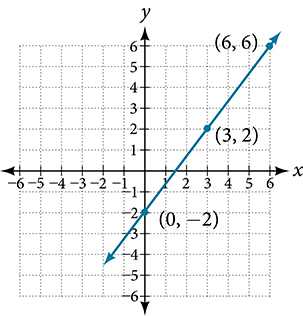
11. \(4x - 3y = 6\)
Solution (click to reveal)
| \(x\) | \(y\) |
| 0 | −2 |
| 3 | 2 |
| 6 | 6 |
Table 2
Linear Equations in One Variable
For the following exercises, solve for \(x.\)
12. \(5x + 2 = 7x - 8\)
13. \(3(x + 2) - 10 = x + 4\)
Solution (click to reveal)
\(x = 4\)
14. \(7x - 3 = 5\)
15. \(12 - 5(x + 1) = 2x - 5\)
Solution (click to reveal)
\(x = \frac{12}{7}\)
16. \(\frac{2x}{3} - \frac{3}{4} = \frac{x}{6} + \frac{21}{4}\)
For the following exercises, solve for \(x.\) State all \(x\)-values that are excluded from the solution set.
17. \(\frac{x}{x^{2} - 9} + \frac{4}{x + 3} = \frac{3}{x^{2} - 9}\) \(x \neq 3,-3\)
Solution (click to reveal)
No solution
18. \(\frac{1}{2} + \frac{2}{x} = \frac{3}{4}\)
For the following exercises, find the equation of the line using the point-slope formula.
19. Passes through these two points: \(\left( {-2,1} \right)\text{,}\left( {4,2} \right).\)
Solution (click to reveal)
\(y = \frac{1}{6}x + \frac{4}{3}\)
20. Passes through the point \(\left( {- 3,4} \right)\) and has a slope of \(- \frac{1}{3}.\)
21. Passes through the point \(\left( {- 3,4} \right)\) and is parallel to the graph \(y = \frac{2}{3}x + 5.\)
Solution (click to reveal)
\(y = \frac{2}{3}x + 6\)
22. Passes through these two points: \(\left( {5,1} \right)\text{,}\left( {5,7} \right).\)
Models and Applications
For the following exercises, write and solve an equation to answer each question.
23. The number of male fish in the tank is five more than three times the number of females. If the total number of fish is 73, how many of each sex are in the tank?
Solution (click to reveal)
females 17, males 56
24. A landscaper has 72 ft. of fencing to put around a rectangular garden. If the length is 3 times the width, find the dimensions of the garden.
25. A truck rental is $25 plus $.30/mi. Find out how many miles Ken traveled if his bill was $50.20.
Solution (click to reveal)
84 mi
Complex Numbers
For the following exercises, use the quadratic equation to solve.
26. \(x^{2} - 5x + 9 = 0\)
27. \(2x^{2} + 3x + 7 = 0\)
Solution (click to reveal)
\(x = - \frac{3}{4} \pm \frac{i\sqrt{47}}{4}\)
For the following exercises, name the horizontal component and the vertical component.
28. \(4 - 3i\)
29. \(-2 - i\)
Solution (click to reveal)
horizontal component \(-2;\) vertical component \(-1\)
For the following exercises, perform the operations indicated.
30. \(\left( {9 - i} \right) - \left( {4 - 7i} \right)\)
31. \(\left( {2 + 3i} \right) - \left( {- 5 - 8i} \right)\)
Solution (click to reveal)
\(7 + 11i\)
32. \(2\sqrt{- 75} + 3\sqrt{25}\)
33. \(\sqrt{- 16} + 4\sqrt{- 9}\)
Solution (click to reveal)
\(16i\)
34. \(- 6i(i - 5)\)
35. \({(3 - 5i)}^{2}\)
Solution (click to reveal)
\(-16 - 30i\)
36. \(\sqrt{- 4} \cdot \sqrt{- 12}\)
37. \(\sqrt{- 2}\left( {\sqrt{- 8} - \sqrt{5}} \right)\)
Solution (click to reveal)
\(-4 - i\sqrt{10}\)
38. \(\frac{2}{5 - 3i}\)
39. \(\frac{3 + 7i}{i}\)
Solution (click to reveal)
\(x = 7 - 3i\)
Quadratic Equations
For the following exercises, solve the quadratic equation by factoring.
40. \(2x^{2} - 7x - 4 = 0\)
41. \(3x^{2} + 18x + 15 = 0\)
Solution (click to reveal)
\(x = -1,-5\)
42. \(\operatorname{}25x^{2} - 9 = 0\)
43. \(\operatorname{}7x^{2} - 9x = 0\)
Solution (click to reveal)
\(x = 0,\frac{9}{7}\)
For the following exercises, solve the quadratic equation by using the square-root property.
44. \(x^{2} = 49\)
45. \(\left( {x - 4} \right)^{2} = 36\)
Solution (click to reveal)
\(x = 10,-2\)
For the following exercises, solve the quadratic equation by completing the square.
46. \(x^{2} + 8x - 5 = 0\)
47. \(4x^{2} + 2x - 1 = 0\)
Solution (click to reveal)
\(x = \frac{- 1 \pm \sqrt{5}}{4}\)
For the following exercises, solve the quadratic equation by using the quadratic formula. If the solutions are not real, state No real solution.
48. \(2x^{2} - 5x + 1 = 0\)
49. \(15x^{2} - x - 2 = 0\)
Solution (click to reveal)
\(x = \frac{2}{5},\frac{- 1}{3}\)
For the following exercises, solve the quadratic equation by the method of your choice.
50. \({(x - 2)}^{2} = 16\)
51. \(x^{2} = 10x + 3\)
Solution (click to reveal)
\(x = 5 \pm 2\sqrt{7}\)
Other Types of Equations
For the following exercises, solve the equations.
52. \(x^{\frac{3}{2}} = 27\)
53. \(x^{\frac{1}{2}} - 4x^{\frac{1}{4}} = 0\)
Solution (click to reveal)
\(x = 0,256\)
54. \(4x^{3} + 8x^{2} - 9x - 18 = 0\)
55. \(3x^{5} - 6x^{3} = 0\)
Solution (click to reveal)
\(x = 0, \pm \sqrt{2}\)
56. \(\sqrt{x + 9} = x - 3\)
57. \(\sqrt{3x + 7} + \sqrt{x + 2} = 1\)
Solution (click to reveal)
\(x = -2\)
58. \(\left| {3x - 7} \right| = 5\)
59. \(\left| {2x + 3} \right| - 5 = 9\)
Solution (click to reveal)
\(x = \frac{11}{2},\frac{-17}{2}\)
Linear Inequalities and Absolute Value Inequalities
For the following exercises, solve the inequality. Write your final answer in interval notation.
60. \(5x - 8 \leq 12\)
61. \(- 2x + 5 > x - 7\)
Solution (click to reveal)
\(\left( {- \infty,4} \right)\)
62. \(\frac{x - 1}{3} + \frac{x + 2}{5} \leq \frac{3}{5}\)
63. \(\left| {3x + 2} \right| + 1 \leq 9\)
Solution (click to reveal)
\(\left\lbrack {\frac{- 10}{3},2} \right\rbrack\)
64. \(\left| {5x - 1} \right| > 14\)
65. \(\left| {x - 3} \right| < -4\)
Solution (click to reveal)
No solution
For the following exercises, solve the compound inequality. Write your answer in interval notation.
66. \(-4 < 3x + 2 \leq 18\)
67. \(3y < 1 - 2y < 5 + y\)
Solution (click to reveal)
\(\left( {- \frac{4}{3},\frac{1}{5}} \right)\)
For the following exercises, graph as described.
68. Graph the absolute value function and graph the constant function. Observe the points of intersection and shade the \(x\)-axis representing the solution set to the inequality. Show your graph and write your final answer in interval notation.
\(\left| {x + 3} \right| \geq 5\)
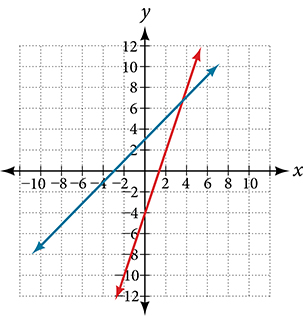
69. Graph both straight lines (left-hand side being y1 and right-hand side being y2) on the same axes. Find the point of intersection and solve the inequality by observing where it is true comparing the \(y\)-values of the lines. See the interval where the inequality is true.
\(x + 3 < 3x - 4\)
Solution (click to reveal)
Where the blue is below the orange line; point of intersection is \(x = 3.5.\)
\(\left( {3.5,\infty} \right)\)
Chapter Practice Test
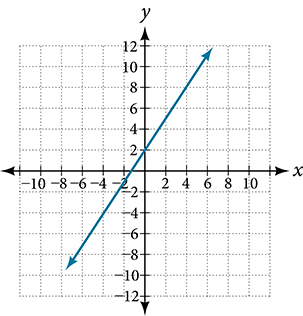
1. Graph the following: \(2y = 3x + 4.\)
Solution (click to reveal)
\(y = \frac{3}{2}x + 2\)
| \(x\) | \(y\) |
|---|---|
| 0 | 2 |
| 2 | 5 |
| 4 | 8 |
2. Find the \(x\)- and \(y\)-intercepts for the following: \(2x - 5y = 6\)
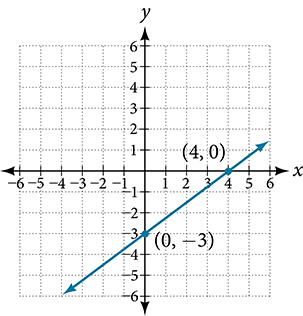
3. Find the \(x\)- and \(y\)-intercepts of this equation, and sketch the graph of the line using just the intercepts plotted.
\(3x - 4y = 12\)
Solution (click to reveal)
\(\left( {0,-3} \right)\) \(\left( {4,0} \right)\)
4. Find the exact distance between \(\left( {5,-3} \right)\) and \(\left( {- 2,8} \right).\) Find the coordinates of the midpoint of the line segment joining the two points.
5. Write the interval notation for the set of numbers represented by \(\left\{ {x\left| {x \leq 9} \right.} \right\}.\)
Solution (click to reveal)
\(\left( {- \infty,9} \right\rbrack\)
6. Solve for \(x\): \(5x + 8 = 3x - 10.\)
7. Solve for \(x\): \(3\left( {2x - 5} \right) - 3\left( {x - 7} \right) = 2x - 9.\)
Solution (click to reveal)
\(x = \operatorname{}-15\)
8. Solve for \(x\): \(\frac{x}{2} + 1 = \frac{4}{x}\)
9. Solve for \(x\): \(\frac{5}{x + 4} = 4 + \frac{3}{x - 2}.\)
Solution (click to reveal)
\(x \neq -4,2;\) \(x = \frac{- 5}{2},1\)
10. The perimeter of a triangle is 30 in. The longest side is 2 less than 3 times the shortest side and the other side is 2 more than twice the shortest side. Find the length of each side.
11. Solve for \(x\). Write the answer in simplest radical form.
\(\frac{x^{2}}{3} - x = - \frac{1}{2}\)
Solution (click to reveal)
\(x = \frac{3 \pm \sqrt{3}}{2}\)
12. Solve: \(3x - 8 \leq 4.\)
13. Solve: \(\left| {2x + 3} \right| < 5.\)
Solution (click to reveal)
\(\left( {-4,1} \right)\)
14. Solve: \(\left| {3x - 2} \right| \geq 4.\)
For the following exercises, find the equation of the line with the given information.
15. Passes through the points \(\left( {- 4,2} \right)\) and \(\left( {5,-3} \right).\)
Solution (click to reveal)
\(y = \frac{-5}{9}x - \frac{2}{9}\)
16. Has an undefined slope and passes through the point \(\left( {4,3} \right).\)
17. Passes through the point \(\left( {2,1} \right)\) and is perpendicular to \(y = - \frac{2}{5}x + 3.\)
Solution (click to reveal)
\(y = \frac{5}{2}x - 4\)
18. Add these complex numbers: \((3 - 2i) + (4 - i).\)
19. Simplify: \(\sqrt{-4} + 3\sqrt{-16}.\)
Solution (click to reveal)
\(14i\)
20. Multiply: \(5i\left( {5 - 3i} \right).\)
21. Divide: \(\frac{4 - i}{2 + 3i}.\)
Solution (click to reveal)
\(\frac{5}{13} - \frac{14}{13}i\)
22. Solve this quadratic equation and write the two complex roots in \(a + bi\) form: \(x^{2} - 4x + 7 = 0.\)
23. Solve: \(\left( {3x - 1} \right)^{2} - 1 = 24.\)
Solution (click to reveal)
\(x = 2,\frac{- 4}{3}\)
24. Solve: \(x^{2} - 6x = 13.\)
25. Solve: \(4x^{2} - 4x - 1 = 0\)
Solution (click to reveal)
\(x = \frac{1}{2} \pm \frac{\sqrt{2}}{2}\)
26. Solve: \(\sqrt{x - 7} = x - 7\)
27. Solve: \(2 + \sqrt{12 - 2x} = x\)
Solution (click to reveal)
\(4\)
28. Solve: \(\left( {x - 1} \right)^{\frac{2}{3}} = 9\)
For the following exercises, find the real solutions of each equation by factoring.
29. \(2x^{3} - x^{2} - 8x + 4 = 0\)
Solution (click to reveal)
\(x = \frac{1}{2},2,-2\)
30. \(\left( {x + 5} \right)^{2} - 3\left( {x + 5} \right) - 4 = 0\)