13.6 Binomial Theorem
A polynomial with two terms is called a binomial. We have already learned to multiply binomials and to raise binomials to powers, but raising a binomial to a high power can be tedious and time-consuming. In this section, we will discuss a shortcut that will allow us to find \({(x + y)}^{n}\) without multiplying the binomial by itself \(n\) times.
13.6.1 Identifying Binomial Coefficients
In Counting Principles, we studied combinations. In the shortcut to finding \((x + y)^{n},\) we will need to use combinations to find the coefficients that will appear in the expansion of the binomial. In this case, we use the notation \(\begin{pmatrix} n \\ r \end{pmatrix}\) instead of \(C(n,r),\) but it can be calculated in the same way. So
\[\begin{pmatrix} n \\ r \end{pmatrix} = C(n,r) = \frac{n!}{r!(n - r)!}\]
The combination \(\begin{pmatrix} n \\ r \end{pmatrix}\) is called a binomial coefficient. An example of a binomial coefficient is \(\begin{pmatrix} 5 \\ 2 \end{pmatrix} = C(5,2) = 10.\)
13.6.2 Using the Binomial Theorem
When we expand \({(x + y)}^{n}\) by multiplying, the result is called a binomial expansion, and it includes binomial coefficients. If we wanted to expand \({(x + y)}^{52},\) we might multiply \((x + y)\) by itself fifty-two times. This could take hours! If we examine some simple binomial expansions, we can find patterns that will lead us to a shortcut for finding more complicated binomial expansions.
\[\begin{array}{l} {{(x + y)}^{2} = x^{2} + 2xy + y^{2}} \\ {{(x + y)}^{3} = x^{3} + 3x^{2}y + 3xy^{2} + y^{3}} \\ {{(x + y)}^{4} = x^{4} + 4x^{3}y + 6x^{2}y^{2} + 4xy^{3} + y^{4}} \end{array}\]
First, let’s examine the exponents. With each successive term, the exponent for \(x\) decreases and the exponent for \(y\) increases. The sum of the two exponents is \(n\) for each term.
Next, let’s examine the coefficients. Notice that the coefficients increase and then decrease in a symmetrical pattern. The coefficients follow a pattern:
\[\begin{pmatrix} n \\ 0 \end{pmatrix},\begin{pmatrix} n \\ 1 \end{pmatrix},\begin{pmatrix} n \\ 2 \end{pmatrix},...,\begin{pmatrix} n \\ n \end{pmatrix}.\]
These patterns lead us to the Binomial Theorem, which can be used to expand any binomial.
\[\begin{array}{ll} {(x + y)}^{n} & {= {\sum\limits_{k = 0}^{n}{\left( \begin{array}{l} n \\ k \end{array} \right)x^{n - k}}}y^{k}} \\ & {= x^{n} + \left( \begin{array}{l} n \\ 1 \end{array} \right)x^{n - 1}y + \left( \begin{array}{l} n \\ 2 \end{array} \right)x^{n - 2}y^{2} + ... + \left( \begin{array}{l} n \\ {n - 1} \end{array} \right)xy^{n - 1} + y^{n}} \end{array}\]
Another way to see the coefficients is to examine the expansion of a binomial in general form, \(x + y,\) to successive powers 1, 2, 3, and 4.
\[\begin{array}{l} {{(x + y)}^{1} = x + y} \\ {{(x + y)}^{2} = x^{2} + 2xy + y^{2}} \\ {{(x + y)}^{3} = x^{3} + 3x^{2}y + 3xy^{2} + y^{3}} \\ {{(x + y)}^{4} = x^{4} + 4x^{3}y + 6x^{2}y^{2} + 4xy^{3} + y^{4}} \end{array}\]
Can you guess the next expansion for the binomial \({(x + y)}^{5}?\)
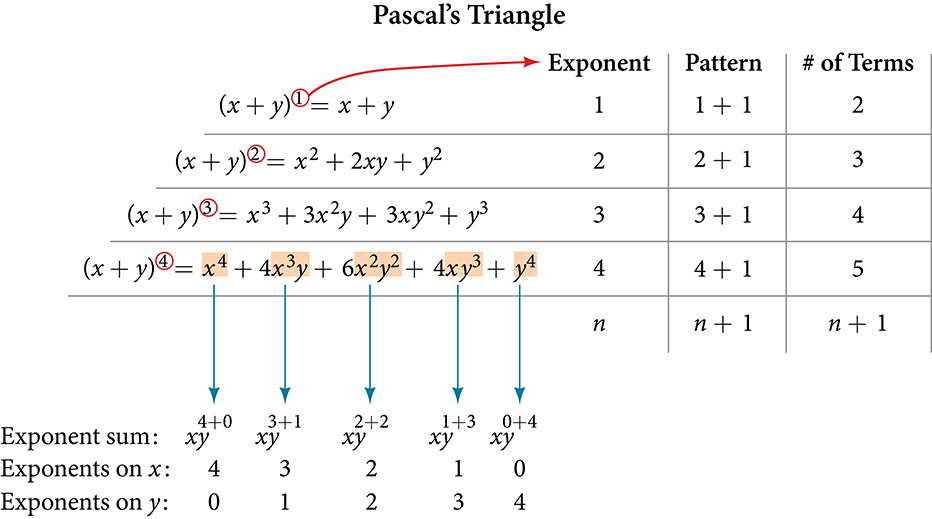
Figure 1
See Figure 1, which illustrates the following:
- There are \(n + 1\) terms in the expansion of \({(x + y)}^{n}.\)
- The degree (or sum of the exponents) for each term is \(n.\)
- The powers on \(x\) begin with \(n\) and decrease to 0.
- The powers on \(y\) begin with 0 and increase to \(n.\)
- The coefficients are symmetric.
To determine the expansion on \({(x + y)}^{5},\) we see \(n = 5,\) thus, there will be 5+1 = 6 terms. Each term has a combined degree of 5. In descending order for powers of \(x,\) the pattern is as follows:
Introduce \(x^{5},\) and then for each successive term reduce the exponent on \(x\) by 1 until \(x^{0} = 1\) is reached.
Introduce \(y^{0} = 1,\) and then increase the exponent on \(y\) by 1 until \(y^{5}\) is reached.
\[x^{5},\mspace{9mu}\mspace{9mu} x^{4}y,\mspace{9mu}\mspace{9mu} x^{3}y^{2},\mspace{9mu}\mspace{9mu} x^{2}y^{3},\mspace{9mu}\mspace{9mu} xy^{4},\mspace{9mu}\mspace{9mu} y^{5}\]
The next expansion would be
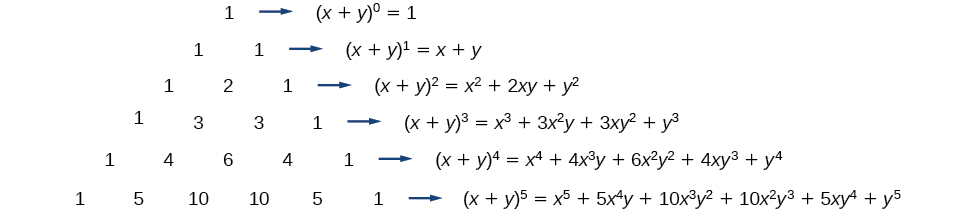
\[{(x + y)}^{5} = x^{5} + 5x^{4}y + 10x^{3}y^{2} + 10x^{2}y^{3} + 5xy^{4} + y^{5}.\]
But where do those coefficients come from? The binomial coefficients are symmetric. We can see these coefficients in an array known as Pascal’s Triangle, shown in Figure 2. Pascal didn’t invent the triangle. The underlying principles had been developed and written about for over 1500 years, first by the Indian mathematician (and poet) Pingala in the second century BCE. Others throughout Asia and Europe worked with the concepts throughout, and the triangle was first published in its graphical form by Omar Khayyam, an Iranian mathematician and astronomer, for whom the triangle is named in Iran. French mathematician Blaise Pascal repopularized it when he republished it and used it to solve a number of probability problems.
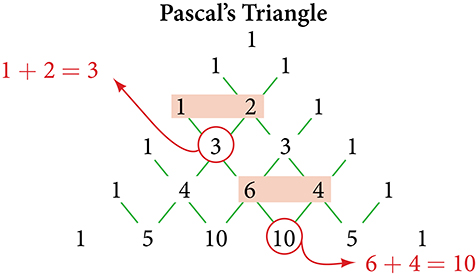
Figure 2
To generate Pascal’s Triangle, we start by writing a 1. In the row below, row 2, we write two 1’s. In the 3rd row, flank the ends of the rows with 1’s, and add \(1 + 1\) to find the middle number, 2. In the \(n\text{th}\) row, flank the ends of the row with 1’s. Each element in the triangle is the sum of the two elements immediately above it.
To see the connection between Pascal’s Triangle and binomial coefficients, let us revisit the expansion of the binomials in general form.
13.6.3 Using the Binomial Theorem to Find a Single Term
Expanding a binomial with a high exponent such as \({(x + 2y)}^{16}\) can be a lengthy process.
Sometimes we are interested only in a certain term of a binomial expansion. We do not need to fully expand a binomial to find a single specific term.
Note the pattern of coefficients in the expansion of \({(x + y)}^{5}.\)
\[{(x + y)}^{5} = x^{5} + \begin{pmatrix} 5 \\ 1 \end{pmatrix}x^{4}y + \begin{pmatrix} 5 \\ 2 \end{pmatrix}x^{3}y^{2} + \begin{pmatrix} 5 \\ 3 \end{pmatrix}x^{2}y^{3} + \begin{pmatrix} 5 \\ 4 \end{pmatrix}xy^{4} + y^{5}\]
The second term is \(\begin{pmatrix} 5 \\ 1 \end{pmatrix}x^{4}y.\) The third term is \(\begin{pmatrix} 5 \\ 2 \end{pmatrix}x^{3}y^{2}.\) We can generalize this result.
\[\begin{pmatrix} n \\ r \end{pmatrix}x^{n - r}y^{r}\]
Section Exercises
Verbal
1. What is a binomial coefficient, and how it is calculated?
Solution (click to reveal)
A binomial coefficient is an alternative way of denoting the combination \(C(n,r\operatorname{).}\) It is defined as \(\begin{pmatrix} n \\ r \end{pmatrix} = \mspace{9mu} C(n,r)\mspace{9mu} = \frac{n!}{r!(n - r)!}.\)
2. What role do binomial coefficients play in a binomial expansion? Are they restricted to any type of number?
3. What is the Binomial Theorem and what is its use?
Solution (click to reveal)
The Binomial Theorem is defined as \({(x + y)}^{n} = {\sum\limits_{k = 0}^{n}{\begin{pmatrix} n \\ k \end{pmatrix}x^{n - k}}}y^{k}\) and can be used to expand any binomial.
4. When is it an advantage to use the Binomial Theorem? Explain.
Algebraic
For the following exercises, evaluate the binomial coefficient.
5. \(\begin{pmatrix} 6 \\ 2 \end{pmatrix}\)
Solution (click to reveal)
15
6. \(\begin{pmatrix} 5 \\ 3 \end{pmatrix}\)
7. \(\begin{pmatrix} 7 \\ 4 \end{pmatrix}\)
Solution (click to reveal)
35
8. \(\begin{pmatrix} 9 \\ 7 \end{pmatrix}\)
9. \(\begin{pmatrix} 10 \\ 9 \end{pmatrix}\)
Solution (click to reveal)
10
10. \(\begin{pmatrix} 25 \\ 11 \end{pmatrix}\)
11. \(\begin{pmatrix} 17 \\ 6 \end{pmatrix}\)
Solution (click to reveal)
12,376
12. \(\begin{pmatrix} 200 \\ 199 \end{pmatrix}\)
For the following exercises, use the Binomial Theorem to expand each binomial.
13. \({(4a - b)}^{3}\)
Solution (click to reveal)
\(64a^{3} - 48a^{2}b + 12ab^{2} - b^{3}\)
14. \({(5a + 2)}^{3}\)
15. \({(3a + 2b)}^{3}\)
Solution (click to reveal)
\(27a^{3} + 54a^{2}b + 36ab^{2} + 8b^{3}\)
16. \({(2x + 3y)}^{4}\)
17. \({(4x + 2y)}^{5}\)
Solution (click to reveal)
\(1024x^{5} + 2560x^{4}y + 2560x^{3}y^{2} + 1280x^{2}y^{3} + 320xy^{4} + 32y^{5}\)
18. \({(3x - 2y)}^{4}\)
19. \({(4x - 3y)}^{5}\)
Solution (click to reveal)
\(1024x^{5} - 3840x^{4}y + 5760x^{3}y^{2} - 4320x^{2}y^{3} + 1620xy^{4} - 243y^{5}\)
20. \(\left( {\frac{1}{x} + 3y} \right)^{5}\)
21. \({(x^{- 1} + 2y^{- 1})}^{4}\)
Solution (click to reveal)
\(\frac{1}{x^{4}} + \frac{8}{x^{3}y} + \frac{24}{x^{2}y^{2}} + \frac{32}{xy^{3}} + \frac{16}{y^{4}}\)
22. \({(\sqrt{x} - \sqrt{y})}^{5}\)
For the following exercises, use the Binomial Theorem to write the first three terms of each binomial.
23. \({(a + b)}^{17}\)
Solution (click to reveal)
\(a^{17} + 17a^{16}b + 136a^{15}b^{2}\)
24. \({(x - 1)}^{18}\)
25. \({(a - 2b)}^{15}\)
Solution (click to reveal)
\(a^{15} - 30a^{14}b + 420a^{13}b^{2}\)
26. \({(x - 2y)}^{8}\)
27. \({(3a + b)}^{20}\)
Solution (click to reveal)
\(3{,}486{,}784{,}401a^{20} + 23{,}245{,}229{,}340a^{19}b + 73{,}609{,}892{,}910a^{18}b^{2}\)
28. \({(2a + 4b)}^{7}\)
29. \({(x^{3} - \sqrt{y})}^{8}\)
Solution (click to reveal)
\(x^{24} - 8x^{21}\sqrt{y} + 28x^{18}y\)
For the following exercises, find the indicated term of each binomial without fully expanding the binomial.
30. The fourth term of \({(2x - 3y)}^{4}\)
31. The fourth term of \({(3x - 2y)}^{5}\)
Solution (click to reveal)
\(- 720x^{2}y^{3}\)
32. The third term of \({(6x - 3y)}^{7}\)
33. The eighth term of \({(7 + 5y)}^{14}\)
Solution (click to reveal)
\(220{,}812{,}466{,}875{,}000y^{7}\)
34. The seventh term of \({(a + b)}^{11}\)
35. The fifth term of \({(x - y)}^{7}\)
Solution (click to reveal)
\(35x^{3}y^{4}\)
36. The tenth term of \({(x - 1)}^{12}\)
37. The ninth term of \({(a - 3b^{2})}^{11}\)
Solution (click to reveal)
\(1{,}082{,}565a^{3}b^{16}\)
38. The fourth term of \(\mspace{9mu}\left( {x^{3} - \frac{1}{2}} \right)^{10}\)
39. The eighth term of \(\mspace{9mu}\left( {\frac{y}{2} + \frac{2}{x}} \right)^{9}\)
Solution (click to reveal)
\(\frac{1152y^{2}}{x^{7}}\)
Graphical
For the following exercises, use the Binomial Theorem to expand the binomial \(f(x) = {(x + 3)}^{4}.\) Then find and graph each indicated sum on one set of axes.
40. Find and graph \(f_{1}(x),\) such that \(f_{1}(x)\) is the first term of the expansion.
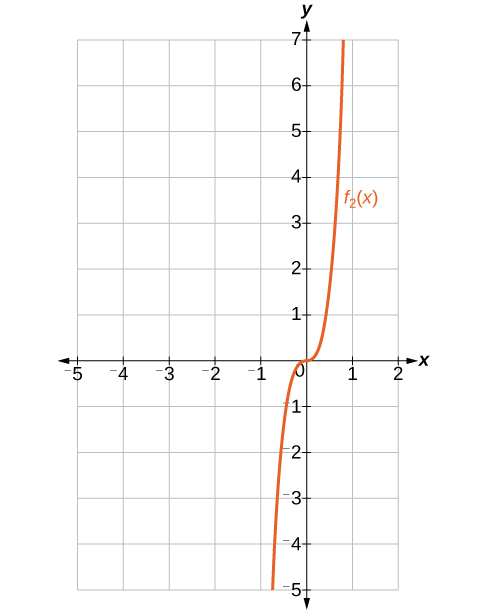
41. Find and graph \(f_{2}(x),\) such that \(f_{2}(x)\) is the sum of the first two terms of the expansion.
Solution (click to reveal)
\(f_{2}(x) = x^{4} + 12x^{3}\)
42. Find and graph \(f_{3}(x),\) such that \(f_{3}(x)\) is the sum of the first three terms of the expansion.
43. Find and graph \(f_{4}(x),\) such that \(f_{4}(x)\) is the sum of the first four terms of the expansion.
Solution (click to reveal)
\(f_{4}(x) = x^{4} + 12x^{3} + 54x^{2} + 108x\)
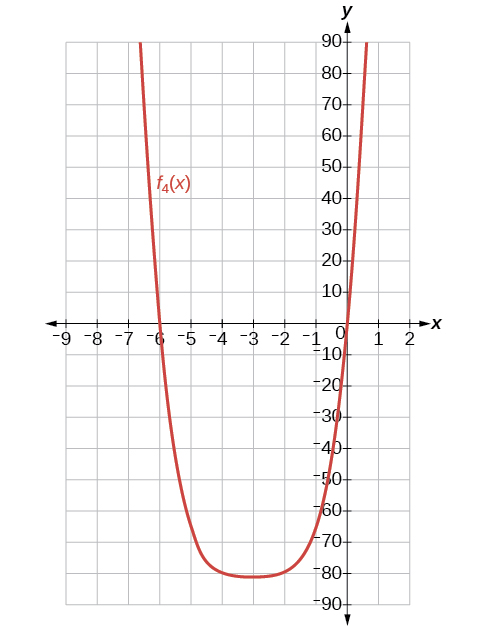
44. Find and graph \(f_{5}(x),\) such that \(f_{5}(x)\) is the sum of the first five terms of the expansion.
Extensions
45. In the expansion of \({(5x + 3y)}^{n},\) each term has the form \(\begin{pmatrix} n \\ k \end{pmatrix}a^{n–k}b^{k}\), where \(k\) successively takes on the value \(0,1,2,\;...,\; n.\) If \(\begin{pmatrix} n \\ k \end{pmatrix} = \begin{pmatrix} 7 \\ 2 \end{pmatrix},\) what is the corresponding term?
Solution (click to reveal)
\(590{,}625x^{5}y^{2}\)
46. In the expansion of \(\left( {a + b} \right)^{n},\) the coefficient of \(a^{n - k}b^{k}\) is the same as the coefficient of which other term?
47. Consider the expansion of \(\mspace{9mu}{(x + b)}^{40}.\) What is the exponent of \(b\) in the \(k\text{th}\) term?
Solution (click to reveal)
\(k - 1\)
48. Find \(\mspace{9mu}\begin{pmatrix} n \\ {k - 1} \end{pmatrix} + \begin{pmatrix} n \\ k \end{pmatrix}\) and write the answer as a binomial coefficient in the form \(\mspace{9mu}\begin{pmatrix} n \\ k \end{pmatrix}.\) Prove it. Hint: Use the fact that, for any integer \(p,\) such that \(p \geq 1,\mspace{9mu} p! = p(p - 1)!\text{.}\)
49. Which expression cannot be expanded using the Binomial Theorem? Explain.
- \((x^{2} - 2x + 1)\)
- \({(\sqrt{a} + 4\sqrt{a} - 5)}^{8}\)
- \({(x^{3} + 2y^{2} - z)}^{5}\)
- \({(3x^{2} - \sqrt{2y^{3}})}^{12}\)
Solution (click to reveal)
The expression \({(x^{3} + 2y^{2} - z)}^{5}\) cannot be expanded using the Binomial Theorem because it cannot be rewritten as a binomial.