2.3 Models and Applications
Figure 1 Credit: Kevin Dooley
Neka is hoping to get an A in his college algebra class. He has scores of 75, 82, 95, 91, and 94 on his first five tests. Only the final exam remains, and the maximum number of points that can be earned is 100. Is it possible for Neka to end the course with an A? A simple linear equation will give Neka his answer.
Many real-world applications can be modeled by linear equations. For example, a cell phone package may include a monthly service fee plus a charge per minute of talk-time; it costs a widget manufacturer a certain amount to produce x widgets per month plus monthly operating charges; a car rental company charges a daily fee plus an amount per mile driven. These are examples of applications we come across every day that are modeled by linear equations. In this section, we will set up and use linear equations to solve such problems.
2.3.1 Setting up a Linear Equation to Solve a Real-World Application
To set up or model a linear equation to fit a real-world application, we must first determine the known quantities and define the unknown quantity as a variable. Then, we begin to interpret the words as mathematical expressions using mathematical symbols. Let us use the car rental example above. In this case, a known cost, such as $0.10/mi, is multiplied by an unknown quantity, the number of miles driven. Therefore, we can write \(0.10x.\) This expression represents a variable cost because it changes according to the number of miles driven.
If a quantity is independent of a variable, we usually just add or subtract it, according to the problem. As these amounts do not change, we call them fixed costs. Consider a car rental agency that charges $0.10/mi plus a daily fee of $50. We can use these quantities to model an equation that can be used to find the daily car rental cost \(C.\)
\[C = 0.10x + 50\]
When dealing with real-world applications, there are certain expressions that we can translate directly into math. Table 1 lists some common verbal expressions and their equivalent mathematical expressions.
| Verbal | Translation to Math Operations |
|---|---|
| One number exceeds another by \(a\) | \(x,\mspace{9mu} x + a\) |
| Twice a number | \(2x\) |
| One number is a more than another number | \(x,\mspace{9mu} x + a\) |
| One number is a less than twice another number | \(x,\mspace{9mu} 2x - a\) |
| The product of a number and \(a\), decreased by \(b\) | \(ax - b\) |
| The quotient of a number and the number plus a is three times the number | \(\frac{x}{x + a} = 3x\) |
| The product of three times a number and the number decreased by b is \(c\) | \(3x\left( {x - b} \right) = c\) |
Table 1
There are two cell phone companies that offer different packages. Company A charges a monthly service fee of $34 plus $.05/min talk-time. Company B charges a monthly service fee of $40 plus $.04/min talk-time.
ⓐ Write a linear equation that models the packages offered by both companies.
ⓑ If the average number of minutes used each month is 1,160, which company offers the better plan?
ⓒ If the average number of minutes used each month is 420, which company offers the better plan?
ⓓ How many minutes of talk-time would yield equal monthly statements from both companies?
Solution (click to reveal)
ⓐ The model for Company A can be written as \(A = 0.05x + 34.\) This includes the variable cost of \(0.05x\) plus the monthly service charge of $34. Company \(B\)’s package charges a higher monthly fee of $40, but a lower variable cost of \(0.04x.\) Company \(B\)’s model can be written as \(B = 0.04x + \text{\$}40.\)
ⓑ If the average number of minutes used each month is 1,160, we have the following:
\[\begin{array}{ccl} {\text{Company~}A} & = & {0.05(1{,}160) + 34} \\ & = & {58 + 34} \\ & = & 92 \\ {\text{Company~}B} & = & {0.04(1{,}160) + 40} \\ & = & {46.4 + 40} \\ & = & 86.4 \end{array}\]
So, Company \(B\) offers the lower monthly cost of $86.40 as compared with the $92 monthly cost offered by Company \(A\) when the average number of minutes used each month is 1,160.
ⓒ If the average number of minutes used each month is 420, we have the following:
\[\begin{array}{ccl} {\text{Company~}A} & = & {0.05(420) + 34} \\ & = & {21 + 34} \\ & = & 55 \\ {\text{Company~}B} & = & {0.04(420) + 40} \\ & = & {16.8 + 40} \\ & = & 56.8 \end{array}\]
If the average number of minutes used each month is 420, then Company A offers a lower monthly cost of $55 compared to Company \(B\)’s monthly cost of $56.80.
ⓓ To answer the question of how many talk-time minutes would yield the same bill from both companies, we should think about the problem in terms of \(\left( {x,y} \right)\) coordinates: At what point are both the \(x\)-value and the \(y\)-value equal? We can find this point by setting the equations equal to each other and solving for \(x\).
\[\begin{array}{rcl} {0.05x + 34} & = & {0.04x + 40} \\ {0.01x} & = & 6 \\ x & = & 600 \end{array}\]
Check the \(x\)-value in each equation.
\[\begin{array}{rcl} {0.05(600) + 34} & = & 64 \\ {0.04(600) + 40} & = & 64 \end{array}\]
Therefore, a monthly average of 600 talk-time minutes renders the plans equal. See Figure 2
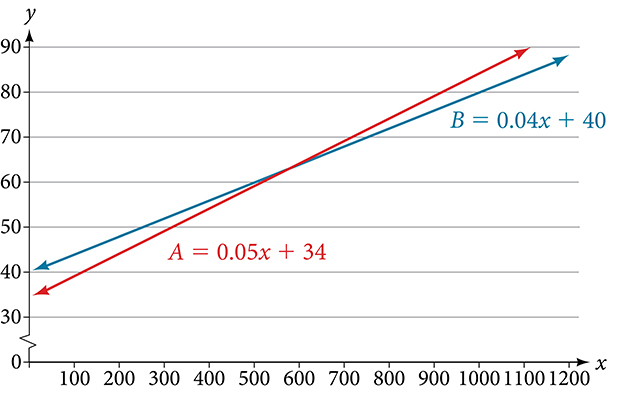
Figure 2
2.3.2 Using a Formula to Solve a Real-World Application
Many applications are solved using known formulas. The problem is stated, a formula is identified, the known quantities are substituted into the formula, the equation is solved for the unknown, and the problem’s question is answered. Typically, these problems involve two equations representing two trips, two investments, two areas, and so on. Examples of formulas include the area of a rectangular region, \(A = LW;\) the perimeter of a rectangle, \(P = 2L + 2W;\) and the volume of a rectangular solid, \(V = LWH.\) When there are two unknowns, we find a way to write one in terms of the other because we can solve for only one variable at a time.
The perimeter of a rectangular outdoor patio is \(54\) ft. The length is \(3\) ft greater than the width. What are the dimensions of the patio?
Solution (click to reveal)
The perimeter formula is standard: \(P = 2L + 2W.\) We have two unknown quantities, length and width. However, we can write the length in terms of the width as \(L = W + 3.\) Substitute the perimeter value and the expression for length into the formula. It is often helpful to make a sketch and label the sides as in Figure 3.
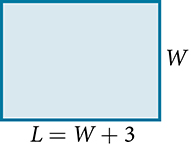
Figure 3
Now we can solve for the width and then calculate the length.
\[\begin{array}{rcl} P & = & {2L + 2W} \\ 54 & = & {2(W + 3) + 2W} \\ 54 & = & {2W + 6 + 2W} \\ 54 & = & {4W + 6} \\ 48 & = & {4W} \\ 12 & = & W \\ {(12 + 3)} & = & L \\ 15 & = & L \end{array}\]
The dimensions are \(L = 15\) ft and \(W = 12\) ft.
Section Exercises
Verbal
1. To set up a model linear equation to fit real-world applications, what should always be the first step?
Solution (click to reveal)
Answers may vary. Possible answers: We should define in words what our variable is representing. We should declare the variable. A heading.
2. Use your own words to describe this equation where \(n\) is a number: \(5(n + 3) = 2n\)
3. If the total amount of money you had to invest was $2,000 and you deposit \(x\) amount in one investment, how can you represent the remaining amount?
Solution (click to reveal)
\(2{,}000 - x\)
4. If a carpenter sawed a 10-ft board into two sections and one section was \(n\) ft long, how long would the other section be in terms of \(n\) ?
5. If Bill was traveling \(v\) mi/h, how would you represent Daemon’s speed if he was traveling 10 mi/h faster?
Solution (click to reveal)
\(v + 10\)
Real-World Applications
For the following exercises, use the information to find a linear algebraic equation model to use to answer the question being asked.
6. Mark and Don are planning to sell each of their marble collections at a garage sale. If Don has 1 more than 3 times the number of marbles Mark has, how many does each boy have to sell if the total number of marbles is 113?
7. Beth and Ann are joking that their combined ages equal Sam’s age. If Beth is twice Ann’s age and Sam is 69 yr old, what are Beth and Ann’s ages?
Solution (click to reveal)
Ann: \(23;\) Beth: \(46\)
8. Ruden originally filled out 8 more applications than Hanh. Then each boy filled out 3 additional applications, bringing the total to 28. How many applications did each boy originally fill out?
For the following exercises, use this scenario: Two different telephone carriers offer the following plans that a person is considering. Company A has a monthly fee of $20 and charges of $.05/min for calls. Company B has a monthly fee of $5 and charges $.10/min for calls.
9. Find the model of the total cost of Company A’s plan, using \(m\) for the minutes.
Solution (click to reveal)
\(20 + 0.05m\)
10. Find the model of the total cost of Company B’s plan, using \(m\) for the minutes.
11. Find out how many minutes of calling would make the two plans equal.
Solution (click to reveal)
300 min
12. If the person makes a monthly average of 200 min of calls, which plan should for the person choose?
For the following exercises, use this scenario: A wireless carrier offers the following plans that a person is considering. The Family Plan: $90 monthly fee, unlimited talk and text on up to 8 lines, and data charges of $40 for each device for up to 2 GB of data per device. The Mobile Share Plan: $120 monthly fee for up to 10 devices, unlimited talk and text for all the lines, and data charges of $35 for each device up to a shared total of 10 GB of data. Use \(P\) for the number of devices that need data plans as part of their cost.
13. Find the model of the total cost of the Family Plan.
Solution (click to reveal)
\(90 + 40P\)
14. Find the model of the total cost of the Mobile Share Plan.
15. Assuming they stay under their data limit, find the number of devices that would make the two plans equal in cost.
Solution (click to reveal)
6 devices
16. If a family has 3 smart phones, which plan should they choose?
For exercises 17 and 18, use this scenario: A retired woman has $50,000 to invest but needs to make $6,000 a year from the interest to meet certain living expenses. One bond investment pays 15% annual interest. The rest of it she wants to put in a CD that pays 7%.
17. If we let \(x\) be the amount the woman invests in the 15% bond, how much will she be able to invest in the CD?
Solution (click to reveal)
\(50{,}000 - x\)
18. Set up and solve the equation for how much the woman should invest in each option to sustain a $6,000 annual return.
19. Two planes fly in opposite directions. One travels 450 mi/h and the other 550 mi/h. How long will it take before they are 4,000 mi apart?
Solution (click to reveal)
4 h
20. Ben starts walking along a path at 4 mi/h. One and a half hours after Ben leaves, his sister Amanda begins jogging along the same path at 6 mi/h. How long will it be before Amanda catches up to Ben?
21. Fiora starts riding her bike at 20 mi/h. After a while, she slows down to 12 mi/h, and maintains that speed for the rest of the trip. The whole trip of 70 mi takes her 4.5 h. For what distance did she travel at 20 mi/h?
Solution (click to reveal)
She traveled for 2 h at 20 mi/h, or 40 miles.
22. A chemistry teacher needs to mix a 30% salt solution with a 70% salt solution to make 20 qt of a 40% salt solution. How many quarts of each solution should the teacher mix to get the desired result?
23. Raúl has $20,000 to invest. His intent is to earn 11% interest on his investment. He can invest part of his money at 8% interest and part at 12% interest. How much does Raúl need to invest in each option to make get a total 11% return on his $20,000?
Solution (click to reveal)
$5,000 at 8% and $15,000 at 12%
For the following exercises, use this scenario: A truck rental agency offers two kinds of plans. Plan A charges $75/wk plus $.10/mi driven. Plan B charges $100/wk plus $.05/mi driven.
24. Write the model equation for the cost of renting a truck with plan A.
25. Write the model equation for the cost of renting a truck with plan B.
Solution (click to reveal)
\(B = 100 + .05x\)
26. Find the number of miles that would generate the same cost for both plans.
27. If Tim knows he has to travel 300 mi, which plan should he choose?
Solution (click to reveal)
Plan A
For the following exercises, use the formula given to solve for the required value.
28. \(A = P(1 + rt)\) is used to find the principal amount \(P\) deposited, earning \(r\)% interest, for \(t\) years. Use this to find what principal amount \(P\) David invested at a 3% rate for 20 yr if \(A = \text{\$}8,000.\)
29. The formula \(F = \frac{mv^{2}}{R}\) relates force \((F)\), velocity \((v)\), mass , and resistance \((m)\). Find \(R\) when \(m = 45,\) \(v = 7,\) and \(F = 245.\)
Solution (click to reveal)
\(R = 9\)
30. \(F = ma\) indicates that force (\(F\)) equals mass (\(m\)) times acceleration (\(a\)). Find the acceleration of a mass of 50 kg if a force of 12 N is exerted on it.
31. \(Sum = \frac{1}{1 - r}\) is the formula for an infinite series sum. If the sum is 5, find \(r.\)
Solution (click to reveal)
\(r = \frac{4}{5}\) or 0.8
For the following exercises, solve for the given variable in the formula. After obtaining a new version of the formula, you will use it to solve a question.
32. Solve for \(W\): \(P = 2L + 2W\)
33. Use the formula from the previous question to find the width, \(W,\) of a rectangle whose length is 15 and whose perimeter is 58.
Solution (click to reveal)
\(W = \frac{P - 2L}{2} = \frac{58 - 2(15)}{2} = 14\)
34. Solve for \(f:\frac{1}{p} + \frac{1}{q} = \frac{1}{f}\)
35. Use the formula from the previous question to find \(f\) when \(p = 8\text{and~}q = 13.\)
Solution (click to reveal)
\(f = \frac{pq}{p + q} = \frac{8(13)}{8 + 13} = \frac{104}{21}\)
36. Solve for \(m\) in the slope-intercept formula: \(y = mx + b\)
37. Use the formula from the previous question to find \(m\) when the coordinates of the point are \(\left( {4,7} \right)\) and \(b = 12.\)
Solution (click to reveal)
\(m = \frac{- 5}{4}\)
38. The area of a trapezoid is given by \(A = \frac{1}{2}h\left( {b_{1} + b_{2}} \right).\) Use the formula to find the area of a trapezoid with \(h = 6,\mspace{9mu} b_{1} = 14,\mspace{9mu}\text{and~}b_{2} = 8.\)
39. Solve for \(h\): \(A = \frac{1}{2}h\left( {b_{1} + b_{2}} \right)\)
Solution (click to reveal)
\(h = \frac{2A}{b_{1} + b_{2}}\)
40. Use the formula from the previous question to find the height of a trapezoid with \(A = 150,b_{1} = 19\), and \(b_{2} = 11.\)
41. Find the dimensions of an American football field. The length is 200 ft more than the width, and the perimeter is 1,040 ft. Find the length and width. Use the perimeter formula \(P = 2L + 2W.\)
Solution (click to reveal)
length = 360 ft; width = 160 ft
42. Distance equals rate times time, \(d = rt.\) Find the distance Tom travels if he is moving at a rate of 55 mi/h for 3.5 h.
43. Using the formula in the previous exercise, find the distance that Susan travels if she is moving at a rate of 60 mi/h for 6.75 h.
Solution (click to reveal)
405 mi
44. What is the total distance that two people travel in 3 h if one of them is riding a bike at 15 mi/h and the other is walking at 3 mi/h?
45. If the area model for a triangle is \(A = \frac{1}{2}bh,\) find the area of a triangle with a height of 16 in. and a base of 11 in.
Solution (click to reveal)
\(A = 88\mspace{9mu}\text{in}.^{2}\)
46. Solve for \(h\): \(A = \frac{1}{2}bh\)
47. Use the formula from the previous question to find the height to the nearest tenth of a triangle with a base of 15 and an area of 215.
Solution (click to reveal)
28.7
48. The volume formula for a cylinder is \(V = \pi r^{2}h.\) Using the symbol \(\pi\) in your answer, find the volume of a cylinder with a radius, \(r,\) of 4 cm and a height of 14 cm.
49. Solve for \(h\): \(V = \pi r^{2}h\)
Solution (click to reveal)
\(h = \frac{V}{\pi r^{2}}\)
50. Use the formula from the previous question to find the height of a cylinder with a radius of 8 and a volume of \(16\pi\)
51. Solve for \(r\): \(V = \pi r^{2}h\)
Solution (click to reveal)
\(r = \sqrt{\frac{V}{\pi h}}\)
52. Use the formula from the previous question to find the radius of a cylinder with a height of 36 and a volume of \(324\pi.\)
53. The formula for the circumference of a circle is \(\mspace{9mu} C = 2\pi r.\) Find the circumference of a circle with a diameter of 12 in. (diameter = \(2r\)). Use the symbol \(\pi\) in your final answer.
Solution (click to reveal)
\(C = 12\pi\)
54. Solve the formula from the previous question for \(\pi.\) Notice why \(\pi\) is sometimes defined as the ratio of the circumference to its diameter.