1.4 Polynomials
Maahi is building a little free library (a small house-shaped book repository), whose front is in the shape of a square topped with a triangle. There will be a rectangular door through which people can take and donate books. Maahi wants to find the area of the front of the library so that they can purchase the correct amount of paint. Using the measurements of the front of the house, shown in Figure 1, we can create an expression that combines several variable terms, allowing us to solve this problem and others like it.
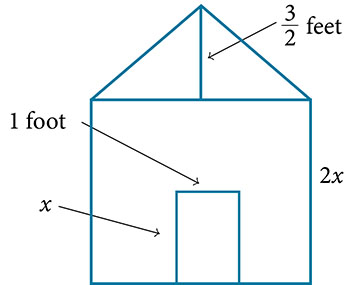
Figure 1
First find the area of the square in square feet.
\[\begin{array}{ccl} A & = & s^{2} \\ & = & {(2x)}^{2} \\ & = & {4x^{2}} \end{array}\]
Then find the area of the triangle in square feet.
\[\begin{array}{ccl} A & = & {\frac{1}{2}bh} \\ & = & {\mspace{9mu}\frac{1}{2}(2x)\left( \frac{3}{2} \right)} \\ & = & {\mspace{9mu}\frac{3}{2}x} \end{array}\]
Next find the area of the rectangular door in square feet.
\[\begin{array}{ccl} A & = & {lw} \\ & = & {x \cdot 1} \\ & = & x \end{array}\]
The area of the front of the library can be found by adding the areas of the square and the triangle, and then subtracting the area of the rectangle. When we do this, we get \(4x^{2} + \frac{3}{2}x - x\mspace{9mu}\text{ft}^{2},\) or \(4x^{2} + \frac{1}{2}x\) ft2.
In this section, we will examine expressions such as this one, which combine several variable terms.
1.4.1 Identifying the Degree and Leading Coefficient of Polynomials
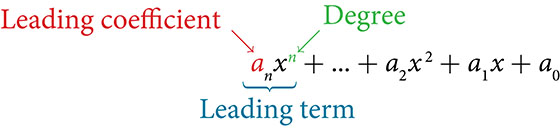
The formula just found is an example of a polynomial, which is a sum of or difference of terms, each consisting of a variable raised to a nonnegative integer power. A number multiplied by a variable raised to an exponent, such as \(384\pi,\) is known as a coefficient. Coefficients can be positive, negative, or zero, and can be whole numbers, decimals, or fractions. Each product \(a_{i}x^{i},\) such as \(384\pi w,\) is a term of a polynomial. If a term does not contain a variable, it is called a constant.
A polynomial containing only one term, such as \(5x^{4},\) is called a monomial. A polynomial containing two terms, such as \(2x - 9,\) is called a binomial. A polynomial containing three terms, such as \(-3x^{2} + 8x - 7,\) is called a trinomial.
We can find the degree of a polynomial by identifying the highest power of the variable that occurs in the polynomial. The term with the highest degree is called the leading term because it is usually written first. The coefficient of the leading term is called the leading coefficient. When a polynomial is written so that the powers are descending, we say that it is in standard form.
1.4.2 Adding and Subtracting Polynomials
We can add and subtract polynomials by combining like terms, which are terms that contain the same variables raised to the same exponents. For example, \(5x^{2}\) and \(-2x^{2}\) are like terms, and can be added to get \(3x^{2},\) but \(3x\) and \(3x^{2}\) are not like terms, and therefore cannot be added.
1.4.3 Multiplying Polynomials
Multiplying polynomials is a bit more challenging than adding and subtracting polynomials. We must use the distributive property to multiply each term in the first polynomial by each term in the second polynomial. We then combine like terms. We can also use a shortcut called the FOIL method when multiplying binomials. Certain special products follow patterns that we can memorize and use instead of multiplying the polynomials by hand each time. We will look at a variety of ways to multiply polynomials.
Multiplying Polynomials Using the Distributive Property
To multiply a number by a polynomial, we use the distributive property. The number must be distributed to each term of the polynomial. We can distribute the \(2\) in \(2(x + 7)\) to obtain the equivalent expression \(2x + 14.\) When multiplying polynomials, the distributive property allows us to multiply each term of the first polynomial by each term of the second. We then add the products together and combine like terms to simplify.
Using FOIL to Multiply Binomials
A shortcut called FOIL is sometimes used to find the product of two binomials. It is called FOIL because we multiply the first terms, the outer terms, the inner terms, and then the last terms of each binomial.
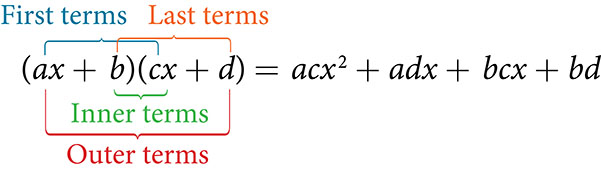
The FOIL method arises out of the distributive property. We are simply multiplying each term of the first binomial by each term of the second binomial, and then combining like terms.
Use FOIL to find the product.
\((2x - 18)(3x + 3)\)
Solution (click to reveal)
Find the product of the first terms.

Find the product of the outer terms.

Find the product of the inner terms.

Find the product of the last terms.

\(\begin{array}{ll} {6x^{2} + 6x - 54x - 54} & {\qquad\text{Add~the~products}.} \\ {6x^{2} + (6x - 54x) - 54} & {\qquad\text{Combine~like~terms}.} \\ {6x^{2} - 48x - 54} & {\qquad\text{Simplify}.} \end{array}\)
Perfect Square Trinomials
Certain binomial products have special forms. When a binomial is squared, the result is called a perfect square trinomial. We can find the square by multiplying the binomial by itself. However, there is a special form that each of these perfect square trinomials takes, and memorizing the form makes squaring binomials much easier and faster. Let’s look at a few perfect square trinomials to familiarize ourselves with the form.
\[\begin{array}{rcl} {\mspace{9mu}{(x + 5)}^{2}} & = & {x^{2} + 10x + 25} \\ {(x - 3)}^{2} & = & {\mspace{9mu} x^{2} - 6x + 9} \\ {(4x - 1)}^{2} & = & {16x^{2} - 8x + 1} \end{array}\]
Notice that the first term of each trinomial is the square of the first term of the binomial and, similarly, the last term of each trinomial is the square of the last term of the binomial. The middle term is double the product of the two terms. Lastly, we see that the first sign of the trinomial is the same as the sign of the binomial.
Difference of Squares
Another special product is called the difference of squares, which occurs when we multiply a binomial by another binomial with the same terms but the opposite sign. Let’s see what happens when we multiply \((x + 1)(x - 1)\) using the FOIL method.
\[\begin{array}{ccl} {(x + 1)(x - 1)} & = & {x^{2} - x + x - 1} \\ & = & {x^{2} - 1} \end{array}\]
The middle term drops out, resulting in a difference of squares. Just as we did with the perfect squares, let’s look at a few examples.
\[\begin{array}{rcl} {(x + 5)(x - 5)} & = & {x^{2} - 25} \\ {(x + 11)(x - 11)} & = & {x^{2} - 121} \\ {(2x + 3)(2x - 3)} & = & {4x^{2} - 9} \end{array}\]
Because the sign changes in the second binomial, the outer and inner terms cancel each other out, and we are left only with the square of the first term minus the square of the last term.
1.4.4 Performing Operations with Polynomials of Several Variables
We have looked at polynomials containing only one variable. However, a polynomial can contain several variables. All of the same rules apply when working with polynomials containing several variables. Consider an example:
\[\begin{array}{ll} {(a + 2b)(4a - b - c)} & \\ {a(4a - b - c) + 2b(4a - b - c)} & {\qquad\text{Use~the~distributive~property}.} \\ {4a^{2} - ab - ac + 8ab - 2b^{2} - 2bc} & {\qquad\text{Multiply}.} \\ {4a^{2} + ( - ab + 8ab) - ac - 2b^{2} - 2bc} & {\qquad\text{Combine~like~terms}.} \\ {4a^{2} + 7ab - ac - 2bc - 2b^{2}} & {\qquad\text{Simplify}.} \end{array}\]
Section Exercises
Verbal
1. Evaluate the following statement: The degree of a polynomial in standard form is the exponent of the leading term. Explain why the statement is true or false.
Solution (click to reveal)
The statement is true. In standard form, the polynomial with the highest value exponent is placed first and is the leading term. The degree of a polynomial is the value of the highest exponent, which in standard form is also the exponent of the leading term.
2. Many times, multiplying two binomials with two variables results in a trinomial. This is not the case when there is a difference of two squares. Explain why the product in this case is also a binomial.
3. You can multiply polynomials with any number of terms and any number of variables using four basic steps over and over until you reach the expanded polynomial. What are the four steps?
Solution (click to reveal)
Use the distributive property, multiply, combine like terms, and simplify.
4. State whether the following statement is true and explain why or why not: A trinomial is always a higher degree than a monomial.
Algebraic
For the following exercises, identify the degree of the polynomial.
5. \(7x - 2x^{2} + 13\)
Solution (click to reveal)
2
6. \(14m^{3} + m^{2} - 16m + 8\)
7. \(-625a^{8} + 16b^{4}\)
Solution (click to reveal)
8
8. \(200p - 30p^{2}m + 40m^{3}\)
9. \(x^{2} + 4x + 4\)
Solution (click to reveal)
2
10. \(6y^{4} - y^{5} + 3y - 4\)
For the following exercises, find the sum or difference.
11. \(\left( {12x^{2} + 3x} \right) - \left( {8x^{2}-19} \right)\)
Solution (click to reveal)
\(4x^{2} + 3x + 19\)
12. \(\left( {4z^{3} + 8z^{2} - z} \right) + \left( {-2z^{2} + z + 6} \right)\)
13. \(\left( {6w^{2} + 24w + 24} \right) - \left( {3w{{}_{}^{2} -}6w + 3} \right)\)
Solution (click to reveal)
\(3w^{2} + 30w + 21\)
14. \(\left( {7a^{3} + 6a^{2} - 4a - 13} \right) + \left( {- 3a^{3} - 4a^{2} + 6a + 17} \right)\)
15. \(\left( {11b^{4} - 6b^{3} + 18b^{2} - 4b + 8} \right) - \left( {3b^{3} + 6b^{2} + 3b} \right)\)
Solution (click to reveal)
\(11b^{4}-9b^{3} + 12b^{2}-7b + 8\)
16. \(\left( {49p^{2} - 25} \right) + \left( {16p^{4} - 32p^{2} + 16} \right)\)
For the following exercises, find the product.
17. \((4x + 2)(6x - 4)\)
Solution (click to reveal)
\(24x^{2}-4x-8\)
18. \(\left( {14c^{2} + 4c} \right)\left( {2c^{2} - 3c} \right)\)
19. \(\left( {6b^{2} - 6} \right)\left( {4b^{2} - 4} \right)\)
Solution (click to reveal)
\(24b^{4}-48b^{2} + 24\)
20. \((3d - 5)(2d + 9)\)
21. \((9v - 11)(11v - 9)\)
Solution (click to reveal)
\(99v^{2}-202v + 99\)
22. \(\left( {4t^{2} + 7t} \right)\left( {-3t^{2} + 4} \right)\)
23. \((8n - 4)\left( {n^{2} + 9} \right)\)
Solution (click to reveal)
\(8n^{3}-4n^{2} + 72n-36\)
For the following exercises, expand the binomial.
24. \(\left( {4x + 5} \right)^{2}\)
25. \({(3y - 7)}^{2}\)
Solution (click to reveal)
\(9y^{2}-42y + 49\)
26. \({(12 - 4x)}^{2}\)
27. \(\left( {4p + 9} \right)^{2}\)
Solution (click to reveal)
\(16p^{2} + 72p + 81\)
28. \({(2m - 3)}^{2}\)
29. \({(3y - 6)}^{2}\)
Solution (click to reveal)
\(9y^{2}-36y + 36\)
30. \(\left( {9b + 1} \right)^{2}\)
For the following exercises, multiply the binomials.
31. \((4c + 1)(4c - 1)\)
Solution (click to reveal)
\(16c^{2}-1\)
32. \((9a - 4)(9a + 4)\)
33. \((15n - 6)(15n + 6)\)
Solution (click to reveal)
\(225n^{2}-36\)
34. \((25b + 2)(25b - 2)\)
35. \((4 + 4m)(4 - 4m)\)
Solution (click to reveal)
\(-16m^{2} + 16\)
36. \((14p + 7)(14p - 7)\)
37. \((11q - 10)(11q + 10)\)
Solution (click to reveal)
\(121q^{2}-100\)
For the following exercises, multiply the polynomials.
38. \(\left( {2x^{2} + 2x + 1} \right)(4x - 1)\)
39. \(\left( {4t^{2} + t - 7} \right)\left( {4t^{2} - 1} \right)\)
Solution (click to reveal)
\(16t^{4} + 4t^{3}-32t^{2} - t + 7\)
40. \((x - 1)\left( {x^{2} - 2x + 1} \right)\)
41. \((y - 2)\left( {y^{2} - 4y - 9} \right)\)
Solution (click to reveal)
\(y^{3}-6y^{2} - y + 18\)
42. \((6k - 5)\left( {6k^{2} + 5k - 1} \right)\)
43. \(\left( {3p^{2} + 2p - 10} \right)(p - 1)\)
Solution (click to reveal)
\(3p^{3} - p^{2}-12p + 10\)
44. \((4m - 13)\left( {2m^{2} - 7m + 9} \right)\)
45. \(\left( {a + b} \right)\left( {a - b} \right)\)
Solution (click to reveal)
\(a^{2} - b^{2}\)
46. \((4x - 6y)(6x - 4y)\)
47. \({(4t - 5u)}^{2}\)
Solution (click to reveal)
\(16t^{2}-40tu + 25u^{2}\)
48. \((9m + 4n - 1)(2m + 8)\)
49. \(\left( {4t - x} \right)\left( {t - x + 1} \right)\)
Solution (click to reveal)
\(4t^{2} + x^{2} + 4t-5tx - x\)
50. \(\left( b^{2} - 1 \right)\left( {a^{2} + 2ab + b^{2}} \right)\)
51. \(\left( {4r - d} \right)\left( {6r + 7d} \right)\)
Solution (click to reveal)
\(24r^{2} + 22rd-7d^{2}\)
52. \(\left( {x + y} \right)\left( {x^{2} - xy + y^{2}} \right)\)
Real-World Applications
53. A developer wants to purchase a plot of land to build a house. The area of the plot can be described by the following expression: \((4x + 1)(8x - 3)\) where \(x\) is measured in meters. Multiply the binomials to find the area of the plot in standard form.
Solution (click to reveal)
\(32x^{2}-4x-3\) m2
54. A prospective buyer wants to know how much grain a specific silo can hold. The area of the floor of the silo is \(\left( {2x + 9} \right)^{2}.\) The height of the silo is \(10x + 10,\) where \(x\) is measured in feet. Expand the square and multiply by the height to find the expression that shows how much grain the silo can hold.
Extensions
For the following exercises, perform the given operations.
55. \({(4t - 7)}^{2}(2t + 1) - \left( {4t^{2} + 2t + 11} \right)\)
Solution (click to reveal)
\(32t^{3} - 100t^{2} + 40t + 38\)
56. \((3b + 6)(3b - 6)\left( 9b^{2} - 36 \right)\)
57. \(\left( a^{2} + 4ac + 4c^{2} \right)\left( a^{2} - 4c^{2} \right)\)
Solution (click to reveal)
\(a^{4} + 4a^{3}c-16ac^{3}-16c^{4}\)