Chapter Review
Key Terms
amplitude — the vertical height of a function; the constant \(A\) appearing in the definition of a sinusoidal function
arccosine — another name for the inverse cosine; \(\arccos\; x = \cos^{- 1}x\)
arcsine — another name for the inverse sine; \(\arcsin\; x = \sin^{- 1}x\)
arctangent — another name for the inverse tangent; \(\arctan\; x = \tan^{- 1}x\)
inverse cosine function — the function \(\cos^{- 1}x,\) which is the inverse of the cosine function and the angle that has a cosine equal to a given number
inverse sine function — the function \(\sin^{- 1}x,\) which is the inverse of the sine function and the angle that has a sine equal to a given number
inverse tangent function — the function \(\tan^{- 1}x,\) which is the inverse of the tangent function and the angle that has a tangent equal to a given number
midline — the horizontal line \(y = D,\) where \(D\) appears in the general form of a sinusoidal function
periodic function — a function \(f(x)\) that satisfies \(f\left( {x + P} \right) = f(x)\) for a specific constant \(P\) and any value of \(x\)
phase shift — the horizontal displacement of the basic sine or cosine function; the constant \(\frac{C}{B}\)
sinusoidal function — any function that can be expressed in the form \(f(x) = A\sin\left( {Bx - C} \right) + D\) or \(f(x) = A\cos\left( {Bx - C} \right) + D\)
Key Equations
| Sinusoidal functions | \(\begin{array}{l} {f(x) = A\sin\left( {Bx - C} \right) + D} \\ {f(x) = A\cos\left( {Bx - C} \right) + D} \end{array}\) |
| Shifted, compressed, and/or stretched tangent function | \(y = A\;\tan\left( {Bx - C} \right) + D\) |
| Shifted, compressed, and/or stretched secant function | \(y = A\;\sec\left( {Bx - C} \right) + D\) |
| Shifted, compressed, and/or stretched cosecant function | \(y = A\;\csc\left( {Bx - C} \right) + D\) |
| Shifted, compressed, and/or stretched cotangent function | \(y = A\;\cot\left( {Bx - C} \right) + D\) |
Key Concepts
8.1 Graphs of the Sine and Cosine Functions
- Periodic functions repeat after a given value. The smallest such value is the period. The basic sine and cosine functions have a period of \(2\pi.\)
- The function \(\sin\; x\) is odd, so its graph is symmetric about the origin. The function \(\cos\; x\) is even, so its graph is symmetric about the \(y\)-axis.
- The graph of a sinusoidal function has the same general shape as a sine or cosine function.
- In the general formula for a sinusoidal function, the period is \(P = \frac{2\pi}{|B|}.\) See Example 1.
- In the general formula for a sinusoidal function, \(|A|\) represents amplitude. If \(|A| > 1,\) the function is stretched, whereas if \(|A| < 1,\) the function is compressed. See Example 2.
- The value \(\frac{C}{B}\) in the general formula for a sinusoidal function indicates the phase shift. See Example 3.
- The value \(D\) in the general formula for a sinusoidal function indicates the vertical shift from the midline. See Example 4.
- Combinations of variations of sinusoidal functions can be detected from an equation. See Example 5.
- The equation for a sinusoidal function can be determined from a graph. See Example 6 and Example 7.
- A function can be graphed by identifying its amplitude and period. See Example 8 and Example 9.
- A function can also be graphed by identifying its amplitude, period, phase shift, and horizontal shift. See Example 10.
- Sinusoidal functions can be used to solve real-world problems. See Example 11, Example 12, and Example 13.
8.2 Graphs of the Other Trigonometric Functions
- The tangent function has period \(\pi.\)
- \(f(x) = A\tan\left( {Bx - C} \right) + D\) is a tangent with vertical and/or horizontal stretch/compression and shift. See Example 1, Example 2, and Example 3.
- The secant and cosecant are both periodic functions with a period of \(2\pi.\) \(f(x) = A\sec\left( {Bx - C} \right) + D\) gives a shifted, compressed, and/or stretched secant function graph. See Example 4 and Example 5.
- \(f(x) = A\csc\left( {Bx - C} \right) + D\) gives a shifted, compressed, and/or stretched cosecant function graph. See Example 6 and Example 7.
- The cotangent function has period \(\pi\) and vertical asymptotes at \(0, \pm \pi, \pm 2\pi,...\)
- The range of cotangent is \(\left( {- \infty,\infty} \right),\) and the function is decreasing at each point in its range.
- The cotangent is zero at \(\pm \frac{\pi}{2}, \pm \frac{3\pi}{2},...\)
- \(f(x) = A\cot\left( {Bx - C} \right) + D\) is a cotangent with vertical and/or horizontal stretch/compression and shift. See Example 8 and Example 9.
- Real-world scenarios can be solved using graphs of trigonometric functions. See Example 10.
8.3 Inverse Trigonometric Functions
- An inverse function is one that “undoes” another function. The domain of an inverse function is the range of the original function and the range of an inverse function is the domain of the original function.
- Because the trigonometric functions are not one-to-one on their natural domains, inverse trigonometric functions are defined for restricted domains.
- For any trigonometric function \(f(x),\) if \(x = f^{- 1}(y),\) then \(f(x) = y.\) However, \(f(x) = y\) only implies \(x = f^{- 1}(y)\) if \(x\) is in the restricted domain of \(f.\) See Example 1.
- Special angles are the outputs of inverse trigonometric functions for special input values; for example, \(\frac{\pi}{4} = \tan^{- 1}(1)\;\text{and}\;\frac{\pi}{6} = \sin^{- 1}\left( \frac{1}{2} \right).\) See Example 2.
- A calculator will return an angle within the restricted domain of the original trigonometric function. See Example 3.
- Inverse functions allow us to find an angle when given two sides of a right triangle. See Example 4.
- In function composition, if the inside function is an inverse trigonometric function, then there are exact expressions; for example, \(\sin\left( {\cos^{- 1}(x)} \right) = \sqrt{1 - x^{2}}.\) See Example 5.
- If the inside function is a trigonometric function, then the only possible combinations are \(\sin^{- 1}\left( {\cos\; x} \right) = \frac{\pi}{2} - x\) if \(0 \leq x \leq \pi\) and \(\cos^{- 1}\left( {\sin\; x} \right) = \frac{\pi}{2} - x\) if \(- \frac{\pi}{2} \leq x \leq \frac{\pi}{2}.\) See Example 6 and Example 7.
- When evaluating the composition of a trigonometric function with an inverse trigonometric function, draw a reference triangle to assist in determining the ratio of sides that represents the output of the trigonometric function. See Example 8.
- When evaluating the composition of a trigonometric function with an inverse trigonometric function, you may use trig identities to assist in determining the ratio of sides. See Example 9.
Chapter Review Exercises
Graphs of the Sine and Cosine Functions
For the following exercises, graph the functions for two periods and determine the amplitude or stretching factor, period, midline equation, and asymptotes.
1. \(f(x) = - 3\cos\; x + 3\)
Solution (click to reveal)
amplitude: 3; period: \(2\pi;\) midline: \(y = 3;\) no asymptotes
![A graph of two periods of a function with a cosine parent function. The graph has a range of [0,6] graphed over -2pi to 2pi. Maximums as -pi and pi.](../images/CNX_Precalc_Figure_06_03_206.jpg)
2. \(f(x) = \frac{1}{4}\sin\; x\)
3. \(f(x) = 3\cos\left( {x + \frac{\pi}{6}} \right)\)
Solution (click to reveal)
amplitude: 3; period: \(2\pi;\) midline: \(y = 0;\) no asymptotes
![A graph of four periods of a function with a cosine parent function. Graphed from -4pi to 4pi. Range is [-3,3].](../images/CNX_Precalc_Figure_06_03_208.jpg)
4. \(f(x) = - 2\sin\left( {x - \frac{2\pi}{3}} \right)\)
5. \(f(x) = 3\sin\left( {x - \frac{\pi}{4}} \right) - 4\)
Solution (click to reveal)
amplitude: 3; period: \(2\pi;\) midline: \(y = - 4;\) no asymptotes
![A graph of two periods of a sinusoidal function. Range is [-7,-1]. Maximums at -5pi/4 and 3pi/4.](../images/CNX_Precalc_Figure_06_03_210.jpg)
6. \(f(x) = 2\left( {\cos\left( {x - \frac{4\pi}{3}} \right) + 1} \right)\)
7. \(f(x) = 6\sin\left( {3x - \frac{\pi}{6}} \right) - 1\)
Solution (click to reveal)
amplitude: 6; period: \(\frac{2\pi}{3};\) midline: \(y = - 1;\) no asymptotes
![A sinusoidal graph over two periods. Range is [-7,5], amplitude is 6, and period is 2pi/3.](../images/CNX_Precalc_Figure_06_03_212.jpg)
8. \(f(x) = - 100\sin\left( {50x - 20} \right)\)
Graphs of the Other Trigonometric Functions
For the following exercises, graph the functions for two periods and determine the amplitude or stretching factor, period, midline equation, and asymptotes.
9. \(f(x) = \tan\; x - 4\)
Solution (click to reveal)
stretching factor: none; period: \(\pi;\) midline: \(y = - 4;\) asymptotes: \(x = \frac{\pi}{2} + \pi k,\) where \(k\) is an integer
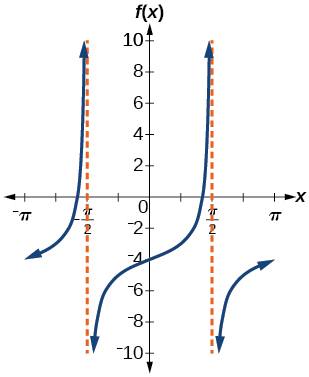
10. \(f(x) = 2\tan\left( {x - \frac{\pi}{6}} \right)\)
11. \(f(x) = - 3\tan\left( {4x} \right) - 2\)
Solution (click to reveal)
stretching factor: 3; period: \(\frac{\pi}{4};\) midline: \(y = - 2;\) asymptotes: \(x = \frac{\pi}{8} + \frac{\pi}{4}k,\) where \(k\) is an integer
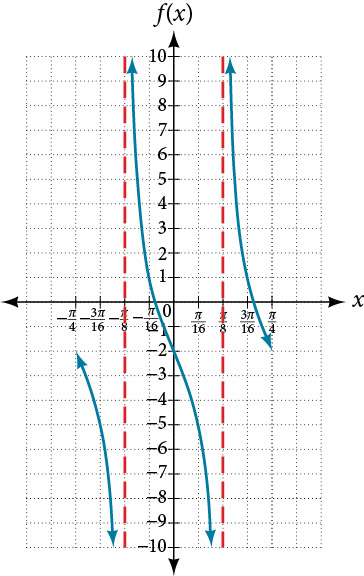
12. \(f(x) = 0.2\cos\left( {0.1x} \right) + 0.3\)
For the following exercises, graph two full periods. Identify the period, the phase shift, the amplitude, and asymptotes.
13. \(f(x) = \frac{1}{3}\sec\; x\)
Solution (click to reveal)
amplitude: none; period: \(2\pi;\) no phase shift; asymptotes: \(x = \frac{\pi}{2}k,\) where \(k\) is an odd integer
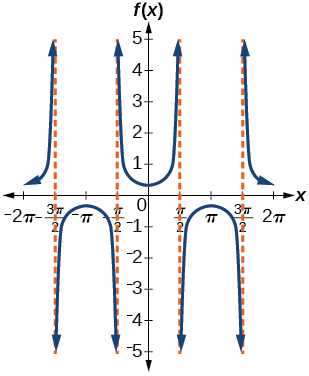
14. \(f(x) = 3\cot\; x\)
15. \(f(x) = 4\csc\left( {5x} \right)\)
Solution (click to reveal)
amplitude: none; period: \(\frac{2\pi}{5};\) no phase shift; asymptotes: \(x = \frac{\pi}{5}k,\) where \(k\) is an integer
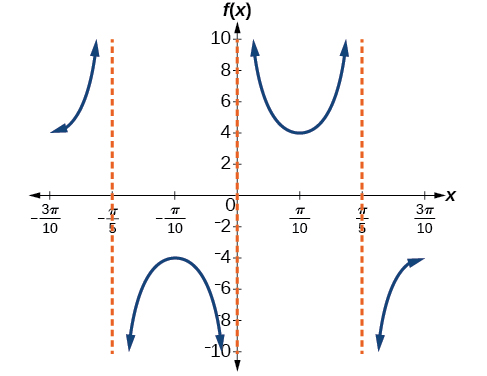
16. \(f(x) = 8\sec\left( {\frac{1}{4}x} \right)\)
17. \(f(x) = \frac{2}{3}\csc\left( {\frac{1}{2}x} \right)\)
Solution (click to reveal)
amplitude: none; period: \(4\pi;\) no phase shift; asymptotes: \(x = 2\pi k,\) where \(k\) is an integer
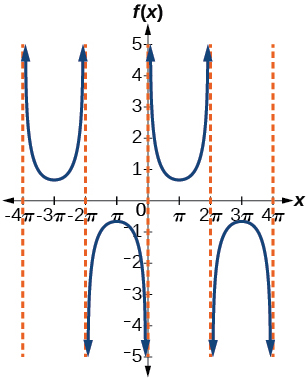
18. \(f(x) = - \csc\left( {2x + \pi} \right)\)
For the following exercises, use this scenario: The population of a city has risen and fallen over a 20-year interval. Its population may be modeled by the following function: \(y = 12{,}000 + 8{,}000\sin\left( {0.628x}\operatorname{),} \right.\) where the domain is the years since 1980 and the range is the population of the city.
19. What is the largest and smallest population the city may have?
Solution (click to reveal)
largest: 20,000; smallest: 4,000
20. Graph the function on the domain of \(\left\lbrack {0,40} \right\rbrack\).
21. What are the amplitude, period, and phase shift for the function?
Solution (click to reveal)
amplitude: 8,000; period: 10; phase shift: 0
22. Over this domain, when does the population reach 18,000? 13,000?
23. What is the predicted population in 2007? 2010?
Solution (click to reveal)
In 2007, the predicted population is 4,413. In 2010, the population will be 11,924.
For the following exercises, suppose a weight is attached to a spring and bobs up and down, exhibiting symmetry.
24. Suppose the graph of the displacement function is shown in Figure 13, where the values on the \(x\)-axis represent the time in seconds and the \(y\)-axis represents the displacement in inches. Give the equation that models the vertical displacement of the weight on the spring.
![A graph of a consine function over one period. Graphed on the domain of [0,10]. Range is [-5,5].](../images/CNX_Precalc_Figure_06_03_225.jpg)
Figure 13
25. At time = 0, what is the displacement of the weight?
Solution (click to reveal)
5 in.
26. At what time does the displacement from the equilibrium point equal zero?
27. What is the time required for the weight to return to its initial height of 5 inches? In other words, what is the period for the displacement function?
Solution (click to reveal)
10 seconds
Inverse Trigonometric Functions
For the following exercises, find the exact value without the aid of a calculator.
28. \(\sin^{- 1}(1)\)
29. \(\cos^{- 1}\left( \frac{\sqrt{3}}{2} \right)\)
Solution (click to reveal)
\(\frac{\pi}{6}\)
30. \(\tan^{-1}(-1)\)
31. \(\cos^{- 1}\left( \frac{1}{\sqrt{2}} \right)\)
Solution (click to reveal)
\(\frac{\pi}{4}\)
32. \(\sin^{- 1}\left( \frac{- \sqrt{3}}{2} \right)\)
33. \(\sin^{- 1}\left( {\cos\left( \frac{\pi}{6} \right)} \right)\)
Solution (click to reveal)
\(\frac{\pi}{3}\)
34. \(\cos^{- 1}\left( {\tan\left( \frac{3\pi}{4} \right)} \right)\)
35. \(\sin\left( {\sec^{- 1}\left( \frac{3}{5} \right)} \right)\)
Solution (click to reveal)
No solution
36. \(\cot\left( {\sin^{- 1}\left( \frac{3}{5} \right)} \right)\)
37. \(\tan\left( {\cos^{- 1}\left( \frac{5}{13} \right)} \right)\)
Solution (click to reveal)
\(\frac{12}{5}\)
38. \(\sin\left( {\cos^{- 1}\left( \frac{x}{x + 1} \right)} \right)\)
39. Graph \(f(x) = \cos\; x\) and \(f(x) = \sec\; x\) on the interval \(\left\lbrack {0,2\pi} \right)\) and explain any observations.
Solution (click to reveal)
The graphs are not symmetrical with respect to the line \(y = x.\) They are symmetrical with respect to the \(y\)-axis.
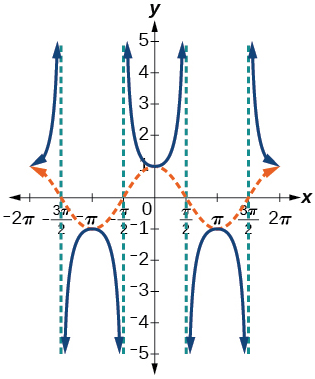
40. Graph \(f(x) = \sin\; x\) and \(f(x) = \csc\; x\) and explain any observations.
41. Graph the function \(f\;(x) = \frac{x}{1} - \frac{x^{3}}{3!} + \frac{x^{5}}{5!} - \frac{x^{7}}{7!}\) on the interval \(\left\lbrack {- 1,1} \right\rbrack\) and compare the graph to the graph of \(f(x) = \sin\; x\) on the same interval. Describe any observations.
Solution (click to reveal)
The graphs appear to be identical.
![Two graphs of two identical functions on the interval [-1 to 1]. Both graphs appear sinusoidal.](../images/CNX_Precalc_Figure_06_03_228.jpg)
Chapter Practice Test
For the following exercises, sketch the graph of each function for two full periods. Determine the amplitude, the period, and the equation for the midline.
1. \(f(x) = 0.5\sin\; x\)
Solution (click to reveal)
amplitude: 0.5; period: \(2\pi;\) midline \(y = 0\)
![A graph of two periods of a sinusoidal function, graphed over -2pi to 2pi. The range is [-0.5,0.5]. X-intercepts at multiples of pi.](../images/CNX_Precalc_Figure_06_03_229.jpg)
2. \(f(x) = 5\cos\; x\)
3. \(f(x) = 5\sin\; x\)
Solution (click to reveal)
amplitude: 5; period: \(2\pi;\) midline: \(y = 0\)
![Two periods of a sine function, graphed over -2pi to 2pi. The range is [-5,5], amplitude of 5, period of 2pi.](../images/CNX_Precalc_Figure_06_03_231.jpg)
4. \(f(x) = \sin\left( {3x} \right)\)
5. \(f(x) = - \cos\left( {x + \frac{\pi}{3}} \right) + 1\)
Solution (click to reveal)
amplitude: 1; period: \(2\pi;\) midline: \(y = 1\)
![A graph of two periods of a cosine function, graphed over -7pi/3 to 5pi/3. Range is [0,2], Period is 2pi, amplitude is1.](../images/CNX_Precalc_Figure_06_03_233.jpg)
6. \(f(x) = 5\sin\left( {3\left( {x - \frac{\pi}{6}} \right)} \right) + 4\)
7. \(f(x) = 3\cos\left( {\frac{1}{3}x - \frac{5\pi}{6}} \right)\)
Solution (click to reveal)
amplitude: 3; period: \(6\pi;\) midline: \(y = 0\)
![A graph of two periods of a cosine function, over -7pi/2 to 17pi/2. The range is [-3,3], period is 6pi, and amplitude is 3.](../images/CNX_Precalc_Figure_06_03_235.jpg)
8. \(f(x) = \tan\left( {4x} \right)\)
9. \(f(x) = - 2\tan\left( {x - \frac{7\pi}{6}} \right) + 2\)
Solution (click to reveal)
amplitude: none; period: \(\pi;\) midline: \(y = 0,\) asymptotes: \(x = \frac{2\pi}{3} + \pi k,\) where \(k\) is an integer
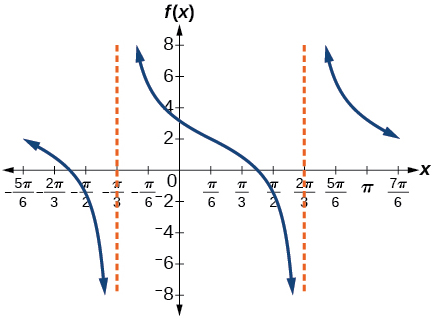
10. \(f(x) = \pi\cos\left( {3x + \pi} \right)\)
11. \(f(x) = 5\csc\left( {3x} \right)\)
Solution (click to reveal)
amplitude: none; period: \(\frac{2\pi}{3};\) midline: \(y = 0,\) asymptotes: \(x = \frac{\pi}{3}k,\) where \(k\) is an integer
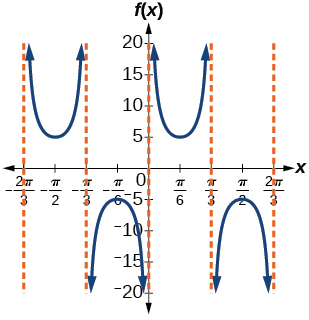
12. \(f(x) = \pi\sec\left( {\frac{\pi}{2}x} \right)\)
13. \(f(x) = 2\csc\left( {x + \frac{\pi}{4}} \right) - 3\)
Solution (click to reveal)
amplitude: none; period: \(2\pi;\) midline: \(y = - 3\)
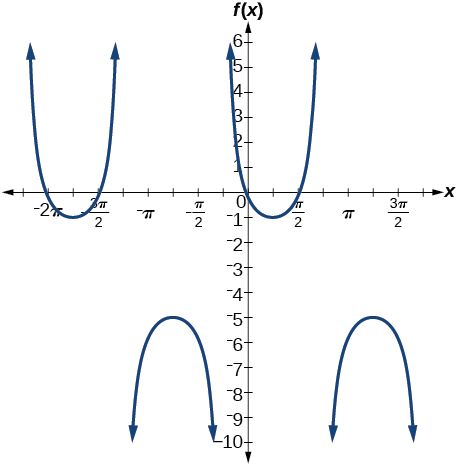
For the following exercises, determine the amplitude, period, and midline of the graph, and then find a formula for the function.
14. Give in terms of a sine function.
![A graph of two periods of a sine function, graphed from -2 to 2. Range is [-6,-2], period is 2, and amplitude is 2.](../images/CNX_Precalc_Figure_06_03_242.jpg)
15. Give in terms of a sine function.
![A graph of two periods of a sine function, graphed over -2 to 2. Range is [-2,2], period is 2, and amplitude is 2.](../images/CNX_Precalc_Figure_06_03_243.jpg)
Solution (click to reveal)
amplitude: 2; period: 2; midline: \(y = 0;\) \(f(x) = 2\sin\left( {\pi\left( {x - 1} \right)} \right)\)
16. Give in terms of a tangent function.
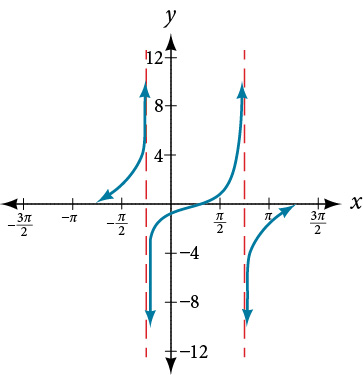
For the following exercises, find the amplitude, period, phase shift, and midline.
17. \(y = \sin\left( {\frac{\pi}{6}x + \pi} \right) - 3\)
Solution (click to reveal)
amplitude: 1; period: 12; phase shift: \(-6;\) midline \(y = -3\)
18. \(y = 8\sin\left( {\frac{7\pi}{6}x + \frac{7\pi}{2}} \right) + 6\)
19. The outside temperature over the course of a day can be modeled as a sinusoidal function. Suppose you know the temperature is 68°F at midnight and the high and low temperatures during the day are 80°F and 56°F, respectively. Assuming \(t\) is the number of hours since midnight, find a function for the temperature, \(D,\) in terms of \(t.\)
Solution (click to reveal)
\(D(t) = 68 - 12\sin\left( {\frac{\pi}{12}x} \right)\)
20. Water is pumped into a storage bin and empties according to a periodic rate. The depth of the water is 3 feet at its lowest at 2:00 a.m. and 71 feet at its highest, which occurs every 5 hours. Write a cosine function that models the depth of the water as a function of time, and then graph the function for one period.
For the following exercises, find the period and horizontal shift of each function.
21. \(g(x) = 3\tan\left( {6x + 42} \right)\)
Solution (click to reveal)
period: \(\frac{\pi}{6};\) horizontal shift: \(-7\)
22. \(n(x) = 4\csc\left( {\frac{5\pi}{3}x - \frac{20\pi}{3}} \right)\)
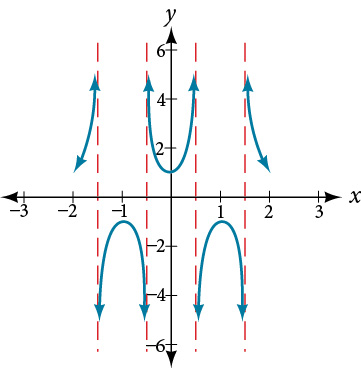
23. Write the equation for the graph in in terms of the secant function and give the period and phase shift.
Solution (click to reveal)
\(f(x) = \sec\left( {\pi x} \right);\) period: 2; phase shift: 0
24. If \(\tan\; x = 3,\) find \(\tan\left( {- x} \right).\)
25. If \(\sec\; x = 4,\) find \(\sec\left( {- x} \right).\)
Solution (click to reveal)
\(4\)
For the following exercises, graph the functions on the specified window and answer the questions.
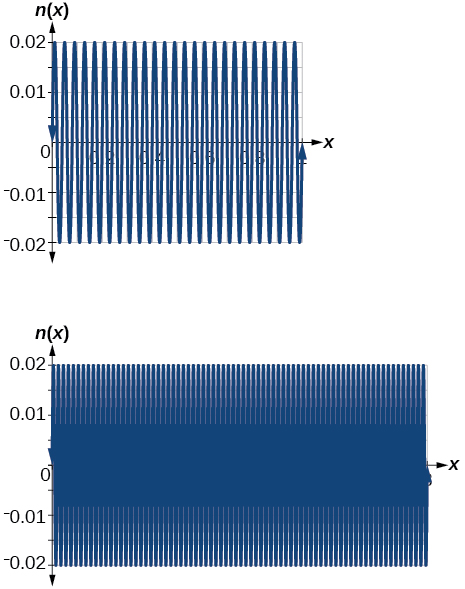
26. Graph \(m(x) = \sin\left( {2x} \right) + \cos\left( {3x} \right)\) on the viewing window \(\left\lbrack {- 10,10} \right\rbrack\) by \(\left\lbrack {- 3,3} \right\rbrack.\) Approximate the graph’s period.
27. Graph \(n(x) = 0.02\sin\left( {50\pi x} \right)\) on the following domains in \(x:\) \(\left\lbrack {0,1} \right\rbrack\) and \(\left\lbrack {0,3} \right\rbrack.\) Suppose this function models sound waves. Why would these views look so different?
Solution (click to reveal)
The views are different because the period of the wave is \(\frac{1}{25}.\) Over a bigger domain, there will be more cycles of the graph.
28. Graph \(f(x) = \frac{\sin\; x}{x}\) on \(\left\lbrack {- 0.5,0.5} \right\rbrack\) and explain any observations.
For the following exercises, let \(f(x) = \frac{3}{5}\cos\left( {6x} \right).\)
29. What is the largest possible value for \(f(x)?\)
Solution (click to reveal)
\(\frac{3}{5}\)
30. What is the smallest possible value for \(f(x)?\)
31. Where is the function increasing on the interval \(\left\lbrack {0,2\pi} \right\rbrack?\)
Solution (click to reveal)
On the approximate intervals \(\left( {0.5,1} \right),\left( {1.6,2.1} \right),\left( {2.6,3.1} \right),\left( {3.7,4.2} \right),\left( {4.7,5.2} \right),(5.6,6.28)\)
For the following exercises, find and graph one period of the periodic function with the given amplitude, period, and phase shift.
32. Sine curve with amplitude 3, period \(\frac{\pi}{3},\) and phase shift \(\left( {h,k} \right) = \left( {\frac{\pi}{4},2} \right)\)
33. Cosine curve with amplitude 2, period \(\frac{\pi}{6},\) and phase shift \(\left( {h,k} \right) = \left( {- \frac{\pi}{4},3} \right)\)
Solution (click to reveal)
\(f(x) = 2\cos\left( {12\left( {x + \frac{\pi}{4}} \right)} \right) + 3\)
![A graph of one period of a cosine function, graphed over -pi/4 to 0. Range is [1,5], period is pi/6.](../images/CNX_Precalc_Figure_06_03_251.jpg)
For the following exercises, graph the function. Describe the graph and, wherever applicable, any periodic behavior, amplitude, asymptotes, or undefined points.
34. \(f(x) = 5\cos\left( {3x} \right) + 4\sin\left( {2x} \right)\)
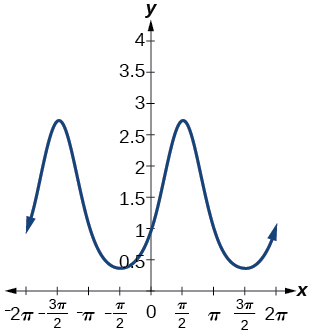
35. \(f(x) = e^{\sin t}\)
Solution (click to reveal)
This graph is periodic with a period of \(2\pi.\)
For the following exercises, find the exact value.
36. \(\sin^{- 1}\left( \frac{\sqrt{3}}{2} \right)\)
37. \(\tan^{- 1}\left( \sqrt{3} \right)\)
Solution (click to reveal)
\(\frac{\pi}{3}\)
38. \(\cos^{- 1}\left( {- \frac{\sqrt{3}}{2}} \right)\)
39. \(\cos^{- 1}\left( {\sin(\pi)} \right)\)
Solution (click to reveal)
\(\frac{\pi}{2}\)
40. \(\cos^{- 1}\left( {\tan\left( \frac{7\pi}{4} \right)} \right)\)
41. \(\cos\left( {\sin^{- 1}\left( {1 - 2x} \right)} \right)\)
Solution (click to reveal)
\(\sqrt{1 - \left( {1 - 2x} \right)^{2}}\)
42. \(\cos^{- 1}\left( {- 0.4} \right)\)
43. \(\cos\left( {\tan^{- 1}\left( x^{2} \right)} \right)\)
Solution (click to reveal)
\(\frac{1}{\sqrt{1 + x^{4}}}\)
For the following exercises, suppose \(\sin\; t = \frac{x}{x + 1}.\) Evaluate the following expressions.
44. \(\tan\; t\)
45. \(\csc\; t\)
Solution (click to reveal)
\(\frac{x + 1}{x}\)
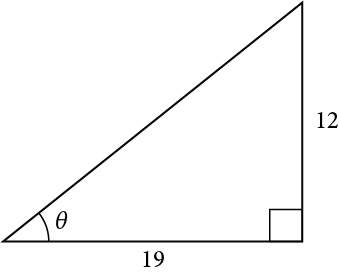
46. Given , find the measure of angle \(\theta\) to three decimal places. Answer in radians.
For the following exercises, determine whether the equation is true or false.
47. \(\arcsin\left( {\sin\left( \frac{5\pi}{6} \right)} \right) = \frac{5\pi}{6}\)
Solution (click to reveal)
False
48. \(\arccos\left( {\cos\left( \frac{5\pi}{6} \right)} \right) = \frac{5\pi}{6}\)
49. The grade of a road is 7%. This means that for every horizontal distance of 100 feet on the road, the vertical rise is 7 feet. Find the angle the road makes with the horizontal in radians.
Solution (click to reveal)
approximately 0.07 radians