12.5 Conic Sections in Polar Coordinates
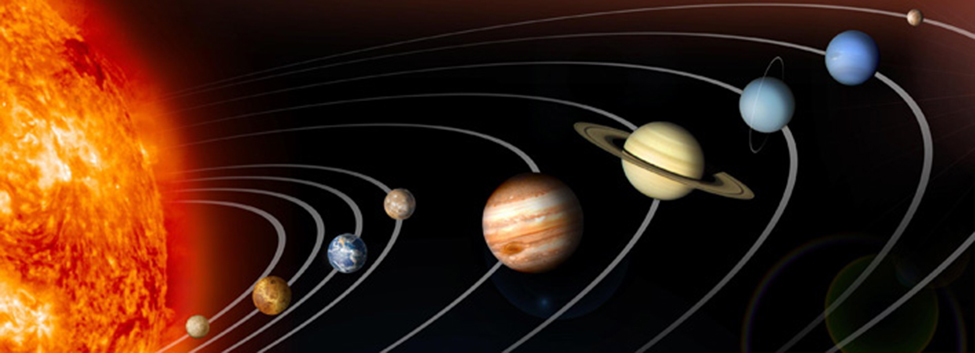
Figure 1 Planets orbiting the sun follow elliptical paths. (credit: NASA Blueshift, Flickr)
Most of us are familiar with orbital motion, such as the motion of a planet around the sun or an electron around an atomic nucleus. Within the planetary system, orbits of planets, asteroids, and comets around a larger celestial body are often elliptical. Comets, however, may take on a parabolic or hyperbolic orbit instead. And, in reality, the characteristics of the planets’ orbits may vary over time. Each orbit is tied to the location of the celestial body being orbited and the distance and direction of the planet or other object from that body. As a result, we tend to use polar coordinates to represent these orbits.
In an elliptical orbit, the periapsis is the point at which the two objects are closest, and the apoapsis is the point at which they are farthest apart. Generally, the velocity of the orbiting body tends to increase as it approaches the periapsis and decrease as it approaches the apoapsis. Some objects reach an escape velocity, which results in an infinite orbit. These bodies exhibit either a parabolic or a hyperbolic orbit about a body; the orbiting body breaks free of the celestial body’s gravitational pull and fires off into space. Each of these orbits can be modeled by a conic section in the polar coordinate system.
12.5.1 Identifying a Conic in Polar Form
Any conic may be determined by three characteristics: a single focus, a fixed line called the directrix, and the ratio of the distances of each to a point on the graph. Consider the parabola \(x = 2 + y^{2}\) shown in Figure 2.
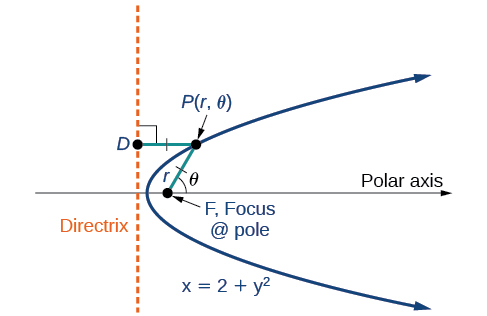
Figure 2
In The Parabola, we learned how a parabola is defined by the focus (a fixed point) and the directrix (a fixed line). In this section, we will learn how to define any conic in the polar coordinate system in terms of a fixed point, the focus \(P(r,\theta)\) at the pole, and a line, the directrix, which is perpendicular to the polar axis.
If \(F\) is a fixed point, the focus, and \(D\) is a fixed line, the directrix, then we can let \(e\) be a fixed positive number, called the eccentricity, which we can define as the ratio of the distances from a point on the graph to the focus and the point on the graph to the directrix. Then the set of all points \(P\) such that \(e = \frac{PF}{PD}\) is a conic. In other words, we can define a conic as the set of all points \(P\) with the property that the ratio of the distance from \(P\) to \(F\) to the distance from \(P\) to \(D\) is equal to the constant \(e.\)
For a conic with eccentricity \(e,\)
- if \(0 \leq e < 1,\) the conic is an ellipse
- if \(e = 1,\) the conic is a parabola
- if \(e > 1,\) the conic is an hyperbola
With this definition, we may now define a conic in terms of the directrix, \(x = \pm p,\) the eccentricity \(e,\) and the angle \(\theta.\) Thus, each conic may be written as a polar equation, an equation written in terms of \(r\) and \(\theta.\)
12.5.2 Graphing the Polar Equations of Conics
When graphing in Cartesian coordinates, each conic section has a unique equation. This is not the case when graphing in polar coordinates. We must use the eccentricity of a conic section to determine which type of curve to graph, and then determine its specific characteristics. The first step is to rewrite the conic in standard form as we have done in the previous example. In other words, we need to rewrite the equation so that the denominator begins with 1. This enables us to determine \(e\) and, therefore, the shape of the curve. The next step is to substitute values for \(\theta\) and solve for \(r\) to plot a few key points. Setting \(\theta\) equal to \(0,\frac{\pi}{2},\pi,\) and \(\frac{3\pi}{2}\) provides the vertices so we can create a rough sketch of the graph.
Graph \(r = \frac{5}{3 + 3\mspace{9mu}\cos\mspace{7mu}\theta}.\)
Solution (click to reveal)
First, we rewrite the conic in standard form by multiplying the numerator and denominator by the reciprocal of 3, which is \(\frac{1}{3}.\)
\[\begin{array}{l} \begin{array}{l} \\ \\ {r = \frac{5}{3 + 3\mspace{9mu}\cos\mspace{7mu}\theta} = \frac{5\left( \frac{1}{3} \right)}{3\left( \frac{1}{3} \right) + 3\left( \frac{1}{3} \right)\cos\mspace{7mu}\theta}} \end{array} \\ {r = \frac{\frac{5}{3}}{1 + \cos\mspace{7mu}\theta}} \end{array}\]
Because \(e = 1,\) we will graph a parabola with a focus at the origin. The function has a \(~\cos\mspace{7mu}\theta,\) and there is an addition sign in the denominator, so the directrix is \(x = p.\)
\[\begin{array}{l} {\frac{5}{3} = ep} \\ {\frac{5}{3} = (1)p} \\ {\frac{5}{3} = p} \end{array}\]
The directrix is \(x = \frac{5}{3}.\)
Plotting a few key points as in Table 1 will enable us to see the vertices. See Figure 3.
| A | B | C | D | |
|---|---|---|---|---|
| \(\theta\) | \(0\) | \(\frac{\pi}{2}\) | \(\pi\) | \(\frac{3\pi}{2}\) |
| \(r = \frac{5}{3 + 3\mspace{9mu}\cos\mspace{7mu}\theta}\) | \(\frac{5}{6} \approx 0.83\) | \(\frac{5}{3} \approx 1.67\) | undefined | \(\frac{5}{3} \approx 1.67\) |
Table 1
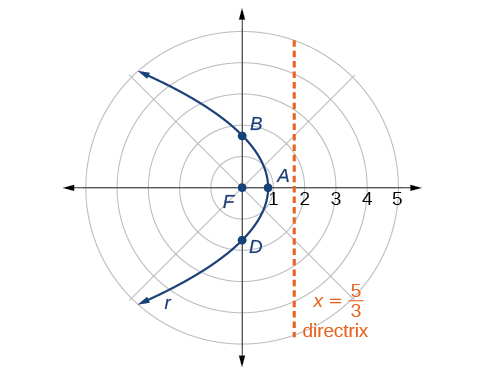
Figure 3
We can check our result with a graphing utility. See Figure 4.
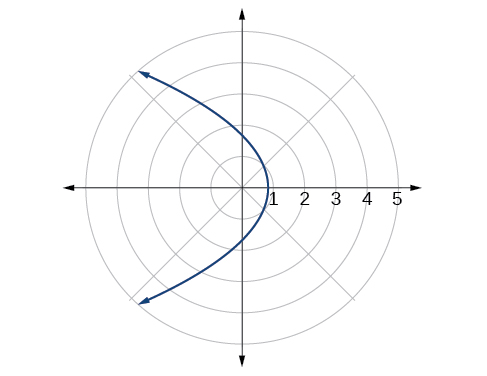
Figure 4
Graph \(r = \frac{8}{2 - 3\mspace{9mu}\sin\mspace{7mu}\theta}.\)
Solution (click to reveal)
First, we rewrite the conic in standard form by multiplying the numerator and denominator by the reciprocal of 2, which is \(\frac{1}{2}.\)
\[\begin{array}{l} \begin{array}{l} \\ \\ {r = \frac{8}{2 - 3\sin\mspace{7mu}\theta} = \frac{8\left( \frac{1}{2} \right)}{2\left( \frac{1}{2} \right) - 3\left( \frac{1}{2} \right)\sin\mspace{7mu}\theta}} \end{array} \\ {r = \frac{4}{1 - \frac{3}{2}\mspace{9mu}\sin\mspace{7mu}\theta}} \end{array}\]
Because \(e = \frac{3}{2},e > 1,\) so we will graph a hyperbola with a focus at the origin. The function has a \(\sin\mspace{7mu}\theta\) term and there is a subtraction sign in the denominator, so the directrix is \(y = -p.\)
\[\begin{array}{l} {4 = ep} \\ {4 = \left( \frac{3}{2} \right)p} \\ {4\left( \frac{2}{3} \right) = p} \\ {\frac{8}{3} = p} \end{array}\]
The directrix is \(y = - \frac{8}{3}.\)
Plotting a few key points as in Table 2 will enable us to see the vertices. See Figure 5.
| A | B | C | D | |
|---|---|---|---|---|
| \(\theta\) | \(0\) | \(\frac{\pi}{2}\) | \(\pi\) | \(\frac{3\pi}{2}\) |
| \(r = \frac{8}{2 - 3\sin\mspace{7mu}\theta}\) | \(4\) | \(- 8\) | \(4\) | \(\frac{8}{5} = 1.6\) |
Table 2
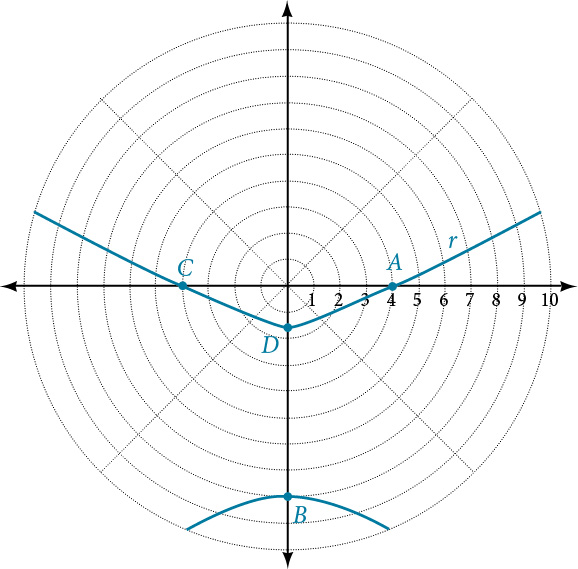
Figure 5
Graph \(r = \frac{10}{5 - 4\mspace{9mu}\cos\mspace{7mu}\theta}.\)
Solution (click to reveal)
First, we rewrite the conic in standard form by multiplying the numerator and denominator by the reciprocal of 5, which is \(\frac{1}{5}.\)
\[\begin{array}{l} \\ \begin{array}{l} {r = \frac{10}{5 - 4\cos\mspace{7mu}\theta} = \frac{10\left( \frac{1}{5} \right)}{5\left( \frac{1}{5} \right) - 4\left( \frac{1}{5} \right)\cos\mspace{7mu}\theta}} \\ {r = \frac{2}{1 - \frac{4}{5}\mspace{9mu}\cos\mspace{7mu}\theta}} \end{array} \end{array}\]
Because \(e = \frac{4}{5},e < 1,\) so we will graph an ellipse with a focus at the origin. The function has a \(\text{cos}\mspace{9mu}\theta,\) and there is a subtraction sign in the denominator, so the directrix is \(x = -p.\)
\[\begin{array}{l} {2 = ep} \\ {2 = \left( \frac{4}{5} \right)p} \\ {2\left( \frac{5}{4} \right) = p} \\ {\frac{5}{2} = p} \end{array}\]
The directrix is \(x = - \frac{5}{2}.\)
Plotting a few key points as in Table 3 will enable us to see the vertices. See Figure 6.
| A | B | C | D | |
|---|---|---|---|---|
| \(\theta\) | \(0\) | \(\frac{\pi}{2}\) | \(\pi\) | \(\frac{3\pi}{2}\) |
| \(r = \frac{10}{5 - 4\mspace{9mu}\cos\mspace{7mu}\theta}\) | \(10\) | \(2\) | \(\frac{10}{9} \approx 1.1\) | \(2\) |
Table 3
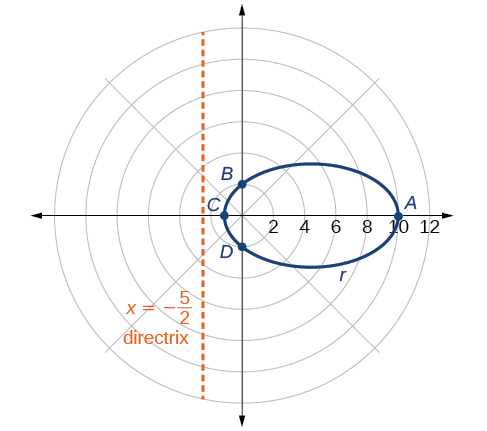
Figure 6
We can check our result using a graphing utility. See Figure 7.
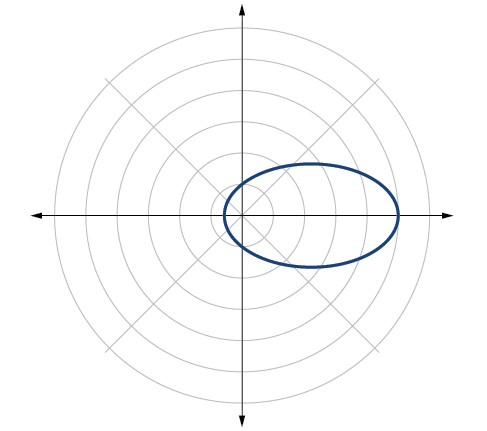
Figure 7 \(r = \frac{10}{5 - 4\mspace{9mu}\cos\mspace{7mu}\theta}\) graphed on a viewing window of \(\left\lbrack {–3,12,1} \right\rbrack\) by \(\lbrack –4,4,1\rbrack,\theta\mspace{9mu}\text{min~=}\mspace{9mu} 0\) and \(\theta\mspace{9mu}\text{max~=}\mspace{9mu} 2\pi.\)
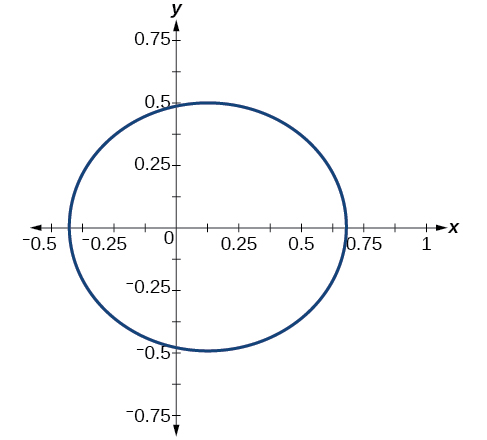
Graph \(r = \frac{2}{4 - \cos\mspace{7mu}\theta}.\)
Solution (click to reveal)
12.5.3 Defining Conics in Terms of a Focus and a Directrix
So far we have been using polar equations of conics to describe and graph the curve. Now we will work in reverse; we will use information about the origin, eccentricity, and directrix to determine the polar equation.
Section Exercises
Verbal
1. Explain how eccentricity determines which conic section is given.
Solution (click to reveal)
If eccentricity is less than 1, it is an ellipse. If eccentricity is equal to 1, it is a parabola. If eccentricity is greater than 1, it is a hyperbola.
2. If a conic section is written as a polar equation, what must be true of the denominator?
3. If a conic section is written as a polar equation, and the denominator involves \(\sin\mspace{7mu}\theta,\) what conclusion can be drawn about the directrix?
Solution (click to reveal)
The directrix will be parallel to the polar axis.
4. If the directrix of a conic section is perpendicular to the polar axis, what do we know about the equation of the graph?
5. What do we know about the focus/foci of a conic section if it is written as a polar equation?
Solution (click to reveal)
One of the foci will be located at the origin.
Algebraic
For the following exercises, identify the conic with a focus at the origin, and then give the directrix and eccentricity.
6. \(r = \frac{6}{1 - 2\mspace{9mu}\cos\mspace{7mu}\theta}\)
7. \(r = \frac{3}{4 - 4\mspace{9mu}\sin\mspace{7mu}\theta}\)
Solution (click to reveal)
Parabola with \(e = 1\) and directrix \(\frac{3}{4}\) units below the pole.
8. \(r = \frac{8}{4 - 3\mspace{9mu}\cos\mspace{7mu}\theta}\)
9. \(r = \frac{5}{1 + 2\mspace{9mu}\sin\mspace{7mu}\theta}\)
Solution (click to reveal)
Hyperbola with \(e = 2\) and directrix \(\frac{5}{2}\) units above the pole.
10. \(r = \frac{16}{4 + 3\mspace{9mu}\cos\mspace{7mu}\theta}\)
11. \(r = \frac{3}{10 + 10\mspace{9mu}\cos\mspace{7mu}\theta}\)
Solution (click to reveal)
Parabola with \(e = 1\) and directrix \(\frac{3}{10}\) units to the right of the pole.
12. \(r = \frac{2}{1 - \cos\mspace{7mu}\theta}\)
13. \(r = \frac{4}{7 + 2\mspace{9mu}\cos\mspace{7mu}\theta}\)
Solution (click to reveal)
Ellipse with \(e = \frac{2}{7}\) and directrix \(2\) units to the right of the pole.
14. \(r(1 - \cos\mspace{7mu}\theta) = 3\)
15. \(r(3 + 5\sin\mspace{7mu}\theta) = 11\)
Solution (click to reveal)
Hyperbola with \(e = \frac{5}{3}\) and directrix \(\frac{11}{5}\) units above the pole.
16. \(r(4 - 5\sin\mspace{7mu}\theta) = 1\)
17. \(r(7 + 8\cos\mspace{7mu}\theta) = 7\)
Solution (click to reveal)
Hyperbola with \(e = \frac{8}{7}\) and directrix \(\frac{7}{8}\) units to the right of the pole.
For the following exercises, convert the polar equation of a conic section to a rectangular equation.
18. \(r = \frac{4}{1 + 3\mspace{9mu}\sin\mspace{7mu}\theta}\)
19. \(r = \frac{2}{5 - 3\mspace{9mu}\sin\mspace{7mu}\theta}\)
Solution (click to reveal)
\(25x^{2} + 16y^{2} - 12y - 4 = 0\)
20. \(r = \frac{8}{3 - 2\mspace{9mu}\cos\mspace{7mu}\theta}\)
21. \(r = \frac{3}{2 + 5\mspace{9mu}\cos\mspace{7mu}\theta}\)
Solution (click to reveal)
\(21x^{2} - 4y^{2} - 30x + 9 = 0\)
22. \(r = \frac{4}{2 + 2\mspace{9mu}\sin\mspace{7mu}\theta}\)
23. \(r = \frac{3}{8 - 8\mspace{9mu}\cos\mspace{7mu}\theta}\)
Solution (click to reveal)
\(64y^{2} = 48x + 9\)
24. \(r = \frac{2}{6 + 7\mspace{9mu}\cos\mspace{7mu}\theta}\)
25. \(r = \frac{5}{5 - 11\mspace{9mu}\sin\mspace{7mu}\theta}\)
Solution (click to reveal)
\(96y^{2} - 25x^{2} + 110y + 25 = 0\)
26. \(r(5 + 2\mspace{9mu}\cos\mspace{7mu}\theta) = 6\)
27. \(r(2 - \cos\mspace{7mu}\theta) = 1\)
Solution (click to reveal)
\(3x^{2} + 4y^{2} - 2x - 1 = 0\)
28. \(r(2.5 - 2.5\mspace{9mu}\sin\mspace{7mu}\theta) = 5\)
29. \(r = \frac{6\sec\mspace{9mu}\theta}{- 2 + 3\mspace{9mu}\sec\mspace{9mu}\theta}\)
Solution (click to reveal)
\(5x^{2} + 9y^{2} - 24x - 36 = 0\)
30. \(r = \frac{6\csc\mspace{9mu}\theta}{3 + 2\mspace{9mu}\csc\mspace{9mu}\theta}\)
For the following exercises, graph the given conic section. If it is a parabola, label the vertex, focus, and directrix. If it is an ellipse, label the vertices and foci. If it is a hyperbola, label the vertices and foci.
31. \(r = \frac{5}{2 + \cos\mspace{7mu}\theta}\)
Solution (click to reveal)
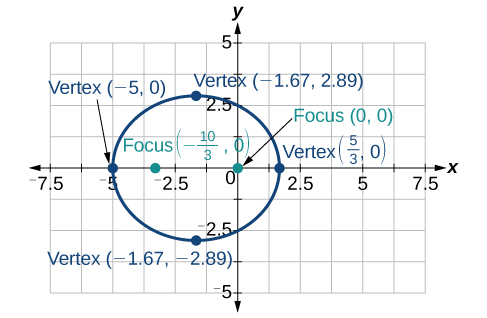
32. \(r = \frac{2}{3 + 3\mspace{9mu}\sin\mspace{7mu}\theta}\)
33. \(r = \frac{10}{5 - 4\mspace{9mu}\sin\mspace{7mu}\theta}\)
Solution (click to reveal)
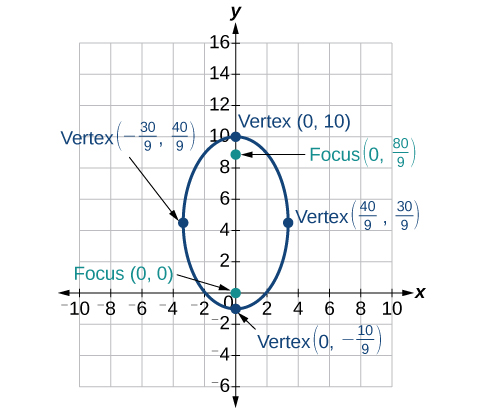
34. \(r = \frac{3}{1 + 2\mspace{9mu}\cos\mspace{7mu}\theta}\)
35. \(r = \frac{8}{4 - 5\mspace{9mu}\cos\mspace{7mu}\theta}\)
Solution (click to reveal)
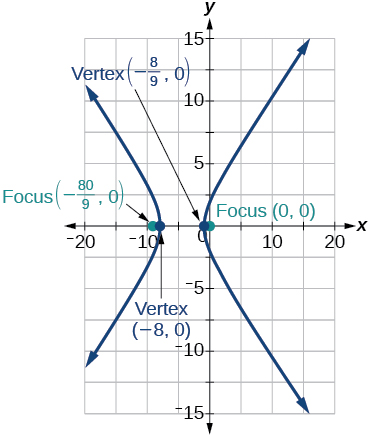
36. \(r = \frac{3}{4 - 4\mspace{9mu}\cos\mspace{7mu}\theta}\)
37. \(r = \frac{2}{1 - \sin\mspace{7mu}\theta}\)
Solution (click to reveal)
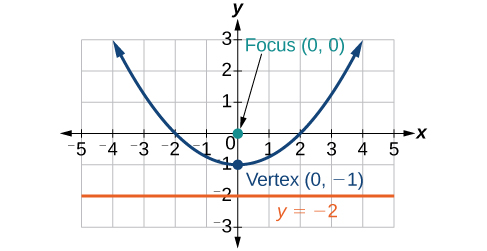
38. \(r = \frac{6}{3 + 2\mspace{9mu}\sin\mspace{7mu}\theta}\)
39. \(r(1 + \cos\mspace{7mu}\theta) = 5\)
Solution (click to reveal)
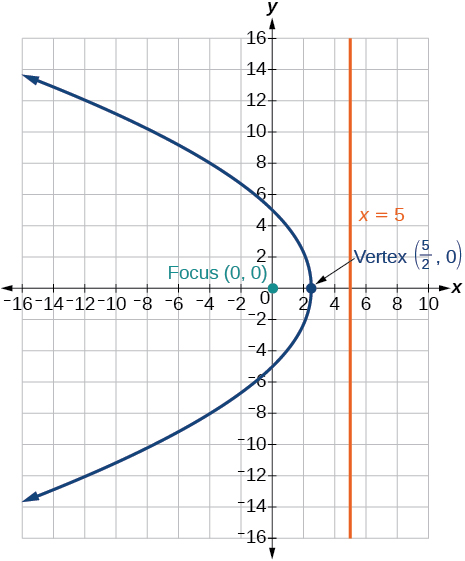
40. \(r(3 - 4\sin\mspace{7mu}\theta) = 9\)
41. \(r(3 - 2\sin\mspace{7mu}\theta) = 6\)
Solution (click to reveal)
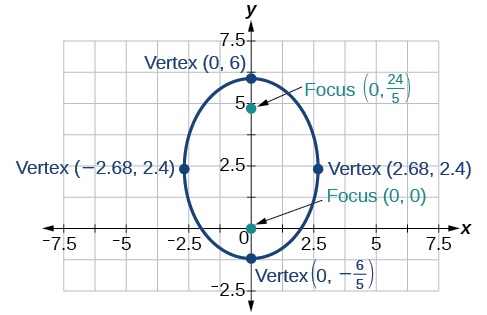
42. \(r(6 - 4\cos\mspace{7mu}\theta) = 5\)
For the following exercises, find the polar equation of the conic with focus at the origin and the given eccentricity and directrix.
43. Directrix: \(x = 4;\mspace{9mu} e = \frac{1}{5}\)
Solution (click to reveal)
\(r = \frac{4}{5 + \cos\theta}\)
44. Directrix: \(x = - 4;\mspace{9mu} e = 5\)
45. Directrix: \(y = 2;\mspace{9mu} e = 2\)
Solution (click to reveal)
\(r = \frac{4}{1 + 2\sin\theta}\)
46. Directrix: \(y = - 2;\mspace{9mu} e = \frac{1}{2}\)
47. Directrix: \(x = 1;\mspace{9mu} e = 1\)
Solution (click to reveal)
\(r = \frac{1}{1 + \cos\theta}\)
48. Directrix: \(x = - 1;\mspace{9mu} e = 1\)
49. Directrix: \(x = - \frac{1}{4};\mspace{9mu} e = \frac{7}{2}\)
Solution (click to reveal)
\(r = \frac{7}{8 - 28\cos\theta}\)
50. Directrix: \(y = \frac{2}{5};\mspace{9mu} e = \frac{7}{2}\)
51. Directrix: \(y = 4;\mspace{9mu} e = \frac{3}{2}\)
Solution (click to reveal)
\(r = \frac{12}{2 + 3\sin\theta}\)
52. Directrix: \(x = -2;\mspace{9mu} e = \frac{8}{3}\)
53. Directrix: \(x = -5;\mspace{9mu} e = \frac{3}{4}\)
Solution (click to reveal)
\(r = \frac{15}{4 - 3\cos\theta}\)
54. Directrix: \(y = 2;\mspace{9mu} e = 2.5\)
55. Directrix: \(x = -3;\mspace{9mu} e = \frac{1}{3}\)
Solution (click to reveal)
\(r = \frac{3}{3 - 3\cos\theta}\)
Extensions
Recall from Rotation of Axes that equations of conics with an \(xy\) term have rotated graphs. For the following exercises, express each equation in polar form with \(r\) as a function of \(\theta.\)
56. \(xy = 2\)
57. \(x^{2} + xy + y^{2} = 4\)
Solution (click to reveal)
\(r = \pm \frac{2}{\sqrt{1 + \sin\theta\cos\theta}}\)
58. \(2x^{2} + 4xy + 2y^{2} = 9\)
59. \(16x^{2} + 24xy + 9y^{2} = 4\)
Solution (click to reveal)
\(r = \pm \frac{2}{4\cos\theta + 3\sin\theta}\)
60. \(2xy + y = 1\)