13.4 Series and Their Notations
A parent decides to start a college fund for their daughter. They plan to invest $50 in the fund each month. The fund pays 6% annual interest, compounded monthly. How much money will they have saved when their daughter is ready to start college in 6 years? In this section, we will learn how to answer this question. To do so, we need to consider the amount of money invested and the amount of interest earned.
13.4.1 Using Summation Notation
To find the total amount of money in the college fund and the sum of the amounts deposited, we need to add the amounts deposited each month and the amounts earned monthly. The sum of the terms of a sequence is called a series. Consider, for example, the following series.
\[3 + 7 + 11 + 15 + 19 + ...\]
The \(\mathbf{n}\)th partial sum of a series is the sum of a finite number of consecutive terms beginning with the first term. The notation \(S_{n}\) represents the partial sum.
\[\begin{array}{l} {S_{1} = 3} \\ {S_{2} = 3 + 7 = 10} \\ {S_{3} = 3 + 7 + 11 = 21} \\ {S_{4} = 3 + 7 + 11 + 15 = 36} \end{array}\]
Summation notation is used to represent series. Summation notation is often known as sigma notation because it uses the Greek capital letter sigma, \(\text{Σ},\) to represent the sum. Summation notation includes an explicit formula and specifies the first and last terms in the series. An explicit formula for each term of the series is given to the right of the sigma. A variable called the index of summation is written below the sigma. The index of summation is set equal to the lower limit of summation, which is the number used to generate the first term in the series. The number above the sigma, called the upper limit of summation, is the number used to generate the last term in a series.

If we interpret the given notation, we see that it asks us to find the sum of the terms in the series \(a_{k} = 2k\) for \(k = 1\) through \(k = 5.\) We can begin by substituting the terms for \(k\) and listing out the terms of this series.
\[\begin{array}{l} \begin{array}{l} \\ {a_{1} = 2(1) = 2} \end{array} \\ {a_{2} = 2(2) = 4} \\ {a_{3} = 2(3) = 6} \\ {a_{4} = 2(4) = 8} \\ {a_{5} = 2(5) = 10} \end{array}\]
We can find the sum of the series by adding the terms:
\[{\sum\limits_{k = 1}^{5}{2k}} = 2 + 4 + 6 + 8 + 10 = 30\]
13.4.2 Using the Formula for Arithmetic Series
Just as we studied special types of sequences, we will look at special types of series. Recall that an arithmetic sequence is a sequence in which the difference between any two consecutive terms is the common difference, \(d.\) The sum of the terms of an arithmetic sequence is called an arithmetic series. We can write the sum of the first \(n\) terms of an arithmetic series as:
\[S_{n} = a_{1} + (a_{1} + d) + (a_{1} + 2d) + ... + (a_{n}–d) + a_{n}.\]
We can also reverse the order of the terms and write the sum as
\[S_{n} = a_{n} + (a_{n}–d) + (a_{n}–2d) + ... + (a_{1} + d) + a_{1}.\]
If we add these two expressions for the sum of the first \(n\) terms of an arithmetic series, we can derive a formula for the sum of the first \(n\) terms of any arithmetic series.
\[\frac{\begin{array}{l} {\mspace{9mu}\mspace{9mu}\mspace{9mu}\mspace{9mu}\mspace{9mu}\mspace{9mu} S_{n} = a_{1} + (a_{1} + d) + (a_{1} + 2d) + ... + (a_{n}–d) + a_{n}} \\ {+ \mspace{9mu}\mspace{9mu} S_{n} = a_{n} + (a_{n}–d) + (a_{n}–2d) + ... + (a_{1} + d) + a_{1}} \end{array}}{2S_{n} = (a_{1} + a_{n}) + (a_{1} + a_{n}) + ... + (a_{1} + a_{n})}\]
Because there are \(n\) terms in the series, we can simplify this sum to
\[2S_{n} = n(a_{1} + a_{n}).\]
We divide by 2 to find the formula for the sum of the first \(n\) terms of an arithmetic series.
\[S_{n} = \frac{n(a_{1} + a_{n})}{2}\]
Use the formula to find the sum of each arithmetic series.
13.4.3 Using the Formula for Geometric Series
Just as the sum of the terms of an arithmetic sequence is called an arithmetic series, the sum of the terms in a geometric sequence is called a geometric series. Recall that a geometric sequence is a sequence in which the ratio of any two consecutive terms is the common ratio, \(r.\) We can write the sum of the first \(n\) terms of a geometric series as
\[S_{n} = a_{1} + ra_{1} + r^{2}a_{1} + ... + r^{n–1}a_{1}.\]
Just as with arithmetic series, we can do some algebraic manipulation to derive a formula for the sum of the first \(n\) terms of a geometric series. We will begin by multiplying both sides of the equation by \(r.\)
\[rS_{n} = ra_{1} + r^{2}a_{1} + r^{3}a_{1} + ... + r^{n}a_{1}\]
Next, we subtract this equation from the original equation.
\[\begin{array}{l} \\ \frac{\begin{array}{l} {\mspace{9mu}\text{~~~}S_{n} = a_{1} + ra_{1} + r^{2}a_{1} + ... + r^{n–1}a_{1}} \\ {- rS_{n} = - (ra_{1} + r^{2}a_{1} + r^{3}a_{1} + ... + r^{n}a_{1})} \end{array}}{(1 - r)S_{n} = a_{1} - r^{n}a_{1}} \end{array}\]
Notice that when we subtract, all but the first term of the top equation and the last term of the bottom equation cancel out. To obtain a formula for \(S_{n},\) divide both sides by \((1 - r).\)
\[S_{n} = \frac{a_{1}(1 - r^{n})}{1 - r}\mspace{9mu}\text{r} \neq \text{1}\]
Use the formula to find the indicated partial sum of each geometric series.
13.4.4 Using the Formula for the Sum of an Infinite Geometric Series
Thus far, we have looked only at finite series. Sometimes, however, we are interested in the sum of the terms of an infinite sequence rather than the sum of only the first \(n\) terms. An infinite series is the sum of the terms of an infinite sequence. An example of an infinite series is \(2 + 4 + 6 + 8 + ...\)
This series can also be written in summation notation as \(\sum\limits_{k = 1}^{\infty}{2k,}\) where the upper limit of summation is infinity. Because the terms are not tending to zero, the sum of the series increases without bound as we add more terms. Therefore, the sum of this infinite series is not defined. When the sum is not a real number, we say the series diverges.
Determining Whether the Sum of an Infinite Geometric Series is Defined
If the terms of an infinite geometric sequence approach 0, the sum of an infinite geometric series can be defined. The terms in this series approach 0:
\[1 + 0.2 + 0.04 + 0.008 + 0.0016 + ...\]
The common ratio \(r\mspace{9mu}\text{=~0}\text{.2}.\) As \(n\) gets very large, the values of \(r^{n}\) get very small and approach 0. Each successive term affects the sum less than the preceding term. As each succeeding term gets closer to 0, the sum of the terms approaches a finite value. The terms of any infinite geometric series with \(- 1 < r < 1\) approach 0; the sum of a geometric series is defined when \(- 1 < r < 1.\)
Determine whether the sum of the infinite series is defined.
Finding Sums of Infinite Series
When the sum of an infinite geometric series exists, we can calculate the sum. The formula for the sum of an infinite series is related to the formula for the sum of the first \(n\) terms of a geometric series.
\[S_{n} = \frac{a_{1}(1 - r^{n})}{1 - r}\]
We will examine an infinite series with \(r = \frac{1}{2}.\) What happens to \(r^{n}\) as \(n\) increases?
\[\begin{array}{l} {\left( \frac{1}{2} \right)^{2} = \frac{1}{4}} \\ {\left( \frac{1}{2} \right)^{3} = \frac{1}{8}} \\ {\left( \frac{1}{2} \right)^{4} = \frac{1}{16}} \end{array}\]
The value of \(r^{n}\) decreases rapidly. What happens for greater values of \(n?\)
\[\begin{array}{l} {{(\frac{1}{2})}^{10} = \frac{1}{1\text{,}024}} \\ {{(\frac{1}{2})}^{20} = \frac{1}{1\text{,}048\text{,}576}} \\ {{(\frac{1}{2})}^{30} = \frac{1}{1\text{,}073\text{,}741\text{,}824}} \end{array}\]
As \(n\) gets very large, \(r^{n}\) gets very small. We say that, as \(n\) increases without bound, \(r^{n}\) approaches 0. As \(r^{n}\) approaches 0, \(1 - r^{n}\) approaches 1. When this happens, the numerator approaches \(a_{1}.\) This give us a formula for the sum of an infinite geometric series.
Find an equivalent fraction for the repeating decimal \(0.\overline{3}\)
Solution (click to reveal)
We notice the repeating decimal \(0.\overline{3} = 0.333...\) so we can rewrite the repeating decimal as a sum of terms.
\[0.\overline{3} = 0.3 + 0.03 + 0.003 + ...\]
Looking for a pattern, we rewrite the sum, noticing that we see the first term multiplied to 0.1 in the second term, and the second term multiplied to 0.1 in the third term.

Notice the pattern; we multiply each consecutive term by a common ratio of 0.1 starting with the first term of 0.3. So, substituting into our formula for an infinite geometric sum, we have
\[S_{n} = \frac{a_{1}}{1 - r} = \frac{0.3}{1 - 0.1} = \frac{0.3}{0.9} = \frac{1}{3}.\]
Find the sum, if it exists.
13.4.5 Solving Annuity Problems
At the beginning of the section, we looked at a problem in which a parent invested a set amount of money each month into a college fund for six years. An annuity is an investment in which the purchaser makes a sequence of periodic, equal payments. To find the amount of an annuity, we need to find the sum of all the payments and the interest earned. In the example, the parent invests $50 each month. This is the value of the initial deposit. The account paid 6% annual interest, compounded monthly. To find the interest rate per payment period, we need to divide the 6% annual percentage interest (APR) rate by 12. So the monthly interest rate is 0.5%. We can multiply the amount in the account each month by 100.5% to find the value of the account after interest has been added.
We can find the value of the annuity right after the last deposit by using a geometric series with \(a_{1} = 50\) and \(r = 100.5\% = 1.005.\) After the first deposit, the value of the annuity will be $50. Let us see if we can determine the amount in the college fund and the interest earned.
We can find the value of the annuity after \(n\) deposits using the formula for the sum of the first \(n\) terms of a geometric series. In 6 years, there are 72 months, so \(n = 72.\) We can substitute \(a_{1} = 50,~r = 1.005,~\text{and}~n = 72\) into the formula, and simplify to find the value of the annuity after 6 years.
\[S_{72} = \frac{50(1 - 1.005^{72})}{1 - 1.005} \approx 4\text{,}320.44\]
After the last deposit, the parent will have a total of $4,320.44 in the account. Notice, the parent made 72 payments of $50 each for a total of \(\text{72(50)~=~\$3{,}600}\text{.}\) This means that because of the annuity, the parent earned $720.44 interest in their college fund.
Section Exercises
Verbal
1. What is an \(n\text{th}\) partial sum?
Solution (click to reveal)
An \(n\text{th}\) partial sum is the sum of the first \(n\) terms of a sequence.
2. What is the difference between an arithmetic sequence and an arithmetic series?
3. What is a geometric series?
Solution (click to reveal)
A geometric series is the sum of the terms in a geometric sequence.
4. How is finding the sum of an infinite geometric series different from finding the \(n\text{th}\) partial sum?
5. What is an annuity?
Solution (click to reveal)
An annuity is a series of regular equal payments that earn a constant compounded interest.
Algebraic
For the following exercises, express each description of a sum using summation notation.
6. The sum of terms \(m^{2} + 3m\) from \(m = 1\) to \(m = 5\)
7. The sum from of \(n = 0\) to \(n = 4\) of \(5n\)
Solution (click to reveal)
\(\sum\limits_{n = 0}^{4}{5n}\)
8. The sum of \(6k - 5\) from \(k = - 2\) to \(k = 1\)
9. The sum that results from adding the number 4 five times
Solution (click to reveal)
\(\sum\limits_{k = 1}^{5}4\)
For the following exercises, express each arithmetic sum using summation notation.
10. \(5 + 10 + 15 + 20 + 25 + 30 + 35 + 40 + 45 + 50\)
11. \(10 + 18 + 26 + \ldots + 162\)
Solution (click to reveal)
\(\sum\limits_{k = 1}^{20}{8k + 2}\)
12. \(\frac{1}{2} + 1 + \frac{3}{2} + 2 + \ldots + 4\)
For the following exercises, use the formula for the sum of the first \(n\) terms of each arithmetic sequence.
13. \(\frac{3}{2} + 2 + \frac{5}{2} + 3 + \frac{7}{2}\)
Solution (click to reveal)
\(S_{5} = \frac{5\left( {\frac{3}{2} + \frac{7}{2}} \right)}{2}\)
14. \(19 + 25 + 31 + \ldots + 73\)
15. \(3.2 + 3.4 + 3.6 + \ldots + 5.6\)
Solution (click to reveal)
\(S_{13} = \frac{13\left( {3.2 + 5.6} \right)}{2}\)
For the following exercises, express each geometric sum using summation notation.
16. \(1 + 3 + 9 + 27 + 81 + 243 + 729 + 2187\)
17. \(8 + 4 + 2 + \ldots + 0.125\)
Solution (click to reveal)
\(\sum\limits_{k = 1}^{7}{8 \cdot 0.5^{k - 1}}\)
18. \(- \frac{1}{6} + \frac{1}{12} - \frac{1}{24} + \ldots + \frac{1}{768}\)
For the following exercises, use the formula for the sum of the first \(n\) terms of each geometric sequence, and then state the indicated sum.
19. \(9 + 3 + 1 + \frac{1}{3} + \frac{1}{9}\)
Solution (click to reveal)
\(S_{5} = \frac{9\left( {1 - \left( \frac{1}{3} \right)^{5}} \right)}{1 - \frac{1}{3}} = \frac{121}{9} \approx 13.44\)
20. \(\sum\limits_{n = 1}^{9}{5 \cdot 2^{n - 1}}\)
21. \(\sum\limits_{a = 1}^{11}{64 \cdot 0.2^{a - 1}}\)
Solution (click to reveal)
\(S_{11} = \frac{64\left( {1 - 0.2^{11}} \right)}{1 - 0.2} = \frac{781{,}249{,}984}{9{,}765{,}625} \approx 80\)
For the following exercises, determine whether the infinite series has a sum. If so, write the formula for the sum. If not, state the reason.
22. \(12 + 18 + 24 + 30 + ...\)
23. \(2 + 1.6 + 1.28 + 1.024 + ...\)
Solution (click to reveal)
The series is defined. \(S = \frac{2}{1 - 0.8}\)
24. \(\sum\limits_{m = 1}^{\infty}4^{m - 1}\)
25. \(\underset{\infty}{\overset{k = 1}{\sum^{}}} - \left( {- \frac{1}{2}} \right)^{k - 1}\)
Solution (click to reveal)
The series is defined. \(S = \frac{- 1}{1 - \left( {- \frac{1}{2}} \right)}\)
Graphical
For the following exercises, use the following scenario. Javier makes monthly deposits into a savings account. He opened the account with an initial deposit of $50. Each month thereafter he increased the previous deposit amount by $20.
26. Graph the arithmetic sequence showing one year of Javier’s deposits.
27. Graph the arithmetic series showing the monthly sums of one year of Javier’s deposits.
Solution (click to reveal)
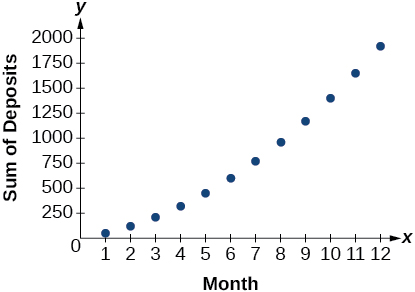
For the following exercises, use the geometric series \({\sum\limits_{k = 1}^{\infty}\left( \frac{1}{2} \right)}^{k}.\)
28. Graph the first 7 partial sums of the series.
29. What number does \(S_{n}\) seem to be approaching in the graph? Find the sum to explain why this makes sense.
Solution (click to reveal)
Sample answer: The graph of \(S_{n}\) seems to be approaching 1. This makes sense because \(\sum\limits_{k = 1}^{\infty}\left( \frac{1}{2} \right)^{k}\) is a defined infinite geometric series with \(S = \frac{\frac{1}{2}}{1–\left( \frac{1}{2} \right)} = 1.\)
Numeric
For the following exercises, find the indicated sum.
30. \(\sum\limits_{a = 1}^{14}a\)
31. \(\sum\limits_{n = 1}^{6}{n(n - 2)}\)
Solution (click to reveal)
49
32. \(\sum\limits_{k = 1}^{17}k^{2}\)
33. \(\sum\limits_{k = 1}^{7}2^{k}\)
Solution (click to reveal)
254
For the following exercises, use the formula for the sum of the first \(n\) terms of an arithmetic series to find the sum.
34. \(- 1.7 + - 0.4 + 0.9 + 2.2 + 3.5 + 4.8\)
35. \(6 + \frac{15}{2} + 9 + \frac{21}{2} + 12 + \frac{27}{2} + 15\)
Solution (click to reveal)
\(S_{7} = \frac{147}{2}\)
36. \(- 1 + 3 + 7 + ... + 31\)
37. \(\sum\limits_{k = 1}^{11}\left( {\frac{k}{2} - \frac{1}{2}} \right)\)
Solution (click to reveal)
\(S_{11} = \frac{55}{2}\)
For the following exercises, use the formula for the sum of the first \(n\) terms of a geometric series to find the partial sum.
38. \(S_{6}\) for the series \(- 2 - 10 - 50 - 250...\)
39. \(S_{7}\) for the series \(0.4 - 2 + 10 - 50...\)
Solution (click to reveal)
\(S_{7} = 5208.4\)
40. \(\sum\limits_{k = 1}^{9}2^{k - 1}\)
41. \(\sum\limits_{n = 1}^{10}{- 2 \cdot \left( \frac{1}{2} \right)^{n - 1}}\)
Solution (click to reveal)
\(S_{10} = - \frac{1023}{256}\)
For the following exercises, find the sum of the infinite geometric series.
42. \(4 + 2 + 1 + \frac{1}{2}...\)
43. \(- 1 - \frac{1}{4} - \frac{1}{16} - \frac{1}{64}...\)
Solution (click to reveal)
\(S = - \frac{4}{3}\)
44. \(\underset{\infty}{\overset{k = 1}{\sum^{}}}3 \cdot \left( \frac{1}{4} \right)^{k - 1}\)
45. \(\sum\limits_{n = 1}^{\infty}{4.6 \cdot 0.5^{n - 1}}\)
Solution (click to reveal)
\(S = 9.2\)
For the following exercises, determine the value of the annuity for the indicated monthly deposit amount, the number of deposits, and the interest rate.
46. Deposit amount: \(\text{\$}50;\) total deposits: \(60;\) interest rate: \(5\%,\) compounded monthly
47. Deposit amount: \(\text{\$}150;\) total deposits: \(24;\) interest rate: \(3\%,\) compounded monthly
Solution (click to reveal)
$3,705.42
48. Deposit amount: \(\text{\$}450;\) total deposits: \(60;\) interest rate: \(4.5\%,\) compounded quarterly
49. Deposit amount: \(\text{\$}100;\) total deposits: \(120;\) interest rate: \(10\%,\) compounded semi-annually
Solution (click to reveal)
$695,823.97
Extensions
50. The sum of terms \(50 - k^{2}\) from \(k = x\) through \(7\) is \(115.\) What is \(x\)?
51. Write an explicit formula for \(a_{k}\) such that \(\sum\limits_{k = 0}^{6}{a_{k} = 189.}\) Assume this is an arithmetic series.
Solution (click to reveal)
\(a_{k} = 30 - k\)
52. Find the smallest value of \(n\) such that \(\sum\limits_{k = 1}^{n}{(3k–5) > 100.}\)
53. How many terms must be added before the series \(- 1 - 3 - 5 - 7....\) has a sum less than \(- 75?\)
Solution (click to reveal)
9 terms
54. Write \(0.\overline{65}\) as an infinite geometric series using summation notation. Then use the formula for finding the sum of an infinite geometric series to convert \(0.\overline{65}\) to a fraction.
55. The sum of an infinite geometric series is five times the value of the first term. What is the common ratio of the series?
Solution (click to reveal)
\(r = \frac{4}{5}\)
56. To get the best loan rates available, the Coleman family want to save enough money to place 20% down on a $160,000 home. They plan to make monthly deposits of $125 in an investment account that offers 8.5% annual interest compounded semi-annually. Will the Colemans have enough for a 20% down payment after five years of saving? How much money will they have saved?
57. Karl has two years to save \(\$ 10{,}000\) to buy a used car when he graduates. To the nearest dollar, what would his monthly deposits need to be if he invests in an account offering a 4.2% annual interest rate that compounds monthly?
Solution (click to reveal)
$400 per month
Real-World Applications
58. Keisha devised a week-long study plan to prepare for finals. On the first day, she plans to study for \(1\) hour, and each successive day she will increase her study time by \(30\) minutes. How many hours will Keisha have studied after one week?
59. A boulder rolled down a mountain, traveling 6 feet in the first second. Each successive second, its distance increased by 8 feet. How far did the boulder travel after 10 seconds?
Solution (click to reveal)
420 feet
60. A scientist places 50 cells in a petri dish. Every hour, the population increases by 1.5%. What will the cell count be after 1 day?
61. A pendulum travels a distance of 3 feet on its first swing. On each successive swing, it travels \(\frac{3}{4}\) the distance of the previous swing. What is the total distance traveled by the pendulum when it stops swinging?
Solution (click to reveal)
12 feet
62. Rachael deposits $1,500 into a retirement fund each year. The fund earns 8.2% annual interest, compounded monthly. If she opened her account when she was 19 years old, how much will she have by the time she is 55? How much of that amount will be interest earned?