Chapter Review
Key Terms
arrow notation — a way to represent symbolically the local and end behavior of a function by using arrows to indicate that an input or output approaches a value
axis of symmetry — a vertical line drawn through the vertex of a parabola, that opens up or down, around which the parabola is symmetric; it is defined by \(x = - \frac{b}{2a}.\)
coefficient — a nonzero real number multiplied by a variable raised to an exponent
constant of variation — the non-zero value \(k\) that helps define the relationship between variables in direct or inverse variation
continuous function — a function whose graph can be drawn without lifting the pen from the paper because there are no breaks in the graph
degree — the highest power of the variable that occurs in a polynomial
Descartes’ Rule of Signs — a rule that determines the maximum possible numbers of positive and negative real zeros based on the number of sign changes of \(f(x)\) and \(f( - x)\)
direct variation — the relationship between two variables that are a constant multiple of each other; as one quantity increases, so does the other
Division Algorithm — given a polynomial dividend \(f(x)\) and a non-zero polynomial divisor \(d(x)\) where the degree of \(d(x)\) is less than or equal to the degree of \(f(x)\) , there exist unique polynomials \(q(x)\) and \(r(x)\) such that \(f(x) = d(x)q(x) + r(x)\) where \(q(x)\) is the quotient and \(r(x)\) is the remainder. The remainder is either equal to zero or has degree strictly less than \(d(x).\)
end behavior — the behavior of the graph of a function as the input decreases without bound and increases without bound
Factor Theorem — \(k\) is a zero of polynomial function \(f(x)\) if and only if \((x - k)\) is a factor of \(f(x)\)
Fundamental Theorem of Algebra — a polynomial function with degree greater than 0 has at least one complex zero
general form of a quadratic function — the function that describes a parabola, written in the form \(f(x) = ax^{2} + bx + c\), where \(a,b,\) and \(c\) are real numbers and \(a \neq 0.\)
global maximum — highest turning point on a graph; \(f(a)\) where \(f(a) \geq f(x)\) for all \(x.\)
global minimum — lowest turning point on a graph; \(f(a)\) where \(f(a) \leq f(x)\) for all \(x.\)
horizontal asymptote — a horizontal line \(y = b\) where the graph approaches the line as the inputs increase or decrease without bound.
Intermediate Value Theorem — for two numbers \(a\) and \(b\) in the domain of \(f,\) if \(a < b\) and \(f(a) \neq f(b),\) then the function \(f\) takes on every value between \(f(a)\) and \(f(b)\) ; specifically, when a polynomial function changes from a negative value to a positive value, the function must cross the \(x\text{-}\) axis
inverse variation — the relationship between two variables in which the product of the variables is a constant
inversely proportional — a relationship where one quantity is a constant divided by the other quantity; as one quantity increases, the other decreases
invertible function — any function that has an inverse function
joint variation — a relationship where a variable varies directly or inversely with multiple variables
leading coefficient — the coefficient of the leading term
leading term — the term containing the highest power of the variable
Linear Factorization Theorem — allowing for multiplicities, a polynomial function will have the same number of factors as its degree, and each factor will be in the form \((x - c)\) , where \(c\) is a complex number
multiplicity — the number of times a given factor appears in the factored form of the equation of a polynomial; if a polynomial contains a factor of the form \({(x - h)}^{p}\) , \(x = h\) is a zero of multiplicity \(p.\)
polynomial function — a function that consists of either zero or the sum of a finite number of non-zero terms, each of which is a product of a number, called the coefficient of the term, and a variable raised to a non-negative integer power.
power function — a function that can be represented in the form \(f(x) = kx^{p}\) where \(k\) is a constant, the base is a variable, and the exponent, \(p\) , is a constant
rational function — a function that can be written as the ratio of two polynomials
Rational Zero Theorem — the possible rational zeros of a polynomial function have the form \(\frac{p}{q}\) where \(p\) is a factor of the constant term and \(q\) is a factor of the leading coefficient.
Remainder Theorem — if a polynomial \(f(x)\) is divided by \(x - k\) , then the remainder is equal to the value \(f(k)\)
removable discontinuity — a single point at which a function is undefined that, if filled in, would make the function continuous; it appears as a hole on the graph of a function
roots — in a given function, the values of \(x\) at which \(y = 0\), also called zeros
smooth curve — a graph with no sharp corners
standard form of a quadratic function — the function that describes a parabola, written in the form \(f(x) = a{(x - h)}^{2} + k\), where \(\left( {h,\mspace{9mu} k} \right)\) is the vertex
synthetic division — a shortcut method that can be used to divide a polynomial by a binomial of the form \(x - k\)
term of a polynomial function — any \(a_{i}x^{i}\) of a polynomial function in the form \(f(x) = a_{n}x^{n} + ... + a_{2}x^{2} + a_{1}x + a_{0}\)
turning point — the location at which the graph of a function changes direction
varies directly — a relationship where one quantity is a constant multiplied by the other quantity
varies inversely — a relationship where one quantity is a constant divided by the other quantity
vertex — the point at which a parabola changes direction, corresponding to the minimum or maximum value of the quadratic function
vertex form of a quadratic function — another name for the standard form of a quadratic function
vertical asymptote — a vertical line \(x = a\) where the graph tends toward positive or negative infinity as the inputs approach \(a\)
zeros — in a given function, the values of \(x\) at which \(y = 0\), also called roots
Key Equations
| general form of a quadratic function | \(f(x) = ax^{2} + bx + c\) |
| standard form of a quadratic function | \(f(x) = a{(x - h)}^{2} + k\) |
| general form of a polynomial function | \(f(x) = a_{n}x^{n} + ... + a_{2}x^{2} + a_{1}x + a_{0}\) |
| Division Algorithm | \(f(x) = d(x)q(x) + r(x)\mspace{9mu}\text{where~}q(x) \neq 0\) |
| Rational Function | \(f(x) = \frac{P(x)}{Q(x)} = \frac{a_{p}x^{p} + a_{p - 1}x^{p - 1} + ... + a_{1}x + a_{0}}{b_{q}x^{q} + b_{q - 1}x^{q - 1} + ... + b_{1}x + b_{0}},~Q(x) \neq 0\) |
| Direct variation | \(y = kx^{n},\mspace{9mu} k\) is a nonzero constant. |
| Inverse variation | \(y = \frac{k}{x^{n}},\mspace{9mu} k\) is a nonzero constant. |
Key Concepts
5.1 Quadratic Functions
- A polynomial function of degree two is called a quadratic function.
- The graph of a quadratic function is a parabola. A parabola is a U-shaped curve that can open either up or down.
- The axis of symmetry is the vertical line passing through the vertex. The zeros, or \(x\text{-}\) intercepts, are the points at which the parabola crosses the \(x\text{-}\) axis. The \(y\text{-}\) intercept is the point at which the parabola crosses the \(y\text{-}\) axis. See Example 1, Example 7, and Example 8.
- Quadratic functions are often written in general form. Standard or vertex form is useful to easily identify the vertex of a parabola. Either form can be written from a graph. See Example 2.
- The vertex can be found from an equation representing a quadratic function. See Example 3.
- The domain of a quadratic function is all real numbers. The range varies with the function. See Example 4.
- A quadratic function’s minimum or maximum value is given by the \(y\text{-}\) value of the vertex.
- The minimum or maximum value of a quadratic function can be used to determine the range of the function and to solve many kinds of real-world problems, including problems involving area and revenue. See Example 5 and Example 6.
- The vertex and the intercepts can be identified and interpreted to solve real-world problems. See Example 9.
5.2 Power Functions and Polynomial Functions
- A power function is a variable base raised to a number power. See Example 1.
- The behavior of a graph as the input decreases beyond bound and increases beyond bound is called the end behavior.
- The end behavior depends on whether the power is even or odd. See Example 2 and Example 3.
- A polynomial function is the sum of terms, each of which consists of a transformed power function with positive whole number power. See Example 4.
- The degree of a polynomial function is the highest power of the variable that occurs in a polynomial. The term containing the highest power of the variable is called the leading term. The coefficient of the leading term is called the leading coefficient. See Example 5.
- The end behavior of a polynomial function is the same as the end behavior of the power function represented by the leading term of the function. See Example 6 and Example 7.
- A polynomial of degree \(n\) will have at most \(n\) \(x\)-intercepts and at most \(n - 1\) turning points. See Example 8, Example 9, Example 10, Example 11, and Example 12.
5.3 Graphs of Polynomial Functions
- Polynomial functions of degree 2 or more are smooth, continuous functions. See Example 1.
- To find the zeros of a polynomial function, if it can be factored, factor the function and set each factor equal to zero. See Example 2, Example 3, and Example 4.
- Another way to find the \(x\text{-}\) intercepts of a polynomial function is to graph the function and identify the points at which the graph crosses the \(x\text{-}\) axis. See Example 5.
- The multiplicity of a zero determines how the graph behaves at the \(x\text{-}\) intercepts. See Example 6.
- The graph of a polynomial will cross the horizontal axis at a zero with odd multiplicity.
- The graph of a polynomial will touch the horizontal axis at a zero with even multiplicity.
- The end behavior of a polynomial function depends on the leading term.
- The graph of a polynomial function changes direction at its turning points.
- A polynomial function of degree \(n\) has at most \(n - 1\) turning points. See Example 7.
- To graph polynomial functions, find the zeros and their multiplicities, determine the end behavior, and ensure that the final graph has at most \(n - 1\) turning points. See Example 8 and Example 10.
- Graphing a polynomial function helps to estimate local and global extremas. See Example 11.
- The Intermediate Value Theorem tells us that if \(f(a)~\text{and}~f(b)\) have opposite signs, then there exists at least one value \(c\) between \(a\) and \(b\) for which \(f(c) = 0.\) See Example 9.
5.4 Dividing Polynomials
- Polynomial long division can be used to divide a polynomial by any polynomial with equal or lower degree. See Example 1 and Example 2.
- The Division Algorithm tells us that a polynomial dividend can be written as the product of the divisor and the quotient added to the remainder.
- Synthetic division is a shortcut that can be used to divide a polynomial by a binomial in the form \(x - k.\) See Example 3, Example 4, and Example 5.
- Polynomial division can be used to solve application problems, including area and volume. See Example 6.
5.5 Zeros of Polynomial Functions
- To find \(f(k),\) determine the remainder of the polynomial \(f(x)\) when it is divided by \(x - k.\) This is known as the Remainder Theorem. See Example 1.
- According to the Factor Theorem, \(k\) is a zero of \(f(x)\) if and only if \((x - k)\) is a factor of \(f(x).\) See Example 2.
- According to the Rational Zero Theorem, each rational zero of a polynomial function with integer coefficients will be equal to a factor of the constant term divided by a factor of the leading coefficient. See Example 3 and Example 4.
- When the leading coefficient is 1, the possible rational zeros are the factors of the constant term.
- Synthetic division can be used to find the zeros of a polynomial function. See Example 5.
- According to the Fundamental Theorem, every polynomial function has at least one complex zero. See Example 6.
- Every polynomial function with degree greater than 0 has at least one complex zero.
- Allowing for multiplicities, a polynomial function will have the same number of factors as its degree. Each factor will be in the form \((x - c),\) where \(c\) is a complex number. See Example 7.
- The number of positive real zeros of a polynomial function is either the number of sign changes of the function or less than the number of sign changes by an even integer.
- The number of negative real zeros of a polynomial function is either the number of sign changes of \(f( - x)\) or less than the number of sign changes by an even integer. See Example 8.
- Polynomial equations model many real-world scenarios. Solving the equations is easiest done by synthetic division. See Example 9.
5.6 Rational Functions
- We can use arrow notation to describe local behavior and end behavior of the toolkit functions \(f(x) = \frac{1}{x}\) and \(f(x) = \frac{1}{x^{2}}.\) See Example 1.
- A function that levels off at a horizontal value has a horizontal asymptote. A function can have more than one vertical asymptote. See Example 2.
- Application problems involving rates and concentrations often involve rational functions. See Example 3.
- The domain of a rational function includes all real numbers except those that cause the denominator to equal zero. See Example 4.
- The vertical asymptotes of a rational function will occur where the denominator of the function is equal to zero and the numerator is not zero. See Example 5.
- A removable discontinuity might occur in the graph of a rational function if an input causes both numerator and denominator to be zero. See Example 6.
- A rational function’s end behavior will mirror that of the ratio of the leading terms of the numerator and denominator functions. See Example 7, Example 8, Example 9, and Example 10.
- Graph rational functions by finding the intercepts, behavior at the intercepts and asymptotes, and end behavior. See Example 11.
- If a rational function has \(x\)-intercepts at \(x = x_{1},x_{2},\ldots,x_{n},\) vertical asymptotes at \(x = v_{1},v_{2},\ldots,v_{m},\) and no \(x_{i} = \text{any~}v_{j},\) then the function can be written in the form
\[\begin{array}{l} \begin{array}{l} \\ {f(x) = a\frac{{(x - x_{1})}^{p_{1}}{(x - x_{2})}^{p_{2}}\cdots{(x - x_{n})}^{p_{n}}}{{(x - v_{1})}^{q_{1}}{(x - v_{2})}^{q_{2}}\cdots{(x - v_{m})}^{q_{n}}}} \end{array} \end{array}\]
See Example 12.
5.7 Inverses and Radical Functions
- The inverse of a quadratic function is a square root function.
- If \(f^{- 1}\) is the inverse of a function \(f,\) then \(f\) is the inverse of the function \(f^{- 1}.\) See Example 1.
- While it is not possible to find an inverse of most polynomial functions, some basic polynomials are invertible. See Example 2.
- To find the inverse of certain functions, we must restrict the function to a domain on which it will be one-to-one. See Example 3 and Example 4.
- When finding the inverse of a radical function, we need a restriction on the domain of the answer. See Example 5 and Example 7.
- Inverse and radical and functions can be used to solve application problems. See Example 6 and Example 8.
5.8 Modeling Using Variation
- A relationship where one quantity is a constant multiplied by another quantity is called direct variation. See Example 1.
- Two variables that are directly proportional to one another will have a constant ratio.
- A relationship where one quantity is a constant divided by another quantity is called inverse variation. See Example 2.
- Two variables that are inversely proportional to one another will have a constant multiple. See Example 3.
- In many problems, a variable varies directly or inversely with multiple variables. We call this type of relationship joint variation. See Example 4.
Chapter Review Exercises
Quadratic Functions
For the following exercises, write the quadratic function in standard form. Then give the vertex and axes intercepts. Finally, graph the function.
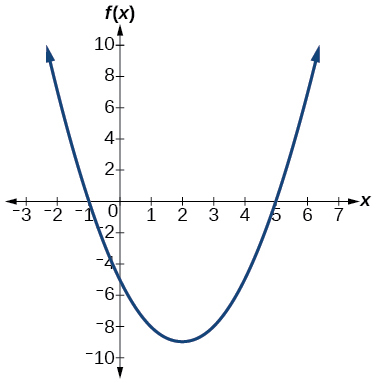
1. \(f(x) = x^{2} - 4x - 5\)
Solution (click to reveal)
\(f(x) = {(x - 2)}^{2} - 9\mspace{9mu}\text{vertex}~(2,–9),~\text{intercepts}~(5,0);~(–1,0);~(0,–5)\)
2. \(f(x) = - 2x^{2} - 4x\)
For the following exercises, find the equation of the quadratic function using the given information.
3. The vertex is \((–2,3)\) and a point on the graph is \((3,6).\)
Solution (click to reveal)
\(f(x) = \frac{3}{25}\left( {x + 2} \right)^{2} + 3\)
4. The vertex is \((–3,6.5)\) and a point on the graph is \((2,6).\)
For the following exercises, complete the task.
5. A rectangular plot of land is to be enclosed by fencing. One side is along a river and so needs no fence. If the total fencing available is 600 meters, find the dimensions of the plot to have maximum area.
Solution (click to reveal)
300 meters by 150 meters, the longer side parallel to river.
6. An object projected from the ground at a 45 degree angle with initial velocity of 120 feet per second has height, \(h,\) in terms of horizontal distance traveled, \(x,\) given by \(h(x) = \frac{- 32}{{(120)}^{2}}x^{2} + x.\) Find the maximum height the object attains.
Power Functions and Polynomial Functions
For the following exercises, determine if the function is a polynomial function and, if so, give the degree and leading coefficient.
7. \(f(x) = 4x^{5} - 3x^{3} + 2x - 1\)
Solution (click to reveal)
Yes, degree = 5, leading coefficient = 4
8. \(f(x) = 5^{x + 1} - x^{2}\)
9. \(f(x) = x^{2}\left( {3 - 6x + x^{2}} \right)\)
Solution (click to reveal)
Yes, degree = 4, leading coefficient = 1
For the following exercises, determine end behavior of the polynomial function.
10. \(f(x) = 2x^{4} + 3x^{3} - 5x^{2} + 7\)
11. \(f(x) = 4x^{3} - 6x^{2} + 2\)
Solution (click to reveal)
\(\text{As}\mspace{9mu} x\rightarrow - \infty,\mspace{9mu} f(x)\rightarrow - \infty,\mspace{9mu}\text{as}\mspace{9mu} x\rightarrow\infty,\mspace{9mu} f(x)\rightarrow\infty\)
12. \(f(x) = 2x^{2}(1 + 3x - x^{2})\)
Graphs of Polynomial Functions
For the following exercises, find all zeros of the polynomial function, noting multiplicities.
13. \(f(x) = {(x + 3)}^{2}(2x - 1){(x + 1)}^{3}\)
Solution (click to reveal)
–3 with multiplicity 2, \(\frac{1}{2}\) with multiplicity 1, –1 with multiplicity 3
14. \(f(x) = x^{5} + 4x^{4} + 4x^{3}\)
15. \(f(x) = x^{3} - 4x^{2} + x - 4\)
Solution (click to reveal)
4 with multiplicity 1
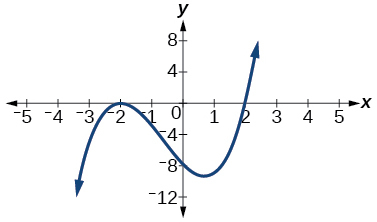
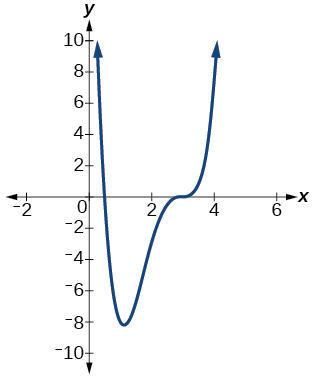
For the following exercises, based on the given graph, determine the zeros of the function and note multiplicity.
16.
17.
Solution (click to reveal)
\(\frac{1}{2}\) with multiplicity 1, 3 with multiplicity 3
18. Use the Intermediate Value Theorem to show that at least one zero lies between 2 and 3 for the function \(f(x) = x^{3} - 5x + 1\)
Dividing Polynomials
For the following exercises, use long division to find the quotient and remainder.
19. \(\frac{x^{3} - 2x^{2} + 4x + 4}{x - 2}\)
Solution (click to reveal)
\(x^{2} + 4\) with remainder 12
20. \(\frac{3x^{4} - 4x^{2} + 4x + 8}{x + 1}\)
For the following exercises, use synthetic division to find the quotient. If the divisor is a factor, then write the factored form.
21. \(\frac{x^{3} - 2x^{2} + 5x - 1}{x + 3}\)
Solution (click to reveal)
\(x^{2} - 5x + 20 - \frac{61}{x + 3}\)
22. \(\frac{x^{3} + 4x + 10}{x - 3}\)
23. \(\frac{2x^{3} + 6x^{2} - 11x - 12}{x + 4}\)
Solution (click to reveal)
\(2x^{2} - 2x - 3\) , so factored form is \((x + 4)(2x^{2} - 2x - 3)\)
24. \(\frac{3x^{4} + 3x^{3} + 2x + 2}{x + 1}\)
Zeros of Polynomial Functions
For the following exercises, use the Rational Zero Theorem to help you solve the polynomial equation.
25. \(2x^{3} - 3x^{2} - 18x - 8 = 0\)
Solution (click to reveal)
\(\left\{ {- 2,~4,~ - \frac{1}{2}} \right\}\)
26. \(3x^{3} + 11x^{2} + 8x - 4 = 0\)
27. \(2x^{4} - 17x^{3} + 46x^{2} - 43x + 12 = 0\)
Solution (click to reveal)
\(\left\{ {1,~3,~4,~\frac{1}{2}} \right\}\)
28. \(4x^{4} + 8x^{3} + 19x^{2} + 32x + 12 = 0\)
For the following exercises, use Descartes’ Rule of Signs to find the possible number of positive and negative solutions.
29. \(x^{3} - 3x^{2} - 2x + 4 = 0\)
Solution (click to reveal)
0 or 2 positive, 1 negative
30. \(2x^{4} - x^{3} + 4x^{2} - 5x + 1 = 0\)
Rational Functions
For the following exercises, find the intercepts and the vertical and horizontal asymptotes, and then use them to sketch a graph of the function.
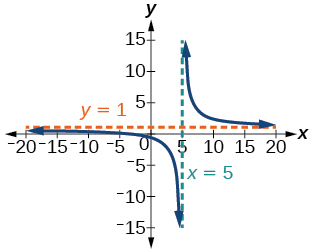
31. \(f(x) = \frac{x + 2}{x - 5}\)
Solution (click to reveal)
Intercepts \((–2,0)\text{and}\left( {0, - \frac{2}{5}} \right)\) , Asymptotes \(x = 5\) and \(y = 1.\)
32. \(f(x) = \frac{x^{2} + 1}{x^{2} - 4}\)
33. \(f(x) = \frac{3x^{2} - 27}{x^{2} + x - 2}\)
Solution (click to reveal)
Intercepts (3, 0), (-3, 0), and \(\left( {0,\frac{27}{2}} \right)\), Asymptotes \(x = 1,~x = –2,~y = 3.\)
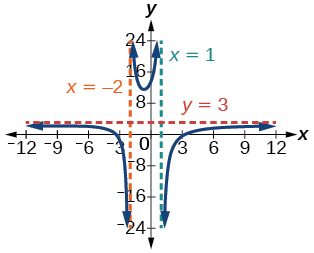
34. \(f(x) = \frac{x + 2}{x^{2} - 9}\)
For the following exercises, find the slant asymptote.
35. \(f(x) = \frac{x^{2} - 1}{x + 2}\)
Solution (click to reveal)
\(y = \mspace{9mu} x - 2\)
36. \(f(x) = \frac{2x^{3} - x^{2} + 4}{x^{2} + 1}\)
Inverses and Radical Functions
For the following exercises, find the inverse of the function with the domain given.
37. \(f(x) = {(x - 2)}^{2},\mspace{9mu} x \geq 2\)
Solution (click to reveal)
\(f^{- 1}(x) = \sqrt{x} + 2\)
38. \(f(x) = {(x + 4)}^{2} - 3,\mspace{9mu} x \geq - 4\)
39. \(f(x) = x^{2} + 6x - 2,\mspace{9mu} x \geq - 3\)
Solution (click to reveal)
\(f^{- 1}(x) = \sqrt{x + 11} - 3\)
40. \(f(x) = 2x^{3} - 3\)
41. \(f(x) = \sqrt{4x + 5} - 3\)
Solution (click to reveal)
\(f^{- 1}(x) = \frac{{(x + 3)}^{2} - 5}{4},\mspace{9mu} x \geq - 3\)
42. \(f(x) = \frac{x - 3}{2x + 1}\)
Modeling Using Variation
For the following exercises, find the unknown value.
43. \(y\) varies directly as the square of \(x.\) If when \(x = 3,\mspace{9mu} y = 36,\) find \(y\) if \(x = 4.\)
Solution (click to reveal)
\(y = 64\)
44. \(y\) varies inversely as the square root of \(x\) If when \(x = 25,\mspace{9mu} y = 2,\) find \(y\) if \(x = 4.\)
45. \(y\) varies jointly as the cube of \(x\) and as \(z.\) If when \(x = 1\) and \(z = 2,\) \(y = 6,\) find \(y\) if \(x = 2\) and \(z = 3.\)
Solution (click to reveal)
\(y\mspace{9mu} = \mspace{9mu} 72\)
46. \(y\) varies jointly as \(x\) and the square of \(z\) and inversely as the cube of \(w.\) If when \(x = 3,\) \(z = 4,\) and \(w = 2,\) \(y = 48,\) find \(y\) if \(x = 4,\) \(z = 5,\) and \(w = 3.\)
For the following exercises, solve the application problem.
47. The weight of an object above the surface of the earth varies inversely with the square of the distance from the center of the earth. If a person weighs 150 pounds when he is on the surface of the earth (3,960 miles from center), find the weight of the person if he is 20 miles above the surface.
Solution (click to reveal)
148.5 pounds
48. The volume \(V\) of an ideal gas varies directly with the temperature \(T\) and inversely with the pressure P. A cylinder contains oxygen at a temperature of 310 degrees K and a pressure of 18 atmospheres in a volume of 120 liters. Find the pressure if the volume is decreased to 100 liters and the temperature is increased to 320 degrees K.
Chapter Test
Give the degree and leading coefficient of the following polynomial function.
1. \(f(x) = x^{3}\left( {3 - 6x - 2x^{2}} \right)\)
Solution (click to reveal)
Degree: 5, leading coefficient: −2
Determine the end behavior of the polynomial function.
2. \(f(x) = 8x^{3} - 3x^{2} + 2x - 4\)
3. \(f(x) = - 2x^{2}(4 - 3x - 5x^{2})\)
Solution (click to reveal)
\(\text{As}\operatorname{}x\rightarrow-\infty,\operatorname{}f(x)\rightarrow\infty,\operatorname{}\text{As}\operatorname{}x\rightarrow\infty,\operatorname{}f(x)\rightarrow\infty\)
Write the quadratic function in standard form. Determine the vertex and axes intercepts and graph the function.
4. \(f(x) = x^{2} + 2x - 8\)
Given information about the graph of a quadratic function, find its equation.
5. Vertex \((2,0)\) and point on graph \((4,12).\)
Solution (click to reveal)
\(f(x) = 3(x - 2)^{2}\)
Solve the following application problem.
6. A rectangular field is to be enclosed by fencing. In addition to the enclosing fence, another fence is to divide the field into two parts, running parallel to two sides. If 1,200 feet of fencing is available, find the maximum area that can be enclosed.
Find all zeros of the following polynomial functions, noting multiplicities.
7. \(f(x) = {(x - 3)}^{3}(3x - 1){(x - 1)}^{2}\)
Solution (click to reveal)
3 with multiplicity 3, \(\frac{1}{3}\) with multiplicity 1, 1 with multiplicity 2
8. \(f(x) = 2x^{6} - 12x^{5} + 18x^{4}\)
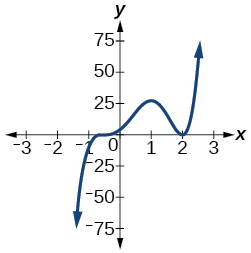
Based on the graph, determine the zeros of the function and multiplicities.
9.
Solution (click to reveal)
\(- \frac{1}{2}\) with multiplicity 3, 2 with multiplicity 2
Use long division to find the quotient.
10. \(\frac{2x^{3} + 3x - 4}{x + 2}\)
Use synthetic division to find the quotient. If the divisor is a factor, write the factored form.
11. \(\frac{x^{4} + 3x^{2} - 4}{x - 2}\)
Solution (click to reveal)
\(x^{3} + 2x^{2} + 7x + 14 + \frac{24}{x - 2}\)
12. \(\frac{2x^{3} + 5x^{2} - 7x - 12}{x + 3}\)
Use the Rational Zero Theorem to help you find the zeros of the polynomial functions.
13. \(f(x) = 2x^{3} + 5x^{2} - 6x - 9\)
Solution (click to reveal)
\(\left\{ {–3,–1,\frac{3}{2}} \right\}\)
14. \(f(x) = 4x^{4} + 8x^{3} + 21x^{2} + 17x + 4\)
15. \(f(x) = 4x^{4} + 16x^{3} + 13x^{2} - 15x - 18\)
Solution (click to reveal)
1, −2, and − \(\frac{3}{2}\) (multiplicity 2)
16. \(f(x) = x^{5} + 6x^{4} + 13x^{3} + 14x^{2} + 12x + 8\)
Given the following information about a polynomial function, find the function.
17. It has a double zero at \(x = 3\) and zeros at \(x = 1\) and \(x = - 2\) . Its \(y\)-intercept is \((0,12).\)
Solution (click to reveal)
\(f(x) = - \frac{2}{3}(x - 3)^{2}(x - 1)(x + 2)\)
18. It has a zero of multiplicity 3 at \(x = \frac{1}{2}\) and another zero at \(x = - 3\) . It contains the point \((1,8).\)
Use Descartes’ Rule of Signs to determine the possible number of positive and negative solutions.
19. \(8x^{3} - 21x^{2} + 6 = 0\)
Solution (click to reveal)
2 or 0 positive, 1 negative
For the following rational functions, find the intercepts and horizontal and vertical asymptotes, and sketch a graph.
20. \(f(x) = \frac{x + 4}{x^{2} - 2x - 3}\)
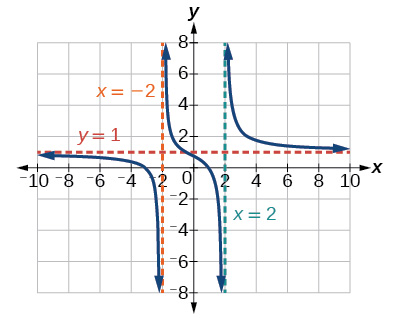
21. \(f(x) = \frac{x^{2} + 2x - 3}{x^{2} - 4}\)
Solution (click to reveal)
\(( - 3,0)(1,0)\left( {0,\frac{3}{4}} \right)\)
Find the slant asymptote of the rational function.
22. \(f(x) = \frac{x^{2} + 3x - 3}{x - 1}\)
Find the inverse of the function.
23. \(f(x) = \sqrt{x - 2} + 4\)
Solution (click to reveal)
\({f^{- 1}(x) =}(x - 4)^{2} + 2,x \geq 4\)
24. \(f(x) = 3x^{3} - 4\)
25. \(f(x) = \frac{2x + 3}{3x - 1}\)
Solution (click to reveal)
\({f^{- 1}(x) =}\frac{x + 3}{3x - 2}\)
Find the unknown value.
26. \(y\) varies inversely as the square of \(x\) and when \(x = 3,\) \(y = 2.\) Find \(y\) if \(x = 1.\)
27. \(y\) varies jointly with \(x\) and the cube root of \(z.\) If when \(x = 2\) and \(z = 27,\) \(y = 12,\) find \(y\) if \(x = 5\) and \(z = 8.\)
Solution (click to reveal)
\(y = 20\)
Solve the following application problem.
28. The distance a body falls varies directly as the square of the time it falls. If an object falls 64 feet in 2 seconds, how long will it take to fall 256 feet?