3.6 Absolute Value Functions
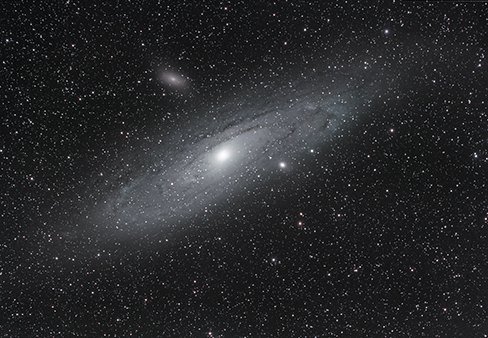
Figure 1 Distances in deep space can be measured in all directions. As such, it is useful to consider distance in terms of absolute values. (credit: “s58y”/Flickr)
Until the 1920s, the so-called spiral nebulae were believed to be clouds of dust and gas in our own galaxy, some tens of thousands of light years away. Then, astronomer Edwin Hubble proved that these objects are galaxies in their own right, at distances of millions of light years. Today, astronomers can detect galaxies that are billions of light years away. Distances in the universe can be measured in all directions. As such, it is useful to consider distance as an absolute value function. In this section, we will continue our investigation of absolute value functions.
3.6.1 Understanding Absolute Value
Recall that in its basic form \(f(x) = |x|,\) the absolute value function is one of our toolkit functions. The absolute value function is commonly thought of as providing the distance the number is from zero on a number line. Algebraically, for whatever the input value is, the output is the value without regard to sign. Knowing this, we can use absolute value functions to solve some kinds of real-world problems.
3.6.2 Graphing an Absolute Value Function
The most significant feature of the absolute value graph is the corner point at which the graph changes direction. This point is shown at the origin in Figure 2.
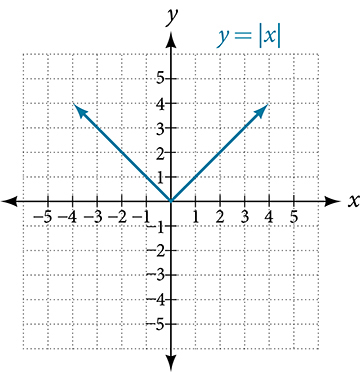
Figure 2
Figure 3 shows the graph of \(y = 2\left| {x–3} \right| + 4.\) The graph of \(y = |x|\) has been shifted right 3 units, vertically stretched by a factor of 2, and shifted up 4 units. This means that the corner point is located at \(\left( {3,4} \right)\) for this transformed function.
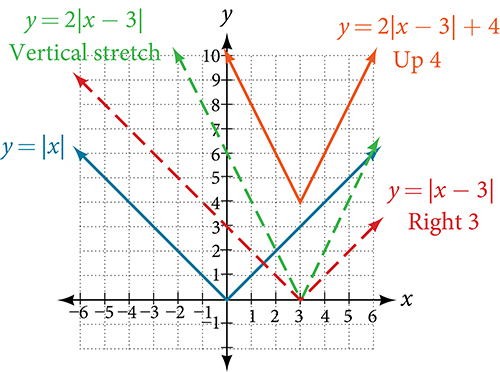
Figure 3
Write an equation for the function graphed in Figure 4.
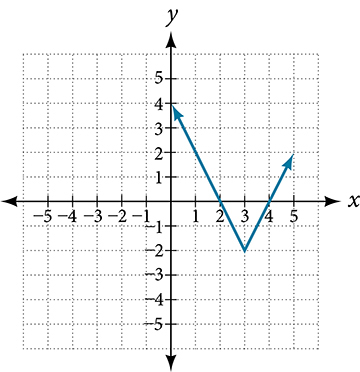
Figure 4
Solution (click to reveal)
The basic absolute value function changes direction at the origin, so this graph has been shifted to the right 3 units and down 2 units from the basic toolkit function. See Figure 5.
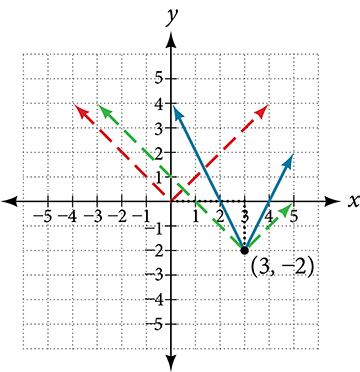
Figure 5
We also notice that the graph appears vertically stretched, because the width of the final graph on a horizontal line is not equal to 2 times the vertical distance from the corner to this line, as it would be for an unstretched absolute value function. Instead, the width is equal to 1 times the vertical distance as shown in Figure 6.
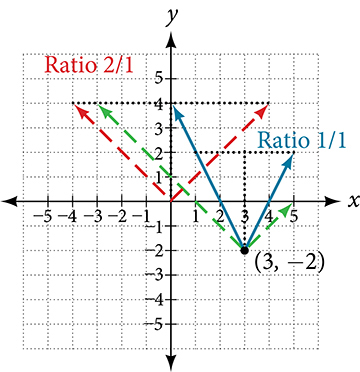
Figure 6
From this information we can write the equation
\[\begin{array}{rcll} {f(x)} & = & \left. 2 \middle| x - 3 \middle| - 2, \right. & {\quad\text{treating~the~stretch~as~}a\mspace{9mu}\text{vertical~stretch,or}} \\ {f(x)} & = & \left| 2(x - 3) \middle| - 2, \right. & {\quad\text{treating~the~stretch~as~}a\mspace{9mu}\text{horizontal~compression}.} \end{array}\]
Note that these equations are algebraically equivalent—the stretch for an absolute value function can be written interchangeably as a vertical or horizontal stretch or compression. Note also that if the vertical stretch factor is negative, there is also a reflection about the x-axis.
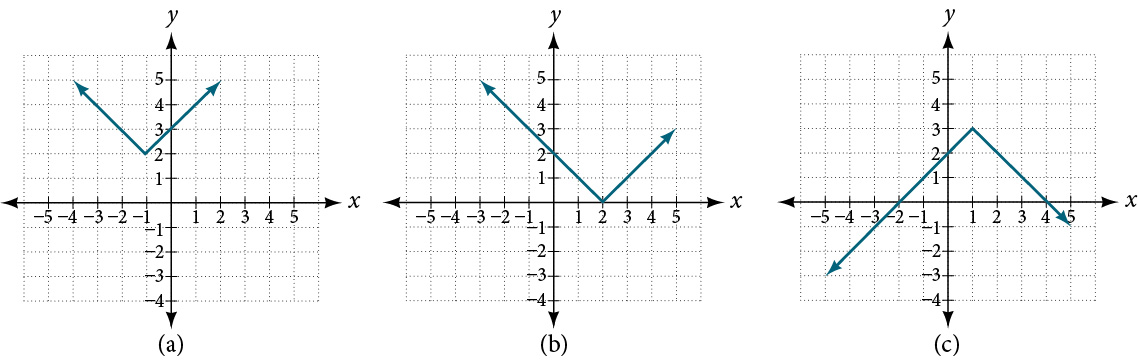
Figure 7 (a) The absolute value function does not intersect the horizontal axis. (b) The absolute value function intersects the horizontal axis at one point. (c) The absolute value function intersects the horizontal axis at two points.
3.6.3 Solving an Absolute Value Equation
In Other Types of Equations, we touched on the concepts of absolute value equations. Now that we understand a little more about their graphs, we can take another look at these types of equations. Now that we can graph an absolute value function, we will learn how to solve an absolute value equation. To solve an equation such as \(8 = \left| {2x - 6} \right|,\) we notice that the absolute value will be equal to 8 if the quantity inside the absolute value is 8 or -8. This leads to two different equations we can solve independently.
\[\begin{array}{rclcrcl} {2x - 6} & = & 8 & {\quad\text{or}\quad} & {2x - 6} & = & -8 \\ {2x} & = & 14 & & {2x} & = & -2 \\ x & = & 7 & & x & = & -1 \end{array}\]
Knowing how to solve problems involving absolute value functions is useful. For example, we may need to identify numbers or points on a line that are at a specified distance from a given reference point.
An absolute value equation is an equation in which the unknown variable appears in absolute value bars. For example,
\[\begin{array}{l} \left| x \middle| = 4, \right. \\ \left| 2x - 1 \middle| = 3,\text{or} \right. \\ \left| 5x + 2 \middle| - 4 = 9 \right. \end{array}\]
For the function \(\left. f(x) = \middle| 4x + 1 \middle| - 7, \right.\) find the values of \(x\) such that \(f(x) = 0.\)
Solution (click to reveal)
\[\begin{matrix} 0 & = & \left| 4x + 1 \middle| - 7 \right. & & & & & {\text{Substitute~0~for~}f(x).} \\ 7 & = & |4x + 1| & & & & & {\text{Isolate~the~absolute~value~on~one~side~of~the~equation}.} \\ & & & & & & & \\ & & & & & & & \\ & & & & & & & \\ 7 & = & {4x + 1} & \text{or} & {\qquad-7} & = & {4x + 1} & {\text{Break~into~two~separate~equations~and~solve}.} \\ 6 & = & {4x} & & -8 & = & {4x} & \\ & & & & & & & \\ x & = & {\frac{6}{4} = 1.5} & & x & = & {\frac{- 8}{4} = - 2} & \end{matrix}\]
The function outputs 0 when \(x = \frac{3}{2}\) or \(x = - 2.\) See Figure 8.
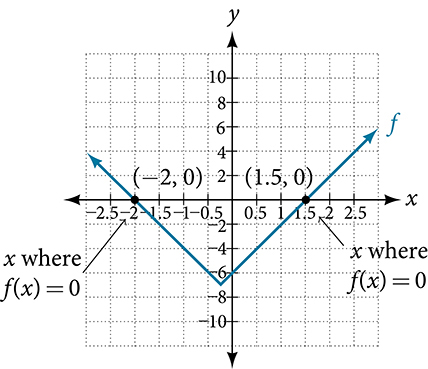
Figure 8
Section Exercises
Verbal
1. How do you solve an absolute value equation?
Solution (click to reveal)
Isolate the absolute value term so that the equation is of the form \(\left| A \middle| = B. \right.\) Form one equation by setting the expression inside the absolute value symbol, \(A,\) equal to the expression on the other side of the equation, \(B.\) Form a second equation by setting \(A\) equal to the opposite of the expression on the other side of the equation, \(- B.\) Solve each equation for the variable.
2. How can you tell whether an absolute value function has two \(x\)-intercepts without graphing the function?
3. When solving an absolute value function, the isolated absolute value term is equal to a negative number. What does that tell you about the graph of the absolute value function?
Solution (click to reveal)
The graph of the absolute value function does not cross the \(x\) -axis, so the graph is either completely above or completely below the \(x\) -axis.
4. How can you use the graph of an absolute value function to determine the \(x\)-values for which the function values are negative?
Algebraic
5. Describe all numbers \(x\) that are at a distance of 4 from the number 8. Express this set of numbers using absolute value notation.
Solution (click to reveal)
The distance from x to 8 can be represented using the absolute value statement: ∣ x − 8 ∣ = 4.
6. Describe all numbers \(x\) that are at a distance of \(\frac{1}{2}\) from the number −4. Express this set of numbers using absolute value notation.
7. Describe the situation in which the distance that point \(x\) is from 10 is at least 15 units. Express this set of numbers using absolute value notation.
Solution (click to reveal)
∣ x − 10 ∣ ≥ 15
8. Find all function values \(f(x)\) such that the distance from \(f(x)\) to the value 8 is less than 0.03 units. Express this set of numbers using absolute value notation.
For the following exercises, find the \(x\)- and \(y\)-intercepts of the graphs of each function.
9. \(f(x) = 4\left| {x - 3} \right| + 4\)
Solution (click to reveal)
There are no x-intercepts.
10. \(f(x) = - 3\left| {x - 2} \right| - 1\)
11. \(f(x) = - 2\left| {x + 1} \right| + 6\)
Solution (click to reveal)
(−4, 0) and (2, 0)
12. \(\left. f(x) = - 5 \middle| x + 2 \middle| + 15 \right.\)
13. \(\left. f(x) = 2 \middle| x - 1 \middle| - 6 \right.\)
Solution (click to reveal)
\((0, - 4),(4,0),( - 2,0)\)
14. \(\left. f(x) = \middle| - 2x + 1 \middle| - 13 \right.\)
15. \(\left. f(x) = - \middle| x - 9 \middle| + 16 \right.\)
Solution (click to reveal)
\((0,7),(25,0),( - 7,0)\)
Graphical
For the following exercises, graph the absolute value function. Plot at least five points by hand for each graph.
16. \(\left. y = \middle| x - 1 \right|\)
17. \(\left. y = \middle| x + 1 \right|\)
Solution (click to reveal)
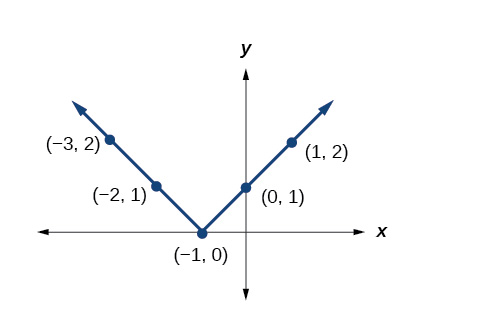
18. \(\left. y = \middle| x \middle| + 1 \right.\)
For the following exercises, graph the given functions by hand.
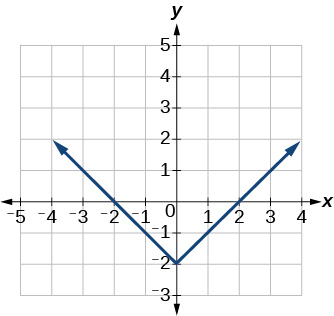
19. \(y = |x| - 2\)
Solution (click to reveal)
20. \(y = - |x|\)
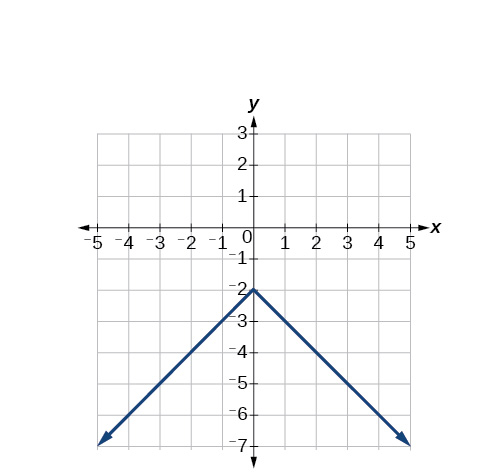
21. \(y = - |x| - 2\)
Solution (click to reveal)
22. \(y = - \left| {x - 3} \right| - 2\)
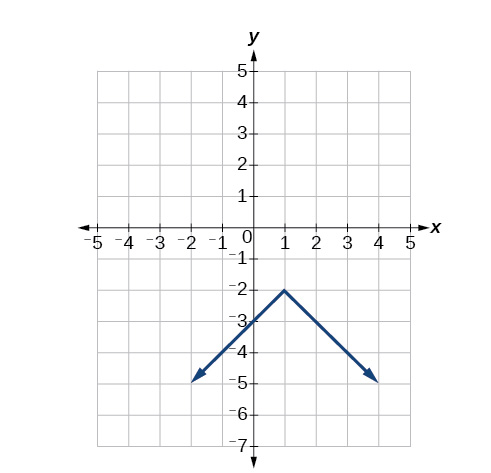
23. \(\left. f(x) = - \middle| x - 1 \middle| - 2 \right.\)
Solution (click to reveal)
24. \(\left. f(x) = - \middle| x + 3 \middle| + 4 \right.\)
25. \(\left. f(x) = 2 \middle| x + 3 \middle| + 1 \right.\)
Solution (click to reveal)
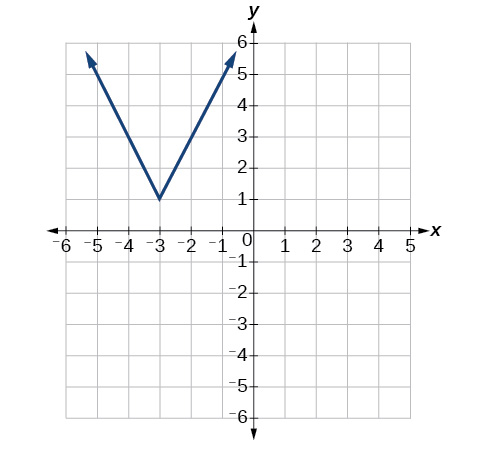
26. \(f(x) = 3\left| {x - 2} \right| + 3\)
27. \(f(x) = \left| {2x - 4} \right| - 3\)
Solution (click to reveal)
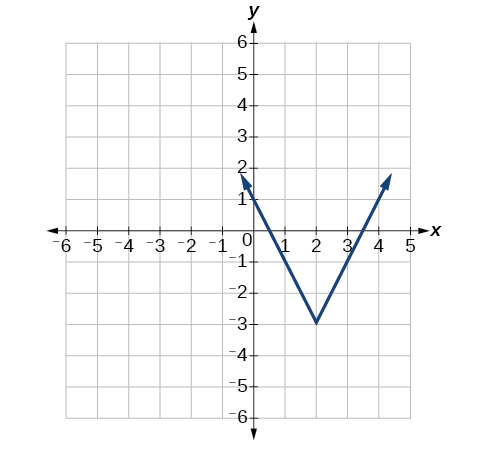
28. \(f(x) = \left| {3x + 9} \right| + 2\)
29. \(f(x) = - \left| {x - 1} \right| - 3\)
Solution (click to reveal)
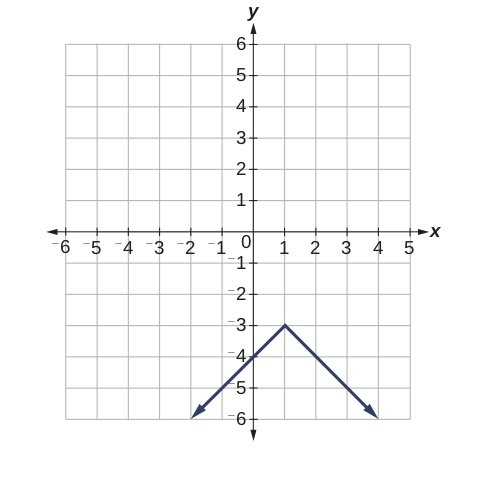
30. \(f(x) = - \left| {x + 4} \right| - 3\)
31. \(f(x) = \frac{1}{2}\left| {x + 4} \right| - 3\)
Solution (click to reveal)
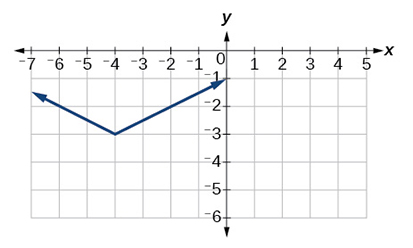
Technology
32. Use a graphing utility to graph \(\left. f(x) = 10 \middle| x - 2 \right|\) on the viewing window \(\left\lbrack {0,4} \right\rbrack.\) Identify the corresponding range. Show the graph.
33. Use a graphing utility to graph \(\left. f(x) = - 100 \middle| x \middle| + 100 \right.\) on the viewing window \(\left\lbrack {- 5,5} \right\rbrack.\) Identify the corresponding range. Show the graph.
Solution (click to reveal)
range: \(\lbrack –400{,}100\rbrack\)
![Graph of f(x) = negative 100|x| + 100 on a coordinate plane with viewing window [negative 5, 5]. The inverted V-shaped graph has its vertex at (0, 100), with the left ray descending through (negative 5, negative 400) and the right ray descending through (5, negative 400).](../images/CNX_Precalc_Figure_01_06_218-8acf.jpg)
For the following exercises, graph each function using a graphing utility. Specify the viewing window.
34. \(f(x) = - 0.1\left| {0.1(0.2 - x)} \right| + 0.3\)
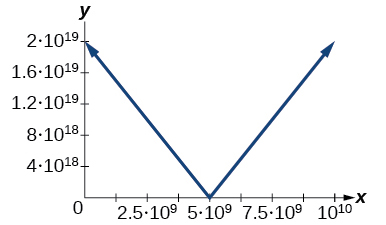
35. \(f(x) = 4 \times 10^{9}\left| {x - \left( 5 \times 10^{9} \right)} \right| + 2 \times 10^{9}\)
Solution (click to reveal)
Extensions
For the following exercises, solve the inequality.
36. If possible, find all values of \(a\) such that there are no \(x\text{-}\) intercepts for \(f(x) = 2\left| {x + 1} \right| + a.\)
37. If possible, find all values of \(a\) such that there are no \(y\) -intercepts for \(f(x) = 2\left| {x + 1} \right| + a.\)
Solution (click to reveal)
There is no solution for \(a\) that will keep the function from having a \(y\) -intercept. The absolute value function always crosses the \(y\) -intercept when \(x = 0.\)
Real-World Applications
38. Cities A and B are on the same east-west line. Assume that city A is located at the origin. If the distance from city A to city B is at least 100 miles and \(x\) represents the distance from city B to city A, express this using absolute value notation.
39. The true proportion \(p\) of people who give a favorable rating to Congress is 8% with a margin of error of 1.5%. Describe this statement using an absolute value equation.
Solution (click to reveal)
\(\left| {p - 0.08} \right| \leq 0.015\)
40. Students who score within 18 points of the number 82 will pass a particular test. Write this statement using absolute value notation and use the variable \(x\) for the score.
41. A machinist must produce a bearing that is within 0.01 inches of the correct diameter of 5.0 inches. Using \(x\) as the diameter of the bearing, write this statement using absolute value notation.
Solution (click to reveal)
\(\left| {x - 5.0} \right| \leq 0.01\)
42. The tolerance for a ball bearing is 0.01. If the true diameter of the bearing is to be 2.0 inches and the measured value of the diameter is \(x\) inches, express the tolerance using absolute value notation.