11.1 Systems of Linear Equations: Two Variables
Figure 1 (credit: Thomas Sørenes)
A skateboard manufacturer introduces a new line of boards. The manufacturer tracks its costs, which is the amount it spends to produce the boards, and its revenue, which is the amount it earns through sales of its boards. How can the company determine if it is making a profit with its new line? How many skateboards must be produced and sold before a profit is possible? In this section, we will consider linear equations with two variables to answer these and similar questions.
11.1.1 Introduction to Systems of Equations
In order to investigate situations such as that of the skateboard manufacturer, we need to recognize that we are dealing with more than one variable and likely more than one equation. A system of linear equations consists of two or more linear equations made up of two or more variables such that all equations in the system are considered simultaneously. To find the unique solution to a system of linear equations, we must find a numerical value for each variable in the system that will satisfy all equations in the system at the same time. Some linear systems may not have a solution and others may have an infinite number of solutions. In order for a linear system to have a unique solution, there must be at least as many equations as there are variables. Even so, this does not guarantee a unique solution.
In this section, we will look at systems of linear equations in two variables, which consist of two equations that contain two different variables. For example, consider the following system of linear equations in two variables.
\[\begin{matrix} {2x + y = \mspace{9mu} 15} \\ {3x–y = \mspace{9mu} 5} \end{matrix}\]
The solution to a system of linear equations in two variables is any ordered pair that satisfies each equation independently. In this example, the ordered pair (4, 7) is the solution to the system of linear equations. We can verify the solution by substituting the values into each equation to see if the ordered pair satisfies both equations. Shortly we will investigate methods of finding such a solution if it exists.
\[\begin{array}{l} {2(4) + (7) = 15\mspace{9mu}\text{True}} \\ {3(4) - (7) = 5\mspace{9mu}\text{True}} \end{array}\]
In addition to considering the number of equations and variables, we can categorize systems of linear equations by the number of solutions. A consistent system of equations has at least one solution. A consistent system is considered to be an independent system if it has a single solution, such as the example we just explored. The two lines have different slopes and intersect at one point in the plane. A consistent system is considered to be a dependent system if the equations have the same slope and the same \(y\)-intercepts. In other words, the lines coincide so the equations represent the same line. Every point on the line represents a coordinate pair that satisfies the system. Thus, there are an infinite number of solutions.
Another type of system of linear equations is an inconsistent system, which is one in which the equations represent two parallel lines. The lines have the same slope and different \(y\)-intercepts. There are no points common to both lines; hence, there is no solution to the system.
There are three types of systems of linear equations in two variables, and three types of solutions.
- An independent system has exactly one solution pair \(\left( {x,y} \right).\) The point where the two lines intersect is the only solution.
- An inconsistent system has no solution. Notice that the two lines are parallel and will never intersect.
- A dependent system has infinitely many solutions. The lines are coincident. They are the same line, so every coordinate pair on the line is a solution to both equations.
Figure 2 compares graphical representations of each type of system.
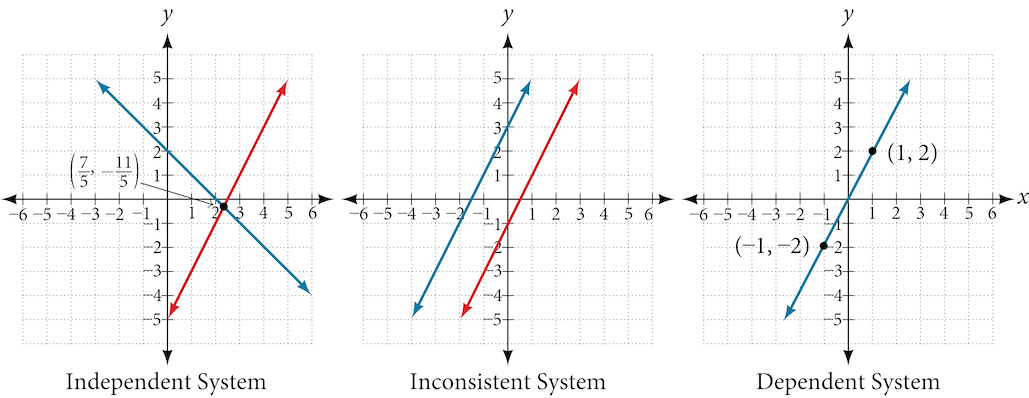
Figure 2
Determine whether the ordered pair \(\left( {5,1} \right)\) is a solution to the given system of equations.
\[\begin{array}{l} {\mspace{9mu} x + 3y = 8} \\ {\mspace{9mu} 2x - 9 = y} \end{array}\]
Solution (click to reveal)
Substitute the ordered pair \(\left( {5,1} \right)\) into both equations.
\[\begin{array}{ll} {(5) + 3(1) = 8} & \\ {8 = 8} & \text{True} \\ {2(5) - 9 = (1)} & \\ \text{1=1} & \text{True} \end{array}\]
The ordered pair \(\left( {5,1} \right)\) satisfies both equations, so it is the solution to the system.
We can see the solution clearly by plotting the graph of each equation. Since the solution is an ordered pair that satisfies both equations, it is a point on both of the lines and thus the point of intersection of the two lines. See Figure 3.
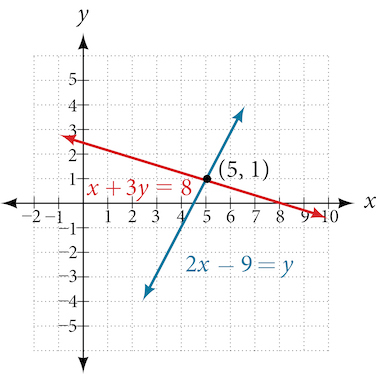
Figure 3
11.1.2 Solving Systems of Equations by Graphing
There are multiple methods of solving systems of linear equations. For a system of linear equations in two variables, we can determine both the type of system and the solution by graphing the system of equations on the same set of axes.
Solve the following system of equations by graphing. Identify the type of system.
\[\begin{matrix} {2x + y = -8} \\ {x - y = -1} \end{matrix}\]
Solution (click to reveal)
Solve the first equation for \(y.\)
\[\begin{matrix} {2x + y = -8} \\ {y = -2x-8} \end{matrix}\]
Solve the second equation for \(y.\)
\[\begin{matrix} {x - y = -1} \\ {y = x + 1} \end{matrix}\]
Graph both equations on the same set of axes as in Figure 4.
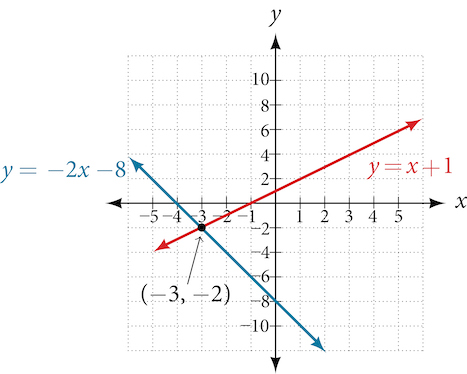
Figure 4
The lines appear to intersect at the point \(\left( {-3,-2} \right).\) We can check to make sure that this is the solution to the system by substituting the ordered pair into both equations.
\[\begin{array}{ll} {2(-3) + (-2) = -8} & \\ {\mspace{9mu}-8 = -8} & \text{True} \\ {\mspace{9mu}(-3) - (-2) = -1} & \\ {\mspace{9mu}-1 = -1} & \text{True} \end{array}\]
The solution to the system is the ordered pair \(\left( {-3,-2} \right),\) so the system is independent.
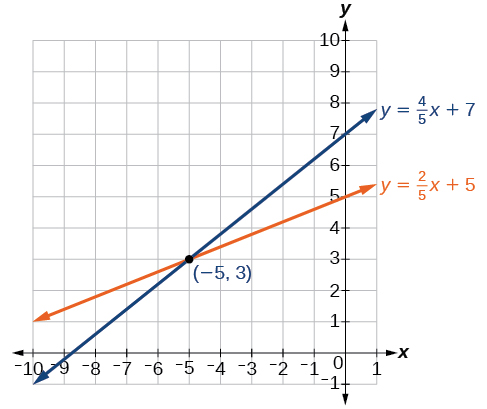
Solve the following system of equations by graphing.
\[\begin{array}{l} {2x - 5y = -25} \\ {- 4x + 5y = 35} \end{array}\]
Solution (click to reveal)
The solution to the system is the ordered pair \(\left( {-5,3} \right).\)
11.1.3 Solving Systems of Equations by Substitution
Solving a linear system in two variables by graphing works well when the solution consists of integer values, but if our solution contains decimals or fractions, it is not the most precise method. We will consider two more methods of solving a system of linear equations that are more precise than graphing. One such method is solving a system of equations by the substitution method, in which we solve one of the equations for one variable and then substitute the result into the second equation to solve for the second variable. Recall that we can solve for only one variable at a time, which is the reason the substitution method is both valuable and practical.
11.1.4 Solving Systems of Equations in Two Variables by the Addition Method
A third method of solving systems of linear equations is the addition method. In this method, we add two terms with the same variable, but opposite coefficients, so that the sum is zero. Of course, not all systems are set up with the two terms of one variable having opposite coefficients. Often we must adjust one or both of the equations by multiplication so that one variable will be eliminated by addition.
Solve the given system of equations by addition.
\[\begin{array}{l} {x + 2y = -1} \\ {- x + y = 3} \end{array}\]
Solution (click to reveal)
Both equations are already set equal to a constant. Notice that the coefficient of \(x\) in the second equation, –1, is the opposite of the coefficient of \(x\) in the first equation, 1. We can add the two equations to eliminate \(x\) without needing to multiply by a constant.
\[\frac{\begin{array}{l} \\ {x + 2y = - 1} \\ {- x + y = 3} \end{array}}{3y = 2}\]
Now that we have eliminated \(x,\) we can solve the resulting equation for \(y.\)
\[\begin{array}{l} {3y = 2} \\ {y = \frac{2}{3}} \end{array}\]
Then, we substitute this value for \(y\) into one of the original equations and solve for \(x.\)
\[\begin{array}{l} {- x + y = 3} \\ {- x + \frac{2}{3} = 3} \\ {- x = 3 - \frac{2}{3}} \\ {- x = \frac{7}{3}} \\ {x = - \frac{7}{3}} \end{array}\]
The solution to this system is \(\left( {- \frac{7}{3},\frac{2}{3}} \right).\)
Check the solution in the first equation.
\[\begin{array}{llll} {x + 2y = -1} & & & \\ {\left( {- \frac{7}{3}} \right) + 2\left( \frac{2}{3} \right) =} & & & \\ {- \frac{7}{3} + \frac{4}{3} =} & & & \\ {- \frac{3}{3} =} & & & \\ {-1 = -1} & & & \text{True} \end{array}\]
We gain an important perspective on systems of equations by looking at the graphical representation. See Figure 5 to find that the equations intersect at the solution. We do not need to ask whether there may be a second solution because observing the graph confirms that the system has exactly one solution.
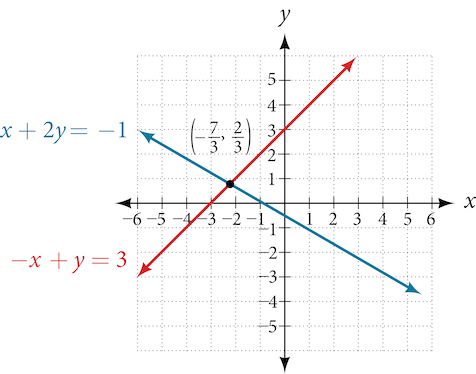
Figure 5
Solve the given system of equations by the addition method.
\[\begin{array}{l} {3x + 5y = -11} \\ \\ {\mspace{9mu} x - 2y = 11} \end{array}\]
Solution (click to reveal)
Adding these equations as presented will not eliminate a variable. However, we see that the first equation has \(3x\) in it and the second equation has \(x.\) So if we multiply the second equation by \(-3,\) the \(x\)-terms will add to zero.
\[\begin{array}{llll} {x-2y = 11} & & & \\ {-3(x-2y) = -3(11)} & & & {\text{Multiply~both~sides~by~}-3.} \\ {-3x + 6y = -33} & & & {\text{Use~the~distributive~property}.} \end{array}\]
Now, let’s add them.
\[\begin{array}{l} \underset{\operatorname{\_\_\_\_\_\_\_\_\_\_\_\_\_\_\_}}{\begin{array}{l} \\ \begin{array}{l} {\mspace{9mu}\text{~~}3x + 5y = -11} \\ {-3x + 6y = -33} \end{array} \end{array}} \\ {\mspace{9mu}\text{~~~~~~~~}11y = -44} \\ {\mspace{9mu}\text{~~~~~~~~~~~~}y = -4} \end{array}\]
For the last step, we substitute \(y = -4\) into one of the original equations and solve for \(x.\)
\[\begin{matrix} {\mspace{9mu} 3x + 5y = - 11} \\ {\mspace{9mu} 3x + 5( - 4) = - 11} \\ {\mspace{9mu} 3x - 20 = - 11} \\ {\mspace{9mu} 3x = 9} \\ {\mspace{9mu} x = 3} \end{matrix}\]
Our solution is the ordered pair \(\left( {3,-4} \right).\) See Figure 6. Check the solution in the original second equation.
\[\begin{array}{llll} {\mspace{9mu} x - 2y = 11} & & & \\ {(3) - 2( - 4) = 3 + 8} & & & \\ {\mspace{9mu} 11 = 11} & & & \text{True} \end{array}\]
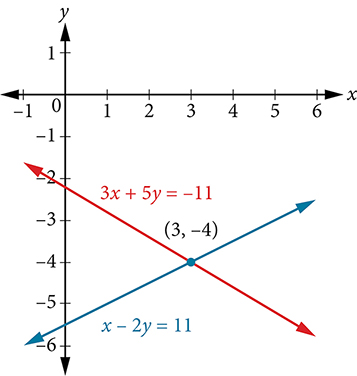
Figure 6
Solve the given system of equations in two variables by addition.
\[\begin{matrix} {2x + 3y = -16} \\ {5x-10y = 30} \end{matrix}\]
Solution (click to reveal)
One equation has \(2x\) and the other has \(5x.\) The least common multiple is \(10x\) so we will have to multiply both equations by a constant in order to eliminate one variable. Let’s eliminate \(x\) by multiplying the first equation by \(-5\) and the second equation by \(2.\)
\[\begin{array}{l} {~ - 5(2x + 3y) = - 5(-16)} \\ {\mspace{9mu}\text{~~~} - 10x - 15y = 80} \\ {\mspace{9mu}\text{~~~~~}2(5x - 10y) = 2(30)} \\ {\mspace{9mu}\text{~~~~~~~~}10x - 20y = 60} \end{array}\]
Then, we add the two equations together.
\[\begin{array}{l} \underset{\_\_\_\_\_\_\_\_\_\_\_\_\_\_\_\_}{\begin{array}{l} \\ \begin{array}{l} {-10x-15y=80\mspace{9mu}\text{~~}} \\ {10x-20y=60} \end{array} \end{array}} \\ {-35y = 140} \\ {y = -4} \end{array}\]
Substitute \(y = -4\) into the original first equation.
\[\begin{matrix} {2x + 3(-4) = -16} \\ {\mspace{9mu} 2x - 12 = -16} \\ {\mspace{9mu} 2x = -4} \\ {\mspace{9mu} x = -2} \end{matrix}\]
The solution is \(\left( {-2,-4} \right).\) Check it in the other equation.
\[\begin{array}{r} {\mspace{9mu}\text{~~~~~~~~~}5x-10y = 30} \\ {5(-2)-10(-4) = 30} \\ {\mspace{9mu}\text{~~~~~~~~}-10 + 40 = 30} \\ {\mspace{9mu}\text{~~~~~~~~~~~~~~~~~~~}30 = 30} \end{array}\]
See Figure 7.
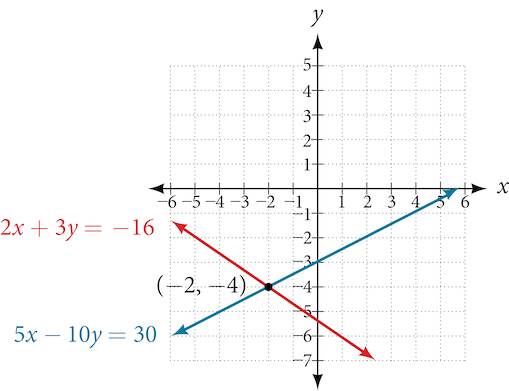
Figure 7
11.1.5 Identifying Inconsistent Systems of Equations Containing Two Variables
Now that we have several methods for solving systems of equations, we can use the methods to identify inconsistent systems. Recall that an inconsistent system consists of parallel lines that have the same slope but different \(y\) -intercepts. They will never intersect. When searching for a solution to an inconsistent system, we will come up with a false statement, such as \(12 = 0.\)
Solve the following system of equations.
\[\begin{array}{l} {x = 9-2y} \\ {x + 2y = 13} \end{array}\]
Solution (click to reveal)
We can approach this problem in two ways. Because one equation is already solved for \(x,\) the most obvious step is to use substitution.
\[\begin{array}{l} {\mspace{9mu} x + 2y = 13} \\ {\mspace{9mu}(9 - 2y) + 2y = 13} \\ {\mspace{9mu} 9 + 0y = 13} \\ {\mspace{9mu} 9 = 13} \end{array}\]
Clearly, this statement is a contradiction because \(9 \neq 13.\) Therefore, the system has no solution.
The second approach would be to first manipulate the equations so that they are both in slope-intercept form. We manipulate the first equation as follows.
\[\begin{array}{l} {\mspace{9mu} x = 9-2y} \\ {2y = - x + 9} \\ {\mspace{9mu} y = - \frac{1}{2}x + \frac{9}{2}} \end{array}\]
We then convert the second equation expressed to slope-intercept form.
\[\begin{array}{l} {x + 2y = 13} \\ {\mspace{9mu} 2y = - x + 13} \\ {\mspace{9mu} y = - \frac{1}{2}x + \frac{13}{2}} \end{array}\]
Comparing the equations, we see that they have the same slope but different \(y\)-intercepts. Therefore, the lines are parallel and do not intersect.
\[\begin{array}{l} \begin{array}{l} \\ {y = - \frac{1}{2}x + \frac{9}{2}} \end{array} \\ {y = - \frac{1}{2}x + \frac{13}{2}} \end{array}\]
Writing the equations in slope-intercept form confirms that the system is inconsistent because all lines will intersect eventually unless they are parallel. Parallel lines will never intersect; thus, the two lines have no points in common. The graphs of the equations in this example are shown in Figure 8.
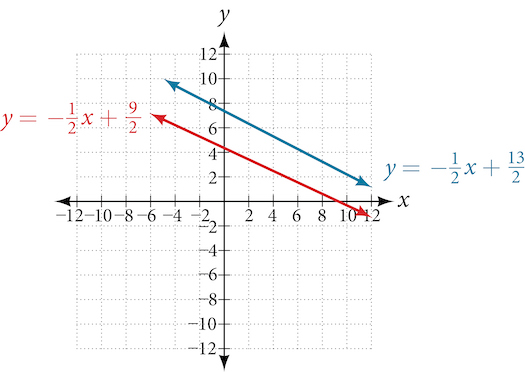
Figure 8
11.1.6 Expressing the Solution of a System of Dependent Equations Containing Two Variables
Recall that a dependent system of equations in two variables is a system in which the two equations represent the same line. Dependent systems have an infinite number of solutions because all of the points on one line are also on the other line. After using substitution or addition, the resulting equation will be an identity, such as \(0 = 0.\)
Find a solution to the system of equations using the addition method.
\[\begin{matrix} {\mspace{9mu} x + 3y = 2} \\ {3x + 9y = 6} \end{matrix}\]
Solution (click to reveal)
With the addition method, we want to eliminate one of the variables by adding the equations. In this case, let’s focus on eliminating \(x.\) If we multiply both sides of the first equation by \(-3,\) then we will be able to eliminate the \(x\) -variable.
\[\begin{array}{l} {\mspace{9mu} x + 3y = 2} \\ {~(-3)(x + 3y) = (-3)(2)} \\ {\mspace{9mu}-3x - 9y = - 6} \end{array}\]
Now add the equations.
\[\begin{array}{l} \underset{\_\_\_\_\_\_\_\_\_\_\_\_\_\_}{\begin{array}{ll} {\mspace{9mu}-3x-9y} & {=-6} \\ {+\mspace{9mu} 3x+9y} & {=6} \end{array}} \\ \begin{array}{ll} {\mspace{9mu} 0} & {= 0} \end{array} \end{array}\]
We can see that there will be an infinite number of solutions that satisfy both equations.
If we rewrote both equations in the slope-intercept form, we might know what the solution would look like before adding. Let’s look at what happens when we convert the system to slope-intercept form.
\[\begin{array}{l} {\mspace{9mu}\ x + 3y = 2} \\ {\mspace{9mu}\text{~~~~~~~}3y = - x + 2} \\ {\mspace{9mu}\text{~~~~~~~~~}y = - \frac{1}{3}x + \frac{2}{3}} \\ {3x + 9y = 6} \\ {\mspace{9mu}\text{~~~~~~~}9y = -3x + 6} \\ {\mspace{9mu}\text{~~~~~~~~~}y = - \frac{3}{9}x + \frac{6}{9}} \\ {\mspace{9mu}\text{~~~~~~~~~}y = - \frac{1}{3}x + \frac{2}{3}} \end{array}\]
See Figure 9. Notice the results are the same. The general solution to the system is \(\left( {x\operatorname{,\ -}\frac{1}{3}x + \frac{2}{3}} \right).\)
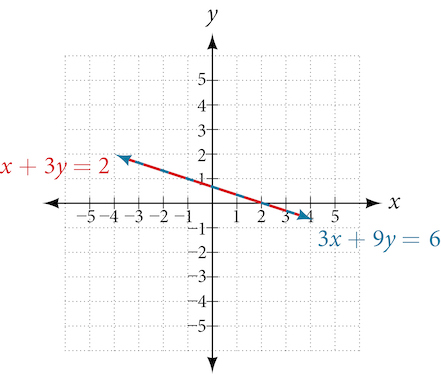
Figure 9
11.1.7 Using Systems of Equations to Investigate Profits
Using what we have learned about systems of equations, we can return to the skateboard manufacturing problem at the beginning of the section. The skateboard manufacturer’s revenue function is the function used to calculate the amount of money that comes into the business. It can be represented by the equation \(R = xp,\) where \(x =\) quantity and \(p =\) price. The revenue function is shown in orange in Figure 10.
The cost function is the function used to calculate the costs of doing business. It includes fixed costs, such as rent and salaries, and variable costs, such as utilities. The cost function is shown in blue in Figure 10. The \(x\) -axis represents quantity in hundreds of units. The \(y\)-axis represents either cost or revenue in hundreds of dollars.
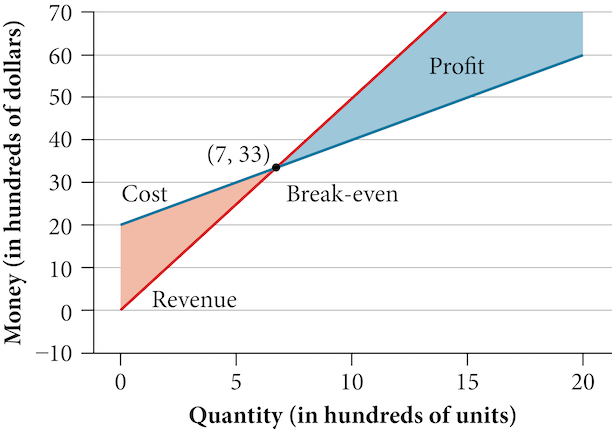
Figure 10
The point at which the two lines intersect is called the break-even point. We can see from the graph that if 700 units are produced, the cost is $3,300 and the revenue is also $3,300. In other words, the company breaks even if they produce and sell 700 units. They neither make money nor lose money.
The shaded region to the right of the break-even point represents quantities for which the company makes a profit. The shaded region to the left represents quantities for which the company suffers a loss. The profit function is the revenue function minus the cost function, written as \(P(x) = R(x) - C(x).\) Clearly, knowing the quantity for which the cost equals the revenue is of great importance to businesses.
Given the cost function \(C(x) = 0.85x + 35{,}000\) and the revenue function \(R(x) = 1.55x,\) find the break-even point and the profit function.
Solution (click to reveal)
Write the system of equations using \(y\) to replace function notation.
\[\begin{array}{l} \begin{array}{l} \\ {y = 0.85x + 35{,}000} \end{array} \\ {y = 1.55x} \end{array}\]
Substitute the expression \(0.85x + 35{,}000\) from the first equation into the second equation and solve for \(x.\)
\[\begin{matrix} {0.85x + 35{,}000 = 1.55x} \\ {\mspace{9mu} 35{,}000 = 0.7x} \\ {\mspace{9mu} 50{,}000 = x} \end{matrix}\]
Then, we substitute \(x = 50{,}000\) into either the cost function or the revenue function.
\[1.55(50{,}000) = 77{,}500\]
The break-even point is \(\left( {50{,}000,77{,}500} \right).\)
The profit function is found using the formula \(P(x) = R(x) - C(x).\)
\[\begin{array}{l} {P(x) = 1.55x - (0.85x + 35{,}000)} \\ {\mspace{9mu}\text{~~~~~~~} = 0.7x - 35{,}000} \end{array}\]
The profit function is \(P(x) = 0.7x-35{,}000.\)
The cost to produce 50,000 units is $77,500, and the revenue from the sales of 50,000 units is also $77,500. To make a profit, the business must produce and sell more than 50,000 units. See Figure 11.
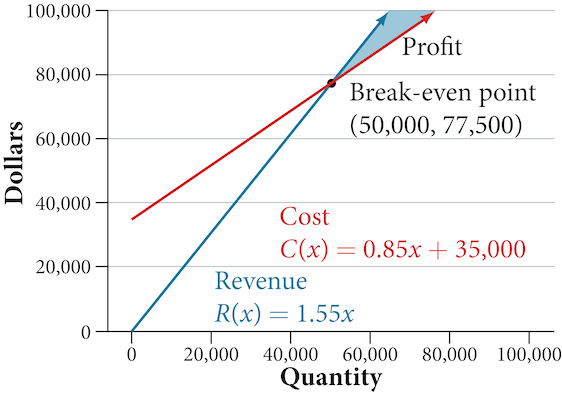
Figure 11
We see from the graph in Figure 12 that the profit function has a negative value until \(x = 50{,}000,\) when the graph crosses the \(x\)-axis. Then, the graph emerges into positive \(y\)-values and continues on this path as the profit function is a straight line. This illustrates that the break-even point for businesses occurs when the profit function is 0. The area to the left of the break-even point represents operating at a loss.
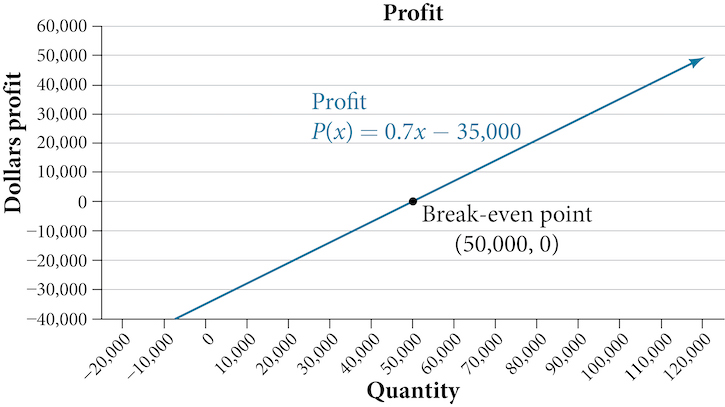
Figure 12
Section Exercises
Verbal
1. Can a system of linear equations have exactly two solutions? Explain why or why not.
Solution (click to reveal)
No, you can either have zero, one, or infinitely many. Examine graphs.
2. If you are performing a break-even analysis for a business and their cost and revenue equations are dependent, explain what this means for the company’s profit margins.
3. If you are solving a break-even analysis and get a negative break-even point, explain what this signifies for the company?
Solution (click to reveal)
This means there is no realistic break-even point. By the time the company produces one unit they are already making profit.
4. If you are solving a break-even analysis and there is no break-even point, explain what this means for the company. How should they ensure there is a break-even point?
5. Given a system of equations, explain at least two different methods of solving that system.
Solution (click to reveal)
You can solve by substitution (isolating \(x\) or \(y\) ), graphically, or by addition.
Algebraic
For the following exercises, determine whether the given ordered pair is a solution to the system of equations.
6. \(\begin{matrix} {5x - y = 4\mspace{9mu}} \\ {x + 6y = 2} \end{matrix}\) and \((4,0)\)
7. \(\begin{array}{l} {-3x - 5y = 13} \\ {\operatorname{} - x + 4y = 10} \end{array}\) and \((-6,1)\)
Solution (click to reveal)
Yes
8. \(\begin{matrix} {3x + 7y = 1\mspace{9mu}} \\ {2x + 4y = 0} \end{matrix}\) and \((2,3)\)
9. \(\begin{array}{l} {-2x + 5y = 7} \\ {\mspace{9mu} 2x + 9y = 7} \end{array}\) and \((-1,1)\)
Solution (click to reveal)
Yes
10. \(\begin{matrix} {x + 8y = 43\mspace{9mu}} \\ {3x-2y = -1} \end{matrix}\) and \((3,5)\)
For the following exercises, solve each system by substitution.
11. \(\begin{array}{l} {\mspace{9mu} x + 3y = 5} \\ {2x + 3y = 4} \end{array}\)
Solution (click to reveal)
\((-1,2)\)
12. \(\begin{array}{l} {\mspace{9mu} 3x-2y = 18} \\ {5x + 10y = -10} \end{array}\)
13. \(\begin{array}{l} {4x + 2y = -10} \\ {3x + 9y = 0} \end{array}\)
Solution (click to reveal)
\((-3,1)\)
14. \(\begin{array}{l} {2x + 4y = -3.8} \\ {9x-5y = 1.3} \end{array}\)
15. \(\begin{array}{l} {- 2x + 3y = 1.2} \\ {- 3x - 6y = 1.8} \end{array}\)
Solution (click to reveal)
\(\left( {- \frac{3}{5},0} \right)\)
16. \(\begin{array}{l} {\mspace{9mu} x-0.2y = 1} \\ {-10x + 2y = 5} \end{array}\)
17. \(\begin{array}{l} {\mspace{9mu} 3x + 5y = 9} \\ {30x + 50y = -90} \end{array}\)
Solution (click to reveal)
No solutions exist.
18. \(\begin{array}{l} {\mspace{9mu}-3x + y = 2} \\ {12x-4y = -8} \end{array}\)
19. \(\begin{array}{l} {\frac{1}{2}x + \frac{1}{3}y = 16} \\ {\frac{1}{6}x + \frac{1}{4}y = 9} \end{array}\)
Solution (click to reveal)
\(\left( {\frac{72}{5},\frac{132}{5}} \right)\)
20. \(\begin{array}{l} {- \frac{1}{4}x + \frac{3}{2}y = 11} \\ {- \frac{1}{8}x + \frac{1}{3}y = 3} \end{array}\)
For the following exercises, solve each system by addition.
21. \(\begin{array}{l} {-2x + 5y = -42} \\ {\mspace{9mu} 7x + 2y = 30} \end{array}\)
Solution (click to reveal)
\(\left( {6,-6} \right)\)
22. \(\begin{array}{l} {6x-5y = -34} \\ {2x + 6y = 4} \end{array}\)
23. \(\begin{array}{l} {\mspace{9mu} 5x - y = -2.6} \\ {-4x-6y = 1.4} \end{array}\)
Solution (click to reveal)
\(\left( {- \frac{1}{2},\frac{1}{10}} \right)\)
24. \(\begin{array}{l} {7x-2y = 3} \\ {4x + 5y = 3.25} \end{array}\)
25. \(\begin{array}{l} {\mspace{9mu}{-x} + 2y = -1} \\ {5x-10y = 6} \end{array}\)
Solution (click to reveal)
No solutions exist.
26. \(\begin{array}{l} {\mspace{9mu} 7x + 6y = 2} \\ {-28x-24y = -8} \end{array}\)
27. \(\begin{array}{l} {\frac{5}{6}x + \frac{1}{4}y = 0} \\ {\frac{1}{8}x - \frac{1}{2}y = - \frac{43}{120}} \end{array}\)
Solution (click to reveal)
\(\left( {- \frac{1}{5},\frac{2}{3}} \right)\)
28. \(\begin{array}{l} {\mspace{9mu}\frac{1}{3}x + \frac{1}{9}y = \frac{2}{9}} \\ {- \frac{1}{2}x + \frac{4}{5}y = - \frac{1}{3}} \end{array}\)
29. \(\begin{array}{l} \\ \begin{array}{l} {-0.2x + 0.4y = 0.6} \\ {\mspace{9mu} x-2y = -3} \end{array} \end{array}\)
Solution (click to reveal)
\(\left( {x,\frac{x + 3}{2}} \right)\)
30. \(\begin{array}{l} \begin{array}{l} \\ {-0.1x + 0.2y = 0.6} \end{array} \\ {\mspace{9mu} 5x-10y = 1} \end{array}\)
For the following exercises, solve each system by any method.
31. \(\begin{array}{l} {5x + 9y = 16} \\ {\mspace{9mu} x + 2y = 4} \end{array}\)
Solution (click to reveal)
\((-4,4)\)
32. \(\begin{array}{l} {6x-8y = -0.6} \\ {3x + 2y = 0.9} \end{array}\)
33. \(\begin{array}{l} {5x-2y = 2.25} \\ {7x-4y = 3} \end{array}\)
Solution (click to reveal)
\(\left( {\frac{1}{2},\frac{1}{8}} \right)\)
34. \(\begin{array}{l} {\mspace{9mu} x - \frac{5}{12}y = - \frac{55}{12}} \\ {-6x + \frac{5}{2}y = \frac{55}{2}} \end{array}\)
35. \(\begin{array}{l} {7x-4y = \frac{7}{6}} \\ {2x + 4y = \frac{1}{3}} \end{array}\)
Solution (click to reveal)
\(\left( {\frac{1}{6},0} \right)\)
36. \(\begin{array}{l} {3x + 6y = 11} \\ {2x + 4y = 9} \end{array}\)
37. \(\begin{array}{l} {\mspace{9mu}\frac{7}{3}x - \frac{1}{6}y = 2} \\ {- \frac{21}{6}x + \frac{3}{12}y = -3} \end{array}\)
Solution (click to reveal)
\(\left( {x,2(7x-6)} \right)\)
38. \(\begin{array}{l} {\frac{1}{2}x + \frac{1}{3}y = \frac{1}{3}} \\ {\frac{3}{2}x + \frac{1}{4}y = - \frac{1}{8}} \end{array}\)
39. \(\begin{array}{l} {2.2x + 1.3y = -0.1} \\ {4.2x + 4.2y = 2.1} \end{array}\)
Solution (click to reveal)
\(\left( {- \frac{5}{6},\frac{4}{3}} \right)\)
40. \(\begin{array}{l} {0.1x + 0.2y = 2} \\ {0.35x-0.3y = 0} \end{array}\)
Graphical
For the following exercises, graph the system of equations and state whether the system is consistent, inconsistent, or dependent and whether the system has one solution, no solution, or infinite solutions.
41. \(\begin{array}{l} {3x - y = 0.6} \\ {x-2y = 1.3} \end{array}\)
Solution (click to reveal)
Consistent with one solution
42. \(\begin{array}{l} \\ {- x + 2y = 4} \\ {\mspace{9mu} 2x-4y = 1} \end{array}\)
43. \(\begin{array}{l} {\mspace{9mu} x + 2y = 7} \\ {2x + 6y = 12} \end{array}\)
Solution (click to reveal)
Consistent with one solution
44. \(\begin{array}{l} {3x-5y = 7} \\ {\mspace{9mu} x-2y = 3} \end{array}\)
45. \(\begin{array}{l} {\mspace{9mu} 3x-2y = 5} \\ {-9x + 6y = -15} \end{array}\)
Solution (click to reveal)
Dependent with infinitely many solutions
Technology
For the following exercises, use the intersect function on a graphing device to solve each system. Round all answers to the nearest hundredth.
46. \(\begin{array}{l} {\mspace{9mu} 0.1x + 0.2y = 0.3} \\ {-0.3x + 0.5y = 1} \end{array}\)
47. \(\begin{array}{l} {-0.01x + 0.12y = 0.62} \\ {\mspace{9mu} 0.15x + 0.20y = 0.52} \end{array}\)
Solution (click to reveal)
\(\left( {-3.08,4.91} \right)\)
48. \(\begin{array}{l} {\mspace{9mu} 0.5x + 0.3y = 4} \\ {0.25x-0.9y = 0.46} \end{array}\)
49. \(\begin{array}{l} {\mspace{9mu} 0.15x + 0.27y = 0.39} \\ {-0.34x + 0.56y = 1.8} \end{array}\)
Solution (click to reveal)
\(\left( {-1.52,2.29} \right)\)
50. \(\begin{array}{l} \\ {-0.71x + 0.92y = 0.13} \\ {\mspace{9mu} 0.83x + 0.05y = 2.1} \end{array}\)
Extensions
For the following exercises, solve each system in terms of \(A,B,C,D,E,\) and \(F\) where \(A–F\) are nonzero numbers. Note that \(A \neq B\) and \(AE \neq BD.\)
51. \(\begin{array}{l} {x + y = A} \\ {x - y = B} \end{array}\)
Solution (click to reveal)
\(\left( {\frac{A + B}{2},\frac{A - B}{2}} \right)\)
52. \(\begin{array}{l} {x + Ay = 1} \\ {x + By = 1} \end{array}\)
53. \(\begin{array}{l} {Ax + y = 0} \\ {Bx + y = 1} \end{array}\)
Solution (click to reveal)
\(\left( {\frac{-1}{A - B},\frac{A}{A - B}} \right)\)
54. \(\begin{array}{l} {Ax + By = C} \\ {x + y = 1} \end{array}\)
55. \(\begin{array}{l} {Ax + By = C} \\ {Dx + Ey = F} \end{array}\)
Solution (click to reveal)
\(\left( {\frac{CE - BF}{BD - AE},\frac{AF - CD}{BD - AE}} \right)\)
Real-World Applications
For the following exercises, solve for the desired quantity.
56. A stuffed animal business has a total cost of production \(C = 12x + 30\) and a revenue function \(R = 20x.\) Find the break-even point.
57. An Ethiopian restaurant has a cost of production \(C(x) = 11x + 120\) and a revenue function \(R(x) = 5x.\) When does the company start to turn a profit?
Solution (click to reveal)
They never turn a profit.
58. A cell phone factory has a cost of production \(C(x) = 150x + 10{,}000\) and a revenue function \(R(x) = 200x.\) What is the break-even point?
59. A musician charges \(C(x) = 64x + 20{,}000\) where \(x\) is the total number of attendees at the concert. The venue charges $80 per ticket. After how many people buy tickets does the venue break even, and what is the value of the total tickets sold at that point?
Solution (click to reveal)
\((1{,}250,100{,}000)\)
60. A guitar factory has a cost of production \(C(x) = 75x + 50{,}000.\) If the company needs to break even after 150 units sold, at what price should they sell each guitar? Round up to the nearest dollar, and write the revenue function.
For the following exercises, use a system of linear equations with two variables and two equations to solve.
61. Find two numbers whose sum is 28 and difference is 13.
Solution (click to reveal)
The numbers are 7.5 and 20.5.
62. A number is 9 more than another number. Twice the sum of the two numbers is 10. Find the two numbers.
63. The startup cost for a restaurant is $120,000, and each meal costs $10 for the restaurant to make. If each meal is then sold for $15, after how many meals does the restaurant break even?
Solution (click to reveal)
24,000
64. A moving company charges a flat rate of $150, and an additional $5 for each box. If a taxi service would charge $20 for each box, how many boxes would you need for it to be cheaper to use the moving company, and what would be the total cost?
65. A total of 1,595 first- and second-year college students gathered at a pep rally. The number of first-years exceeded the number of second-years by 15. How many students from each year group were in attendance?
Solution (click to reveal)
790 second-year students, 805 first-year students
66. 276 students enrolled in an introductory chemistry class. By the end of the semester, 5 times the number of students passed as failed. Find the number of students who passed, and the number of students who failed.
67. There were 130 faculty at a conference. If there were 18 more women than men attending, how many of each gender attended the conference?
Solution (click to reveal)
56 men, 74 women
68. A jeep and a pickup truck enter a highway running east-west at the same exit heading in opposite directions. The jeep entered the highway 30 minutes before the pickup did, and traveled 7 mph slower than the pickup. After 2 hours from the time the pickup entered the highway, the cars were 306.5 miles apart. Find the speed of each car, assuming they were driven on cruise control and retained the same speed.
69. If a scientist mixed 10% saline solution with 60% saline solution to get 25 gallons of 40% saline solution, how many gallons of 10% and 60% solutions were mixed?
Solution (click to reveal)
10 gallons of 10% solution, 15 gallons of 60% solution
70. An investor earned triple the profits of what they earned last year. If they made $500,000.48 total for both years, how much did the investor earn in profits each year?
71. An investor invested 1.1 million dollars into two land investments. On the first investment, Swan Peak, her return was a 110% increase on the money she invested. On the second investment, Riverside Community, she earned 50% over what she invested. If she earned $1 million in profits, how much did she invest in each of the land deals?
Solution (click to reveal)
Swan Peak: $750,000, Riverside: $350,000
72. If an investor invests a total of $25,000 into two bonds, one that pays 3% simple interest, and the other that pays \(2\frac{7}{8}\text{\%}\) interest, and the investor earns $737.50 annual interest, how much was invested in each account?
73. If an investor invests $23,000 into two bonds, one that pays 4% in simple interest, and the other paying 2% simple interest, and the investor earns $710.00 annual interest, how much was invested in each account?
Solution (click to reveal)
$12,500 in the first account, $10,500 in the second account.
74. Blu-rays cost $5.96 more than regular DVDs at All Bets Are Off Electronics. How much would 6 Blu-rays and 2 DVDs cost if 5 Blu-rays and 2 DVDs cost $127.73?
75. A store clerk sold 60 pairs of sneakers. The high-tops sold for $98.99 and the low-tops sold for $129.99. If the receipts for the two types of sales totaled $6,404.40, how many of each type of sneaker were sold?
Solution (click to reveal)
High-tops: 45, Low-tops: 15
76. A concert manager counted 350 ticket receipts the day after a concert. The price for a student ticket was $12.50, and the price for an adult ticket was $16.00. The register confirms that $5,075 was taken in. How many student tickets and adult tickets were sold?
77. Admission into an amusement park for 4 children and 2 adults is $116.90. For 6 children and 3 adults, the admission is $175.35. Assuming a different price for children and adults, what is the price of the child’s ticket and the price of the adult ticket?
Solution (click to reveal)
Infinitely many solutions. We need more information.