6.1 Exponential Functions
India is the second most populous country in the world with a population of about \(1.39\) billion people in 2021. The population is growing at a rate of about \(1.2\%\) each year. If this rate continues, the population of India will exceed China’s population by the year \(2027.\) When populations grow rapidly, we often say that the growth is “exponential,” meaning that something is growing very rapidly. To a mathematician, however, the term exponential growth has a very specific meaning. In this section, we will take a look at exponential functions, which model this kind of rapid growth.
6.1.1 Identifying Exponential Functions
When exploring linear growth, we observed a constant rate of change—a constant number by which the output increased for each unit increase in input. For example, in the equation \(f(x) = 3x + 4,\) the slope tells us the output increases by 3 each time the input increases by 1. The scenario in the India population example is different because we have a percent change per unit time (rather than a constant change) in the number of people.
Defining an Exponential Function
A study found that the percent of the population who are vegans in the United States doubled from 2009 to 2011. In 2011, 2.5% of the population was vegan, adhering to a diet that does not include any animal products—no meat, poultry, fish, dairy, or eggs. If this rate continues, vegans will make up 10% of the U.S. population in 2015, 40% in 2019, and 80% in 2021.
What exactly does it mean to grow exponentially? What does the word double have in common with percent increase? People toss these words around errantly. Are these words used correctly? The words certainly appear frequently in the media.
- Percent change refers to a change based on a percent of the original amount.
- Exponential growth refers to an increase based on a constant multiplicative rate of change over equal increments of time, that is, a percent increase of the original amount over time.
- Exponential decay refers to a decrease based on a constant multiplicative rate of change over equal increments of time, that is, a percent decrease of the original amount over time.
For us to gain a clear understanding of exponential growth, let us contrast exponential growth with linear growth. We will construct two functions. The first function is exponential. We will start with an input of 0, and increase each input by 1. We will double the corresponding consecutive outputs. The second function is linear. We will start with an input of 0, and increase each input by 1. We will add 2 to the corresponding consecutive outputs. See Table 1.
| \(x\) | \(f(x) = 2^{x}\) | \(g(x) = 2x\) |
|---|---|---|
| 0 | 1 | 0 |
| 1 | 2 | 2 |
| 2 | 4 | 4 |
| 3 | 8 | 6 |
| 4 | 16 | 8 |
| 5 | 32 | 10 |
| 6 | 64 | 12 |
Table 1
From Table 1 we can infer that for these two functions, exponential growth dwarfs linear growth.
- Exponential growth refers to the original value from the range increasing by the same percentage over equal increments found in the domain.
- Linear growth refers to the original value from the range increasing by the same amount over equal increments found in the domain.
Apparently, the difference between “the same percentage” and “the same amount” is quite significant. For exponential growth, over equal increments, the constant multiplicative rate of change resulted in doubling the output whenever the input increased by one. For linear growth, the constant additive rate of change over equal increments resulted in adding 2 to the output whenever the input was increased by one.
The general form of the exponential function is \(f(x) = ab^{x},\) where \(a\) is any nonzero number, \(b\) is a positive real number not equal to 1.
- If \(b > 1,\) the function grows at a rate proportional to its size.
- If \(0 < b < 1,\) the function decays at a rate proportional to its size.
Let’s look at the function \(f(x) = 2^{x}\) from our example. We will create a table (Table 2) to determine the corresponding outputs over an interval in the domain from \(-3\) to \(3.\)
| \(x\) | \(- 3\) | \(- 2\) | \(- 1\) | \(0\) | \(1\) | \(2\) | \(3\) |
| \(f(x) = 2^{x}\) | \(2^{- 3} = \frac{1}{8}\) | \(2^{- 2} = \frac{1}{4}\) | \(2^{- 1} = \frac{1}{2}\) | \(2^{0} = 1\) | \(2^{1} = 2\) | \(2^{2} = 4\) | \(2^{3} = 8\) |
Table 2
Let us examine the graph of \(f\) by plotting the ordered pairs we observe on the table in Figure 1, and then make a few observations.
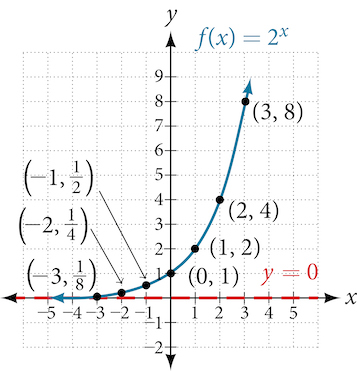
Figure 1
Let’s define the behavior of the graph of the exponential function \(f(x) = 2^{x}\) and highlight some its key characteristics.
- the domain is \(\left( {- \infty,\infty} \right),\)
- the range is \(\left( {0,\infty} \right),\)
- as \(x\rightarrow\infty,f(x)\rightarrow\infty,\)
- as \(x\rightarrow - \infty,f(x)\rightarrow 0,\)
- \(f(x)\) is always increasing,
- the graph of \(f(x)\) will never touch the \(x\)-axis because base two raised to any exponent never has the result of zero.
- \(y = 0\) is the horizontal asymptote.
- the \(y\)-intercept is 1.
6.1.2 Evaluating Exponential Functions
Recall that the base of an exponential function must be a positive real number other than \(1.\) Why do we limit the base \(b\) to positive values? To ensure that the outputs will be real numbers. Observe what happens if the base is not positive:
- Let \(b = - 9\) and \(x = \frac{1}{2}.\) Then \(f(x) = f\left( \frac{1}{2} \right) = \left( {- 9} \right)^{\frac{1}{2}} = \sqrt{- 9},\) which is not a real number.
Why do we limit the base to positive values other than \(1?\) Because base \(1\) results in the constant function. Observe what happens if the base is \(1:\)
- Let \(b = 1.\) Then \(f(x) = 1^{x} = 1\) for any value of \(x.\)
To evaluate an exponential function with the form \(f(x) = b^{x},\) we simply substitute \(x\) with the given value, and calculate the resulting power. For example:
Let \(f(x) = 2^{x}.\) What is \(f(3)?\)
\[\begin{array}{lll} {f(x)} & {= 2^{x}} & \\ {f(3)} & {= 2^{3}\mspace{9mu}} & {\text{Substitute~}x = 3.} \\ & {= 8\mspace{9mu}} & {\text{Evaluate~the~power}\text{.}} \end{array}\]
To evaluate an exponential function with a form other than the basic form, it is important to follow the order of operations. For example:
Let \(f(x) = 30(2)^{x}.\) What is \(f(3)?\)
\[\begin{array}{lll} {f(x)} & {= 30(2)^{x}} & \\ {f(3)} & {= 30(2)^{3}} & {\text{Substitute~}x = 3.} \\ & {= 30(8)\mspace{9mu}} & {\text{Simplify~the~power~first}\text{.}} \\ & {= 240} & {\text{Multiply}\text{.}} \end{array}\]
Note that if the order of operations were not followed, the result would be incorrect:
\[f(3) = 30(2)^{3} \neq 60^{3} = 216{,}000\]
Defining Exponential Growth
Because the output of exponential functions increases very rapidly, the term “exponential growth” is often used in everyday language to describe anything that grows or increases rapidly. However, exponential growth can be defined more precisely in a mathematical sense. If the growth rate is proportional to the amount present, the function models exponential growth.
In more general terms, we have an exponential function, in which a constant base is raised to a variable exponent. To differentiate between linear and exponential functions, let’s consider two companies, A and B. Company A has 100 stores and expands by opening 50 new stores a year, so its growth can be represented by the function \(A(x) = 100 + 50x.\) Company B has 100 stores and expands by increasing the number of stores by 50% each year, so its growth can be represented by the function \(B(x) = 100\left( {1 + 0.5} \right)^{x}.\)
A few years of growth for these companies are illustrated in Table 3.
| Year, \(x\) | Stores, Company A | Stores, Company B |
|---|---|---|
| \(0\) | \(100 + 50(0) = 100\) | \(100\left( {1 + 0.5} \right)^{0} = 100\) |
| \(1\) | \(100 + 50(1) = 150\) | \(100\left( {1 + 0.5} \right)^{1} = 150\) |
| \(2\) | \(100 + 50(2) = 200\) | \(100\left( {1 + 0.5} \right)^{2} = 225\) |
| \(3\) | \(100 + 50(3) = 250\) | \(100\left( {1 + 0.5} \right)^{3} = 337.5\) |
| \(x\) | \(A(x) = 100 + 50x\) | \(B(x) = 100\left( {1 + 0.5} \right)^{x}\) |
Table 3
The graphs comparing the number of stores for each company over a five-year period are shown in Figure 2. We can see that, with exponential growth, the number of stores increases much more rapidly than with linear growth.
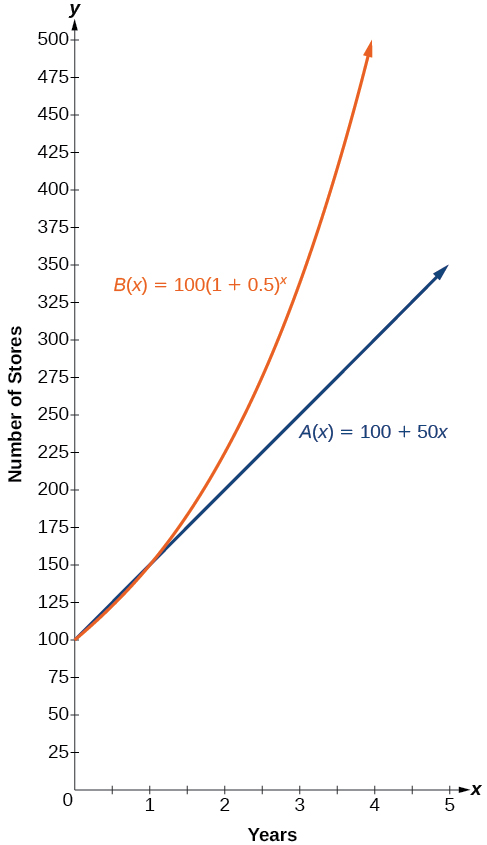
Figure 2 The graph shows the numbers of stores Companies A and B opened over a five-year period.
Notice that the domain for both functions is \(\lbrack 0,\infty),\) and the range for both functions is \(\lbrack 100,\infty).\) After year 1, Company B always has more stores than Company A.
Now we will turn our attention to the function representing the number of stores for Company B, \(B(x) = 100\left( {1 + 0.5} \right)^{x}.\) In this exponential function, 100 represents the initial number of stores, 0.50 represents the growth rate, and \(1 + 0.5 = 1.5\) represents the growth factor. Generalizing further, we can write this function as \(B(x) = 100(1.5)^{x},\) where 100 is the initial value, \(1.5\) is called the base, and \(x\) is called the exponent.
6.1.3 Finding Equations of Exponential Functions
In the previous examples, we were given an exponential function, which we then evaluated for a given input. Sometimes we are given information about an exponential function without knowing the function explicitly. We must use the information to first write the form of the function, then determine the constants \(a\) and \(b,\) and evaluate the function.
In 2006, 80 deer were introduced into a wildlife refuge. By 2012, the population had grown to 180 deer. The population was growing exponentially. Write an exponential function \(N(t)\) representing the population \((N)\) of deer over time \(t.\)
Solution (click to reveal)
We let our independent variable \(t\) be the number of years after 2006. Thus, the information given in the problem can be written as input-output pairs: (0, 80) and (6, 180). Notice that by choosing our input variable to be measured as years after 2006, we have given ourselves the initial value for the function, \(a = 80.\) We can now substitute the second point into the equation \(N(t) = 80b^{t}\) to find \(b:\)
\[\begin{array}{lll} {N(t)} & {= 80b^{t}} & \\ {\mspace{9mu}\mspace{9mu} 180} & {= 80b^{6}} & {\text{Substitute~using~point~}(6,~180).} \\ {\mspace{9mu}\mspace{9mu}\mspace{9mu}\mspace{9mu}\mspace{9mu}\frac{9}{4}} & {= b^{6}} & {\text{Divide~and~write~in~lowest~terms}.} \\ {\mspace{9mu}\mspace{9mu}\mspace{9mu}\mspace{9mu}\mspace{9mu}\mspace{9mu}\mspace{9mu}\mspace{9mu} b} & {= \left( \frac{9}{4} \right)^{\frac{1}{6}}} & {\text{Isolate~}b\mspace{9mu}\text{using~properties~of~exponents}.} \\ {\mspace{9mu}\mspace{9mu}\mspace{9mu}\mspace{9mu}\mspace{9mu}\mspace{9mu}\mspace{9mu}\mspace{9mu} b} & {\approx 1.1447\begin{array}{llll} & & & \end{array}} & {\text{Round~to~4~decimal~places}.} \end{array}\]
NOTE: Unless otherwise stated, do not round any intermediate calculations. Then round the final answer to four places for the remainder of this section.
The exponential model for the population of deer is \(N(t) = 80(1.1447)^{t}.\) (Note that this exponential function models short-term growth. As the inputs gets large, the output will get increasingly larger, so much so that the model may not be useful in the long term.)
We can graph our model to observe the population growth of deer in the refuge over time. Notice that the graph in Figure 3 passes through the initial points given in the problem, \(\left( {0,80} \right)\) and \(\left( {\text{6},180} \right).\) We can also see that the domain for the function is \(\lbrack 0,\infty),\) and the range for the function is \(\lbrack 80,\infty).\)
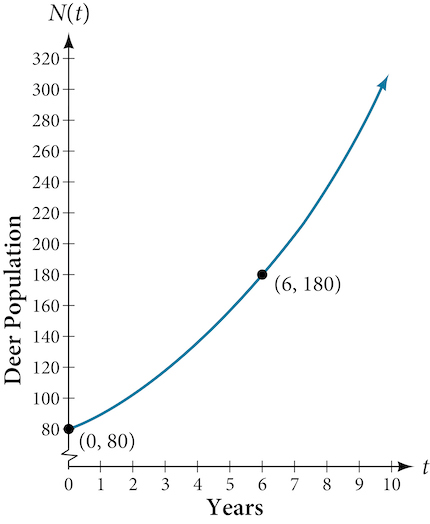
Figure 3 Graph showing the population of deer over time, \(N(t) = 80(1.1447)^{t},\) \(t\) years after 2006
Find an exponential function that passes through the points \(\left( {- 2,6} \right)\) and \(\left( {2,1} \right).\)
Solution (click to reveal)
Because we don’t have the initial value, we substitute both points into an equation of the form \(f(x) = ab^{x},\) and then solve the system for \(a\) and \(b.\)
- Substituting \(\left( {- 2,6} \right)\) gives \(6 = ab^{- 2}\)
- Substituting \(\left( {2,1} \right)\) gives \(1 = ab^{2}\)
Use the first equation to solve for \(a\) in terms of \(b:\)

Substitute \(a\) in the second equation, and solve for \(b:\)
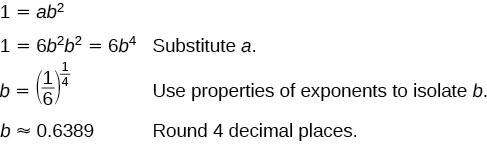
Use the value of \(b\) in the first equation to solve for the value of \(a:\)

Thus, the equation is \(f(x) = 2.4492{(0.6389)}^{x}.\)
We can graph our model to check our work. Notice that the graph in Figure 4 passes through the initial points given in the problem, \(\left( {- 2,\mspace{9mu}\text{6}} \right)\) and \(\left( {2,\mspace{9mu}\text{1}} \right).\) The graph is an example of an exponential decay function.
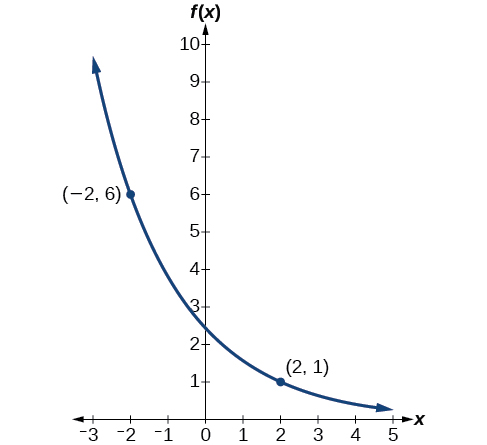
Figure 4 The graph of \(f(x) = 2.4492{(0.6389)}^{x}\) models exponential decay.
Find an equation for the exponential function graphed in Figure 5.
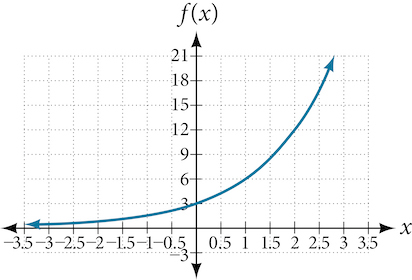
Figure 5
Solution (click to reveal)
We can choose the \(y\)-intercept of the graph, \(\left( {0,3} \right),\) as our first point. This gives us the initial value, \(a = 3.\) Next, choose a point on the curve some distance away from \(\left( {0,3} \right)\) that has integer coordinates. One such point is \((2,12).\)
\[\begin{array}{ll} {\mspace{9mu}\ y = ab^{x}} & {\text{Write~the~general~form~of~an~exponential~equation}.} \\ {\mspace{9mu}\ y = 3b^{x}} & {\text{Substitute~the~initial~value~3~for~}a.} \\ {12 = 3b^{2}} & {\text{Substitute~in~12~for~}y\mspace{9mu}\text{and~2~for~}x.} \\ {\mspace{9mu}\ 4 = b^{2}} & {\text{Divide~by~3}.} \\ {\mspace{9mu}\ b = \pm 2\begin{array}{llll} & & & \end{array}} & {\text{Take~the~square~root}.} \end{array}\]
Because we restrict ourselves to positive values of \(b,\) we will use \(b = 2.\) Substitute \(a\) and \(b\) into the standard form to yield the equation \(f(x) = 3{(2)}^{x}.\)
Find an equation for the exponential function graphed in Figure 6.
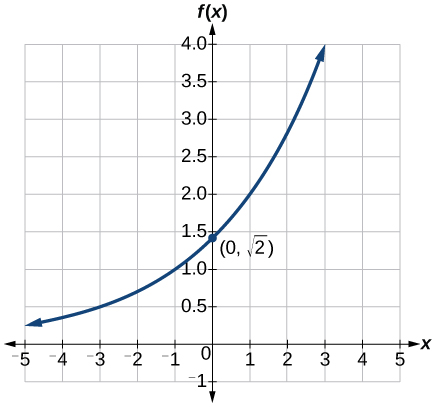
Figure 6
Solution (click to reveal)
\(f(x) = \sqrt{2}\left( \sqrt{2} \right)^{x}.\) Answers may vary due to round-off error. The answer should be very close to \(1.4142(1.4142)^{x}.\)
6.1.4 Applying the Compound-Interest Formula
Savings instruments in which earnings are continually reinvested, such as mutual funds and retirement accounts, use compound interest. The term compounding refers to interest earned not only on the original value, but on the accumulated value of the account.
The annual percentage rate (APR) of an account, also called the nominal rate, is the yearly interest rate earned by an investment account. The term nominal is used when the compounding occurs a number of times other than once per year. In fact, when interest is compounded more than once a year, the effective interest rate ends up being greater than the nominal rate! This is a powerful tool for investing.
We can calculate the compound interest using the compound interest formula, which is an exponential function of the variables time \(t,\) principal \(P,\) APR \(r,\) and number of compounding periods in a year \(n:\)
\[A(t) = P\left( {1 + \frac{r}{n}} \right)^{nt}\]
For example, observe Table 4, which shows the result of investing $1,000 at 10% for one year. Notice how the value of the account increases as the compounding frequency increases.
| Frequency | Value after 1 year |
|---|---|
| Annually | $1100 |
| Semiannually | $1102.50 |
| Quarterly | $1103.81 |
| Monthly | $1104.71 |
| Daily | $1105.16 |
Table 4
6.1.5 Evaluating Functions with Base \(e\)
As we saw earlier, the amount earned on an account increases as the compounding frequency increases. Table 5 shows that the increase from annual to semi-annual compounding is larger than the increase from monthly to daily compounding. This might lead us to ask whether this pattern will continue.
Examine the value of $1 invested at 100% interest for 1 year, compounded at various frequencies, listed in Table 5.
| Frequency | \(A(n) = \left( {1 + \frac{1}{n}} \right)^{n}\) | Value |
|---|---|---|
| Annually | \(\left( {1 + \frac{1}{1}} \right)^{1}\) | $2 |
| Semiannually | \(\left( {1 + \frac{1}{2}} \right)^{2}\) | $2.25 |
| Quarterly | \(\left( {1 + \frac{1}{4}} \right)^{4}\) | $2.441406 |
| Monthly | \(\left( {1 + \frac{1}{12}} \right)^{12}\) | $2.613035 |
| Daily | \(\left( {1 + \frac{1}{365}} \right)^{365}\) | $2.714567 |
| Hourly | \(\left( {1 + \frac{1}{\text{8760}}} \right)^{\text{8760}}\) | $2.718127 |
| Once per minute | \(\left( {1 + \frac{1}{\text{525600}}} \right)^{\text{525600}}\) | $2.718279 |
| Once per second | \(\left( {1 + \frac{1}{31536000}} \right)^{31536000}\) | $2.718282 |
Table 5
These values appear to be approaching a limit as \(n\) increases without bound. In fact, as \(n\) gets larger and larger, the expression \(\left( {1 + \frac{1}{n}} \right)^{n}\) approaches a number used so frequently in mathematics that it has its own name: the letter \(e.\) This value is an irrational number, which means that its decimal expansion goes on forever without repeating. Its approximation to six decimal places is shown below.
6.1.6 Investigating Continuous Growth
So far we have worked with rational bases for exponential functions. For most real-world phenomena, however, e is used as the base for exponential functions. Exponential models that use \(e\) as the base are called continuous growth or decay models. We see these models in finance, computer science, and most of the sciences, such as physics, toxicology, and fluid dynamics.
Section Exercises
Verbal
1. Explain why the values of an increasing exponential function will eventually overtake the values of an increasing linear function.
Solution (click to reveal)
Linear functions have a constant rate of change. Exponential functions increase based on a percent of the original.
2. Given a formula for an exponential function, is it possible to determine whether the function grows or decays exponentially just by looking at the formula? Explain.
3. The Oxford Dictionary defines the word nominal as a value that is “stated or expressed but not necessarily corresponding exactly to the real value.” Develop a reasonable argument for why the term nominal rate is used to describe the annual percentage rate of an investment account that compounds interest.
Solution (click to reveal)
When interest is compounded, the percentage of interest earned to principal ends up being greater than the annual percentage rate for the investment account. Thus, the annual percentage rate does not necessarily correspond to the real interest earned, which is the very definition of nominal.
Algebraic
For the following exercises, identify whether the statement represents an exponential function. Explain.
4. The average annual population increase of a pack of wolves is 25.
5. A population of bacteria decreases by a factor of \(\frac{1}{8}\) every \(24\) hours.
Solution (click to reveal)
exponential; the population decreases by a proportional rate. .
6. The value of a coin collection has increased by \(3.25\%\) annually over the last \(20\) years.
7. For each training session, a personal trainer charges his clients \(\text{\$}5\) less than the previous training session.
Solution (click to reveal)
not exponential; the charge decreases by a constant amount each visit, so the statement represents a linear function. .
8. The height of a projectile at time \(t\) is represented by the function \(h(t) = - 4.9t^{2} + 18t + 40.\)
For the following exercises, consider this scenario: For each year \(t,\) the population of a forest of trees is represented by the function \(A(t) = 115{(1.025)}^{t}.\) In a neighboring forest, the population of the same type of tree is represented by the function \(B(t) = 82{(1.029)}^{t}.\) (Round answers to the nearest whole number.)
9. Which forest’s population is growing at a faster rate?
Solution (click to reveal)
The forest represented by the function \(B(t) = 82{(1.029)}^{t}.\)
10. Which forest had a greater number of trees initially? By how many?
11. Assuming the population growth models continue to represent the growth of the forests, which forest will have a greater number of trees after \(20\) years? By how many?
Solution (click to reveal)
After \(t = 20\) years, forest A will have \(43\) more trees than forest B.
12. Assuming the population growth models continue to represent the growth of the forests, which forest will have a greater number of trees after \(100\) years? By how many?
13. Discuss the above results from the previous four exercises. Assuming the population growth models continue to represent the growth of the forests, which forest will have the greater number of trees in the long run? Why? What are some factors that might influence the long-term validity of the exponential growth model?
Solution (click to reveal)
Answers will vary. Sample response: For a number of years, the population of forest A will increasingly exceed forest B, but because forest B actually grows at a faster rate, the population will eventually become larger than forest A and will remain that way as long as the population growth models hold. Some factors that might influence the long-term validity of the exponential growth model are drought, an epidemic that culls the population, and other environmental and biological factors.
For the following exercises, determine whether the equation represents exponential growth, exponential decay, or neither. Explain.
14. \(y = 300\left( {1 - t} \right)^{5}\)
15. \(y = 220(1.06)^{x}\)
Solution (click to reveal)
exponential growth; The growth factor, \(1.06,\) is greater than \(1.\)
16. \(y = 16.5(1.025)^{\frac{1}{x}}\)
17. \(y = 11{,}701(0.97)^{t}\)
Solution (click to reveal)
exponential decay; The decay factor, \(0.97,\) is between \(0\) and \(1.\)
For the following exercises, find the formula for an exponential function that passes through the two points given.
18. \(\left( {0,6} \right)\) and \((3{,}750)\)
19. \(\left( {0,2000} \right)\) and \((2,20)\)
Solution (click to reveal)
\(f(x) = 2000{(0.1)}^{x}\)
20. \(\left( {- 1,\frac{3}{2}} \right)\) and \(\left( {3,24} \right)\)
21. \(\left( {- 2,6} \right)\) and \(\left( {3,1} \right)\)
Solution (click to reveal)
\(f(x) = \left( \frac{1}{6} \right)^{- \frac{3}{5}}\left( \frac{1}{6} \right)^{\frac{x}{5}} \approx 2.93(0.699)^{x}\)
22. \(\left( {3,1} \right)\) and \((5,4)\)
For the following exercises, determine whether the table could represent a function that is linear, exponential, or neither. If it appears to be exponential, find a function that passes through the points.
23.
| \(x\) | 1 | 2 | 3 | 4 |
| \(f(x)\) | 70 | 40 | 10 | -20 |
Solution (click to reveal)
Linear
24.
| \(x\) | 1 | 2 | 3 | 4 |
| \(h(x)\) | 70 | 49 | 34.3 | 24.01 |
25.
| \(x\) | 1 | 2 | 3 | 4 |
| \(m(x)\) | 80 | 61 | 42.9 | 25.61 |
Solution (click to reveal)
Neither
26.
| \(x\) | 1 | 2 | 3 | 4 |
| \(f(x)\) | 10 | 20 | 40 | 80 |
27.
| \(x\) | 1 | 2 | 3 | 4 |
| \(g(x)\) | -3.25 | 2 | 7.25 | 12.5 |
Solution (click to reveal)
Linear
For the following exercises, use the compound interest formula, \(A(t) = P\left( {1 + \frac{r}{n}} \right)^{nt}.\)
28. After a certain number of years, the value of an investment account is represented by the equation \(A = 10{,}250\left( {1 + \frac{0.04}{12}} \right)^{120}.\) What is the value of the account?
29. What was the initial deposit made to the account in the previous exercise?
Solution (click to reveal)
\(\$ 10,250\)
30. How many years had the account from the previous exercise been accumulating interest?
31. An account is opened with an initial deposit of $6,500 and earns \(3.6\%\) interest compounded semi-annually. What will the account be worth in \(20\) years?
Solution (click to reveal)
\(\$ 13,268.58\)
32. How much more would the account in the previous exercise have been worth if the interest were compounding weekly?
33. Solve the compound interest formula for the principal, \(P\) .
Solution (click to reveal)
\(P = A(t) \cdot \left( {1 + \frac{r}{n}} \right)^{- nt}\)
34. Use the formula found in the previous exercise to calculate the initial deposit of an account that is worth \(\$ 14,472.74\) after earning \(5.5\%\) interest compounded monthly for \(5\) years. (Round to the nearest dollar.)
35. How much more would the account in the previous two exercises be worth if it were earning interest for \(5\) more years?
Solution (click to reveal)
\(\$ 4{,}572.56\)
36. Use properties of rational exponents to solve the compound interest formula for the interest rate, \(r.\)
37. Use the formula found in the previous exercise to calculate the interest rate for an account that was compounded semi-annually, had an initial deposit of $9,000 and was worth $13,373.53 after 10 years.
Solution (click to reveal)
\(4\%\)
38. Use the formula found in the previous exercise to calculate the interest rate for an account that was compounded monthly, had an initial deposit of $5,500, and was worth $38,455 after 30 years.
For the following exercises, determine whether the equation represents continuous growth, continuous decay, or neither. Explain.
39. \(y = 3742(e)^{0.75t}\)
Solution (click to reveal)
continuous growth; the growth rate is greater than \(0.\)
40. \(y = 150(e)^{\frac{3.25}{t}}\)
41. \(y = 2.25(e)^{- 2t}\)
Solution (click to reveal)
continuous decay; the growth rate is less than \(0.\)
42. Suppose an investment account is opened with an initial deposit of \(\$ 12{,}000\) earning \(7.2\%\) interest compounded continuously. How much will the account be worth after \(30\) years?
43. How much less would the account from Exercise 42 be worth after \(30\) years if it were compounded monthly instead?
Solution (click to reveal)
\(\$ 669.42\)
Numeric
For the following exercises, evaluate each function. Round answers to four decimal places, if necessary.
44. \(f(x) = 2(5)^{x},\) for \(f\left( {- 3} \right)\)
45. \(f(x) = - 4^{2x + 3},\) for \(f\left( {- 1} \right)\)
Solution (click to reveal)
\(f( - 1) = - 4\)
46. \(f(x) = e^{x},\) for \(f(3)\)
47. \(f(x) = - 2e^{x - 1},\) for \(f\left( {- 1} \right)\)
Solution (click to reveal)
\(f( - 1) \approx - 0.2707\)
48. \(f(x) = 2.7(4)^{- x + 1} + 1.5,\) for \(f\left( {- 2} \right)\)
49. \(f(x) = 1.2e^{2x} - 0.3,\) for \(f(3)\)
Solution (click to reveal)
\(f(3) \approx 483.8146\)
50. \(f(x) = - \frac{3}{2}(3)^{- x} + \frac{3}{2},\) for \(f(2)\)
Technology
For the following exercises, use a graphing calculator to find the equation of an exponential function given the points on the curve.
51. \((0,3)\) and \((3{,}375)\)
Solution (click to reveal)
\(y = 3 \cdot 5^{x}\)
52. \((3{,}222.62)\) and \((10,77.456)\)
53. \((20,29.495)\) and \((150{,}730.89)\)
Solution (click to reveal)
\(y \approx 18 \cdot 1.025^{x}\)
54. \((5,2.909)\) and \((13,0.005)\)
55. \((11{,}310.035)\) and \((25,356365.2)\)
Solution (click to reveal)
\(y \approx 0.2 \cdot 1.95^{x}\)
Extensions
56. The annual percentage yield (APY) of an investment account is a representation of the actual interest rate earned on a compounding account. It is based on a compounding period of one year. Show that the APY of an account that compounds monthly can be found with the formula \(\text{APY} = \left( {1 + \frac{r}{12}} \right)^{12} - 1.\)
57. Repeat the previous exercise to find the formula for the APY of an account that compounds daily. Use the results from this and the previous exercise to develop a function \(I(n)\) for the APY of any account that compounds \(n\) times per year.
Solution (click to reveal)
\(\text{APY} = \frac{A(t) - a}{a} = \frac{a\left( {1 + \frac{r}{365}} \right)^{365(1)} - a}{a} = \frac{a\left\lbrack {\left( {1 + \frac{r}{365}} \right)^{365} - 1} \right\rbrack}{a} = \left( {1 + \frac{r}{365}} \right)^{365} - 1;\) \(I(n) = \left( {1 + \frac{r}{n}} \right)^{n} - 1\)
58. Recall that an exponential function is any equation written in the form \(f(x) = a \cdot b^{x}\) such that \(~a~\) and \(~b~\) are positive numbers and \(~b \neq 1.~\) Any positive number \(~b~\) can be written as \(~b = e^{n}~\) for some value of \(~n\) . Use this fact to rewrite the formula for an exponential function that uses the number \(~e~\) as a base.
59. In an exponential decay function, the base of the exponent is a value between 0 and 1. Thus, for some number \(b > 1,\) the exponential decay function can be written as \(f(x) = a \cdot \left( \frac{1}{b} \right)^{x}.\) Use this formula, along with the fact that \(b = e^{n},\) to show that an exponential decay function takes the form \(f(x) = a(e)^{- nx}\) for some positive number \(n\) .
Solution (click to reveal)
Let \(f\) be the exponential decay function \(f(x) = a \cdot \left( \frac{1}{b} \right)^{x}\) such that \(b > 1.\) Then for some number \(n > 0,\) \(f(x) = a \cdot \left( \frac{1}{b} \right)^{x} = a\left( b^{- 1} \right)^{x} = a\left( \left( e^{n} \right)^{- 1} \right)^{x} = a\left( e^{- n} \right)^{x} = a(e)^{- nx}.\)
60. The formula for the amount \(A\) in an investment account with a nominal interest rate \(r\) at any time \(t\) is given by \(A(t) = a(e)^{rt},\) where \(a\) is the amount of principal initially deposited into an account that compounds continuously. Prove that the percentage of interest earned to principal at any time \(t\) can be calculated with the formula \(I(t) = e^{rt} - 1.\)
Real-World Applications
61. The fox population in a certain region has an annual growth rate of 9% per year. In the year 2012, there were 23,900 fox counted in the area. What is the fox population predicted to be in the year 2020?
Solution (click to reveal)
\(47{,}622\) fox
62. A scientist begins with 100 milligrams of a radioactive substance that decays exponentially. After 35 hours, 50mg of the substance remains. How many milligrams will remain after 54 hours?
63. In the year 1985, a house was valued at $110,000. By the year 2005, the value had appreciated to $145,000. What was the annual growth rate between 1985 and 2005? Assume that the value continued to grow by the same percentage. What was the value of the house in the year 2010?
Solution (click to reveal)
\(1.39\%;\) \(\$ 155,368.09\)
64. A car was valued at $38,000 in the year 2007. By 2013, the value had depreciated to $11,000 If the car’s value continues to drop by the same percentage, what will it be worth by 2017?
65. Jaylen wants to save $54,000 for a down payment on a home. How much will he need to invest in an account with 8.2% APR, compounding daily, in order to reach his goal in 5 years?
Solution (click to reveal)
\(\$ 35,838.76\)
66. Kyoko has $10,000 that she wants to invest. Her bank has several investment accounts to choose from, all compounding daily. Her goal is to have $15,000 by the time she finishes graduate school in 6 years. To the nearest hundredth of a percent, what should her minimum annual interest rate be in order to reach her goal? (Hint: solve the compound interest formula for the interest rate.)
67. Alyssa opened a retirement account with 7.25% APR in the year 2000. Her initial deposit was $13,500. How much will the account be worth in 2025 if interest compounds monthly? How much more would she make if interest compounded continuously?
Solution (click to reveal)
\(\$ 82,247.78;\) \(\$ 449.75\)
68. An investment account with an annual interest rate of 7% was opened with an initial deposit of $4,000 Compare the values of the account after 9 years when the interest is compounded annually, quarterly, monthly, and continuously.