5.4 Dividing Polynomials
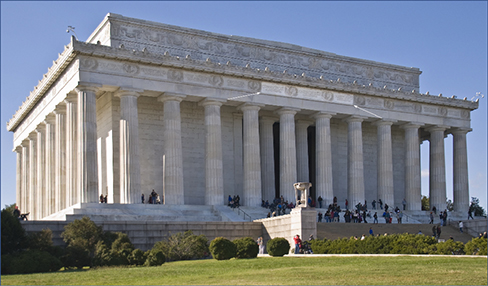
Figure 1 Lincoln Memorial, Washington, D.C. (credit: Ron Cogswell, Flickr)
The exterior of the Lincoln Memorial in Washington, D.C., is a large rectangular solid with length 61.5 meters (m), width 40 m, and height 30 m. We can easily find the volume using elementary geometry.
\[\begin{array}{ccl} V & = & {l \cdot w \cdot h} \\ & = & {61.5 \cdot 40 \cdot 30} \\ & = & 73{,}800 \end{array}\]
So the volume is 73,800 cubic meters \(\left( {\text{m}³} \right).\) Suppose we knew the volume, length, and width. We could divide to find the height.
\[\begin{array}{ccl} h & = & \frac{V}{l \cdot w} \\ & = & \frac{73{,}800}{61.5 \cdot 40} \\ & = & 30 \end{array}\]
As we can confirm from the dimensions above, the height is 30 m. We can use similar methods to find any of the missing dimensions. We can also use the same method if any, or all, of the measurements contain variable expressions. For example, suppose the volume of a rectangular solid is given by the polynomial \(3x^{4} - 3x^{3} - 33x^{2} + 54x.\) The length of the solid is given by \(3x;\) the width is given by \(x - 2.\) To find the height of the solid, we can use polynomial division, which is the focus of this section.
5.4.1 Using Long Division to Divide Polynomials
We are familiar with the long division algorithm for ordinary arithmetic. We begin by dividing into the digits of the dividend that have the greatest place value. We divide, multiply, subtract, include the digit in the next place value position, and repeat. For example, let’s divide 178 by 3 using long division.
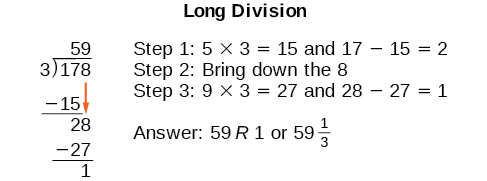
Another way to look at the solution is as a sum of parts. This should look familiar, since it is the same method used to check division in elementary arithmetic.
\[\begin{array}{ccl} \text{dividend} & = & {(\text{divisor} \cdot \text{quotient)~+~remainder}} \\ 178 & = & {(3 \cdot 59) + 1} \\ & = & {177 + 1} \\ & = & 178 \end{array}\]
We call this the Division Algorithm and will discuss it more formally after looking at an example.
Division of polynomials that contain more than one term has similarities to long division of whole numbers. We can write a polynomial dividend as the product of the divisor and the quotient added to the remainder. The terms of the polynomial division correspond to the digits (and place values) of the whole number division. This method allows us to divide two polynomials. For example, if we were to divide \(2x^{3} - 3x^{2} + 4x + 5\) by \(x + 2\) using the long division algorithm, it would look like this:
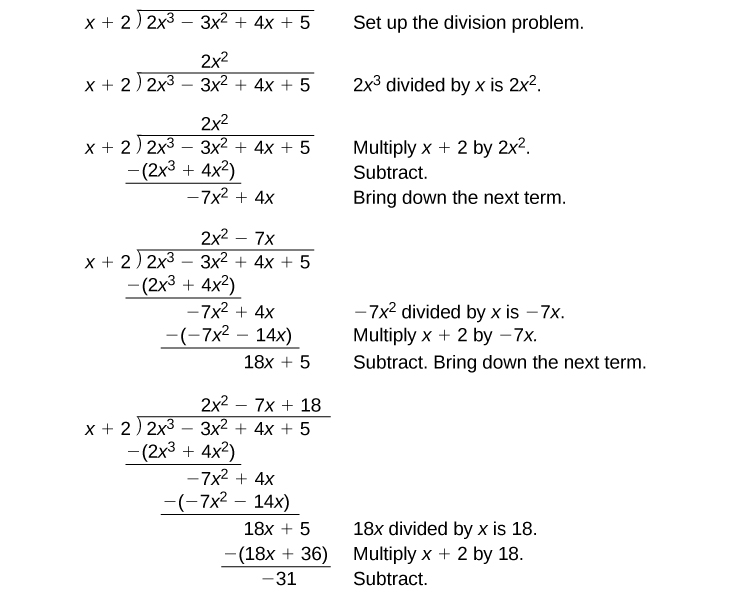
We have found
\[\frac{2x^{3} - 3x^{2} + 4x + 5}{x + 2} = 2x^{2} - 7x + 18 - \frac{31}{x + 2}\]
or
\[{2x^{3} - 3x^{2} + 4x + 5} = (x + 2)(2x^{2} - 7x + 18) - 31\]
We can identify the dividend, the divisor, the quotient, and the remainder.
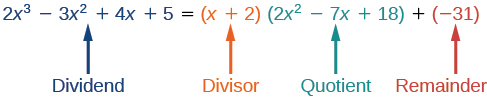
Writing the result in this manner illustrates the Division Algorithm.
Divide \(5x^{2} + 3x - 2\) by \(x + 1.\)
Solution (click to reveal)
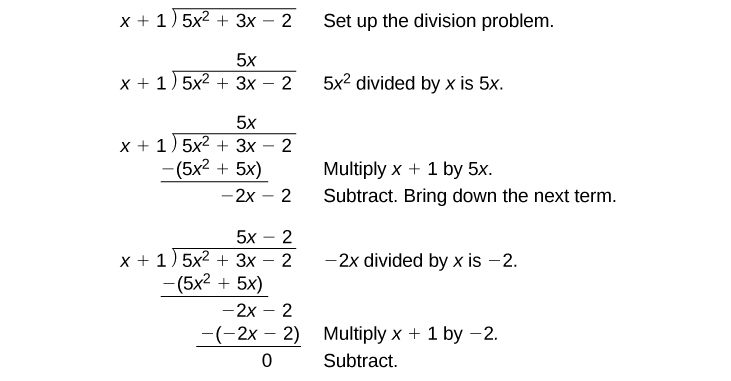
The quotient is \(5x - 2.\) The remainder is 0. We write the result as
\[\frac{5x^{2} + 3x - 2}{x + 1} = 5x - 2\]
or
\[5x^{2} + 3x - 2 = \left( {x + 1} \right)\left( {5x - 2} \right)\]
This division problem had a remainder of 0. This tells us that the dividend is divided evenly by the divisor, and that the divisor is a factor of the dividend.
Divide \(6x^{3} + 11x^{2} - 31x + 15\) by \(3x - 2.\)
Solution (click to reveal)
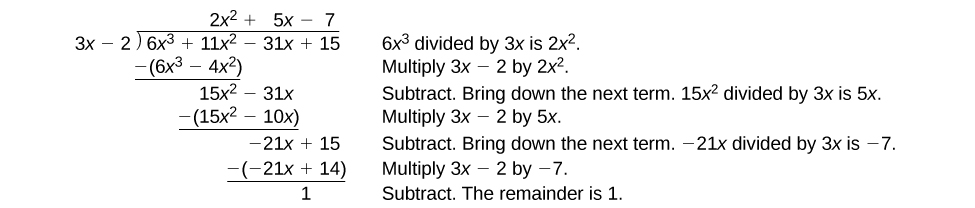
There is a remainder of 1. We can express the result as:
\[\frac{6x^{3} + 11x^{2} - 31x + 15}{3x - 2} = 2x^{2} + 5x - 7 + \frac{1}{3x - 2}\]
We can check our work by using the Division Algorithm to rewrite the solution. Then multiply.
\[(3x - 2)(2x^{2} + 5x - 7) + 1 = 6x^{3} + 11x^{2} - 31x + 15\]
Notice, as we write our result,
- the dividend is \(6x^{3} + 11x^{2} - 31x + 15\)
- the divisor is \(3x - 2\)
- the quotient is \(2x^{2} + 5x - 7\)
- the remainder is \(1\)
5.4.2 Using Synthetic Division to Divide Polynomials
As we’ve seen, long division of polynomials can involve many steps and be quite cumbersome. Synthetic division is a shorthand method of dividing polynomials for the special case of dividing by a linear factor whose leading coefficient is 1.
To illustrate the process, recall the example at the beginning of the section.
Divide \(2x^{3} - 3x^{2} + 4x + 5\) by \(x + 2\) using the long division algorithm.
The final form of the process looked like this:
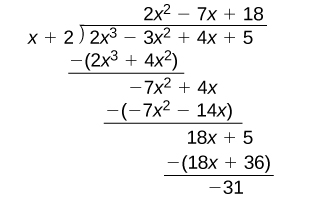
There is a lot of repetition in the table. If we don’t write the variables but, instead, line up their coefficients in columns under the division sign and also eliminate the partial products, we already have a simpler version of the entire problem.

Synthetic division carries this simplification even a few more steps. Collapse the table by moving each of the rows up to fill any vacant spots. Also, instead of dividing by 2, as we would in division of whole numbers, then multiplying and subtracting the middle product, we change the sign of the “divisor” to –2, multiply and add. The process starts by bringing down the leading coefficient.

We then multiply it by the “divisor” and add, repeating this process column by column, until there are no entries left. The bottom row represents the coefficients of the quotient; the last entry of the bottom row is the remainder. In this case, the quotient is \(2x^{2}–7x + 18\) and the remainder is \(–31.\) The process will be made more clear in Example 3.
Use synthetic division to divide \(5x^{2} - 3x - 36\) by \(x - 3.\)
Solution (click to reveal)
Begin by setting up the synthetic division. Write \(k\) and the coefficients.

Bring down the lead coefficient. Multiply the lead coefficient by \(k.\)

Continue by adding the numbers in the second column. Multiply the resulting number by \(k.\) Write the result in the next column. Then add the numbers in the third column.

The result is \(5x + 12.\) The remainder is 0. So \(x - 3\) is a factor of the original polynomial.
Just as with long division, we can check our work by multiplying the quotient by the divisor and adding the remainder.
\((x - 3)(5x + 12) + 0 = 5x^{2} - 3x - 36\)
Use synthetic division to divide \(4x^{3} + 10x^{2} - 6x - 20\) by \(x + 2.\)
Solution (click to reveal)
The binomial divisor is \(x + 2\) so \(k = -2.\) Add each column, multiply the result by –2, and repeat until the last column is reached.

The result is \(4x^{2} + 2x - 10.\) The remainder is 0. Thus, \(x + 2\) is a factor of \(4x^{3} + 10x^{2} - 6x - 20.\)
The graph of the polynomial function \(f(x) = 4x^{3} + 10x^{2} - 6x - 20\) in Figure 2 shows a zero at \(x = k = -2.\) This confirms that \(x + 2\) is a factor of \(4x^{3} + 10x^{2} - 6x - 20.\)
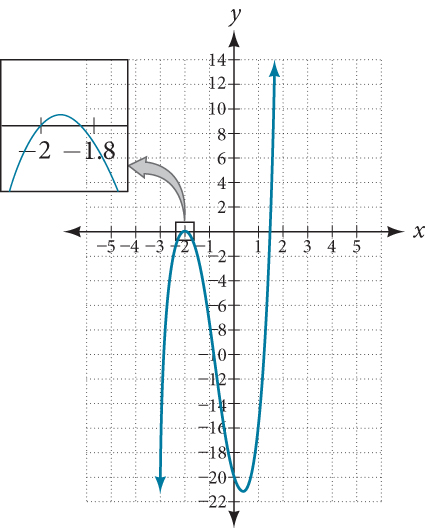
Figure 2
Use synthetic division to divide \(- 9x^{4} + 10x^{3} + 7x^{2} - 6\) by \(x - 1.\)
Solution (click to reveal)
Notice there is no \(x\)-term. We will use a zero as the coefficient for that term.
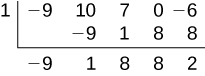
The result is \(- 9x^{3} + x^{2} + 8x + 8 + \frac{2}{x - 1}.\)
5.4.3 Using Polynomial Division to Solve Application Problems
Polynomial division can be used to solve a variety of application problems involving expressions for area and volume. We looked at an application at the beginning of this section. Now we will solve that problem in the following example.
The volume of a rectangular solid is given by the polynomial \(3x^{4} - 3x^{3} - 33x^{2} + 54x.\) The length of the solid is given by \(3x\) and the width is given by \(x - 2.\) Find the height, \(h,\) of the solid.
Solution (click to reveal)
There are a few ways to approach this problem. We need to divide the expression for the volume of the solid by the expressions for the length and width. Let us create a sketch as in Figure 3.
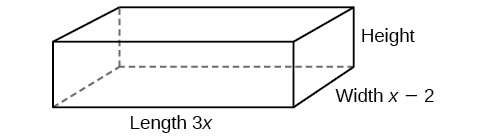
Figure 3
We can now write an equation by substituting the known values into the formula for the volume of a rectangular solid.
\[\begin{array}{rcl} V & = & {l \cdot w \cdot h} \\ {3x^{4} - 3x^{3} - 33x^{2} + 54x} & = & {3x \cdot (x - 2) \cdot h} \end{array}\]
To solve for \(h,\) first divide both sides by \(3x.\)
\[\begin{array}{rcl} \frac{3x \cdot (x - 2) \cdot h}{3x} & = & \frac{3x^{4} - 3x^{3} - 33x^{2} + 54x}{3x} \\ {(x - 2)h} & = & {x^{3} - x^{2} - 11x + 18} \end{array}\]
Now solve for \(h\) using synthetic division.
\[h = \frac{x^{3} - x^{2} - 11x + 18}{x - 2}\]

The quotient is \(x^{2} + x - 9\) and the remainder is 0. The height of the solid is \(x^{2} + x - 9.\)
Section Exercises
Verbal
1. If division of a polynomial by a binomial results in a remainder of zero, what can be conclude?
Solution (click to reveal)
The binomial is a factor of the polynomial.
2. If a polynomial of degree \(n\) is divided by a binomial of degree 1, what is the degree of the quotient?
Algebraic
For the following exercises, use long division to divide. Specify the quotient and the remainder.
3. \(\left( {x^{2} + 5x - 1} \right) \div \left( {x - 1} \right)\)
Solution (click to reveal)
\(x + 6 + \frac{5}{x - 1}\text{,}\mspace{9mu}\text{quotient:}\mspace{9mu} x + 6\text{,}\mspace{9mu}\text{remainder:}\mspace{9mu}\text{5}\)
4. \(\left( {2x^{2} - 9x - 5} \right) \div \left( {x - 5} \right)\)
5. \(\left( {3x^{2} + 23x + 14} \right) \div \left( {x + 7} \right)\)
Solution (click to reveal)
\(3x + 2\text{,}\mspace{9mu}\text{quotient:~}3x + 2\text{,}\mspace{9mu}\text{remainder:~0}\)
6. \(\left( {4x^{2} - 10x + 6} \right) \div \left( {4x + 2} \right)\)
7. \(\left( {6x^{2} - 25x - 25} \right) \div \left( {6x + 5} \right)\)
Solution (click to reveal)
\(x - 5\text{,}\mspace{9mu}\text{quotient:}\mspace{9mu} x - 5\text{,}\mspace{9mu}\text{remainder:}\mspace{9mu}\text{0}\)
8. \(\left( {- x^{2} - 1} \right) \div \left( {x + 1} \right)\)
9. \(\left( {2x^{2} - 3x + 2} \right) \div \left( {x + 2} \right)\)
Solution (click to reveal)
\(2x - 7 + \frac{16}{x + 2}\text{,}\mspace{9mu}\text{quotient:}\mspace{9mu} 2x - 7\text{,}\mspace{9mu}\text{remainder:}\mspace{9mu}\text{16}\)
10. \(\left( {x^{3} - 126} \right) \div \left( {x - 5} \right)\)
11. \(\left( {3x^{2} - 5x + 4} \right) \div \left( {3x + 1} \right)\)
Solution (click to reveal)
\(x - 2 + \frac{6}{3x + 1}\text{,}\mspace{9mu}\text{quotient:}\mspace{9mu} x - 2\text{,}\mspace{9mu}\text{remainder:}\mspace{9mu}\text{6}\)
12. \(\left( {x^{3} - 3x^{2} + 5x - 6} \right) \div \left( {x - 2} \right)\)
13. \(\left( {2x^{3} + 3x^{2} - 4x + 15} \right) \div \left( {x + 3} \right)\)
Solution (click to reveal)
\(2x^{2} - 3x + 5\text{,}\mspace{9mu}\text{quotient:}\mspace{9mu} 2x^{2} - 3x + 5\text{,}\mspace{9mu}\text{remainder:}\mspace{9mu}\text{0}\)
For the following exercises, use synthetic division to find the quotient. Ensure the equation is in the form required by synthetic division. (Hint: divide the dividend and divisor by the coefficient of the linear term in the divisor.)
14. \(\left( {3x^{3} + 2x^{2} - x + 4} \right) \div \left( {x - 3} \right)\)
15. \(\left( {2x^{3} - 6x^{2} - 7x + 6} \right) \div (x - 4)\)
Solution (click to reveal)
\(2x^{2} + 2x + 1 + \frac{10}{x - 4}\)
16. \(\left( {6x^{3} - 10x^{2} - 7x - 15} \right) \div (x + 1)\)
17. \(\left( {4x^{3} - 12x^{2} - 5x - 1} \right) \div (2x + 1)\)
Solution (click to reveal)
\(2x^{2} - 7x + 1 - \frac{2}{2x + 1}\)
18. \(\left( {9x^{3} - 9x^{2} + 18x + 5} \right) \div (3x - 1)\)
19. \(\left( {3x^{3} - 2x^{2} + x - 4} \right) \div \left( {x + 3} \right)\)
Solution (click to reveal)
\(3x^{2} - 11x + 34 - \frac{106}{x + 3}\)
20. \(\left( {- 6x^{3} + x^{2} - 4} \right) \div \left( {2x - 3} \right)\)
21. \(\left( {2x^{3} + 7x^{2} - 13x - 3} \right) \div \left( {2x - 3} \right)\)
Solution (click to reveal)
\(x^{2} + 5x + 1\)
22. \(\left( {3x^{3} - 5x^{2} + 2x + 3} \right) \div (x + 2)\)
23. \(\left( {4x^{3} - 5x^{2} + 13} \right) \div (x + 4)\)
Solution (click to reveal)
\(4x^{2} - 21x + 84 - \frac{323}{x + 4}\)
24. \(\left( {x^{3} - 3x + 2} \right) \div \left( {x + 2} \right)\)
25. \(\left( {x^{3} - 21x^{2} + 147x - 343} \right) \div \left( {x - 7} \right)\)
Solution (click to reveal)
\(x^{2} - 14x + 49\)
26. \(\left( {x^{3} - 15x^{2} + 75x - 125} \right) \div \left( {x - 5} \right)\)
27. \(\left( {9x^{3} - x + 2} \right) \div \left( {3x - 1} \right)\)
Solution (click to reveal)
\(3x^{2} + x + \frac{2}{3x - 1}\)
28. \(\left( {6x^{3} - x^{2} + 5x + 2} \right) \div \left( {3x + 1} \right)\)
29. \(\left( {x^{4} + x^{3} - 3x^{2} - 2x + 1} \right) \div \left( {x + 1} \right)\)
Solution (click to reveal)
\(x^{3} - 3x + 1\)
30. \(\left( {x^{4} - 3x^{2} + 1} \right) \div \left( {x - 1} \right)\)
31. \(\left( {x^{4} + 2x^{3} - 3x^{2} + 2x + 6} \right) \div \left( {x + 3} \right)\)
Solution (click to reveal)
\(x^{3} - x^{2} + 2\)
32. \(\left( {x^{4} - 10x^{3} + 37x^{2} - 60x + 36} \right) \div \left( {x - 2} \right)\)
33. \(\left( {x^{4} - 8x^{3} + 24x^{2} - 32x + 16} \right) \div \left( {x - 2} \right)\)
Solution (click to reveal)
\(x^{3} - 6x^{2} + 12x - 8\)
34. \(\left( {x^{4} + 5x^{3} - 3x^{2} - 13x + 10} \right) \div \left( {x + 5} \right)\)
35. \(\left( {x^{4} - 12x^{3} + 54x^{2} - 108x + 81} \right) \div \left( {x - 3} \right)\)
Solution (click to reveal)
\(x^{3} - 9x^{2} + 27x - 27\)
36. \(\left( {4x^{4} - 2x^{3} - 4x + 2} \right) \div \left( {2x - 1} \right)\)
37. \(\left( {4x^{4} + 2x^{3} - 4x^{2} + 2x + 2} \right) \div \left( {2x + 1} \right)\)
Solution (click to reveal)
\(2x^{3} - 2x + 2\)
For the following exercises, use synthetic division to determine whether the first expression is a factor of the second. If it is, indicate the factorization.
38. \(x - 2,\mspace{9mu} 4x^{3} - 3x^{2} - 8x + 4\)
39. \(x - 2,\mspace{9mu} 3x^{4} - 6x^{3} - 5x + 10\)
Solution (click to reveal)
Yes \(\left( {x - 2} \right)(3x^{3} - 5)\)
40. \(x + 3,\mspace{9mu} - 4x^{3} + 5x^{2} + 8\)
41. \(x - 2,\mspace{9mu} 4x^{4} - 15x^{2} - 4\)
Solution (click to reveal)
Yes \(\left( {x - 2} \right)(4x^{3} + 8x^{2} + x + 2)\)
42. \(x - \frac{1}{2},\mspace{9mu} 2x^{4} - x^{3} + 2x - 1\)
43. \(x + \frac{1}{3},\mspace{9mu} 3x^{4} + x^{3} - 3x + 1\)
Solution (click to reveal)
No
Graphical
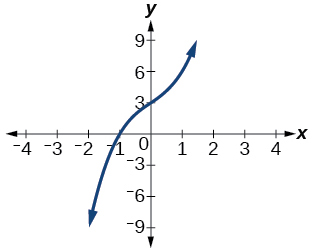
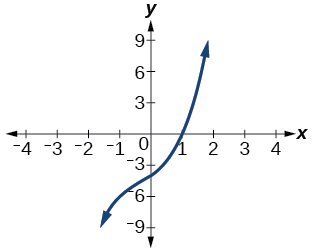
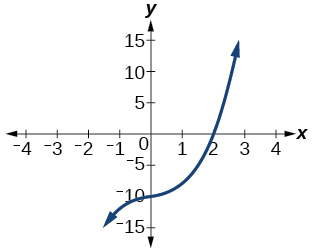
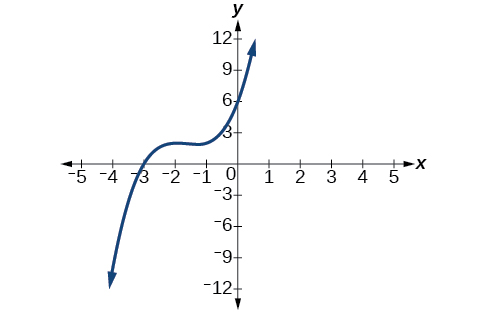
For the following exercises, use the graph of the third-degree polynomial and one factor to write the factored form of the polynomial suggested by the graph. The leading coefficient is one.
44. Factor is \(x^{2} - x + 3\)
45. Factor is \((x^{2} + 2x + 4)\)
Solution (click to reveal)
\((x - 1)(x^{2} + 2x + 4)\)
46. Factor is \(x^{2} + 2x + 5\)
47. Factor is \(x^{2} + x + 1\)
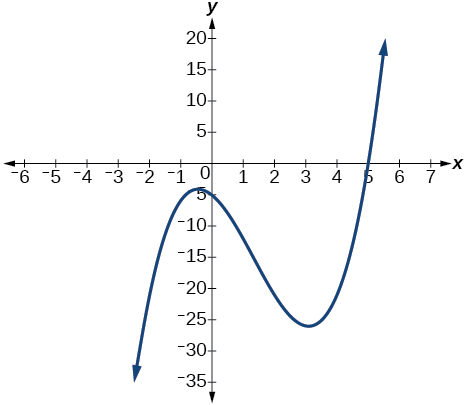
Solution (click to reveal)
\((x - 5)(x^{2} + x + 1)\)
48. Factor is \(x^{2} + 2x + 2\)
For the following exercises, use synthetic division to find the quotient and remainder.
49. \(\frac{4x^{3} - 33}{x - 2}\)
Solution (click to reveal)
\(\text{Quotient:}\mspace{9mu} 4x^{2} + 8x + 16\text{,}\mspace{9mu}\text{remainder:}\mspace{9mu} - 1\)
50. \(\frac{2x^{3} + 25}{x + 3}\)
51. \(\frac{3x^{3} + 2x - 5}{x - 1}\)
Solution (click to reveal)
\(\text{Quotient:}\mspace{9mu} 3x^{2} + 3x + 5\text{,}\mspace{9mu}\text{remainder:}\mspace{9mu} 0\)
52. \(\frac{- 4x^{3} - x^{2} - 12}{x + 4}\)
53. \(\frac{x^{4} - 22}{x + 2}\)
Solution (click to reveal)
\(\text{Quotient:}\mspace{9mu} x^{3} - 2x^{2} + 4x - 8\text{,}\mspace{9mu}\text{remainder:}\mspace{9mu} - 6\)
Technology
For the following exercises, use a calculator with CAS to answer the questions.
54. Consider \(\frac{x^{k} - 1}{x - 1}\) with \(k = 1,~2,~3.\) What do you expect the result to be if \(k = 4?\)
55. Consider \(\frac{x^{k} + 1}{x + 1}\) for \(k = 1,~3,~5.\) What do you expect the result to be if \(k = 7?\)
Solution (click to reveal)
\(x^{6} - x^{5} + x^{4} - x^{3} + x^{2} - x + 1\)
56. Consider \(\frac{x^{4} - k^{4}}{x - k}\) for \(k = 1,~2,~3.\) What do you expect the result to be if \(k = 4?\)
57. Consider \(\frac{x^{k}}{x + 1}\) with \(k = 1,~2,~3.\) What do you expect the result to be if \(k = 4?\)
Solution (click to reveal)
\(x^{3} - x^{2} + x - 1 + \frac{1}{x + 1}\)
58. Consider \(\frac{x^{k}}{x - 1}\) with \(k = 1,~2,~3.\) What do you expect the result to be if \(k = 4?\)
Extensions
For the following exercises, use synthetic division to determine the quotient involving a complex number.
59. \(\frac{x + 1}{x - i}\)
Solution (click to reveal)
\(1 + \frac{1 + i}{x - i}\)
60. \(\frac{x^{2} + 1}{x - i}\)
61. \(\frac{x + 1}{x + i}\)
Solution (click to reveal)
\(1 + \frac{1 - i}{x + i}\)
62. \(\frac{x^{2} + 1}{x + i}\)
63. \(\frac{x^{3} + 1}{x - i}\)
Solution (click to reveal)
\(x^{2} + ix - 1 + \frac{1 - i}{x - i}\)
Real-World Applications
For the following exercises, use the given length and area of a rectangle to express the width algebraically.
64. Length is \(x + 5,\) area is \(2x^{2} + 9x - 5.\)
65. Length is \(2x + 5,\) area is \(4x^{3} + 10x^{2} + 6x + 15\)
Solution (click to reveal)
\(2x^{2} + 3\)
66. Length is \(3x–4,\) area is \(6x^{4} - 8x^{3} + 9x^{2} - 9x - 4\)
For the following exercises, use the given volume of a box and its length and width to express the height of the box algebraically.
67. Volume is \(12x^{3} + 20x^{2} - 21x - 36,\) length is \(2x + 3,\) width is \(3x - 4.\)
Solution (click to reveal)
\(2x + 3\)
68. Volume is \(18x^{3} - 21x^{2} - 40x + 48,\) length is \(3x–4,\) width is \(3x–4.\)
69. Volume is \(10x^{3} + 27x^{2} + 2x - 24,\) length is \(5x–4,\) width is \(2x + 3.\)
Solution (click to reveal)
\(x + 2\)
70. Volume is \(10x^{3} + 30x^{2} - 8x - 24,\) length is \(2,\) width is \(x + 3.\)
For the following exercises, use the given volume and radius of a cylinder to express the height of the cylinder algebraically.
71. Volume is \(\pi\left( 25x^{3} - 65x^{2} - 29x - 3 \right),\) radius is \(5x + 1.\)
Solution (click to reveal)
\(x - 3\)
72. Volume is \(\pi\left( 4x^{3} + 12x^{2} - 15x - 50 \right),\) radius is \(2x + 5.\)
73. Volume is \(\pi\left( 3x^{4} + 24x^{3} + 46x^{2} - 16x - 32 \right),\) radius is \(x + 4.\)
Solution (click to reveal)
\(3x^{2} - 2\)