3.4 Composition of Functions
Suppose we want to calculate how much it costs to heat a house on a particular day of the year. The cost to heat a house will depend on the average daily temperature, and in turn, the average daily temperature depends on the particular day of the year. Notice how we have just defined two relationships: The cost depends on the temperature, and the temperature depends on the day.
Using descriptive variables, we can notate these two functions. The function \(C(T)\) gives the cost \(C\) of heating a house for a given average daily temperature in \(T\) degrees Celsius. The function \(T(d)\) gives the average daily temperature on day \(d\) of the year. For any given day, \(\text{Cost} = C\left( {T(d)} \right)\) means that the cost depends on the temperature, which in turns depends on the day of the year. Thus, we can evaluate the cost function at the temperature \(T(d).\) For example, we could evaluate \(T(5)\) to determine the average daily temperature on the 5th day of the year. Then, we could evaluate the cost function at that temperature. We would write \(C\left( {T(5)} \right).\)

By combining these two relationships into one function, we have performed function composition, which is the focus of this section.
3.4.1 Combining Functions Using Algebraic Operations
Function composition is only one way to combine existing functions. Another way is to carry out the usual algebraic operations on functions, such as addition, subtraction, multiplication and division. We do this by performing the operations with the function outputs, defining the result as the output of our new function.
Suppose we need to add two columns of numbers that represent a husband and wife’s separate annual incomes over a period of years, with the result being their total household income. We want to do this for every year, adding only that year’s incomes and then collecting all the data in a new column. If \(w(y)\) is the wife’s income and \(h(y)\) is the husband’s income in year \(y,\) and we want \(T\) to represent the total income, then we can define a new function.
\[T(y) = h(y) + w(y)\]
If this holds true for every year, then we can focus on the relation between the functions without reference to a year and write
\[T = h + w\]
Just as for this sum of two functions, we can define difference, product, and ratio functions for any pair of functions that have the same kinds of inputs (not necessarily numbers) and also the same kinds of outputs (which do have to be numbers so that the usual operations of algebra can apply to them, and which also must have the same units or no units when we add and subtract). In this way, we can think of adding, subtracting, multiplying, and dividing functions.
For two functions \(f(x)\) and \(g(x)\) with real number outputs, we define new functions \(f + g,\mspace{9mu} f - g,\mspace{9mu} fg,\) and \(\frac{f}{g}\) by the relations
\[\begin{array}{rclc} {(f + g)(x)} & = & {f(x) + g(x)} & \\ {(f - g)(x)} & = & {f(x) - g(x)} & \\ {~(fg)(x)} & = & {f(x)g(x)} & \\ {\left( \frac{f}{g} \right)(x)} & = & \frac{f(x)}{g(x)} & {\text{where}\mspace{9mu} g(x)\mspace{9mu} \neq \mspace{9mu} 0} \end{array}\]
3.4.2 Create a Function by Composition of Functions
Performing algebraic operations on functions combines them into a new function, but we can also create functions by composing functions. When we wanted to compute a heating cost from a day of the year, we created a new function that takes a day as input and yields a cost as output. The process of combining functions so that the output of one function becomes the input of another is known as a composition of functions. The resulting function is known as a composite function. We represent this combination by the following notation:
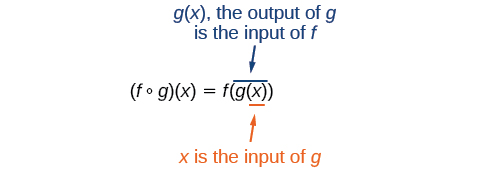
\[\left( {f \circ g} \right)(x) = f\left( {g(x)} \right)\]
We read the left-hand side as \(``f\) composed with \(g\) at \(x\operatorname{,"}\) and the right-hand side as \(``f\) of \(g\) of \(x."\) The two sides of the equation have the same mathematical meaning and are equal. The open circle symbol \(\circ\) is called the composition operator. We use this operator mainly when we wish to emphasize the relationship between the functions themselves without referring to any particular input value. Composition is a binary operation that takes two functions and forms a new function, much as addition or multiplication takes two numbers and gives a new number. However, it is important not to confuse function composition with multiplication because, as we learned above, in most cases \(f(g(x)) \neq f(x)g(x).\)
It is also important to understand the order of operations in evaluating a composite function. We follow the usual convention with parentheses by starting with the innermost parentheses first, and then working to the outside. In the equation above, the function \(g\) takes the input \(x\) first and yields an output \(g(x).\) Then the function \(f\) takes \(g(x)\) as an input and yields an output \(f\left( {g(x)} \right).\)
In general, \(f \circ g\) and \(g \circ f\) are different functions. In other words, in many cases \(f\left( {g(x)} \right) \neq g\left( {f(x)} \right)\) for all \(x.\) We will also see that sometimes two functions can be composed only in one specific order.
For example, if \(f(x) = x^{2}\) and \(g(x) = x + 2,\) then
\[\begin{array}{ccl} {f(g(x))} & = & {f(x + 2)} \\ & = & {(x + 2)}^{2} \\ & = & {x^{2} + 4x + 4} \end{array}\]
but
\[\begin{array}{ccl} {g(f(x))} & = & {g\left( x^{2} \right)} \\ & = & {x^{2} + 2} \end{array}\]
These expressions are not equal for all values of \(x,\) so the two functions are not equal. It is irrelevant that the expressions happen to be equal for the single input value \(x = - \frac{1}{2}.\)
Note that the range of the inside function (the first function to be evaluated) needs to be within the domain of the outside function. Less formally, the composition has to make sense in terms of inputs and outputs.
3.4.3 Evaluating Composite Functions
Once we compose a new function from two existing functions, we need to be able to evaluate it for any input in its domain. We will do this with specific numerical inputs for functions expressed as tables, graphs, and formulas and with variables as inputs to functions expressed as formulas. In each case, we evaluate the inner function using the starting input and then use the inner function’s output as the input for the outer function.
Evaluating Composite Functions Using Tables
When working with functions given as tables, we read input and output values from the table entries and always work from the inside to the outside. We evaluate the inside function first and then use the output of the inside function as the input to the outside function.
Evaluating Composite Functions Using Graphs
When we are given individual functions as graphs, the procedure for evaluating composite functions is similar to the process we use for evaluating tables. We read the input and output values, but this time, from the \(x\text{-}\) and \(y\text{-}\) axes of the graphs.
Using Figure 1, evaluate \(f(g(1)).\)
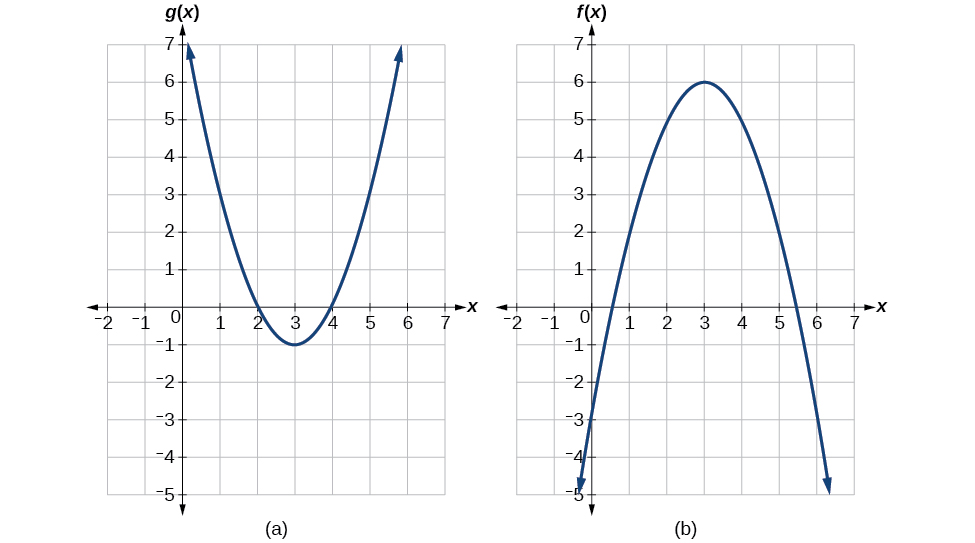
Figure 1
Solution (click to reveal)
To evaluate \(f(g(1)),\) we start with the inside evaluation. See Figure 2.
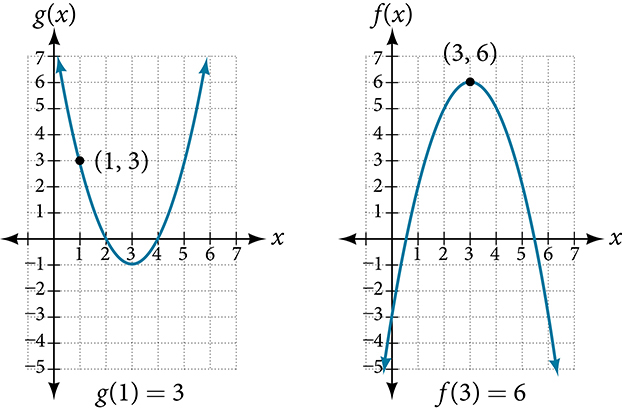
Figure 2
We evaluate \(g(1)\) using the graph of \(g(x),\) finding the input of 1 on the \(x\text{-}\) axis and finding the output value of the graph at that input. Here, \(g(1) = 3.\) We use this value as the input to the function \(f.\)
\[f(g(1)) = f(3)\]
We can then evaluate the composite function by looking to the graph of \(f(x),\) finding the input of 3 on the \(x\text{-}\) axis and reading the output value of the graph at this input. Here, \(f(3) = 6,\) so \(f(g(1)) = 6.\)
Figure 3 shows how we can mark the graphs with arrows to trace the path from the input value to the output value.
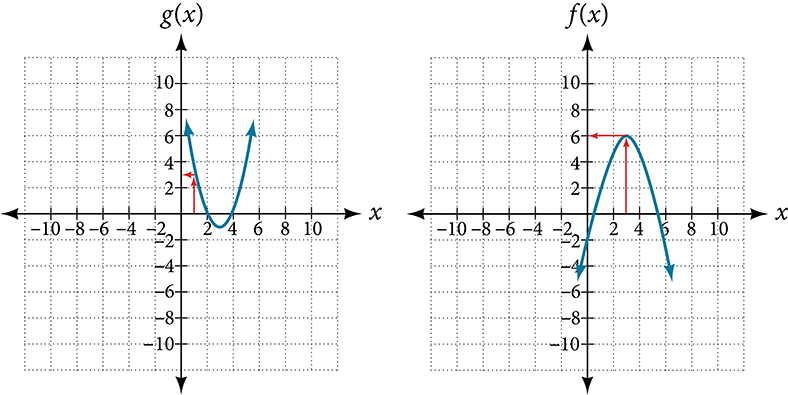
Figure 3
Evaluating Composite Functions Using Formulas
When evaluating a composite function where we have either created or been given formulas, the rule of working from the inside out remains the same. The input value to the outer function will be the output of the inner function, which may be a numerical value, a variable name, or a more complicated expression.
While we can compose the functions for each individual input value, it is sometimes helpful to find a single formula that will calculate the result of a composition \(f\left( {g(x)} \right).\) To do this, we will extend our idea of function evaluation. Recall that, when we evaluate a function like \(f(t) = t^{2} - t,\) we substitute the value inside the parentheses into the formula wherever we see the input variable.
3.4.4 Finding the Domain of a Composite Function
As we discussed previously, the domain of a composite function such as \(f \circ g\) is dependent on the domain of \(g\) and the domain of \(f.\) It is important to know when we can apply a composite function and when we cannot, that is, to know the domain of a function such as \(f \circ g.\) Let us assume we know the domains of the functions \(f\) and \(g\) separately. If we write the composite function for an input \(x\) as \(f\left( {g(x)} \right),\) we can see right away that \(x\) must be a member of the domain of \(g\) in order for the expression to be meaningful, because otherwise we cannot complete the inner function evaluation. However, we also see that \(g(x)\) must be a member of the domain of \(f,\) otherwise the second function evaluation in \(f\left( {g(x)} \right)\) cannot be completed, and the expression is still undefined. Thus the domain of \(f \circ g\) consists of only those inputs in the domain of \(g\) that produce outputs from \(g\) belonging to the domain of \(f.\) Note that the domain of \(f\) composed with \(g\) is the set of all \(x\) such that \(x\) is in the domain of \(g\) and \(g(x)\) is in the domain of \(f.\)
3.4.5 Decomposing a Composite Function into its Component Functions
In some cases, it is necessary to decompose a complicated function. In other words, we can write it as a composition of two simpler functions. There may be more than one way to decompose a composite function, so we may choose the decomposition that appears to be most expedient.
Section Exercises
Verbal
1. How does one find the domain of the quotient of two functions, \(\frac{f}{g}?\)
Solution (click to reveal)
Find the numbers that make the function in the denominator \(g\) equal to zero, and check for any other domain restrictions on \(f\) and \(g,\) such as an even-indexed root or zeros in the denominator.
2. What is the composition of two functions, \(f \circ g?\)
3. If the order is reversed when composing two functions, can the result ever be the same as the answer in the original order of the composition? If yes, give an example. If no, explain why not.
Solution (click to reveal)
Yes. Sample answer: Let \(f(x) = x + 1\mspace{9mu}\text{and~}g(x) = x - 1.\) Then \(f(g(x)) = f(x - 1) = (x - 1) + 1 = x\) and \(g(f(x)) = g(x + 1) = (x + 1) - 1 = x.\) So \(f \circ g = g \circ f.\)
4. How do you find the domain for the composition of two functions, \(f \circ g?\)
Algebraic
For the following exercises, determine the domain for each function in interval notation.
5. Given \(f(x) = x^{2} + 2x\) and \(~g(x) = 6 - x^{2},\) find \(f + g,\mspace{9mu} f - g,\mspace{9mu} fg,\) and \(\mspace{9mu}\frac{f}{g}.\)
Solution (click to reveal)
\((f + g)(x) = 2x + 6,\) domain: \(( - \infty,\infty)\)
\((f - g)(x) = 2x^{2} + 2x - 6,\) domain: \(( - \infty,\infty)\)
\((fg)(x) = - x^{4} - 2x^{3} + 6x^{2} + 12x,\) domain: \(( - \infty,\infty)\)
\(\left( \frac{f}{g} \right)(x) = \frac{x^{2} + 2x}{6 - x^{2}},\) domain: \(( - \infty, - \sqrt{6}) \cup ( - \sqrt{6},\sqrt{6}) \cup (\sqrt{6},\infty)\)
6. Given \(f(x) = - 3x^{2} + x\) and \(g(x) = 5,\) find \(f + g,\mspace{9mu} f - g,\mspace{9mu} fg,\) and \(\mspace{9mu}\frac{f}{g}.\)
7. Given \(f(x) = 2x^{2} + 4x\) and \(g(x) = \frac{1}{2x},\) find \(f + g,\mspace{9mu} f - g,\mspace{9mu} fg,\) and \(\frac{f}{g}.\)
Solution (click to reveal)
\((f + g)(x) = \frac{4x^{3} + 8x^{2} + 1}{2x},\) domain: \(( - \infty,0) \cup (0,\infty)\)
\((f - g)(x) = \frac{4x^{3} + 8x^{2} - 1}{2x},\) domain: \(( - \infty,0) \cup (0,\infty)\)
\((fg)(x) = x + 2,\) domain: \(( - \infty,0) \cup (0,\infty)\)
\(\left( \frac{f}{g} \right)(x) = 4x^{3} + 8x^{2},\) domain: \(( - \infty,0) \cup (0,\infty)\)
8. Given \(f(x) = \frac{1}{x - 4}\) and \(g(x) = \frac{1}{6 - x},\) find \(f + g,\mspace{9mu} f - g,\mspace{9mu} fg,\) and \(\frac{f}{g}.\)
9. Given \(f(x) = 3x^{2}\) and \(g(x) = \sqrt{x - 5},\) find \(f + g,\mspace{9mu} f - g,\mspace{9mu} fg,\) and \(\frac{f}{g}.\)
Solution (click to reveal)
\((f + g)(x) = 3x^{2} + \sqrt{x - 5},\) domain: \(\lbrack 5,\infty)\)
\((f - g)(x) = 3x^{2} - \sqrt{x - 5},\) domain: \(\lbrack 5,\infty)\)
\((fg)(x) = 3x^{2}\sqrt{x - 5},\) domain: \(\lbrack 5,\infty)\)
\(\left( \frac{f}{g} \right)(x) = \frac{3x^{2}}{\sqrt{x - 5}},\) domain: \((5,\infty)\)
10. Given \(f(x) = \sqrt{x}\) and \(\left. g(x) = \middle| x - 3 \middle| , \right.\) find \(\frac{g}{f}.\)
11. For the following exercise, find the indicated function given \(f(x) = 2x^{2} + 1\) and \(g(x) = 3x - 5.\)
ⓐ \(f(g(2))\)
ⓑ \(f(g(x))\)
ⓒ \(g(f(x))\)
ⓓ \(\left( {g \circ g} \right)(x)\)
ⓔ \(\left( {f \circ f} \right)\left( {- 2} \right)\)
Solution (click to reveal)
ⓐ \(3 = ~2\left( 9x^{2}~–~30x~ + ~25 \right)~ + ~1~ = ~18x^{2}~–~60x~ + ~51\)
ⓑ \(f\left( {g(x)} \right) = 2\left( {3x - 5} \right)^{2} + 1\)
ⓒ \(g\left( {f(x)} \right) = 3\left( 2x^{2} + 1 \right) - 5 = 6x^{2} - 2\)
ⓓ \(\left( {g \circ g} \right)(x) = 3(3x - 5) - 5 = 9x - 20\)
ⓔ \(\left( {f \circ f} \right)\left( {- 2} \right) = 163\)
For the following exercises, use each pair of functions to find \(f\left( {g(x)} \right)\) and \(g\left( {f(x)} \right).\) Simplify your answers.
12. \(f(x) = x^{2} + 1,\mspace{9mu} g(x) = \sqrt{x + 2}\)
13. \(f(x) = \sqrt{x} + 2,\mspace{9mu} g(x) = x^{2} + 3\)
Solution (click to reveal)
\(f(g(x)) = \sqrt{x^{2} + 3} + 2,\mspace{9mu} g(f(x)) = x + 4\sqrt{x} + 7\)
14. \(f(x) = |x|,\mspace{9mu} g(x) = 5x + 1\)
15. \(f(x) = \sqrt[3]{x},\mspace{9mu} g(x) = \frac{x + 1}{x^{3}}\)
Solution (click to reveal)
\(f(g(x)) = \sqrt[3]{\frac{x + 1}{x^{3}}} = \frac{\sqrt[3]{x + 1}}{x},\mspace{9mu} g(f(x)) = \frac{\sqrt[3]{x} + 1}{x}\)
16. \(f(x) = \frac{1}{x - 6},\mspace{9mu} g(x) = \frac{7}{x} + 6\)
17. \(f(x) = \frac{1}{x - 4},\mspace{9mu} g(x) = \frac{2}{x} + 4\)
Solution (click to reveal)
\(\left( {f \circ g} \right)(x) = \frac{1}{\frac{2}{x} + 4 - 4} = \frac{x}{2},\mspace{9mu}\left( {g \circ f} \right)(x) = 2x - 4\)
For the following exercises, use each set of functions to find \(f\left( {g\left( {h(x)} \right)} \right).\) Simplify your answers.
18. \(f(x) = x^{4} + 6,\) \(g(x) = x - 6,\) and \(h(x) = \sqrt{x}\)
19. \(f(x) = x^{2} + 1,\) \(g(x) = \frac{1}{x},\) and \(h(x) = x + 3\)
Solution (click to reveal)
\(f(g(h(x))) = \left( \frac{1}{x + 3} \right)^{2} + 1\)
20. Given \(f(x) = \frac{1}{x}\) and \(g(x) = x - 3,\) find the following:
ⓐ \((f \circ g)(x)\)
ⓑ the domain of \((f \circ g)(x)\) in interval notation
ⓒ \((g \circ f)(x)\)
ⓓ the domain of \((g \circ f)(x)\)
ⓔ \(\left( \frac{f}{g} \right){(x)}\)
21. Given \(f(x) = \sqrt{2 - 4x}\) and \(g(x) = - \frac{3}{x},\) find the following:
ⓐ \((g \circ f)(x)\) ⓑ the domain of \((g \circ f)(x)\) in interval notation
Solution (click to reveal)
ⓐ \((g \circ f)(x) = - \frac{3}{\sqrt{2 - 4x}}\)
ⓑ \(\left( {- \infty,\frac{1}{2}} \right)\)
22. Given the functions \(f(x) = \frac{1 - x}{x}\mspace{9mu}\text{and}\mspace{9mu} g(x) = \frac{1}{1 + x^{2}},\) find the following:
ⓐ \((g \circ f)(x)\) ⓑ \((g \circ f)(\text{2})\)
23. Given functions \(p(x) = \frac{1}{\sqrt{x}}\) and \(m(x) = x^{2} - 4,\) state the domain of each of the following functions using interval notation:
ⓐ \(\frac{p(x)}{m(x)}\) ⓑ \(p(m(x))\) ⓒ \(m(p(x))\)
Solution (click to reveal)
ⓐ \((0,2) \cup (2,\infty);\) ⓑ \(( - \infty, - 2) \cup (2,\infty);\) ⓒ \((0,\infty)\)
24. Given functions \(q(x) = \frac{1}{\sqrt{x}}\) and \(h(x) = x^{2} - 9,\) state the domain of each of the following functions using interval notation.
ⓐ \(\frac{q(x)}{h(x)}\) ⓑ \(q\left( {h(x)} \right)\) ⓒ \(h\left( {q(x)} \right)\)
25. For \(f(x) = \frac{1}{x}\) and \(g(x) = \sqrt{x - 1},\) write the domain of \((f \circ g)(x)\) in interval notation.
Solution (click to reveal)
\((1,\infty)\)
For the following exercises, find functions \(f(x)\) and \(g(x)\) so the given function can be expressed as \(h(x) = f\left( {g(x)} \right).\)
26. \(h(x) = {(x + 2)}^{2}\)
27. \(h(x) = {(x - 5)}^{3}\)
Solution (click to reveal)
sample: \(\begin{array}{l} {f(x) = x^{3}} \\ {g(x) = x - 5} \end{array}\)
28. \(h(x) = \frac{3}{x - 5}\)
29. \(h(x) = \frac{4}{{(x + 2)}^{2}}\)
Solution (click to reveal)
sample: \(\begin{array}{l} {f(x) = \frac{4}{x}} \\ {g(x) = {(x + 2)}^{2}} \end{array}\)
30. \(h(x) = 4 + \sqrt[3]{x}\)
31. \(h(x) = \sqrt[3]{\frac{1}{2x - 3}}\)
Solution (click to reveal)
sample: \(\begin{array}{l} {f(x) = \sqrt[3]{x}} \\ {g(x) = \frac{1}{2x - 3}} \end{array}\)
32. \(h(x) = \frac{1}{{(3x^{2} - 4)}^{- 3}}\)
33. \(h(x) = \sqrt[4]{\frac{3x - 2}{x + 5}}\)
Solution (click to reveal)
sample: \(\begin{array}{l} {f(x) = \sqrt[4]{x}} \\ {g(x) = \frac{3x - 2}{x + 5}} \end{array}\)
34. \(h(x) = \left( \frac{8 + x^{3}}{8 - x^{3}} \right)^{4}\)
35. \(h(x) = \sqrt{2x + 6}\)
Solution (click to reveal)
sample: \(\begin{array}{l} {\mspace{9mu} f(x) = \sqrt{x}\mspace{9mu}} \\ {\mspace{9mu} g(x) = 2x + 6} \end{array}\)
36. \(h(x) = {(5x - 1)}^{3}\)
37. \(h(x) = \sqrt[3]{x - 1}\)
Solution (click to reveal)
sample: \(\begin{array}{l} {\mspace{9mu} f(x) = \sqrt[3]{x}} \\ {\mspace{9mu} g(x) = (x - 1)} \end{array}\)
38. \(h(x) = \left| {x^{2} + 7} \right|\)
39. \(h(x) = \frac{1}{{(x - 2)}^{3}}\)
Solution (click to reveal)
sample: \(\begin{array}{l} {\mspace{9mu} f(x) = x^{3}} \\ {\mspace{9mu} g(x) = \frac{1}{x - 2}} \end{array}\)
40. \(h(x) = \left( \frac{1}{2x - 3} \right)^{2}\)
41. \(h(x) = \sqrt{\frac{2x - 1}{3x + 4}}\)
Solution (click to reveal)
sample: \(\begin{array}{l} {\mspace{9mu} f(x) = \sqrt{x}} \\ {\mspace{9mu} g(x) = \frac{2x - 1}{3x + 4}} \end{array}\)
Graphical
For the following exercises, use the graphs of \(f,\) shown in Figure 4, and \(g,\) shown in Figure 5, to evaluate the expressions.
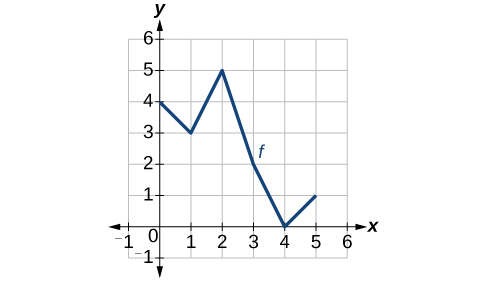
Figure 4
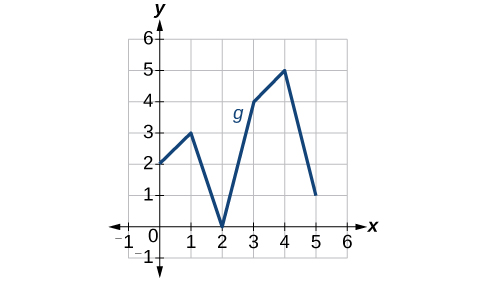
Figure 5
42. \(f\left( {g(3)} \right)\)
43. \(f\left( {g(1)} \right)\)
Solution (click to reveal)
2
44. \(g\left( {f(1)} \right)\)
45. \(g\left( {f(0)} \right)\)
Solution (click to reveal)
5
46. \(f\left( {f(5)} \right)\)
47. \(f\left( {f(4)} \right)\)
Solution (click to reveal)
4
48. \(g\left( {g(2)} \right)\)
49. \(g\left( {g(0)} \right)\)
Solution (click to reveal)
0
For the following exercises, use graphs of \(f(x),\) shown in Figure 6, \(g(x),\) shown in Figure 7, and \(h(x),\) shown in Figure 8, to evaluate the expressions.
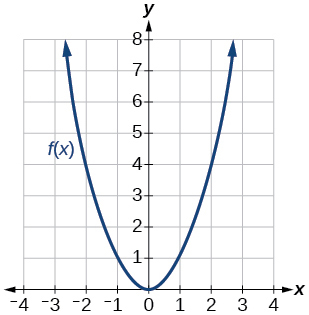
Figure 6
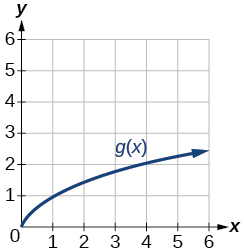
Figure 7
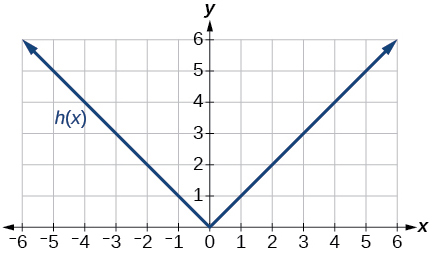
Figure 8
50. \(g\left( {f(1)} \right)\)
51. \(g\left( {f(2)} \right)\)
Solution (click to reveal)
2
52. \(f\left( {g(4)} \right)\)
53. \(f\left( {g(1)} \right)\)
Solution (click to reveal)
1
54. \(f\left( {h(2)} \right)\)
55. \(h\left( {f(2)} \right)\)
Solution (click to reveal)
4
56. \(f\left( {g\left( {h(4)} \right)} \right)\)
57. \(f\left( {g\left( {f\left( {- 2} \right)} \right)} \right)\)
Solution (click to reveal)
4
Numeric
For the following exercises, use the function values for \(f\mspace{9mu}\text{and~}g\) shown in Table 3 to evaluate each expression.
| \(x\) | \(f(x)\) | \(g(x)\) |
|---|---|---|
| 0 | 7 | 9 |
| 1 | 6 | 5 |
| 2 | 5 | 6 |
| 3 | 8 | 2 |
| 4 | 4 | 1 |
| 5 | 0 | 8 |
| 6 | 2 | 7 |
| 7 | 1 | 3 |
| 8 | 9 | 4 |
| 9 | 3 | 0 |
Table 3
58. \(f\left( {g(8)} \right)\)
59. \(f\left( {g(5)} \right)\)
Solution (click to reveal)
9
60. \(g\left( {f(5)} \right)\)
61. \(g\left( {f(3)} \right)\)
Solution (click to reveal)
4
62. \(f\left( {f(4)} \right)\)
63. \(f\left( {f(1)} \right)\)
Solution (click to reveal)
2
64. \(g\left( {g(2)} \right)\)
65. \(g\left( {g(6)} \right)\)
Solution (click to reveal)
3
For the following exercises, use the function values for \(f\mspace{9mu}\text{and~}g\) shown in Table 4 to evaluate the expressions.
| \(x\) | \(f(x)\) | \(g(x)\) |
|---|---|---|
| \(-3\) | 11 | \(-8\) |
| \(-2\) | 9 | \(-3\) |
| \(-1\) | 7 | 0 |
| 0 | 5 | 1 |
| 1 | 3 | 0 |
| 2 | 1 | \(-3\) |
| 3 | \(-1\) | \(-8\) |
Table 4
66. \((f \circ g)(1)\)
67. \((f \circ g)(2)\)
Solution (click to reveal)
11
68. \((g \circ f)(2)\)
69. \((g \circ f)(3)\)
Solution (click to reveal)
0
70. \((g \circ g)(1)\)
71. \((f \circ f)(3)\)
Solution (click to reveal)
7
For the following exercises, use each pair of functions to find \(f\left( {g(0)} \right)\) and \(g\left( {f(0)} \right).\)
72. \(f(x) = 4x + 8,\mspace{9mu} g(x) = 7 - x^{2}\)
73. \(f(x) = 5x + 7,\mspace{9mu} g(x) = 4 - 2x^{2}\)
Solution (click to reveal)
\(f(g(0)) = 27,\mspace{9mu} g\left( {f(0)} \right) = - 94\)
74. \(f(x) = \sqrt{x + 4},\mspace{9mu} g(x) = 12 - x^{3}\)
75. \(f(x) = \frac{1}{x + 2},\mspace{9mu} g(x) = 4x + 3\)
Solution (click to reveal)
\(f(g(0)) = \frac{1}{5},\mspace{9mu} g(f(0)) = 5\)
For the following exercises, use the functions \(f(x) = 2x^{2} + 1\) and \(g(x) = 3x + 5\) to evaluate or find the composite function as indicated.
76. \(f\left( {g(2)} \right)\)
77. \(f\left( {g(x)} \right)\)
Solution (click to reveal)
\(18x^{2} + 60x + 51\)
78. \(g\left( {f( - 3)} \right)\)
79. \((g \circ g)(x)\)
Solution (click to reveal)
\(g \circ g(x) = 9x + 20\)
Extensions
For the following exercises, use \(f(x) = x^{3} + 1\) and \(g(x) = \sqrt[3]{x - 1}.\)
80. Find \((f \circ g)(x)\) and \((g \circ f)(x).\) Compare the two answers.
81. Find \((f \circ g)(2)\) and \((g \circ f)(2).\)
Solution (click to reveal)
2
82. What is the domain of \((g \circ f)(x)?\)
83. What is the domain of \((f \circ g)(x)?\)
Solution (click to reveal)
\(( - \infty,\infty)\)
84. Let \(f(x) = \frac{1}{x}.\)
ⓐ Find \((f \circ f)(x).\)
ⓑ Is \((f \circ f)(x)\) for any function \(f\) the same result as the answer to part (a) for any function? Explain.
For the following exercises, let \(F(x) = {(x + 1)}^{5},\) \(f(x) = x^{5},\) and \(g(x) = x + 1.\)
85. True or False: \((g \circ f)(x) = F(x).\)
Solution (click to reveal)
False
86. True or False: \((f \circ g)(x) = F(x).\)
For the following exercises, find the composition when \(f(x) = x^{2} + 2\) for all \(x \geq 0\) and \(g(x) = \sqrt{x - 2}.\)
87. \((f \circ g)(6);\mspace{9mu}(g \circ f)(6)\)
Solution (click to reveal)
\((f \circ g)(6) = 6\) ; \((g \circ f)(6) = 6\)
88. \((g \circ f)(a);\mspace{9mu}(f \circ g)(a)\)
89. \((f \circ g)(11);\mspace{9mu}(g \circ f)(11)\)
Solution (click to reveal)
\((f \circ g)(11) = 11\mspace{9mu},\mspace{9mu}(g \circ f)(11) = 11\)
Real-World Applications
90. The function \(D(p)\) gives the number of items that will be demanded when the price is \(p.\) The production cost \(C(x)\) is the cost of producing \(x\) items. To determine the cost of production when the price is $6, you would do which of the following?
ⓐ Evaluate \(D\left( {C(6)} \right).\)
ⓑ Evaluate \(C\left( {D(6)} \right).\)
ⓒ Solve \(D\left( {C(x)} \right) = 6.\)
ⓓ Solve \(C\left( {D(p)} \right) = 6.\)
91. The function \(A(d)\) gives the pain level on a scale of 0 to 10 experienced by a patient with \(d\) milligrams of a pain-reducing drug in her system. The milligrams of the drug in the patient’s system after \(t\) minutes is modeled by \(m(t).\) Which of the following would you do in order to determine when the patient will be at a pain level of 4?
ⓐ Evaluate \(A\left( {m(4)} \right).\)
ⓑ Evaluate \(m\left( {A(4)} \right).\)
ⓒ Solve \(A\left( {m(t)} \right) = 4.\)
ⓓ Solve \(m\left( {A(d)} \right) = 4.\)
Solution (click to reveal)
c
92. A store offers customers a 30% discount on the price \(x\) of selected items. Then, the store takes off an additional 15% at the cash register. Write a price function \(P(x)\) that computes the final price of the item in terms of the original price \(x.\) (Hint: Use function composition to find your answer.)
93. A rain drop hitting a lake makes a circular ripple. If the radius, in inches, grows as a function of time in minutes according to \(r(t) = 25\sqrt{t + 2},\) find the area of the ripple as a function of time. Find the area of the ripple at \(t = 2.\)
Solution (click to reveal)
\(A(t) = \pi\left( {25\sqrt{t + 2}} \right)^{2}\) and \(A(2) = \pi\left( {25\sqrt{4}} \right)^{2} = 2500\pi\) square inches
94. A forest fire leaves behind an area of grass burned in an expanding circular pattern. If the radius of the circle of burning grass is increasing with time according to the formula \(r(t) = 2t + 1,\) express the area burned as a function of time, \(t\) (minutes).
95. Use the function you found in the previous exercise to find the total area burned after 5 minutes.
Solution (click to reveal)
\(A(5) = \pi\left( {2(5) + 1} \right)^{2} = 121\pi\) square units
96. The radius \(r,\) in inches, of a spherical balloon is related to the volume, \(V,\) by \(r(V) = \sqrt[3]{\frac{3V}{4\pi}}.\) Air is pumped into the balloon, so the volume after \(t\) seconds is given by \(V(t) = 10 + 20t.\)
ⓐ Find the composite function \(r\left( {V(t)} \right).\)
ⓑ Find the exact time when the radius reaches 10 inches.
97. The number of bacteria in a refrigerated food product is given by \(N(T) = 23T^{2} - 56T + 1,\) \(3 < T < 33,\) where \(T\) is the temperature of the food. When the food is removed from the refrigerator, the temperature is given by \(T(t) = 5t + 1.5,\) where \(t\) is the time in hours.
ⓐ Find the composite function \(N\left( {T(t)} \right).\)
ⓑ Find the time (round to two decimal places) when the bacteria count reaches 6752.
Solution (click to reveal)
ⓐ \(N(T(t)) = 23{(5t + 1.5)}^{2} - 56(5t + 1.5) + 1\) ⓑ 3.38 hours