2.6 Other Types of Equations

NoteLearning Objectives

In this section, you will:

  • Solve equations involving rational exponents.
  • Solve equations using factoring.
  • Solve radical equations.
  • Solve absolute value equations.
  • Solve other types of equations.

We have solved linear equations, rational equations, and quadratic equations using several methods. However, there are many other types of equations, and we will investigate a few more types in this section. We will look at equations involving rational exponents, polynomial equations, radical equations, absolute value equations, equations in quadratic form, and some rational equations that can be transformed into quadratics. Solving any equation, however, employs the same basic algebraic rules. We will learn some new techniques as they apply to certain equations, but the algebra never changes.

2.6.1 Solving Equations Involving Rational Exponents

Rational exponents are exponents that are fractions, where the numerator is a power and the denominator is a root. For example, \(16^{\frac{1}{2}}\) is another way of writing \(\sqrt{16};\) \(8^{\frac{1}{3}}\) is another way of writing \(\mspace{9mu}\sqrt[3]{8}.\) The ability to work with rational exponents is a useful skill, as it is highly applicable in calculus.

We can solve equations in which a variable is raised to a rational exponent by raising both sides of the equation to the reciprocal of the exponent. The reason we raise the equation to the reciprocal of the exponent is because we want to eliminate the exponent on the variable term, and a number multiplied by its reciprocal equals 1. For example, \(\frac{2}{3}\left( \frac{3}{2} \right) = 1,\) \(3\left( \frac{1}{3} \right) = 1,\) and so on.

NoteRational Exponents

A rational exponent indicates a power in the numerator and a root in the denominator. There are multiple ways of writing an expression, a variable, or a number with a rational exponent:

\[a^{\frac{m}{n}} = \left( a^{\frac{1}{n}} \right)^{m} = \left( a^{m} \right)^{\frac{1}{n}} = \sqrt[n]{a^{m}} = \left( \sqrt[n]{a} \right)^{m}\]

TipExample 1 — Evaluating a Number Raised to a Rational Exponent

Evaluate \(8^{\frac{2}{3}}.\)

Solution (click to reveal)

Whether we take the root first or the power first depends on the number. It is easy to find the cube root of 8, so rewrite \(8^{\frac{2}{3}}\) as \(\left( 8^{\frac{1}{3}} \right)^{2}.\)

\[\begin{array}{ccl} \left( 8^{\frac{1}{3}} \right)^{2} & = & {(2)}^{2} \\ & = & 4 \end{array}\]

WarningTry It #1

Evaluate \(64^{- \frac{1}{3}}.\)

Solution (click to reveal)

\(\frac{1}{4}\)

TipExample 2 — Solve the Equation Including a Variable Raised to a Rational Exponent

Solve the equation in which a variable is raised to a rational exponent: \(x^{\frac{5}{4}} = 32.\)

Solution (click to reveal)

The way to remove the exponent on \(x\) is by raising both sides of the equation to a power that is the reciprocal of \(\frac{5}{4},\) which is \(\frac{4}{5}.\)

\[\begin{array}{cclc} x^{\frac{5}{4}} & = & 32 & \\ \left( x^{\frac{5}{4}} \right)^{\frac{4}{5}} & = & {(32)}^{\frac{4}{5}} & \\ x & = & {(2)}^{4} & {\qquad\text{The~fifth~root~of~32~is~2.}} \\ & = & 16 & \end{array}\]

WarningTry It #2

Solve the equation \(x^{\frac{3}{2}} = 125.\)

Solution (click to reveal)

\(25\)

TipExample 3 — Solving an Equation Involving Rational Exponents and Factoring

Solve \(3x^{\frac{3}{4}} = x^{\frac{1}{2}}.\)

Solution (click to reveal)

This equation involves rational exponents as well as factoring rational exponents. Let us take this one step at a time. First, put the variable terms on one side of the equal sign and set the equation equal to zero.

\[\begin{array}{rcl} {3x^{\frac{3}{4}} - \left( x^{\frac{1}{2}} \right)} & = & {x^{\frac{1}{2}} - \left( x^{\frac{1}{2}} \right)} \\ {3x^{\frac{3}{4}} - x^{\frac{1}{2}}} & = & 0 \end{array}\]

Now, it looks like we should factor the left side, but what do we factor out? We can always factor the term with the lowest exponent. Rewrite \(x^{\frac{1}{2}}\) as \(x^{\frac{2}{4}}.\) Then, factor out \(x^{\frac{2}{4}}\) from both terms on the left.

\[\begin{array}{rcl} {3x^{\frac{3}{4}} - x^{\frac{2}{4}}} & = & 0 \\ {x^{\frac{2}{4}}\left( {3x^{\frac{1}{4}} - 1} \right)} & = & 0 \end{array}\]

Where did \(x^{\frac{1}{4}}\) come from? Remember, when we multiply two numbers with the same base, we add the exponents. Therefore, if we multiply \(x^{\frac{2}{4}}\) back in using the distributive property, we get the expression we had before the factoring, which is what should happen. We need an exponent such that when added to \(\frac{2}{4}\) equals \(\frac{3}{4}.\) Thus, the exponent on x in the parentheses is \(\frac{1}{4}.\)

Let us continue. Now we have two factors and can use the zero factor theorem.

\[\begin{array}{rclc} {x^{\frac{2}{4}}\left( {3x^{\frac{1}{4}} - 1} \right)} & = & 0 & \\ x^{\frac{2}{4}} & = & 0 & \\ x & = & 0 & \\ {3x^{\frac{1}{4}} - 1} & = & 0 & \\ {3x^{\frac{1}{4}}} & = & 1 & \\ x^{\frac{1}{4}} & = & \frac{1}{3} & {\qquad\text{Divide~both~sides~by~3}.} \\ \left( x^{\frac{1}{4}} \right)^{4} & = & \left( \frac{1}{3} \right)^{4} & {\qquad\text{Raise~both~sides~to~the~reciprocal~of~}\frac{1}{4}.} \\ x & = & \frac{1}{81} & \end{array}\]

The two solutions are \(0\) and \(\frac{1}{81}.\)

WarningTry It #3

Solve: \(\left( {x + 5} \right)^{\frac{3}{2}} = 8.\)

Solution (click to reveal)

\(\left\{ -1 \right\}\)

2.6.2 Solving Equations Using Factoring

We have used factoring to solve quadratic equations, but it is a technique that we can use with many types of polynomial equations, which are equations that contain a string of terms including numerical coefficients and variables. When we are faced with an equation containing polynomials of degree higher than 2, we can often solve them by factoring.

NotePolynomial Equations

A polynomial of degree n is an expression of the type

\[a_{n}x^{n} + a_{n - 1}x^{n - 1} + \mspace{9mu}\mspace{9mu}\mspace{9mu} \cdot \mspace{9mu}\mspace{9mu} \cdot \mspace{9mu}\mspace{9mu} \cdot \mspace{9mu}\mspace{9mu} + a_{2}x^{2} + a_{1}x + a_{0}\]

where \(n\) is a positive integer and \(a_{n},\ldots,a_{0}\) are real numbers and \(a_{n} \neq 0.\)

Setting the polynomial equal to zero gives a polynomial equation. The total number of solutions (real and complex) to a polynomial equation is equal to the highest exponent \(n\).

TipExample 4 — Solving a Polynomial by Factoring

Solve the polynomial by factoring: \(5x^{4} = 80x^{2}.\)

Solution (click to reveal)

First, set the equation equal to zero. Then factor out what is common to both terms, the GCF.

\[\begin{array}{rcl} {5x^{4} - 80x^{2}} & = & 0 \\ {5x^{2}\left( x^{2} - 16 \right)} & = & 0 \end{array}\]

Notice that we have the difference of squares in the factor \(x^{2} - 16,\) which we will continue to factor and obtain two solutions. The first term, \(5x^{2},\) generates, technically, two solutions as the exponent is 2, but they are the same solution.

\[\begin{array}{rcl} {5x^{2}} & = & 0 \\ x & = & 0 \\ {x^{2} - 16} & = & 0 \\ {(x - 4)(x + 4)} & = & 0 \\ x & = & 4 \\ x & = & -4 \end{array}\]

The solutions are \(0\mspace{9mu}\text{(double~solution),}\) \(4,\) and \(-4.\)

We can see the solutions on the graph in Figure 1. The \(x\)-coordinates of the points where the graph crosses the \(x\)-axis are the solutions—the \(x\)-intercepts. Notice on the graph that at the solution \(0,\) the graph touches the \(x\)-axis and bounces back. It does not cross the \(x\)-axis. This is typical of double solutions.
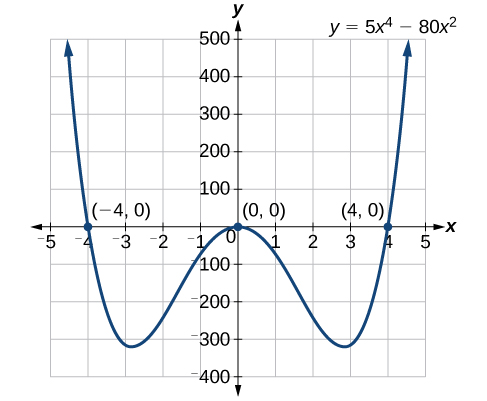
Coordinate plane with the x-axis ranging from negative 5 to 5 and the y-axis ranging from negative 400 to 500 in intervals of 100. The function five times x to the fourth power minus eighty x squared equals zero is graphed along with the points (negative 4,0), (0,0), and (4,0).

Figure 1

WarningTry It #4

Solve by factoring: \(12x^{4} = 3x^{2}.\)

Solution (click to reveal)

\(0,\) \(\frac{1}{2},\) \(- \frac{1}{2}\)

TipExample 5 — Solve a Polynomial by Grouping

Solve a polynomial by grouping: \(x^{3} + x^{2} - 9x - 9 = 0.\)

Solution (click to reveal)

This polynomial consists of 4 terms, which we can solve by grouping. Grouping procedures require factoring the first two terms and then factoring the last two terms. If the factors in the parentheses are identical, we can continue the process and solve, unless more factoring is suggested.

\[\begin{array}{rcl} {x^{3} + x^{2} - 9x - 9} & = & 0 \\ {x^{2}(x + 1) - 9(x + 1)} & = & 0 \\ {\left( x^{2} - 9 \right)(x + 1)} & = & 0 \end{array}\]

The grouping process ends here, as we can factor \(x^{2} - 9\) using the difference of squares formula.

\[\begin{array}{ccl} {\left( x^{2} - 9 \right)(x + 1)} & = & 0 \\ {(x - 3)(x + 3)(x + 1)} & = & 0 \\ x & = & 3 \\ x & = & -3 \\ x & = & -1 \end{array}\]

The solutions are \(3,\) \(-3,\) and \(-1.\) Note that the highest exponent is 3 and we obtained 3 solutions. We can see the solutions, the \(x\)-intercepts, on the graph in Figure 2.
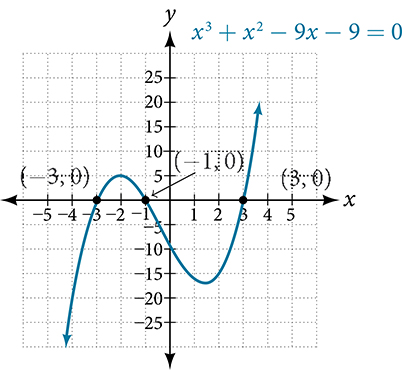
Coordinate plane with the x-axis ranging from negative 5 to 5 and the y-axis ranging from negative 30 to 20 in intervals of 5. The function x cubed plus x squared minus nine times x minus nine equals zero is graphed along with the points (negative 3,0), (negative 1,0), and (3,0).

Figure 2

We looked at solving quadratic equations by factoring when the leading coefficient is 1. When the leading coefficient is not 1, we solved by grouping. Grouping requires four terms, which we obtained by splitting the linear term of quadratic equations. We can also use grouping for some polynomials of degree higher than 2, as we saw here, since there were already four terms.

2.6.3 Solving Radical Equations

Radical equations are equations that contain variables in the radicand (the expression under a radical symbol), such as

\[\begin{array}{rcl} \sqrt{3x + 18} & = & x \\ \sqrt{x + 3} & = & {x - 3} \\ {\sqrt{x + 5} - \sqrt{x - 3}} & = & 2 \end{array}\]

Radical equations may have one or more radical terms, and are solved by eliminating each radical, one at a time. We have to be careful when solving radical equations, as it is not unusual to find extraneous solutions, roots that are not, in fact, solutions to the equation. These solutions are not due to a mistake in the solving method, but result from the process of raising both sides of an equation to a power. However, checking each answer in the original equation will confirm the true solutions.

NoteRadical Equations

An equation containing terms with a variable in the radicand is called a radical equation.

ImportantHow To

Given a radical equation, solve it.

  1. Isolate the radical expression on one side of the equal sign. Put all remaining terms on the other side.
  2. If the radical is a square root, then square both sides of the equation. If it is a cube root, then raise both sides of the equation to the third power. In other words, for an \(n\)th root radical, raise both sides to the \(n\)th power. Doing so eliminates the radical symbol.
  3. Solve the remaining equation.
  4. If a radical term still remains, repeat steps 1–2.
  5. Confirm solutions by substituting them into the original equation.
TipExample 6 — Solving an Equation with One Radical

Solve \(\sqrt{15 - 2x} = x.\)

Solution (click to reveal)

The radical is already isolated on the left side of the equal side, so proceed to square both sides.

\[\begin{array}{rcl} \sqrt{15 - 2x} & = & x \\ \left( \sqrt{15 - 2x} \right)^{2} & = & {(x)}^{2} \\ {15 - 2x} & = & x^{2} \end{array}\]

We see that the remaining equation is a quadratic. Set it equal to zero and solve.

\[\begin{array}{ccl} 0 & = & {x^{2} + 2x - 15} \\ & = & {(x + 5)(x - 3)} \\ x & = & -5 \\ x & = & 3 \end{array}\]

The proposed solutions are \(-5\) and \(3.\) Let us check each solution back in the original equation. First, check \(x = -5.\)

\[\begin{array}{rcl} \sqrt{15 - 2x} & = & x \\ \sqrt{15 - 2( - 5)} & = & -5 \\ \sqrt{25} & = & -5 \\ 5 & \neq & {\operatorname{}-5} \end{array}\]

This is an extraneous solution. While no mistake was made solving the equation, we found a solution that does not satisfy the original equation.

Check \(x = 3.\)

\[\begin{array}{rcl} \sqrt{15 - 2x} & = & x \\ \sqrt{15 - 2(3)} & = & 3 \\ \sqrt{9} & = & 3 \\ 3 & = & 3 \end{array}\]

The solution is \(3.\)

WarningTry It #5

Solve the radical equation: \(\sqrt{x + 3} = 3x - 1\)

Solution (click to reveal)

\(1;\) extraneous solution \(- \frac{2}{9}\)

TipExample 7 — Solving a Radical Equation Containing Two Radicals

Solve \(\sqrt{2x + 3} + \sqrt{x - 2} = 4.\)

Solution (click to reveal)

As this equation contains two radicals, we isolate one radical, eliminate it, and then isolate the second radical.

\[\begin{array}{rclc} {\sqrt{2x + 3} + \sqrt{x - 2}} & = & 4 & \\ \sqrt{2x + 3} & = & {4 - \sqrt{x - 2}} & {\qquad\text{Subtract~}\sqrt{x - 2}\mspace{9mu}\text{from~both~sides}.} \\ \left( \sqrt{2x + 3} \right)^{2} & = & \left( 4 - \sqrt{x - 2} \right)^{2} & {\qquad\text{Square~both~sides}.} \end{array}\]

Use the perfect square formula to expand the right side: \(\left( {a - b} \right)^{2} = a^{2}-2ab + b^{2}.\)

\[\begin{array}{rclc} {2x + 3} & = & {{(4)}^{2} - 2(4)\sqrt{x - 2} + \left( \sqrt{x - 2} \right)^{2}} & \\ {2x + 3} & = & {16 - 8\sqrt{x - 2} + (x - 2)} & \\ {2x + 3} & = & {14 + x - 8\sqrt{x - 2}} & {\qquad\text{Combine~like~terms}.} \\ {x - 11} & = & {-8\sqrt{x - 2}} & {\qquad\text{Isolate~the~second~radical}.} \\ {(x - 11)}^{2} & = & \left( -8\sqrt{x - 2} \right)^{2} & {\qquad\text{Square~both~sides}.} \\ {x^{2} - 22x + 121} & = & {64(x - 2)} & \end{array}\]

Now that both radicals have been eliminated, set the quadratic equal to zero and solve.

\[\begin{array}{rclc} {x^{2} - 22x + 121} & = & {64x - 128} & \\ {x^{2} - 86x + 249} & = & 0 & \\ {(x - 3)(x - 83)} & = & 0 & {\qquad\text{Factor~and~solve}.} \\ x & = & 3 & \\ x & = & 83 & \end{array}\]

The proposed solutions are \(3\) and \(83.\) Check each solution in the original equation.

\[\begin{array}{rcl} {\sqrt{2x + 3} + \sqrt{x - 2}} & = & 4 \\ \sqrt{2x + 3} & = & {4 - \sqrt{x - 2}} \\ \sqrt{2(3) + 3} & = & {4 - \sqrt{(3) - 2}} \\ \sqrt{9} & = & {4 - \sqrt{1}} \\ 3 & = & 3 \end{array}\]

One solution is \(3.\)

Check \(x = 83.\)

\[\begin{array}{rcl} {\sqrt{2x + 3} + \sqrt{x - 2}} & = & 4 \\ \sqrt{2x + 3} & = & {4 - \sqrt{x - 2}} \\ \sqrt{2(83) + 3} & = & {4 - \sqrt{(83 - 2)}} \\ \sqrt{169} & = & {4 - \sqrt{81}} \\ 13 & \neq & {- 5} \end{array}\]

The only solution is \(3.\) We see that \(83\) is an extraneous solution.

WarningTry It #6

Solve the equation with two radicals: \(\sqrt{3x + 7} + \sqrt{x + 2} = 1.\)

Solution (click to reveal)

\(-2;\) extraneous solution \(-1\)

2.6.4 Solving an Absolute Value Equation

Next, we will learn how to solve an absolute value equation. To solve an equation such as \(\left| {2x - 6} \right| = 8,\) we notice that the absolute value will be equal to 8 if the quantity inside the absolute value bars is \(8\) or \(-8.\) This leads to two different equations we can solve independently.

\[\begin{array}{rcccrcl} {2x - 6} & = & 8 & {\qquad\text{or}\qquad} & {2x - 6} & = & -8 \\ {2x} & = & 14 & & {2x} & = & -2 \\ x & = & 7 & & x & = & -1 \end{array}\]

Knowing how to solve problems involving absolute value functions is useful. For example, we may need to identify numbers or points on a line that are at a specified distance from a given reference point.

NoteAbsolute Value Equations

The absolute value of x is written as \(|x|.\) It has the following properties:

\[\begin{array}{l} \left. \text{If~}x \geq 0,\mspace{9mu}\text{then~} \middle| x \middle| = x. \right. \\ \left. \text{If~}x < 0,\mspace{9mu}\text{then~} \middle| x \middle| = -x. \right. \end{array}\]

For real numbers \(A\) and \(B,\) an equation of the form \(|A| = B,\) with \(B \geq 0,\) will have solutions when \(A = B\) or \(A = - B.\) If \(B < 0,\) the equation \(|A| = B\) has no solution.

An absolute value equation in the form \(\left| {ax + b} \right| = c\) has the following properties:

\[\begin{array}{l} \left. \text{If~~}c < 0, \middle| ax + b \middle| = c\mspace{9mu}\text{has~no~solution}. \right. \\ \left. \text{If~~}c = 0, \middle| ax + b \middle| = c\mspace{9mu}\text{has~one~solution}. \right. \\ \left. \text{If~~}c > 0, \middle| ax + b \middle| = c\mspace{9mu}\text{has~two~solutions}. \right. \end{array}\]

ImportantHow To

Given an absolute value equation, solve it.

  1. Isolate the absolute value expression on one side of the equal sign.
  2. If \(c > 0,\) write and solve two equations: \(ax + b = c\) and \(ax + b = - c.\)
TipExample 8 — Solving Absolute Value Equations

Solve the following absolute value equations:

\(\left| {6x + 4} \right| = 8\)

\(\left| {3x + 4} \right| = -9\)

\(\left| {3x - 5} \right| - 4 = 6\)

\(\left| {-5x + 10} \right| = 0\)

Solution (click to reveal)

\(\left| {6x + 4} \right| = 8\) Write two equations and solve each:

\[\begin{array}{rclcrcl} {6x + 4} & = & 8 & \mspace{90mu} & {6x + 4} & = & -8 \\ {6x} & = & 4 & \mspace{90mu} & {6x} & = & -12 \\ x & = & \frac{2}{3} & \mspace{90mu} & x & = & -2 \end{array}\]

The two solutions are \(\frac{2}{3}\) and \(-2.\)

\(\left| {3x + 4} \right| = -9\)There is no solution as an absolute value cannot be negative.

\(\left| {3x - 5} \right| - 4 = 6\)Isolate the absolute value expression and then write two equations.

\[\begin{matrix} & & & {\left| {3x - 5} \right| - 4} & = & 6 & & & \\ & & & \left| {3x - 5} \right| & = & 10 & & & \\ {3x - 5} & = & 10 & & & & {3x - 5} & = & -10 \\ {3x} & = & 15 & & & & {3x} & = & -5 \\ x & = & 5 & & & & x & = & {- \frac{5}{3}} \end{matrix}\]

There are two solutions: \(5,\) and \(- \frac{5}{3}.\)

ⓓ (d) \(\left| {-5x + 10} \right| = 0\)The equation is set equal to zero, so we have to write only one equation.

\[\begin{array}{rcl} {-5x + 10} & = & 0 \\ {-5x} & = & -10 \\ x & = & 2 \end{array}\]

There is one solution: \(2.\)

WarningTry It #7

Solve the absolute value equation: \(\left| 1 - 4x \middle| + 8 = 13. \right.\)

Solution (click to reveal)

\(-1,\) \(\frac{3}{2}\)

2.6.5 Solving Other Types of Equations

There are many other types of equations in addition to the ones we have discussed so far. We will see more of them throughout the text. Here, we will discuss equations that are in quadratic form, and rational equations that result in a quadratic.

Solving Equations in Quadratic Form

Equations in quadratic form are equations with three terms. The first term has a power other than 2. The middle term has an exponent that is one-half the exponent of the leading term. The third term is a constant. We can solve equations in this form as if they were quadratic. A few examples of these equations include \(x^{4} - 5x^{2} + 4 = 0,x^{6} + 7x^{3} - 8 = 0,\) and \(x^{\frac{2}{3}} + 4x^{\frac{1}{3}} + 2 = 0.\) In each one, doubling the exponent of the middle term equals the exponent on the leading term. We can solve these equations by substituting a variable for the middle term.

NoteQuadratic Form

If the exponent on the middle term is one-half of the exponent on the leading term, we have an equation in quadratic form, which we can solve as if it were a quadratic. We substitute a variable for the middle term to solve equations in quadratic form.

ImportantHow To

Given an equation quadratic in form, solve it.

  1. Identify the exponent on the leading term and determine whether it is double the exponent on the middle term.
  2. If it is, substitute a variable, such as \(u\), for the variable portion of the middle term.
  3. Rewrite the equation so that it takes on the standard form of a quadratic.
  4. Solve using one of the usual methods for solving a quadratic.
  5. Replace the substitution variable with the original term.
  6. Solve the remaining equation.
TipExample 9 — Solving a Fourth-degree Equation in Quadratic Form

Solve this fourth-degree equation: \(3x^{4} - 2x^{2} - 1 = 0.\)

Solution (click to reveal)

This equation fits the main criteria, that the power on the leading term is double the power on the middle term. Next, we will make a substitution for the variable term in the middle. Let \(u = x^{2}.\) Rewrite the equation in \(u\).

\[3u^{2} - 2u - 1 = 0\]

Now solve the quadratic.

\[\begin{array}{rcl} {3u^{2} - 2u - 1} & = & 0 \\ {\left( {3u + 1} \right)\left( {u - 1} \right)} & = & 0 \end{array}\]

Solve each factor and replace the original term for \(u\).

\[\begin{array}{rcl} {3u + 1} & = & 0 \\ {3u} & = & -1 \\ u & = & {- \frac{1}{3}} \\ x^{2} & = & {- \frac{1}{3}} \\ x & = & {\pm i\sqrt{\frac{1}{3}}} \end{array}\]

\[\begin{array}{rcl} {u - 1} & = & 0 \\ u & = & 1 \\ x^{2} & = & 1 \\ x & = & \pm 1 \end{array}\]

The solutions are \(\pm i\sqrt{\frac{1}{3}}\) and \(\pm 1.\)

WarningTry It #8

Solve using substitution: \(x^{4} - 8x^{2} - 9 = 0.\)

Solution (click to reveal)

\(-3,3, - i,i\)

TipExample 10 — Solving an Equation in Quadratic Form Containing a Binomial

Solve the equation in quadratic form: \(\left( {x + 2} \right)^{2} + 11\left( {x + 2} \right) - 12 = 0.\)

Solution (click to reveal)

This equation contains a binomial in place of the single variable. The tendency is to expand what is presented. However, recognizing that it fits the criteria for being in quadratic form makes all the difference in the solving process. First, make a substitution, letting \(u = x + 2.\) Then rewrite the equation in \(u\).

\[\begin{array}{rcl} {u^{2} + 11u - 12} & = & 0 \\ {(u + 12)(u - 1)} & = & 0 \end{array}\]

Solve using the zero-factor property and then replace \(u\) with the original expression.

\[\begin{array}{rcl} {u + 12} & = & 0 \\ u & = & -12 \\ {x + 2} & = & -12 \\ x & = & -14 \end{array}\]

The second factor results in

\[\begin{array}{rcl} {u - 1} & = & 0 \\ u & = & 1 \\ {x + 2} & = & 1 \\ x & = & -1 \end{array}\]

We have two solutions: \(-14,\) and \(-1.\)

WarningTry It #9

Solve: \(\left( {x - 5} \right)^{2} - 4\left( {x - 5} \right) - 21 = 0.\)

Solution (click to reveal)

\(2,12\)

Solving Rational Equations Resulting in a Quadratic

Earlier, we solved rational equations. Sometimes, solving a rational equation results in a quadratic. When this happens, we continue the solution by simplifying the quadratic equation by one of the methods we have seen. It may turn out that there is no solution.

TipExample 11 — Solving a Rational Equation Leading to a Quadratic

Solve the following rational equation: \(\frac{- 4x}{x - 1} + \frac{4}{x + 1} = \frac{- 8}{x^{2} - 1}.\)

Solution (click to reveal)

We want all denominators in factored form to find the LCD. Two of the denominators cannot be factored further. However, \(x^{2}-1 = \left( {x + 1} \right)\left( {x - 1} \right).\) Then, the LCD is \(\left( {x + 1} \right)\left( {x - 1} \right).\) Next, we multiply the whole equation by the LCD.

\[\begin{array}{rcl} {(x + 1)(x - 1)\left\lbrack {\frac{-4x}{x - 1} + \frac{4}{x + 1}} \right\rbrack} & = & {\left\lbrack \frac{-8}{(x + 1)(x - 1)} \right\rbrack(x + 1)(x - 1)} \\ {-4x(x + 1) + 4(x - 1)} & = & -8 \\ {-4x^{2} - 4x + 4x - 4} & = & -8 \\ {-4x^{2} + 4} & = & 0 \\ {-4\left( {x^{2} - 1} \right)} & = & 0 \\ {-4(x + 1)(x - 1)} & = & 0 \\ x & = & -1 \\ x & = & 1 \end{array}\]

In this case, either solution produces a zero in the denominator in the original equation. Thus, there is no solution.

WarningTry It #10

Solve \(\frac{3x + 2}{x - 2} + \frac{1}{x} = \frac{- 2}{x^{2} - 2x}.\)

Solution (click to reveal)

\(-1\) (\(0\) is not a solution).

NoteMedia

Section Exercises

Verbal

1. In a radical equation, what does it mean if a number is an extraneous solution?

Solution (click to reveal)

This is not a solution to the radical equation, it is a value obtained from squaring both sides and thus changing the signs of an equation which has caused it not to be a solution in the original equation.

2. Explain why possible solutions must be checked in radical equations.

3. Your friend tries to calculate the value \(- 9^{\frac{3}{2}}\) and keeps getting an ERROR message. What mistake are they probably making?

Solution (click to reveal)

They are probably trying to enter negative 9, but taking the square root of \(-9\) is not a real number. The negative sign is in front of this, so your friend should be taking the square root of 9, cubing it, and then putting the negative sign in front, resulting in \(-27.\)

4. Explain why \(\left| {2x + 5} \right| = -7\) has no solutions.

5. Explain how to change a rational exponent into the correct radical expression.

Solution (click to reveal)

A rational exponent is a fraction: the denominator of the fraction is the root or index number and the numerator is the power to which it is raised.

Algebraic

For the following exercises, solve the rational exponent equation. Use factoring where necessary.

6. \(x^{\frac{2}{3}} = 16\)

7. \(x^{\frac{3}{4}} = 27\)

Solution (click to reveal)

\(x = 81\)

8. \(2x^{\frac{1}{2}} - x^{\frac{1}{4}} = 0\)

9. \(\left( {x - 1} \right)^{\frac{3}{4}} = 8\)

Solution (click to reveal)

\(x = 17\)

10. \(\left( {x + 1} \right)^{\frac{2}{3}} = 4\)

11. \(x^{\frac{2}{3}} - 5x^{\frac{1}{3}} + 6 = 0\)

Solution (click to reveal)

\(x = 8,~~x = 27\)

12. \(x^{\frac{7}{3}} - 3x^{\frac{4}{3}} - 4x^{\frac{1}{3}} = 0\)

For the following exercises, solve the following polynomial equations by grouping and factoring.

13. \(x^{3} + 2x^{2} - x - 2 = 0\)

Solution (click to reveal)

\(x = -2,1,-1\)

14. \(3x^{3} - 6x^{2} - 27x + 54 = 0\)

15. \(4y^{3} - 9y = 0\)

Solution (click to reveal)

\(y = 0,~~\frac{3}{2},~~\frac{- 3}{2}\)

16. \(x^{3} + 3x^{2} - 25x - 75 = 0\)

17. \(m^{3} + m^{2} - m - 1 = 0\)

Solution (click to reveal)

\(m = 1,-1\)

18. \(2x^{5}-14x^{3} = 0\)

19. \(5x^{3} + 45x = 2x^{2} + 18\)

Solution (click to reveal)

\(x = \frac{2}{5},\pm 3i\)

For the following exercises, solve the radical equation. Be sure to check all solutions to eliminate extraneous solutions.

20. \(\sqrt{3x - 1} - 2 = 0\)

21. \(\sqrt{x - 7} = 5\)

Solution (click to reveal)

\(x = 32\)

22. \(\sqrt{x - 1} = x - 7\)

23. \(\sqrt{3t + 5} = 7\)

Solution (click to reveal)

\(t = \frac{44}{3}\)

24. \(\sqrt{t + 1} + 9 = 7\)

25. \(\sqrt{12 - x} = x\)

Solution (click to reveal)

\(x = 3\)

26. \(\sqrt{2x + 3} - \sqrt{x + 2} = 2\)

27. \(\sqrt{3x + 7} + \sqrt{x + 2} = 1\)

Solution (click to reveal)

\(x = -2\)

28. \(\sqrt{2x + 3} - \sqrt{x + 1} = 1\)

For the following exercises, solve the equation involving absolute value.

29. \(\left| {3x - 4} \right| = 8\)

Solution (click to reveal)

\(x = 4,\frac{-4}{3}\)

30. \(\left| {2x - 3} \right| = -2\)

31. \(\left| {1 - 4x} \right| - 1 = 5\)

Solution (click to reveal)

\(x = \frac{- 5}{4},\frac{7}{4}\)

32. \(\left| {4x + 1} \right| - 3 = 6\)

33. \(\left| {2x - 1} \right| - 7 = -2\)

Solution (click to reveal)

\(x = 3,-2\)

34. \(\left| {2x + 1} \right| - 2 = -3\)

35. \(\left| {x + 5} \right| = 0\)

Solution (click to reveal)

\(x = -5\)

36. \(- \left| {2x + 1} \right| = -3\)

For the following exercises, solve the equation by identifying the quadratic form. Use a substitute variable and find all real solutions by factoring.

37. \(x^{4} - 10x^{2} + 9 = 0\)

Solution (click to reveal)

\(x = 1,-1,3,-3\)

38. \(4\left( {t - 1} \right)^{2} - 9\left( {t - 1} \right) = -2\)

39. \(\left( {x^{2} - 1} \right)^{2} + \left( {x^{2} - 1} \right) - 12 = 0\)

Solution (click to reveal)

\(x = 2,-2\)

40. \(\left( {x + 1} \right)^{2} - 8\left( {x + 1} \right) - 9 = 0\)

41. \(\left( {x - 3} \right)^{2} - 4 = 0\)

Solution (click to reveal)

\(x = 1,5\)

Extensions

For the following exercises, solve for the unknown variable.

42. \(x^{-2} - x^{-1} - 12 = 0\)

43. \(\sqrt{|x|^{2}} = x\)

Solution (click to reveal)

\(x \geq 0\)

44. \(t^{10} - 2t^{5} + 1 = 0\)

45. \(\left| {x^{2} + 2x - 36} \right| = 12\)

Solution (click to reveal)

\(x = 4,6,-6,-8\)

Real-World Applications

For the following exercises, use the model for the period of a pendulum, \(T,\) such that \(T = 2\pi\sqrt{\frac{L}{g}},\) where the length of the pendulum is \(L\) and the acceleration due to gravity is \(g.\)

46. If the acceleration due to gravity is 9.8 m/s2 and the period equals 1 s, find the length to the nearest cm (100 cm = 1 m).

47. If the gravity is 32 ft/s2 and the period equals 1 s, find the length to the nearest in. (12 in. = 1 ft). Round your answer to the nearest in.

Solution (click to reveal)

10 in.

For the following exercises, use a model for body surface area, BSA, such that \(BSA = \sqrt{\frac{wh}{3600}},\) where \(w\) = weight in kg and \(h\) = height in cm.

48. Find the height of a 72-kg female to the nearest cm whose \(BSA = 1.8.\)

49. Find the weight of a 177-cm male to the nearest kg whose \(BSA = 2.1.\)

Solution (click to reveal)

90 kg