13.1 Sequences and Their Notations
A video game company launches an exciting new advertising campaign. They predict the number of online visits to their website, or hits, will double each day. The model they are using shows 2 hits the first day, 4 hits the second day, 8 hits the third day, and so on. See Table 1.
| Day | 1 | 2 | 3 | 4 | 5 | … |
| Hits | 2 | 4 | 8 | 16 | 32 | … |
Table 1
If their model continues, how many hits will there be at the end of the month? To answer this question, we’ll first need to know how to determine a list of numbers written in a specific order. In this section, we will explore these kinds of ordered lists.
13.1.1 Writing the Terms of a Sequence Defined by an Explicit Formula
One way to describe an ordered list of numbers is as a sequence. A sequence is a function whose domain is a subset of the counting numbers. The sequence established by the number of hits on the website is
\[\left\{ 2,4,8,16,32,\ldots \right\}.\]
The ellipsis (…) indicates that the sequence continues indefinitely. Each number in the sequence is called a term. The first five terms of this sequence are 2, 4, 8, 16, and 32.
Listing all of the terms for a sequence can be cumbersome. For example, finding the number of hits on the website at the end of the month would require listing out as many as 31 terms. A more efficient way to determine a specific term is by writing a formula to define the sequence.
One type of formula is an explicit formula, which defines the terms of a sequence using their position in the sequence. Explicit formulas are helpful if we want to find a specific term of a sequence without finding all of the previous terms. We can use the formula to find the nth term of the sequence, where \(n\) is any positive number. In our example, each number in the sequence is double the previous number, so we can use powers of 2 to write a formula for the \(n\text{th}\) term.

The first term of the sequence is \(2^{1} = 2,\) the second term is \(2^{2} = 4,\) the third term is \(2^{3} = 8,\) and so on. The \(n\text{th}\) term of the sequence can be found by raising 2 to the \(n\text{th}\) power. An explicit formula for a sequence is named by a lower case letter \(a,b,c...\) with the subscript \(n.\) The explicit formula for this sequence is
\[a_{n} = 2^{n}.\]
Now that we have a formula for the \(n\text{th}\) term of the sequence, we can answer the question posed at the beginning of this section. We were asked to find the number of hits at the end of the month, which we will take to be 31 days. To find the number of hits on the last day of the month, we need to find the 31st term of the sequence. We will substitute 31 for \(n\) in the formula.
\[\begin{array}{l} {a_{31} = 2^{31}} \\ {\mspace{9mu}\text{~~~~~} = \text{2{,}147{,}483{,}648}} \end{array}\]
If the doubling trend continues, the company will get \(\text{2{,}147{,}483{,}648}\) hits on the last day of the month. That is over 2.1 billion hits! The huge number is probably a little unrealistic because it does not take consumer interest and competition into account. It does, however, give the company a starting point from which to consider business decisions.
Another way to represent the sequence is by using a table. The first five terms of the sequence and the \(n\text{th}\) term of the sequence are shown in Table 2.
| \(n\) | 1 | 2 | 3 | 4 | 5 | \(n\) |
| \(n\text{th}\) term of the sequence, \(a_{n}\) | 2 | 4 | 8 | 16 | 32 | \(2^{n}\) |
Table 2
Graphing provides a visual representation of the sequence as a set of distinct points. We can see from the graph in Figure 1 that the number of hits is rising at an exponential rate. This particular sequence forms an exponential function.
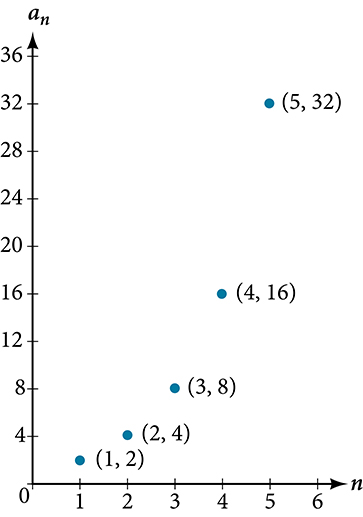
Figure 1
Lastly, we can write this particular sequence as
\[\left\{ 2,4,8,16,32,\ldots,2^{n},\ldots \right\}.\]
A sequence that continues indefinitely is called an infinite sequence. The domain of an infinite sequence is the set of counting numbers. If we consider only the first 10 terms of the sequence, we could write
\[\left\{ 2,4,8,16,32,\ldots,2^{n},\ldots,1024 \right\}.\]
This sequence is called a finite sequence because it does not continue indefinitely.
Write the first five terms of the sequence defined by the explicit formula \(a_{n} = - 3n + 8.\)
Solution (click to reveal)
Substitute \(n = 1\) into the formula. Repeat with values 2 through 5 for \(n.\)
\[\begin{array}{llllll} {n = 1} & & & & & {a_{1} = - 3(1) + 8 = 5} \\ {n = 2} & & & & & {a_{2} = - 3(2) + 8 = 2} \\ {n = 3} & & & & & {a_{3} = - 3(3) + 8 = - 1} \\ {n = 4} & & & & & {a_{4} = - 3(4) + 8 = - 4} \\ {n = 5} & & & & & {a_{5} = - 3(5) + 8 = - 7} \end{array}\]
The first five terms are \(\left\{ 5,\mspace{9mu} 2,\mspace{9mu}-1,\mspace{9mu}-4,\mspace{9mu}-7 \right\}.\)
The sequence values can be listed in a table. A table, such as Table 3, is a convenient way to input the function into a graphing utility.
| \(n\) | 1 | 2 | 3 | 4 | 5 |
| \(a_{n}\) | 5 | 2 | –1 | –4 | –7 |
Table 3
A graph can be made from this table of values. From the graph in Figure 2, we can see that this sequence represents a linear function, but notice the graph is not continuous because the domain is over the positive integers only.
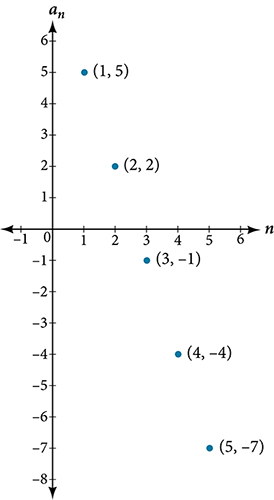
Figure 2
Investigating Alternating Sequences
Sometimes sequences have terms that are alternate. In fact, the terms may actually alternate in sign. The steps to finding terms of the sequence are the same as if the signs did not alternate. However, the resulting terms will not show increase or decrease as \(n\) increases. Let’s take a look at the following sequence.
\[\left\{ 2,-4,6,-8 \right\}\]
Notice the first term is greater than the second term, the second term is less than the third term, and the third term is greater than the fourth term. This trend continues forever. Do not rearrange the terms in numerical order to interpret the sequence.
Write the first five terms of the sequence.
\[a_{n} = \frac{{( - 1)}^{n}n^{2}}{n + 1}\]
Solution (click to reveal)
Substitute \(n = 1,\) \(n = 2,\) and so on in the formula.
\[\begin{array}{lll} {n = 1} & \begin{array}{ll} & \end{array} & {a_{1} = \frac{{( - 1)}^{1}1^{2}}{1 + 1} = - \frac{1}{2}} \\ {n = 2} & \begin{array}{ll} & \end{array} & {a_{2} = \frac{{( - 1)}^{2}2^{2}}{2 + 1} = \frac{4}{3}} \\ {n = 3} & \begin{array}{ll} & \end{array} & {a_{3} = \frac{{( - 1)}^{3}3^{2}}{3 + 1} = - \frac{9}{4}} \\ {n = 4} & \begin{array}{ll} & \end{array} & {a_{4} = \frac{{( - 1)}^{4}4^{2}}{4 + 1} = \frac{16}{5}} \\ {n = 5} & & {a_{5} = \frac{{( - 1)}^{5}5^{2}}{5 + 1} = - \frac{25}{6}} \end{array}\]
The first five terms are \(\left\{ {- \frac{1}{2},\frac{4}{3}\operatorname{,-}\frac{9}{4},\frac{16}{5}\operatorname{,-}\frac{25}{6}} \right\}.\)
The graph of this function, shown in Figure 3, looks different from the ones we have seen previously in this section because the terms of the sequence alternate between positive and negative values.
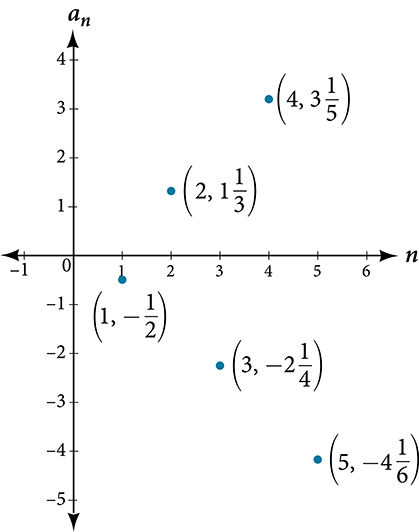
Figure 3
Investigating Piecewise Explicit Formulas
We’ve learned that sequences are functions whose domain is over the positive integers. This is true for other types of functions, including some piecewise functions. Recall that a piecewise function is a function defined by multiple subsections. A different formula might represent each individual subsection.
Write the first six terms of the sequence.
\[a_{n} = \begin{cases} n^{2} & {\text{if~}n\mspace{9mu}\text{is~not~divisible~by~3}} \\ \frac{n}{3} & {\text{if~}n\mspace{9mu}\text{is~divisible~by~3}} \end{cases}\]
Solution (click to reveal)
Substitute \(n = 1,n = 2,\) and so on in the appropriate formula. Use \(n^{2}\) when \(n\) is not a multiple of 3. Use \(\frac{n}{3}\) when \(n\) is a multiple of 3.
\[\begin{array}{ll} {a_{1} = 1^{2} = 1\begin{array}{llll} & & & \end{array}} & {\text{1~is~not~a~multiple~of~3}\text{.~~Use~}n^{2}.} \\ {a_{2} = 2^{2} = 4} & {\text{2~is~not~a~multiple~of~3}\text{.~~Use~}n^{2}.} \\ {a_{3} = \frac{3}{3} = 1} & {\text{3~is~a~multiple~of~3}\text{.~~Use~}\frac{n}{3}.} \\ {a_{4} = 4^{2} = 16} & {\text{4~is~not~a~multiple~of~3}\text{.~~Use~}n^{2}.} \\ {a_{5} = 5^{2} = 25} & {\text{5~is~not~a~multiple~of~3}\text{.~~Use~}n^{2}.} \\ {a_{6} = \frac{6}{3} = 2} & {\text{6~is~a~multiple~of~3}\text{.~~Use~}\frac{n}{3}.} \end{array}\]
The first six terms are \(\left\{ {1,\mspace{9mu} 4,\mspace{9mu} 1,\mspace{9mu} 16,\mspace{9mu} 25,\mspace{9mu} 2} \right\}.\)
Every third point on the graph shown in Figure 4 stands out from the two nearby points. This occurs because the sequence was defined by a piecewise function.
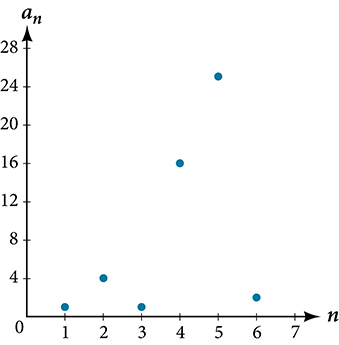
Figure 4
Finding an Explicit Formula
Thus far, we have been given the explicit formula and asked to find a number of terms of the sequence. Sometimes, the explicit formula for the \(n\text{th}\) term of a sequence is not given. Instead, we are given several terms from the sequence. When this happens, we can work in reverse to find an explicit formula from the first few terms of a sequence. The key to finding an explicit formula is to look for a pattern in the terms. Keep in mind that the pattern may involve alternating terms, formulas for numerators, formulas for denominators, exponents, or bases.
Write an explicit formula for the \(n\text{th}\) term of each sequence.
ⓐ \(\left\{ {- \frac{2}{11},\frac{3}{13}, - \frac{4}{15},\frac{5}{17}, - \frac{6}{19},\ldots} \right\}\)
ⓑ \(\left\{ - \frac{2}{25}\text{,} - \frac{2}{125}\text{,} - \frac{2}{625}\text{,} - \frac{2}{3\text{,}125}\text{,} - \frac{2}{15\text{,}625}\text{,}\ldots \right\}\)
ⓒ \(\left\{ e^{4}\text{,}e^{5}\text{,}e^{6}\text{,}e^{7}\text{,}e^{8}\text{,}\ldots \right\}\)
Solution (click to reveal)
Look for the pattern in each sequence.
ⓐ The terms alternate between positive and negative. We can use \({( - 1)}^{n}\) to make the terms alternate. The numerator can be represented by \(n + 1.\) The denominator can be represented by \(2n + 9.\) \(a_{n} = \frac{{( - 1)}^{n}(n + 1)}{2n + 9}\)
ⓑ The terms are all negative.

So we know that the fraction is negative, the numerator is 2, and the denominator can be represented by \(5^{n + 1}.\)
\[a_{n} = - \frac{2}{5^{n + 1}}\]
ⓒ The terms are powers of \(e.\) For \(n = 1,\) the first term is \(e^{4}\) so the exponent must be \(n + 3.\)
\[a_{n} = e^{n + 3}\]
13.1.2 Writing the Terms of a Sequence Defined by a Recursive Formula
Sequences occur naturally in the growth patterns of nautilus shells, pinecones, tree branches, and many other natural structures. We may see the sequence in the leaf or branch arrangement, the number of petals of a flower, or the pattern of the chambers in a nautilus shell. Their growth follows the Fibonacci sequence, a famous sequence in which each term can be found by adding the preceding two terms. The numbers in the sequence are 1, 1, 2, 3, 5, 8, 13, 21, 34,…. Other examples from the natural world that exhibit the Fibonacci sequence are the Calla Lily, which has just one petal, the Black-Eyed Susan with 13 petals, and different varieties of daisies that may have 21 or 34 petals.
Each term of the Fibonacci sequence depends on the terms that come before it. The Fibonacci sequence cannot easily be written using an explicit formula. Instead, we describe the sequence using a recursive formula, a formula that defines the terms of a sequence using previous terms.
A recursive formula always has two parts: the value of an initial term (or terms), and an equation defining \(a_{n}\) in terms of preceding terms. For example, suppose we know the following:
\[\begin{array}{l} {a_{1} = 3} \\ {a_{n} = 2a_{n - 1} - 1~\text{for}~n \geq 2} \end{array}\]
We can find the subsequent terms of the sequence using the first term.
\[\begin{array}{l} {a_{1} = 3} \\ {a_{2} = 2a_{1} - 1 = 2(3) - 1 = 5} \\ {a_{3} = 2a_{2} - 1 = 2(5) - 1 = 9} \\ {a_{4} = 2a_{3} - 1 = 2(9) - 1 = 17} \end{array}\]
So the first four terms of the sequence are \(\left\{ {3,\mspace{9mu} 5,\mspace{9mu} 9,\mspace{9mu} 17} \right\}\) .
The recursive formula for the Fibonacci sequence states the first two terms and defines each successive term as the sum of the preceding two terms.
\[\begin{array}{l} {a_{1} = 1} \\ {a_{2} = 1} \\ {a_{n} = a_{n - 1} + a_{n - 2}~\text{for}~~n \geq 3} \end{array}\]
To find the tenth term of the sequence, for example, we would need to add the eighth and ninth terms. We were told previously that the eighth and ninth terms are 21 and 34, so
\[a_{10} = a_{9} + a_{8} = 34 + 21 = 55\]
Write the first five terms of the sequence defined by the recursive formula.
\[\begin{array}{l} \begin{array}{l} \\ {a_{1} = 9} \end{array} \\ {a_{n} = 3a_{n - 1} - 20\text{,~for~}n \geq 2} \end{array}\]
Solution (click to reveal)
The first term is given in the formula. For each subsequent term, we replace \(a_{n - 1}\) with the value of the preceding term.
\[\begin{array}{ll} {n = 1\begin{array}{lllll} & & & & \end{array}} & {a_{1} = 9} \\ {n = 2} & {a_{2} = 3a_{1} - 20 = 3(9) - 20 = 27 - 20 = 7} \\ {n = 3} & {a_{3} = 3a_{2} - 20 = 3(7) - 20 = 21 - 20 = 1} \\ {n = 4} & {a_{4} = 3a_{3} - 20 = 3(1) - 20 = 3 - 20 = - 17} \\ {n = 5} & {a_{5} = 3a_{4} - 20 = 3( - 17) - 20 = - 51 - 20 = - 71} \end{array}\]
The first five terms are \(\left\{ {9,\mspace{9mu} 7,\mspace{9mu} 1,\mspace{9mu} –17,\mspace{9mu} –71} \right\}.\) See Figure 5.
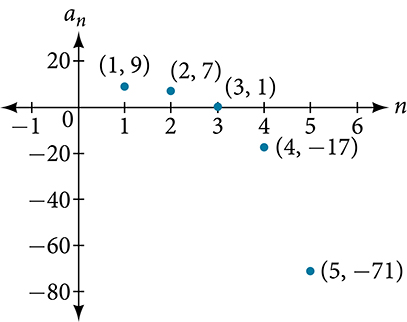
Figure 5
Write the first six terms of the sequence defined by the recursive formula.
\[\begin{array}{l} {a_{1} = 1} \\ {a_{2} = 2} \\ {a_{n} = 3a_{n - 1} + 4a_{n - 2}\text{,~for~}n \geq 3} \end{array}\]
Solution (click to reveal)
The first two terms are given. For each subsequent term, we replace \(a_{n - 1}\) and \(a_{n - 2}\) with the values of the two preceding terms.
\[\begin{array}{lllllll} {n = 3} & & & & & & {a_{3} = 3a_{2} + 4a_{1} = 3(2) + 4(1) = 10} \\ {n = 4} & & & & & & {a_{4} = 3a_{3} + 4a_{2} = 3(10) + 4(2) = 38} \\ {n = 5} & & & & & & {a_{5} = 3a_{4} + 4a_{3} = 3(38) + 4(10) = 154} \\ {n = 6} & & & & & & {a_{6} = 3a_{5} + 4a_{4} = 3(154) + 4(38) = 614} \end{array}\]
The first six terms are \(\text{\{1,2,10,38,154,614\}}\text{.}\) See Figure 6.
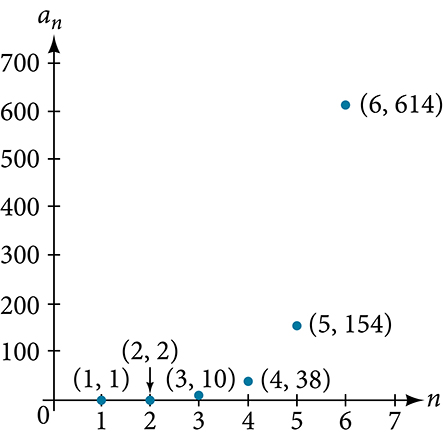
Figure 6
13.1.3 Using Factorial Notation
The formulas for some sequences include products of consecutive positive integers. \(n\) factorial, written as \(n!,\) is the product of the positive integers from 1 to \(n.\) For example,
\[\begin{array}{l} {4! = 4 \cdot 3 \cdot 2 \cdot 1 = 24} \\ {5! = 5 \cdot 4 \cdot 3 \cdot 2 \cdot 1 = 120} \end{array}\]
An example of formula containing a factorial is \(a_{n} = (n + 1)!.\) The sixth term of the sequence can be found by substituting 6 for \(n.\)
\[a_{6} = (6 + 1)! = 7! = 7 \cdot 6 \cdot 5 \cdot 4 \cdot 3 \cdot 2 \cdot 1 = 5040\]
The factorial of any whole number \(n\) is \(n(n - 1)!\) We can therefore also think of \(5!\) as \(5 \cdot 4!\text{.}\)
Write the first five terms of the sequence defined by the explicit formula \(a_{n} = \frac{5n}{(n + 2)!}.\)
Solution (click to reveal)
Substitute \(n = 1,n = 2,\) and so on in the formula.
\[\begin{array}{lllll} {n = 1} & & & & {a_{1} = \frac{5(1)}{(1 + 2)!} = \frac{5}{3!} = \frac{5}{3 \cdot 2 \cdot 1} = \frac{5}{6}} \\ {n = 2} & & & & {a_{2} = \frac{5(2)}{(2 + 2)!} = \frac{10}{4!} = \frac{10}{4 \cdot 3 \cdot 2 \cdot 1} = \frac{5}{12}} \\ {n = 3} & & & & {a_{3} = \frac{5(3)}{(3 + 2)!} = \frac{15}{5!} = \frac{15}{5 \cdot 4 \cdot 3 \cdot 2 \cdot 1} = \frac{1}{8}} \\ {n = 4} & & & & {a_{4} = \frac{5(4)}{(4 + 2)!} = \frac{20}{6!} = \frac{20}{6 \cdot 5 \cdot 4 \cdot 3 \cdot 2 \cdot 1} = \frac{1}{36}} \\ {n = 5} & & & & {a_{5} = \frac{5(5)}{(5 + 2)!} = \frac{25}{7!} = \frac{25}{7 \cdot 6 \cdot 5 \cdot 4 \cdot 3 \cdot 2 \cdot 1} = \frac{5}{1\text{,}008}} \end{array}\]
The first five terms are \(\left\{ \frac{5}{6},\frac{5}{12},\frac{1}{8},\frac{1}{36},\frac{5}{1{,}008} \right\}.\)
Figure 7 shows the graph of the sequence. Notice that, since factorials grow very quickly, the presence of the factorial term in the denominator results in the denominator becoming much larger than the numerator as \(n\) increases. This means the quotient gets smaller and, as the plot of the terms shows, the terms are decreasing and nearing zero.
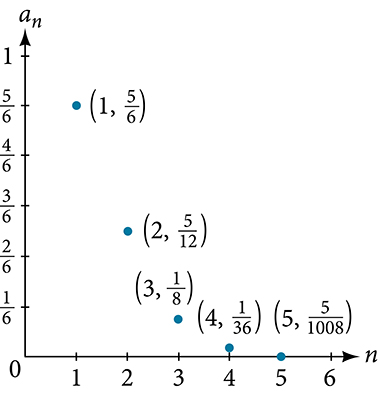
Figure 7
Section Exercises
Verbal
1. Discuss the meaning of a sequence. If a finite sequence is defined by a formula, what is its domain? What about an infinite sequence?
Solution (click to reveal)
A sequence is an ordered list of numbers that can be either finite or infinite in number. When a finite sequence is defined by a formula, its domain is a subset of the non-negative integers. When an infinite sequence is defined by a formula, its domain is all positive or all non-negative integers.
2. Describe three ways that a sequence can be defined.
3. Is the ordered set of even numbers an infinite sequence? What about the ordered set of odd numbers? Explain why or why not.
Solution (click to reveal)
Yes, both sets go on indefinitely, so they are both infinite sequences.
4. What happens to the terms \(a_{n}\) of a sequence when there is a negative factor in the formula that is raised to a power that includes \(n?\) What is the term used to describe this phenomenon?
5. What is a factorial, and how is it denoted? Use an example to illustrate how factorial notation can be beneficial.
Solution (click to reveal)
A factorial is the product of a positive integer and all the positive integers below it. An exclamation point is used to indicate the operation. Answers may vary. An example of the benefit of using factorial notation is when indicating the product It is much easier to write than it is to write out \(\text{13} \cdot \text{12} \cdot \text{11} \cdot \text{10} \cdot \text{9} \cdot \text{8} \cdot \text{7} \cdot \text{6} \cdot \text{5} \cdot \text{4} \cdot \text{3} \cdot \text{2} \cdot \text{1}\text{.}\)
Algebraic
For the following exercises, write the first four terms of the sequence.
6. \(a_{n} = 2^{n} - 2\)
7. \(a_{n} = - \frac{16}{n + 1}\)
Solution (click to reveal)
First four terms: \(- 8,\mspace{9mu} - \frac{16}{3},\mspace{9mu} - 4,\mspace{9mu} - \frac{16}{5}\)
8. \(a_{n} = - \left( {- 5} \right)^{n - 1}\)
9. \(a_{n} = \frac{2^{n}}{n^{3}}\)
Solution (click to reveal)
First four terms: \(2,\mspace{9mu}\frac{1}{2},\mspace{9mu}\frac{8}{27},\mspace{9mu}\frac{1}{4}\) .
10. \(a_{n} = \frac{2n + 1}{n^{3}}\)
11. \(a_{n} = 1.25 \cdot \left( {- 4} \right)^{n - 1}\)
Solution (click to reveal)
First four terms: \(1.25,\mspace{9mu} - 5,\mspace{9mu} 20,\mspace{9mu} - 80\) .
12. \(a_{n} = - 4 \cdot \left( {- 6} \right)^{n - 1}\)
13. \(a_{n} = \frac{n^{2}}{2n + 1}\)
Solution (click to reveal)
First four terms: \(\frac{1}{3},\mspace{9mu}\frac{4}{5},\mspace{9mu}\frac{9}{7},\mspace{9mu}\frac{16}{9}\) .
14. \(a_{n} = \left( {- 10} \right)^{n} + 1\)
15. \(a_{n} = - \left( \frac{4 \cdot {( - 5)}^{n - 1}}{5} \right)\)
Solution (click to reveal)
First four terms: \(- \frac{4}{5},\mspace{9mu} 4,\mspace{9mu} - 20,\mspace{9mu} 100\)
For the following exercises, write the first eight terms of the piecewise sequence.
16. \(a_{n} = \begin{cases} {{( - 2)}^{n} - 2} & {\text{if~}n\mspace{9mu}\text{is~even}} \\ {(3)}^{n - 1} & {\text{if~}n\mspace{9mu}\text{is~odd}} \end{cases}\)
17. \(a_{n} = \begin{cases} \frac{n^{2}}{2n + 1} & {\text{if~}n\mspace{9mu} \leq \text{5}} \\ {n^{2} - 5} & {\text{if~}n\mspace{9mu}\text{>5}} \end{cases}\)
Solution (click to reveal)
\(\frac{1}{3},\mspace{9mu}\frac{4}{5},\mspace{9mu}\frac{9}{7},\mspace{9mu}\frac{16}{9},\mspace{9mu}\frac{25}{11},\mspace{9mu} 31,\mspace{9mu} 44,\mspace{9mu} 59\)
18. \(a_{n} = \begin{cases} {(2n + 1)}^{2} & {\text{if~}n\mspace{9mu}\text{is~divisible~by~4}} \\ \frac{2}{n} & {\text{if~}n\mspace{9mu}\text{is~not~divisible~by~4}} \end{cases}\)
19. \(a_{n} = \begin{cases} {- 0.6 \cdot 5^{n - 1}} & {\text{if~}n\mspace{9mu}\text{is~prime~or~1}} \\ {2.5 \cdot {( - 2)}^{n - 1}} & {\text{if~}n\mspace{9mu}\text{is~composite}} \end{cases}\)
Solution (click to reveal)
\(- 0.6, - 3, - 15, - 20, - 375, - 80, - 9375, - 320\)
20. \(a_{n} = \begin{cases} {4(n^{2} - 2)} & {\text{if~}n\mspace{9mu} \leq 3\mspace{9mu}\text{or~}n\mspace{9mu}\text{>~6}} \\ \frac{n^{2} - 2}{4} & {\text{if~}3 < n \leq 6} \end{cases}\)
For the following exercises, write an explicit formula for each sequence.
21. \(4,~7,~12,~19,~28,\ldots\)
Solution (click to reveal)
\(a_{n} = n^{2} + 3\)
22. \(- 4,2, - 10,14, - 34,\ldots\)
23. \(1,1,\frac{4}{3},2,\frac{16}{5},\ldots\)
Solution (click to reveal)
\(a_{n} = \frac{2^{n}}{2n}\mspace{9mu}\text{or~}\frac{2^{n - 1}}{n}\)
24. \(0,\frac{1 - e^{1}}{1 + e^{2}},\frac{1 - e^{2}}{1 + e^{3}},\frac{1 - e^{3}}{1 + e^{4}},\frac{1 - e^{4}}{1 + e^{5}},\ldots\)
25. \(1, - \frac{1}{2},\frac{1}{4}, - \frac{1}{8},\frac{1}{16},\ldots\)
Solution (click to reveal)
\(a_{n} = \left( {- \frac{1}{2}} \right)^{n - 1}\)
For the following exercises, write the first five terms of the sequence.
26. \(a_{1} = 9,\mspace{9mu} a_{n} = a_{n - 1} + n\)
27. \(a_{1} = 3,\mspace{9mu} a_{n} = \left( {- 3} \right)a_{n - 1}\)
Solution (click to reveal)
First five terms: \(3,\mspace{9mu} - 9,\mspace{9mu} 27,\mspace{9mu} - 81,\mspace{9mu} 243\)
28. \(a_{1} = - 4,\mspace{9mu} a_{n} = \frac{a_{n - 1} + 2n}{a_{n - 1} - 1}\)
29. \(a_{1} = - 1,\mspace{9mu} a_{n} = \frac{\left( {- 3} \right)^{n - 1}}{a_{n - 1} - 2}\)
Solution (click to reveal)
First five terms: \(- 1,\mspace{9mu} 1,\mspace{9mu} - 9,\mspace{9mu}\frac{27}{11},\mspace{9mu}\frac{891}{5}\)
30. \(a_{1} = - 30,\mspace{9mu} a_{n} = \left( {2 + a_{n - 1}} \right)\left( \frac{1}{2} \right)^{n}\)
For the following exercises, write the first eight terms of the sequence.
31. \(a_{1} = \frac{1}{24},{\mspace{9mu}\text{a}}_{2} = 1,\mspace{9mu} a_{n} = \left( {2a_{n - 2}} \right)\left( {3a_{n - 1}} \right)\)
Solution (click to reveal)
\(\frac{1}{24},\mspace{9mu}\text{1,~}\frac{1}{4},\mspace{9mu}\frac{3}{2},\mspace{9mu}\frac{9}{4},\mspace{9mu}\frac{81}{4},\mspace{9mu}\frac{2187}{8},\mspace{9mu}\frac{531{,}441}{16}\)
32. \(a_{1} = - 1,{\mspace{9mu}\text{a}}_{2} = 5,\mspace{9mu} a_{n} = a_{n - 2}\left( {3 - a_{n - 1}} \right)\)
33. \(a_{1} = 2,{\mspace{9mu}\text{a}}_{2} = 10,\mspace{9mu} a_{n} = \frac{2\left( {a_{n - 1} + 2} \right)}{a_{n - 2}}\)
Solution (click to reveal)
\(2,\mspace{9mu} 10,\mspace{9mu} 12,\mspace{9mu}\frac{14}{5},\mspace{9mu}\frac{4}{5},\mspace{9mu} 2,\mspace{9mu} 10,\mspace{9mu} 12\)
For the following exercises, write a recursive formula for each sequence.
34. \(- 2.5, - 5, - 10, - 20, - 40,\ldots\)
35. \(- 8, - 6, - 3,1,6,\ldots\)
Solution (click to reveal)
\(a_{1} = - 8,a_{n} = a_{n - 1} + n\)
36. \(2,\mspace{9mu} 4,\mspace{9mu} 12,\mspace{9mu} 48,\mspace{9mu} 240,\mspace{9mu}\ldots\)
37. \(35,\mspace{9mu} 38,\mspace{9mu} 41,\mspace{9mu} 44,\mspace{9mu} 47,\mspace{9mu}\ldots\)
Solution (click to reveal)
\(a_{1} = 35,a_{n} = a_{n - 1} + 3\)
38. \(15,3,\frac{3}{5},\frac{3}{25},\frac{3}{125},\cdots\)
For the following exercises, evaluate the factorial.
39. \(6!\)
Solution (click to reveal)
\(720\)
40. \(\left( \frac{12}{6} \right)!\)
41. \(\frac{12!}{6!}\)
Solution (click to reveal)
\(665{,}280\)
42. \(\frac{100!}{99!}\)
For the following exercises, write the first four terms of the sequence.
43. \(a_{n} = \frac{n!}{n^{\text{2}}}\)
Solution (click to reveal)
First four terms: \(1,\frac{1}{2},\frac{2}{3},\frac{3}{2}\)
44. \(a_{n} = \frac{3 \cdot n!}{4 \cdot n!}\)
45. \(a_{n} = \frac{n!}{n^{2} - n - 1}\)
Solution (click to reveal)
First four terms: \(- 1,2,\frac{6}{5},\frac{24}{11}\)
46. \(a_{n} = \frac{100 \cdot n}{n(n - 1)!}\)
Graphical
For the following exercises, graph the first five terms of the indicated sequence
47. \(a_{n} = \frac{\left( {- 1} \right)^{n}}{n} + n\)
Solution (click to reveal)
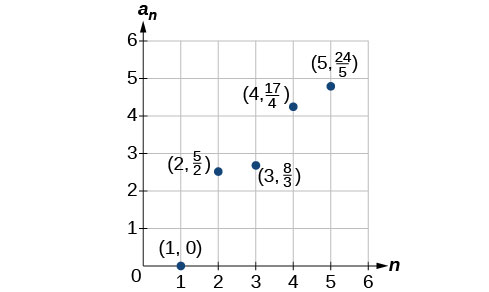
48. \(a_{n} = \begin{cases} \frac{4 + n}{2n} & {\text{if~}n\mspace{9mu}\text{is~even}} \\ {3 + n} & {\text{if~}n\mspace{9mu}\text{is~odd}} \end{cases}\)
49. \(a_{1} = 2,\mspace{9mu} a_{n} = \left( {- a_{n - 1} + 1} \right)^{2}\)
Solution (click to reveal)
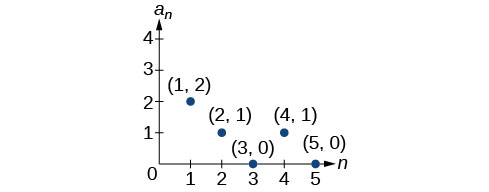
50. \(a_{1} = 1,\mspace{9mu} a_{n} = a_{n - 1} + 8\)
51. \(a_{n} = \frac{\left( {n + 1} \right)!}{\left( {n - 1} \right)!}\)
Solution (click to reveal)
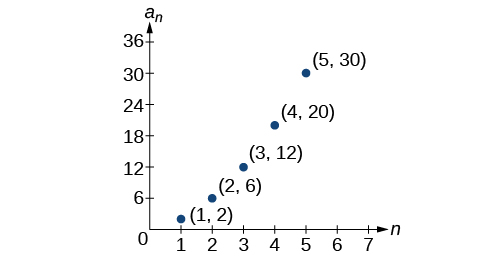
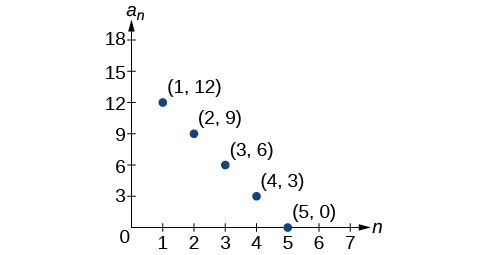
For the following exercises, write an explicit formula for the sequence using the first five points shown on the graph.
52.
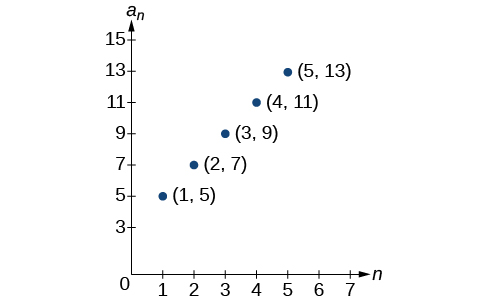
53.
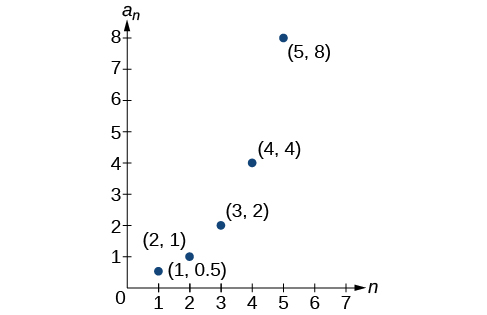
Solution (click to reveal)
\(a_{n} = 2^{n - 2}\)
54.
For the following exercises, write a recursive formula for the sequence using the first five points shown on the graph.
55.
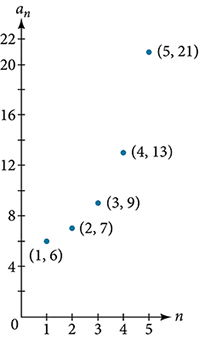
Solution (click to reveal)
\(a_{1} = 6,\mspace{9mu} a_{n} = 2a_{n - 1} - 5\)
56.
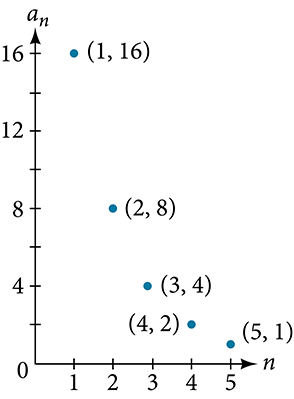
Technology
Follow these steps to evaluate a sequence defined recursively using a graphing calculator:
- On the home screen, key in the value for the initial term \(a_{1}\) and press [ENTER].
- Enter the recursive formula by keying in all numerical values given in the formula, along with the key strokes [2ND] ANS for the previous term \(a_{n - 1}.\) Press [ENTER].
- Continue pressing [ENTER] to calculate the values for each successive term.
For the following exercises, use the steps above to find the indicated term or terms for the sequence.
57. Find the first five terms of the sequence \(a_{1} = \frac{87}{111}\), \(a_{n} = \frac{4}{3}a_{n - 1} + \frac{12}{37}.\) Use the >Frac feature to give fractional results.
Solution (click to reveal)
First five terms: \(\frac{29}{37}\), \(\frac{152}{111}\), \(\frac{716}{333}\), \(\frac{3188}{999}\), \(\frac{13724}{2997}\)
58. Find the 15th term of the sequence \(a_{1} = 625\), \(a_{n} = 0.8a_{n - 1} + 18.\)
59. Find the first five terms of the sequence \(a_{1} = 2\), \(a_{n} = 2^{\lbrack(a_{n} - 1) - 1\rbrack} + 1.\)
Solution (click to reveal)
First five terms: 2, 3, 5, 17, 65537
60. Find the first ten terms of the sequence \(a_{1} = 8\), \(a_{n} = \frac{\left( {a_{n - 1} + 1} \right)!}{a_{n - 1}!}.\)
61. Find the tenth term of the sequence \(a_{1} = 2\), \(a_{n} = na_{n - 1}\)
Solution (click to reveal)
\(a_{10} = 7{,}257{,}600\)
Follow these steps to evaluate a finite sequence defined by an explicit formula. Using a TI-84, do the following.
- In the home screen, press [2ND] LIST.
- Scroll over to OPS and choose “seq(” from the dropdown list. Press [ENTER].
- In the line headed “Expr:” type in the explicit formula, using the \(\lbrack\text{X,T},\theta,n\rbrack\) button for \(n\)
- In the line headed “Variable:” type in the variable used on the previous step.
- In the line headed “start:” key in the value of \(n\) that begins the sequence.
- In the line headed “end:” key in the value of \(n\) that ends the sequence.
- Press [ENTER] 3 times to return to the home screen. You will see the sequence syntax on the screen. Press [ENTER] to see the list of terms for the finite sequence defined. Use the right arrow key to scroll through the list of terms.
Using a TI-83, do the following.
- In the home screen, press [2ND] LIST.
- Scroll over to OPS and choose “seq(” from the dropdown list. Press [ENTER].
- Enter the items in the order “Expr”, “Variable”, “start”, “end” separated by commas. See the instructions above for the description of each item.
- Press [ENTER] to see the list of terms for the finite sequence defined. Use the right arrow key to scroll through the list of terms.
For the following exercises, use the steps above to find the indicated terms for the sequence. Round to the nearest thousandth when necessary.
62. List the first five terms of the sequence \(a_{n} = - \frac{28}{9}n + \frac{5}{3}.\)
63. List the first six terms of the sequence \(a_{n} = \frac{n^{3} - 3.5n^{2} + ~4.1n - 1.5}{2.4n}.\)
Solution (click to reveal)
First six terms: 0.042, 0.146, 0.875, 2.385, 4.708
64. List the first five terms of the sequence \(a_{n} = \frac{15n \cdot \left( {- 2} \right)^{n - 1}}{47}\)
65. List the first four terms of the sequence \(a_{n} = 5.7^{n} + 0.275\left( {n - 1} \right)!\)
Solution (click to reveal)
First four terms: 5.975, 2.765, 185.743, 1057.25, 6023.521
66. List the first six terms of the sequence \(a_{n} = \frac{n!}{n}.\)
Extensions
67. Consider the sequence defined by \(a_{n} = - 6 - 8n.\) Is \(a_{n} = - 421\) a term in the sequence? Verify the result.
Solution (click to reveal)
If \(a_{n} = - 421\) is a term in the sequence, then solving the equation \(- 421 = - 6 - 8n\) for \(n\) will yield a non-negative integer. However, if \(- 421 = - 6 - 8n,\) then \(n = 51.875\) so \(a_{n} = - 421\) is not a term in the sequence.
68. What term in the sequence \(a_{n} = \frac{n^{2} + 4n + 4}{2\left( {n + 2} \right)}\) has the value \(41?\) Verify the result.
69. Find a recursive formula for the sequence 1, 0, −1, −1, 0, 1, 1, 0, −1, −1, 0, 1, 1, …. (Hint: find a pattern for \(a_{n}\) based on the first two terms.)
Solution (click to reveal)
\(a_{1} = 1,a_{2} = 0,a_{n} = a_{n - 1} - a_{n - 2}\)
70. Calculate the first eight terms of the sequences \(a_{n} = \frac{\left( {n + 2} \right)!}{\left( {n - 1} \right)!}\) and \(b_{n} = n^{3} + 3n^{2} + 2n,\) and then make a conjecture about the relationship between these two sequences.
71. Prove the conjecture made in the preceding exercise.
Solution (click to reveal)
\(\frac{(n + 2)!}{(n - 1)!} = \frac{(n + 2) \cdot (n + 1) \cdot (n) \cdot (n - 1) \cdot ... \cdot 3 \cdot 2 \cdot 1}{(n - 1) \cdot ... \cdot 3 \cdot 2 \cdot 1} = n(n + 1)(n + 2) = n^{3} + 3n^{2} + 2n\)