12.2 The Hyperbola
What do paths of comets, supersonic booms, ancient Grecian pillars, and natural draft cooling towers have in common? They can all be modeled by the same type of conic. For instance, when something moves faster than the speed of sound, a shock wave in the form of a cone is created. A portion of a conic is formed when the wave intersects the ground, resulting in a sonic boom. See Figure 1.
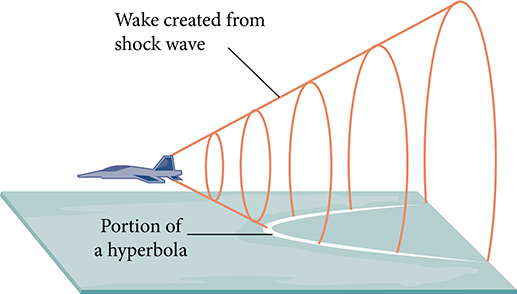
Figure 1 A shock wave intersecting the ground forms a portion of a conic and results in a sonic boom.
Most people are familiar with the sonic boom created by supersonic aircraft, but humans were breaking the sound barrier long before the first supersonic flight. The crack of a whip occurs because the tip is exceeding the speed of sound. The bullets shot from many firearms also break the sound barrier, although the bang of the gun usually supersedes the sound of the sonic boom.
12.2.1 Locating the Vertices and Foci of a Hyperbola
In analytic geometry, a hyperbola is a conic section formed by intersecting a right circular cone with a plane at an angle such that both halves of the cone are intersected. This intersection produces two separate unbounded curves that are mirror images of each other. See Figure 2.
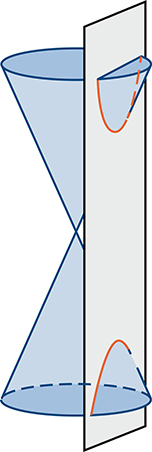
Figure 2 A hyperbola
Like the ellipse, the hyperbola can also be defined as a set of points in the coordinate plane. A hyperbola is the set of all points \(\left( {x,y} \right)\) in a plane such that the difference of the distances between \(\left( {x,y} \right)\) and the foci is a positive constant.
Notice that the definition of a hyperbola is very similar to that of an ellipse. The distinction is that the hyperbola is defined in terms of the difference of two distances, whereas the ellipse is defined in terms of the sum of two distances.
As with the ellipse, every hyperbola has two axes of symmetry. The transverse axis is a line segment that passes through the center of the hyperbola and has vertices as its endpoints. The foci lie on the line that contains the transverse axis. The conjugate axis is perpendicular to the transverse axis and has the co-vertices as its endpoints. The center of a hyperbola is the midpoint of both the transverse and conjugate axes, where they intersect. Every hyperbola also has two asymptotes that pass through its center. As a hyperbola recedes from the center, its branches approach these asymptotes. The central rectangle of the hyperbola is centered at the origin with sides that pass through each vertex and co-vertex; it is a useful tool for graphing the hyperbola and its asymptotes. To sketch the asymptotes of the hyperbola, simply sketch and extend the diagonals of the central rectangle. See Figure 3.
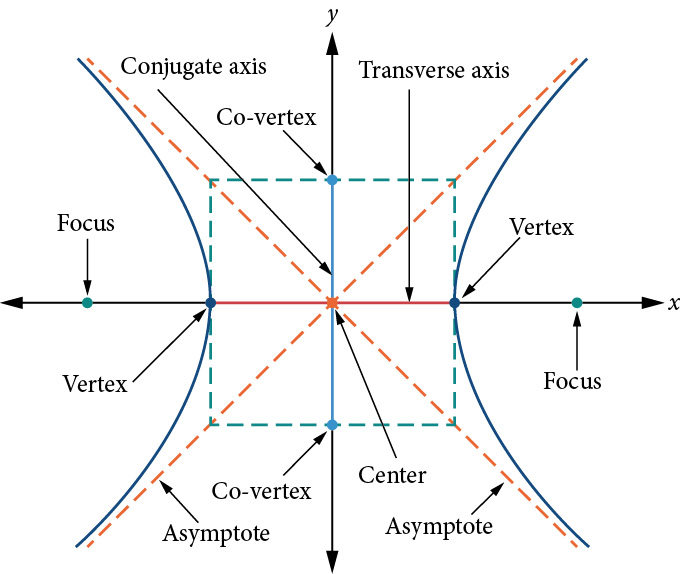
Figure 3 Key features of the hyperbola
In this section, we will limit our discussion to hyperbolas that are positioned vertically or horizontally in the coordinate plane; the axes will either lie on or be parallel to the \(x\)- and \(y\)-axes. We will consider two cases: those that are centered at the origin, and those that are centered at a point other than the origin.
Deriving the Equation of a Hyperbola Centered at the Origin
Let \(\left( {- c,0} \right)\) and \(\left( {c,0} \right)\) be the foci of a hyperbola centered at the origin. The hyperbola is the set of all points \(\left( {x,y} \right)\) such that the difference of the distances from \(\left( {x,y} \right)\) to the foci is constant. See Figure 4.
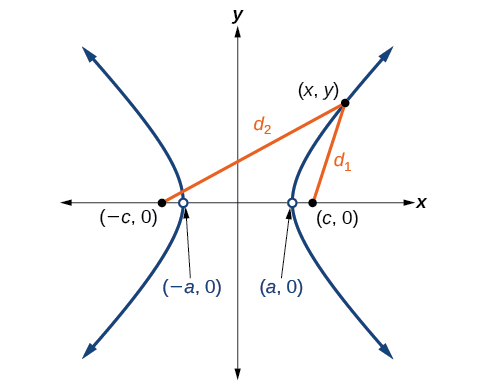
Figure 4
If \(\left( {a,0} \right)\) is a vertex of the hyperbola, the distance from \(\left( {- c,0} \right)\) to \(\left( {a,0} \right)\) is \(a - \left( {- c} \right) = a + c.\) The distance from \(\left( {c,0} \right)\) to \(\left( {a,0} \right)\) is \(c - a.\) The difference of the distances from the foci to the vertex is
\[\left( {a + c} \right) - \left( {c - a} \right) = 2a\]
If \(\left( {x,y} \right)\) is a point on the hyperbola, we can define the following variables:
\[\begin{array}{l} {d_{2} = \text{the~distance~from~}\left( {- c,0} \right)\mspace{9mu}\text{to~}\left( {x,y} \right)} \\ {d_{1} = \text{the~distance~from~}\left( {c,0} \right)\mspace{9mu}\text{to~}\left( {x,y} \right)} \end{array}\]
By definition of a hyperbola, \(d_{2} - d_{1}\) is constant for any point \(\left( {x,y} \right)\) on the hyperbola. We know that the difference of these distances is \(2a\) for the vertex \((a,0).\) It follows that \(d_{2} - d_{1} = 2a\) for any point on the hyperbola. As with the derivation of the equation of an ellipse, we will begin by applying the distance formula. The rest of the derivation is algebraic. Compare this derivation with the one from the previous section for ellipses.
\[\begin{array}{ll} {\mspace{9mu}\text{~~~~~~~~~~~~~~~~~~~~~~~~~~~~~~~~~~~~~}d_{2} - d_{1} = \sqrt{{(x - ( - c))}^{2} + {(y - 0)}^{2}} - \sqrt{{(x - c)}^{2} + {(y - 0)}^{2}} = 2a} & \text{Distance~Formula} \\ {\sqrt{{(x + c)}^{2} + y^{2}} - \sqrt{{(x - c)}^{2} + y^{2}} = 2a} & {\text{Simplify~expressions}\text{.}} \\ {\mspace{9mu}\text{~~~~~~~~~~~~~~~~~~~~~~~~~~}\sqrt{{(x + c)}^{2} + y^{2}} = 2a + \sqrt{{(x - c)}^{2} + y^{2}}} & {\text{Move~radical~to~opposite~side}\text{.}} \\ {\mspace{9mu}\text{~~~~~~~~~~~~~~~~~~~~~~~~~~~~}{(x + c)}^{2} + y^{2} = \left( {2a + \sqrt{{(x - c)}^{2} + y^{2}}} \right)^{2}} & {\text{Square~both~sides}\text{.}} \\ {\mspace{9mu}\text{~~~~~~~~~~~~~~~~~~~}x^{2} + 2cx + c^{2} + y^{2} = 4a^{2} + 4a\sqrt{{(x - c)}^{2} + y^{2}} + {(x - c)}^{2} + y^{2}} & {\text{Expand~the~squares}\text{.}} \\ {\mspace{9mu}\text{~~~~~~~~~~~~~~~~~~~}x^{2} + 2cx + c^{2} + y^{2} = 4a^{2} + 4a\sqrt{{(x - c)}^{2} + y^{2}} + x^{2} - 2cx + c^{2} + y^{2}} & {\text{Expand~remaining~square}\text{.}} \\ {\mspace{9mu}\text{~~~~~~~~~~~~~~~~~~~~~~~~~~~~~~~~~~~~~~~~~~~~}2cx = 4a^{2} + 4a\sqrt{{(x - c)}^{2} + y^{2}} - 2cx} & {\text{Combine~like~terms}\text{.}} \\ {\mspace{9mu}\text{~~~~~~~~~~~~~~~~~~~~~~~~~~~~~~~~~}4cx - 4a^{2} = 4a\sqrt{{(x - c)}^{2} + y^{2}}} & {\text{Isolate~the~radical}\text{.}} \\ {\mspace{9mu}\text{~~~~~~~~~~~~~~~~~~~~~~~~~~~~~~~~~~~~~}cx - a^{2} = a\sqrt{{(x - c)}^{2} + y^{2}}} & {\text{Divide~by~4}\text{.}} \\ {\mspace{9mu}\text{~~~~~~~~~~~~~~~~~~~~~~~~~~~~~~~~~}\left( {cx - a^{2}} \right)^{2} = a^{2}\left( \sqrt{{(x - c)}^{2} + y^{2}} \right)^{2}} & {\text{Square~both~sides}\text{.}} \\ {\mspace{9mu}\text{~~~~~~~~~~~~~~~~~~~}c^{2}x^{2} - 2a^{2}cx + a^{4} = a^{2}\left( {x^{2} - 2cx + c^{2} + y^{2}} \right)} & {\text{Expand~the~squares}\text{.}} \\ {\mspace{9mu}\text{~~~~~~~~~~~~~~~~~~}c^{2}x^{2} - 2a^{2}cx + a^{4} = a^{2}x^{2} - 2a^{2}cx + a^{2}c^{2} + a^{2}y^{2}} & {\text{Distribute~}a^{2}\text{.}} \\ {\mspace{9mu}\text{~~~~~~~~~~~~~~~~~~~~~~~~~~~~~~~~~}a^{4} + c^{2}x^{2} = a^{2}x^{2} + a^{2}c^{2} + a^{2}y^{2}} & {\text{Combine~like~terms}\text{.}} \\ {\mspace{9mu}\text{~~~~~~~~~~~~~~~~}c^{2}x^{2} - a^{2}x^{2} - a^{2}y^{2} = a^{2}c^{2} - a^{4}} & {\text{Rearrange~terms}\text{.}} \\ {\mspace{9mu}\text{~~~~~~~~~~~~~~~~~~}x^{2}\left( {c^{2} - a^{2}} \right) - a^{2}y^{2} = a^{2}\left( {c^{2} - a^{2}} \right)} & {\text{Factor~common~terms}\text{.}} \\ {\mspace{9mu}\text{~~~~~~~~~~~~~~~~~~~~~~~~~~~~}x^{2}b^{2} - a^{2}y^{2} = a^{2}b^{2}} & {\text{Set~}b^{2} = c^{2} - a^{2}.} \\ {\mspace{9mu}\text{~~~~~~~~~~~~~~~~~~~~~~~~~~~}\frac{x^{2}b^{2}}{a^{2}b^{2}} - \frac{a^{2}y^{2}}{a^{2}b^{2}} = \frac{a^{2}b^{2}}{a^{2}b^{2}}} & {\text{Divide~both~sides~by~}a^{2}b^{2}} \\ {\mspace{9mu}\text{~~~~~~~~~~~~~~~~~~~~~~~~~~~~~~~~~~~}\frac{x^{2}}{a^{2}} - \frac{y^{2}}{b^{2}} = 1} & \end{array}\]
This equation defines a hyperbola centered at the origin with vertices \(\left( {\pm a,0} \right)\) and co-vertices \(\left( {0 \pm b} \right).\)
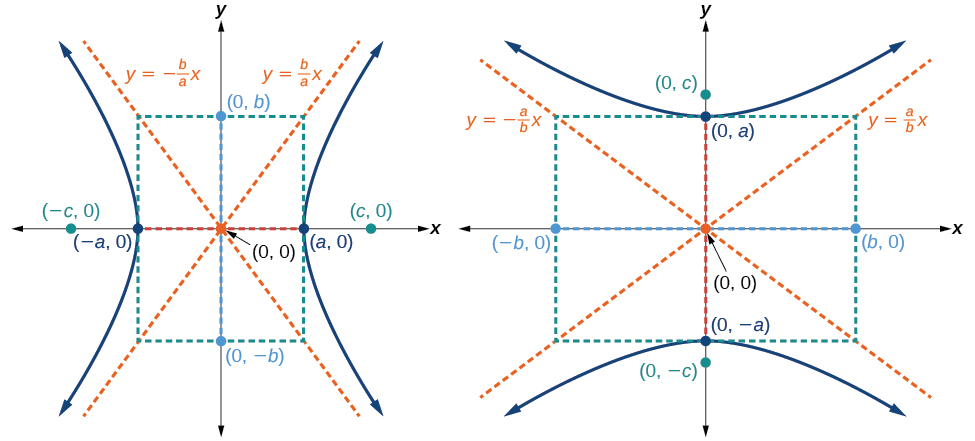
Figure 5 (a) Horizontal hyperbola with center \(\left( {0,0} \right)\) (b) Vertical hyperbola with center \(\left( {0,0} \right)\)
12.2.2 Writing Equations of Hyperbolas in Standard Form
Just as with ellipses, writing the equation for a hyperbola in standard form allows us to calculate the key features: its center, vertices, co-vertices, foci, asymptotes, and the lengths and positions of the transverse and conjugate axes. Conversely, an equation for a hyperbola can be found given its key features. We begin by finding standard equations for hyperbolas centered at the origin. Then we will turn our attention to finding standard equations for hyperbolas centered at some point other than the origin.
Hyperbolas Centered at the Origin
Reviewing the standard forms given for hyperbolas centered at \(\left( {0,0} \right),\) we see that the vertices, co-vertices, and foci are related by the equation \(c^{2} = a^{2} + b^{2}.\) Note that this equation can also be rewritten as \(b^{2} = c^{2} - a^{2}.\) This relationship is used to write the equation for a hyperbola when given the coordinates of its foci and vertices.
What is the standard form equation of the hyperbola that has vertices \(\left( {\pm 6,0} \right)\) and foci \(\left( {\pm 2\sqrt{10},0} \right)?\)
Solution (click to reveal)
The vertices and foci are on the \(x\)-axis. Thus, the equation for the hyperbola will have the form \(\frac{x^{2}}{a^{2}} - \frac{y^{2}}{b^{2}} = 1.\)
The vertices are \(\left( {\pm 6,0} \right),\) so \(a = 6\) and \(a^{2} = 36.\)
The foci are \(\left( {\pm 2\sqrt{10},0} \right),\) so \(c = 2\sqrt{10}\) and \(c^{2} = 40.\)
Solving for \(b^{2},\) we have
\[\begin{array}{ll} {b^{2} = c^{2} - a^{2}} & \\ {b^{2} = 40 - 36} & {\begin{array}{llll} & & & \end{array}\text{Substitute~for~}c^{2}\mspace{9mu}\text{and~}a^{2}.} \\ {b^{2} = 4} & {\begin{array}{llll} & & & \end{array}\text{Subtract}.} \end{array}\]
Finally, we substitute \(a^{2} = 36\) and \(b^{2} = 4\) into the standard form of the equation, \(\frac{x^{2}}{a^{2}} - \frac{y^{2}}{b^{2}} = 1.\) The equation of the hyperbola is \(\frac{x^{2}}{36} - \frac{y^{2}}{4} = 1,\) as shown in Figure 6.
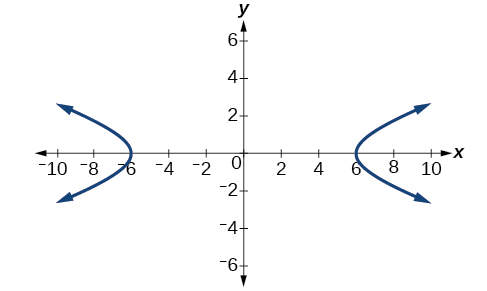
Figure 6
Hyperbolas Not Centered at the Origin
Like the graphs for other equations, the graph of a hyperbola can be translated. If a hyperbola is translated \(h\) units horizontally and \(k\) units vertically, the center of the hyperbola will be \(\left( {h,k} \right).\) This translation results in the standard form of the equation we saw previously, with \(x\) replaced by \(\left( {x - h} \right)\) and \(y\) replaced by \(\left( {y - k} \right).\)
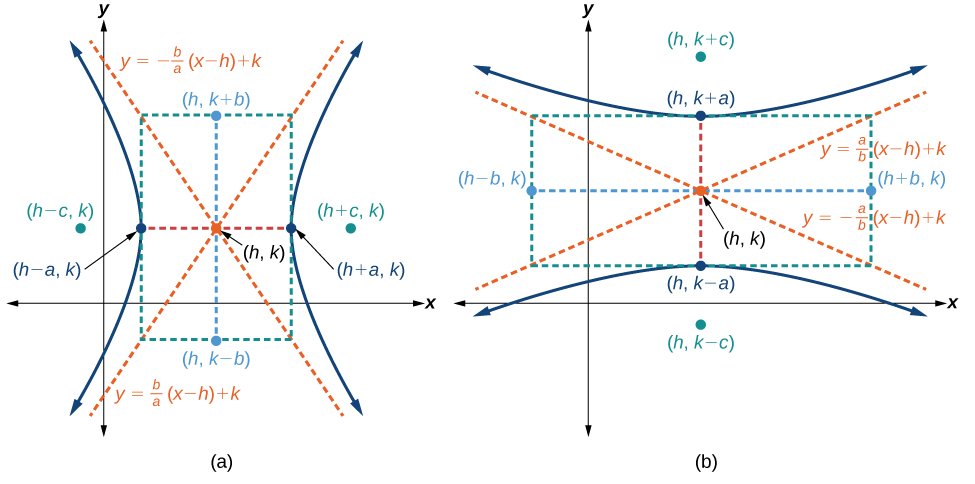
Figure 7 (a) Horizontal hyperbola with center \(\left( {h,k} \right)\) (b) Vertical hyperbola with center \(\left( {h,k} \right)\)
Like hyperbolas centered at the origin, hyperbolas centered at a point \(\left( {h,k} \right)\) have vertices, co-vertices, and foci that are related by the equation \(c^{2} = a^{2} + b^{2}.\) We can use this relationship along with the midpoint and distance formulas to find the standard equation of a hyperbola when the vertices and foci are given.
12.2.3 Graphing Hyperbolas Centered at the Origin
When we have an equation in standard form for a hyperbola centered at the origin, we can interpret its parts to identify the key features of its graph: the center, vertices, co-vertices, asymptotes, foci, and lengths and positions of the transverse and conjugate axes. To graph hyperbolas centered at the origin, we use the standard form \(\frac{x^{2}}{a^{2}} - \frac{y^{2}}{b^{2}} = 1\) for horizontal hyperbolas and the standard form \(\frac{y^{2}}{a^{2}} - \frac{x^{2}}{b^{2}} = 1\) for vertical hyperbolas.
Graph the hyperbola given by the equation \(\frac{y^{2}}{64} - \frac{x^{2}}{36} = 1.\) Identify and label the vertices, co-vertices, foci, and asymptotes.
Solution (click to reveal)
The standard form that applies to the given equation is \(\frac{y^{2}}{a^{2}} - \frac{x^{2}}{b^{2}} = 1.\) Thus, the transverse axis is on the \(y\)-axis
The coordinates of the vertices are \(\left( {0, \pm a} \right) = \left( {0, \pm \sqrt{64}} \right) = \left( {0, \pm 8} \right)\)
The coordinates of the co-vertices are \(\left( {\pm b,0} \right) = \left( {\pm \sqrt{36},\mspace{9mu} 0} \right) = \left( {\pm 6,0} \right)\)
The coordinates of the foci are \(\left( {0, \pm c} \right),\) where \(c = \pm \sqrt{a^{2} + b^{2}}.\) Solving for \(c,\) we have
\[c = \pm \sqrt{a^{2} + b^{2}} = \pm \sqrt{64 + 36} = \pm \sqrt{100} = \pm 10\]
Therefore, the coordinates of the foci are \(\left( {0, \pm 10} \right)\)
The equations of the asymptotes are \(y = \pm \frac{a}{b}x = \pm \frac{8}{6}x = \pm \frac{4}{3}x\)
Plot and label the vertices and co-vertices, and then sketch the central rectangle. Sides of the rectangle are parallel to the axes and pass through the vertices and co-vertices. Sketch and extend the diagonals of the central rectangle to show the asymptotes. The central rectangle and asymptotes provide the framework needed to sketch an accurate graph of the hyperbola. Label the foci and asymptotes, and draw a smooth curve to form the hyperbola, as shown in Figure 8.
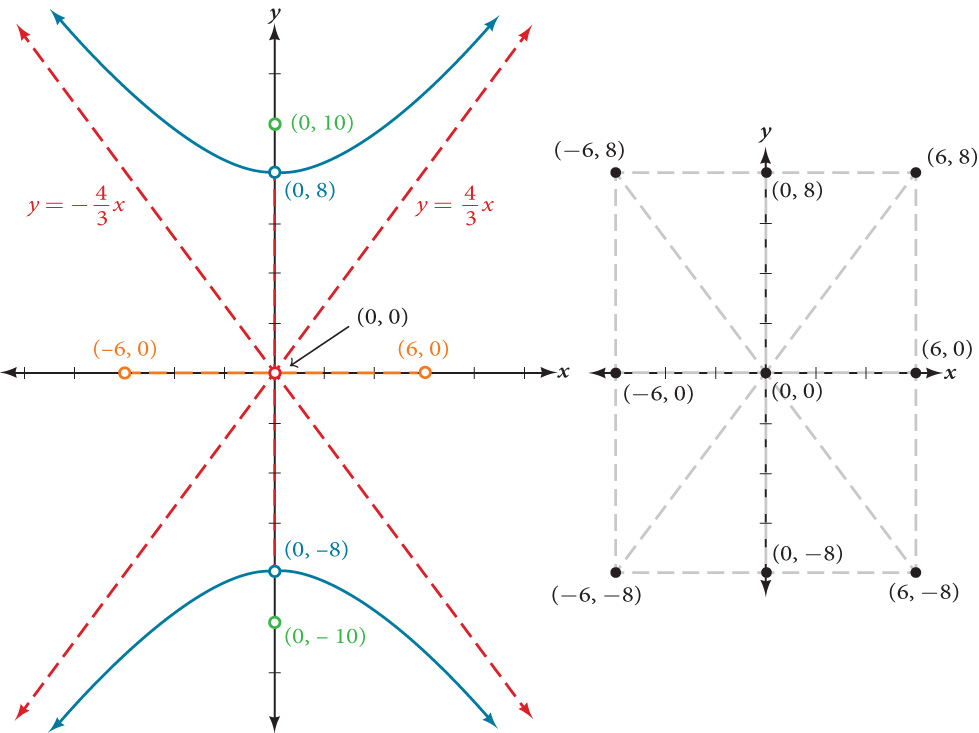
Figure 8
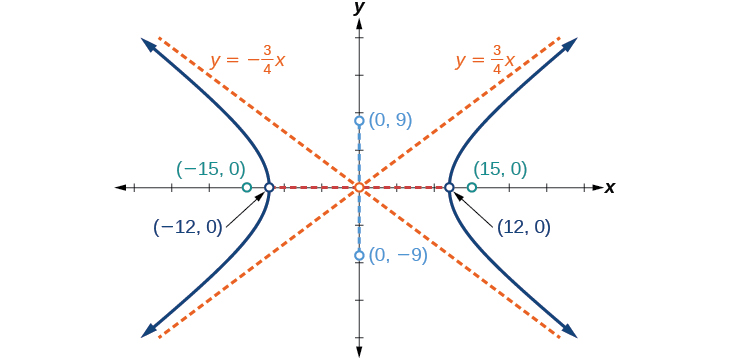
Graph the hyperbola given by the equation \(\frac{x^{2}}{144} - \frac{y^{2}}{81} = 1.\) Identify and label the vertices, co-vertices, foci, and asymptotes.
Solution (click to reveal)
vertices: \(\left( {\pm 12,0} \right);\) co-vertices: \(\left( {0, \pm 9} \right);\) foci: \(\left( {\pm 15,0} \right);\) asymptotes: \(y = \pm \frac{3}{4}x;\)
12.2.4 Graphing Hyperbolas Not Centered at the Origin
Graphing hyperbolas centered at a point \(\left( {h,k} \right)\) other than the origin is similar to graphing ellipses centered at a point other than the origin. We use the standard forms \(\frac{\left( {x - h} \right)^{2}}{a^{2}} - \frac{\left( {y - k} \right)^{2}}{b^{2}} = 1\) for horizontal hyperbolas, and \(\frac{\left( {y - k} \right)^{2}}{a^{2}} - \frac{\left( {x - h} \right)^{2}}{b^{2}} = 1\) for vertical hyperbolas. From these standard form equations we can easily calculate and plot key features of the graph: the coordinates of its center, vertices, co-vertices, and foci; the equations of its asymptotes; and the positions of the transverse and conjugate axes.
Graph the hyperbola given by the equation \(9x^{2} - 4y^{2} - 36x - 40y - 388 = 0.\) Identify and label the center, vertices, co-vertices, foci, and asymptotes.
Solution (click to reveal)
Start by expressing the equation in standard form. Group terms that contain the same variable, and move the constant to the opposite side of the equation.
\[\left( {9x^{2} - 36x} \right) - \left( {4y^{2} + 40y} \right) = 388\]
Factor the leading coefficient of each expression.
\[9\left( {x^{2} - 4x} \right) - 4\left( {y^{2} + 10y} \right) = 388\]
Complete the square twice. Remember to balance the equation by adding the same constants to each side.
\[9\left( {x^{2} - 4x + 4} \right) - 4\left( {y^{2} + 10y + 25} \right) = 388 + 36 - 100\]
Rewrite as perfect squares.
\[9\left( {x - 2} \right)^{2} - 4\left( {y + 5} \right)^{2} = 324\]
Divide both sides by the constant term to place the equation in standard form.
\[\frac{\left( {x - 2} \right)^{2}}{36} - \frac{\left( {y + 5} \right)^{2}}{81} = 1\]
The standard form that applies to the given equation is \(\frac{\left( {x - h} \right)^{2}}{a^{2}} - \frac{\left( {y - k} \right)^{2}}{b^{2}} = 1,\) where \(a^{2} = 36\) and \(b^{2} = 81,\) or \(a = 6\) and \(b = 9.\) Thus, the transverse axis is parallel to the \(x\)-axis. It follows that:
- the center of the ellipse is \(\left( {h,k} \right) = \left( {2,-5} \right)\)
- the coordinates of the vertices are \(\left( {h \pm a,k} \right) = \left( {2 \pm 6,-5} \right),\) or \(\left( {- 4,-5} \right)\) and \(\left( {8,-5} \right)\)
- the coordinates of the co-vertices are \(\left( {h,k \pm b} \right) = \left( {2, - 5 \pm 9} \right),\) or \(\left( {2, - 14} \right)\) and \(\left( {2,4} \right)\)
- the coordinates of the foci are \(\left( {h \pm c,k} \right),\) where \(c = \pm \sqrt{a^{2} + b^{2}}.\) Solving for \(c,\) we have
\[c = \pm \sqrt{36 + 81} = \pm \sqrt{117} = \pm 3\sqrt{13}\]
Therefore, the coordinates of the foci are \(\left( {2 - 3\sqrt{13},-5} \right)\) and \(\left( {2 + 3\sqrt{13},-5} \right).\)
The equations of the asymptotes are \(y = \pm \frac{b}{a}\left( {x - h} \right) + k = \pm \frac{3}{2}\left( {x - 2} \right) - 5.\)
Next, we plot and label the center, vertices, co-vertices, foci, and asymptotes and draw smooth curves to form the hyperbola, as shown in Figure 9.
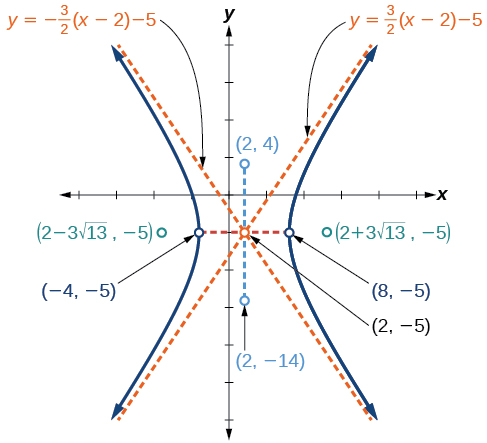
Figure 9
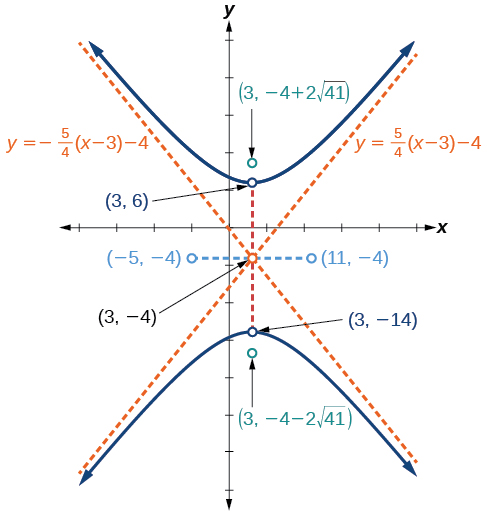
Graph the hyperbola given by the standard form of an equation \(\frac{\left( {y + 4} \right)^{2}}{100} - \frac{\left( {x - 3} \right)^{2}}{64} = 1.\) Identify and label the center, vertices, co-vertices, foci, and asymptotes.
Solution (click to reveal)
center: \(\left( {3, - 4} \right);\) vertices: \(\left( {3, - 14} \right)\) and \(\left( {3,6} \right);\) co-vertices: \(\left( {- 5, - 4} \right);\) and \(\left( {11, - 4} \right);\) foci: \(\left( {3, - 4 - 2\sqrt{41}} \right)\) and \(\left( {3, - 4 + 2\sqrt{41}} \right);\) asymptotes: \(y = \pm \frac{5}{4}\left( {x - 3} \right) - 4\)
12.2.5 Solving Applied Problems Involving Hyperbolas
As we discussed at the beginning of this section, hyperbolas have real-world applications in many fields, such as astronomy, physics, engineering, and architecture. The design efficiency of hyperbolic cooling towers is particularly interesting. Cooling towers are used to transfer waste heat to the atmosphere and are often touted for their ability to generate power efficiently. Because of their hyperbolic form, these structures are able to withstand extreme winds while requiring less material than any other forms of their size and strength. See Figure 10. For example, a 500-foot tower can be made of a reinforced concrete shell only 6 or 8 inches wide!
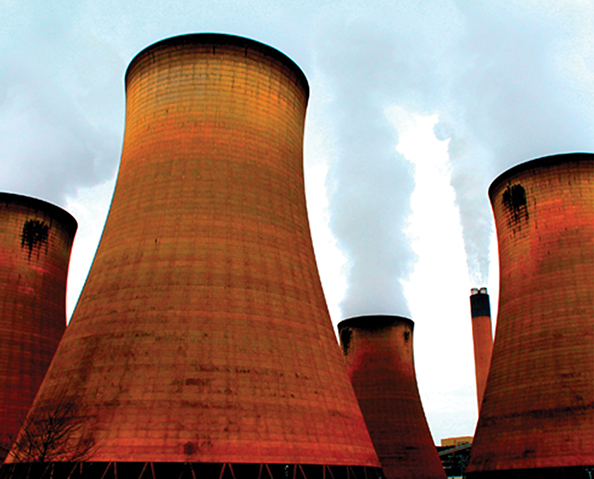
Figure 10 Cooling towers at the Drax power station in North Yorkshire, United Kingdom (credit: Les Haines, Flickr)
The first hyperbolic towers were designed in 1914 and were 35 meters high. Today, the tallest cooling towers are in France, standing a remarkable 170 meters tall. In Example 6 we will use the design layout of a cooling tower to find a hyperbolic equation that models its sides.
The design layout of a cooling tower is shown in Figure 11. The tower stands 179.6 meters tall. The diameter of the top is 72 meters. At their closest, the sides of the tower are 60 meters apart.
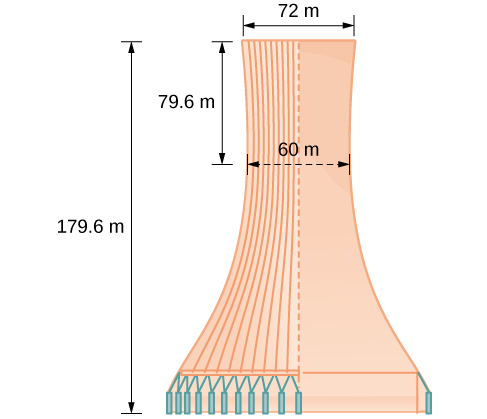
Figure 11 Project design for a natural draft cooling tower
Find the equation of the hyperbola that models the sides of the cooling tower. Assume that the center of the hyperbola—indicated by the intersection of dashed perpendicular lines in the figure—is the origin of the coordinate plane. Round final values to four decimal places.
Solution (click to reveal)
We are assuming the center of the tower is at the origin, so we can use the standard form of a horizontal hyperbola centered at the origin: \(\frac{x^{2}}{a^{2}} - \frac{y^{2}}{b^{2}} = 1,\) where the branches of the hyperbola form the sides of the cooling tower. We must find the values of \(a^{2}\) and \(b^{2}\) to complete the model.
First, we find \(a^{2}.\) Recall that the length of the transverse axis of a hyperbola is \(2a.\) This length is represented by the distance where the sides are closest, which is given as \(60\) meters. So, \(2a = 60.\) Therefore, \(a = 30\) and \(a^{2} = 900.\)
To solve for \(b^{2},\) we need to substitute for \(x\) and \(y\) in our equation using a known point. To do this, we can use the dimensions of the tower to find some point \(\left( {x,y} \right)\) that lies on the hyperbola. We will use the top right corner of the tower to represent that point. Since the \(y\)-axis bisects the tower, our \(x\)-value can be represented by the radius of the top, or 36 meters. The \(y\)-value is represented by the distance from the origin to the top, which is given as 79.6 meters. Therefore,
\[\begin{array}{ll} {\frac{x^{2}}{a^{2}} - \frac{y^{2}}{b^{2}} = 1} & {\begin{array}{llll} & & & \end{array}\text{Standard~form~of~horizontal~hyperbola}.} \\ {\mspace{9mu}\text{~~~~~~~~~}b^{2} = \frac{y^{2}}{\frac{x^{2}}{a^{2}} - 1}} & {\begin{array}{llll} & & & \end{array}\text{Isolate~}b^{2}} \\ {\mspace{9mu}\text{~~~~~~~~~~~~} = \frac{{(79.6)}^{2}}{\frac{{(36)}^{2}}{900} - 1}} & {\begin{array}{llll} & & & \end{array}\text{Substitute~for~}a^{2},x,\mspace{9mu}\text{and~}y} \\ {\mspace{9mu}\text{~~~~~~~~~~~~} \approx 14400.3636} & {\begin{array}{llll} & & & \end{array}\text{Round~to~four~decimal~places}} \end{array}\]
The sides of the tower can be modeled by the hyperbolic equation
\[\frac{x^{2}}{900} - \frac{y^{2}}{14400.3636~} = 1,\text{or}\mspace{9mu}\mspace{9mu}\frac{x^{2}}{30^{2}} - \frac{y^{2}}{120.0015^{2}~} = 1\]
A design for a cooling tower project is shown in Figure 12. Find the equation of the hyperbola that models the sides of the cooling tower. Assume that the center of the hyperbola—indicated by the intersection of dashed perpendicular lines in the figure—is the origin of the coordinate plane. Round final values to four decimal places.
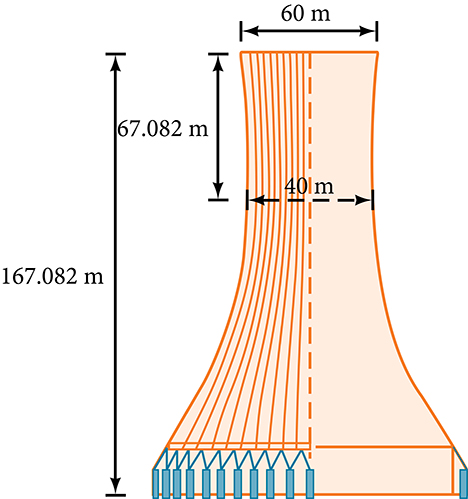
Figure 12
Solution (click to reveal)
The sides of the tower can be modeled by the hyperbolic equation. \(\frac{x^{2}}{400} - \frac{y^{2}}{3600} = 1\text{or~}\frac{x^{2}}{20^{2}} - \frac{y^{2}}{60^{2}} = 1.\)
Section Exercises
Verbal
1. Define a hyperbola in terms of its foci.
Solution (click to reveal)
A hyperbola is the set of points in a plane the difference of whose distances from two fixed points (foci) is a positive constant.
2. What can we conclude about a hyperbola if its asymptotes intersect at the origin?
3. What must be true of the foci of a hyperbola?
Solution (click to reveal)
The foci must lie on the transverse axis and be in the interior of the hyperbola.
4. If the transverse axis of a hyperbola is vertical, what do we know about the graph?
5. Where must the center of hyperbola be relative to its foci?
Solution (click to reveal)
The center must be the midpoint of the line segment joining the foci.
Algebraic
For the following exercises, determine whether the following equations represent hyperbolas. If so, write in standard form.
6. \(3y^{2} + 2x = 6\)
7. \(\frac{x^{2}}{36} - \frac{y^{2}}{9} = 1\)
Solution (click to reveal)
yes \(\frac{x^{2}}{6^{2}} - \frac{y^{2}}{3^{2}} = 1\)
8. \(5y^{2} + 4x^{2} = 6x\)
9. \(25x^{2} - 16y^{2} = 400\)
Solution (click to reveal)
yes \(\frac{x^{2}}{4^{2}} - \frac{y^{2}}{5^{2}} = 1\)
10. \(- 9x^{2} + 18x + y^{2} + 4y - 14 = 0\)
For the following exercises, write the equation for the hyperbola in standard form if it is not already, and identify the vertices and foci, and write equations of asymptotes.
11. \(\frac{x^{2}}{25} - \frac{y^{2}}{36} = 1\)
Solution (click to reveal)
\(\frac{x^{2}}{5^{2}} - \frac{y^{2}}{6^{2}} = 1;\) vertices: \(\left( {5,0} \right),\left( {- 5,0} \right);\) foci: \(\left( {\sqrt{61},0} \right),\left( {- \sqrt{61},0} \right);\) asymptotes: \(y = \frac{6}{5}x,y = - \frac{6}{5}x\)
12. \(\frac{x^{2}}{100} - \frac{y^{2}}{9} = 1\)
13. \(\frac{y^{2}}{4} - \frac{x^{2}}{81} = 1\)
Solution (click to reveal)
\(\frac{y^{2}}{2^{2}} - \frac{x^{2}}{9^{2}} = 1;\) vertices: \(\left( {0,2} \right),\left( {0, - 2} \right);\) foci: \(\left( {0,\sqrt{85}} \right),\left( {0, - \sqrt{85}} \right);\) asymptotes: \(y = \frac{2}{9}x,y = - \frac{2}{9}x\)
14. \(9y^{2} - 4x^{2} = 1\)
15. \(\frac{\left( {x - 1} \right)^{2}}{9} - \frac{\left( {y - 2} \right)^{2}}{16} = 1\)
Solution (click to reveal)
\(\frac{\left( {x - 1} \right)^{2}}{3^{2}} - \frac{\left( {y - 2} \right)^{2}}{4^{2}} = 1;\) vertices: \(\left( {4,2} \right),\left( {- 2,2} \right);\) foci: \(\left( {6,2} \right),\left( {- 4,2} \right);\) asymptotes: \(y = \frac{4}{3}\left( {x - 1} \right) + 2,y = - \frac{4}{3}\left( {x - 1} \right) + 2\)
16. \(\frac{\left( {y - 6} \right)^{2}}{36} - \frac{\left( {x + 1} \right)^{2}}{16} = 1\)
17. \(\frac{\left( {x - 2} \right)^{2}}{49} - \frac{\left( {y + 7} \right)^{2}}{49} = 1\)
Solution (click to reveal)
\(\frac{\left( {x - 2} \right)^{2}}{7^{2}} - \frac{\left( {y + 7} \right)^{2}}{7^{2}} = 1;\) vertices: \(\left( {9, - 7} \right),\left( {- 5, - 7} \right);\) foci: \(\left( {2 + 7\sqrt{2}, - 7} \right),\left( {2 - 7\sqrt{2}, - 7} \right);\) asymptotes: \(y = x - 9,y = - x - 5\)
18. \(4x^{2} - 8x - 9y^{2} - 72y + 112 = 0\)
19. \(- 9x^{2} - 54x + 9y^{2} - 54y + 81 = 0\)
Solution (click to reveal)
\(\frac{\left( {x + 3} \right)^{2}}{3^{2}} - \frac{\left( {y - 3} \right)^{2}}{3^{2}} = 1;\) vertices: \(\left( {0,3} \right),\left( {- 6,3} \right);\) foci: \(\left( {- 3 + 3\sqrt{2},1} \right),\left( {- 3 - 3\sqrt{2},1} \right);\) asymptotes: \(y = x + 6,y = - x\)
20. \(4x^{2} - 24x - 36y^{2} - 360y + 864 = 0\)
21. \(- 4x^{2} + 24x + 16y^{2} - 128y + 156 = 0\)
Solution (click to reveal)
\(\frac{\left( {y - 4} \right)^{2}}{2^{2}} - \frac{\left( {x - 3} \right)^{2}}{4^{2}} = 1;\) vertices: \(\left( {3,6} \right),\left( {3,2} \right);\) foci: \(\left( {3,4 + 2\sqrt{5}} \right),\left( {3,4 - 2\sqrt{5}} \right);\) asymptotes: \(y = \frac{1}{2}\left( {x - 3} \right) + 4,y = - \frac{1}{2}\left( {x - 3} \right) + 4\)
22. \(- 4x^{2} + 40x + 25y^{2} - 100y + 100 = 0\)
23. \(x^{2} + 2x - 100y^{2} - 1000y + 2401 = 0\)
Solution (click to reveal)
\(\frac{\left( {y + 5} \right)^{2}}{7^{2}} - \frac{\left( {x + 1} \right)^{2}}{70^{2}} = 1;\) vertices: \(\left( {- 1,2} \right),\left( {- 1, - 12} \right);\) foci: \(\left( {- 1, - 5 + 7\sqrt{101}} \right),\left( {- 1, - 5 - 7\sqrt{101}} \right);\) asymptotes: \(y = \frac{1}{10}\left( {x + 1} \right) - 5,y = - \frac{1}{10}\left( {x + 1} \right) - 5\)
24. \(- 9x^{2} + 72x + 16y^{2} + 16y + 4 = 0\)
25. \(4x^{2} + 24x - 25y^{2} + 200y - 464 = 0\)
Solution (click to reveal)
\(\frac{\left( {x + 3} \right)^{2}}{5^{2}} - \frac{\left( {y - 4} \right)^{2}}{2^{2}} = 1;\) vertices: \(\left( {2,4} \right),\left( {- 8,4} \right);\) foci: \(\left( {- 3 + \sqrt{29},4} \right),\left( {- 3 - \sqrt{29},4} \right);\) asymptotes: \(y = \frac{2}{5}\left( {x + 3} \right) + 4,y = - \frac{2}{5}\left( {x + 3} \right) + 4\)
For the following exercises, find the equations of the asymptotes for each hyperbola.
26. \(\frac{y^{2}}{3^{2}} - \frac{x^{2}}{3^{2}} = 1\)
27. \(\frac{\left( {x - 3} \right)^{2}}{5^{2}} - \frac{\left( {y + 4} \right)^{2}}{2^{2}} = 1\)
Solution (click to reveal)
\(y = \frac{2}{5}\left( {x - 3} \right) - 4,y = - \frac{2}{5}\left( {x - 3} \right) - 4\)
28. \(\frac{\left( {y - 3} \right)^{2}}{3^{2}} - \frac{\left( {x + 5} \right)^{2}}{6^{2}} = 1\)
29. \(9x^{2} - 18x - 16y^{2} + 32y - 151 = 0\)
Solution (click to reveal)
\(y = \frac{3}{4}\left( {x - 1} \right) + 1,y = - \frac{3}{4}\left( {x - 1} \right) + 1\)
30. \(16y^{2} + 96y - 4x^{2} + 16x + 112 = 0\)
Graphical
For the following exercises, sketch a graph of the hyperbola, labeling vertices and foci.
31. \(\frac{x^{2}}{49} - \frac{y^{2}}{16} = 1\)
Solution (click to reveal)
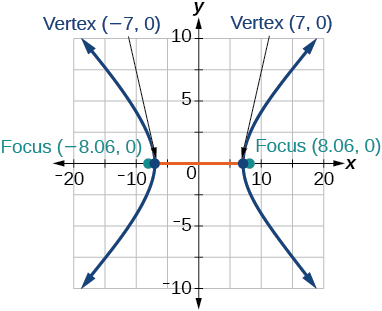
32. \(\frac{x^{2}}{64} - \frac{y^{2}}{4} = 1\)
33. \(\frac{y^{2}}{9} - \frac{x^{2}}{25} = 1\)
Solution (click to reveal)
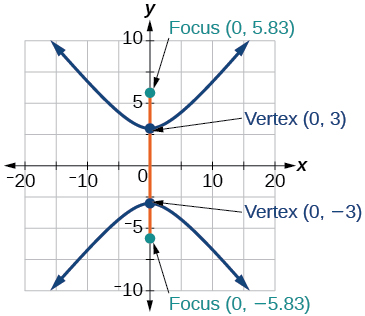
34. \(81x^{2} - 9y^{2} = 1\)
35. \(\frac{\left( {y + 5} \right)^{2}}{9} - \frac{\left( {x - 4} \right)^{2}}{25} = 1\)
Solution (click to reveal)
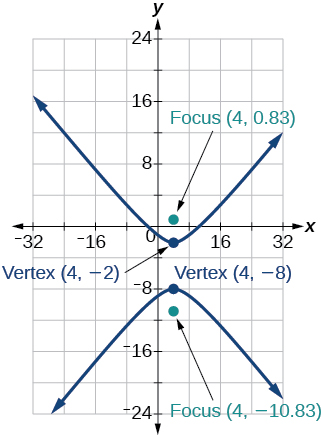
36. \(\frac{\left( {x - 2} \right)^{2}}{8} - \frac{\left( {y + 3} \right)^{2}}{27} = 1\)
37. \(\frac{\left( {y - 3} \right)^{2}}{9} - \frac{\left( {x - 3} \right)^{2}}{9} = 1\)
Solution (click to reveal)
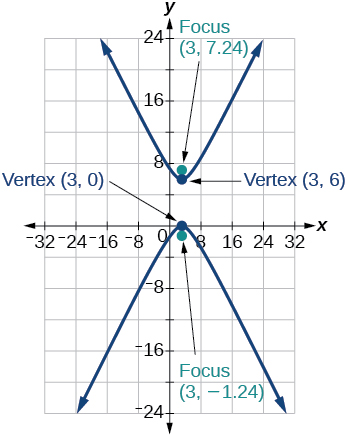
38. \(- 4x^{2} - 8x + 16y^{2} - 32y - 52 = 0\)
39. \(x^{2} - 8x - 25y^{2} - 100y - 109 = 0\)
Solution (click to reveal)
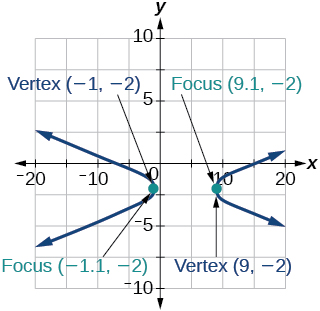
40. \(- x^{2} + 8x + 4y^{2} - 40y + 88 = 0\)
41. \(64x^{2} + 128x - 9y^{2} - 72y - 656 = 0\)
Solution (click to reveal)
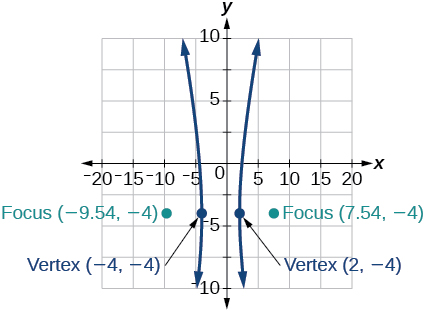
42. \(16x^{2} + 64x - 4y^{2} - 8y - 4 = 0\)
43. \(- 100x^{2} + 1000x + y^{2} - 10y - 2575 = 0\)
Solution (click to reveal)
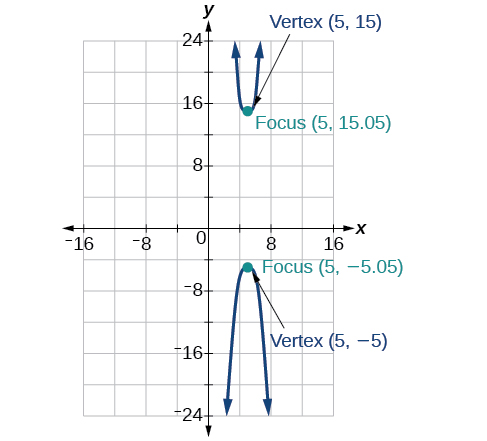
44. \(4x^{2} + 16x - 4y^{2} + 16y + 16 = 0\)
For the following exercises, given information about the graph of the hyperbola, find its equation.
45. Vertices at \(\left( {3,0} \right)\) and \(\left( {-3,0} \right)\) and one focus at \(\left( {5,0} \right).\)
Solution (click to reveal)
\(\frac{x^{2}}{9} - \frac{y^{2}}{16} = 1\)
46. Vertices at \(\left( {0,6} \right)\) and \(\left( {0,-6} \right)\) and one focus at \(\left( {0,-8} \right).\)
47. Vertices at \(\left( {1,1} \right)\) and \(\left( {11,1} \right)\) and one focus at \(\left( {12,1} \right).\)
Solution (click to reveal)
\(\frac{\left( {x - 6} \right)^{2}}{25} - \frac{\left( {y - 1} \right)^{2}}{11} = 1\)
48. Center: \(\left( {0,0} \right);\) vertex: \(\left( {0,-13} \right);\) one focus: \(\left( {0,\sqrt{313}} \right).\)
49. Center: \(\left( {4,2} \right);\) vertex: \(\left( {9,2} \right);\) one focus: \(\left( {4 + \sqrt{26},2} \right).\)
Solution (click to reveal)
\(\frac{\left( {x - 4} \right)^{2}}{25} - \frac{\left( {y - 2} \right)^{2}}{1} = 1\)
50. Center: \(\left( {3,5} \right);\) vertex: \(\left( {3,11} \right);\) one focus: \(\left( {3,5 + 2\sqrt{10}} \right).\)
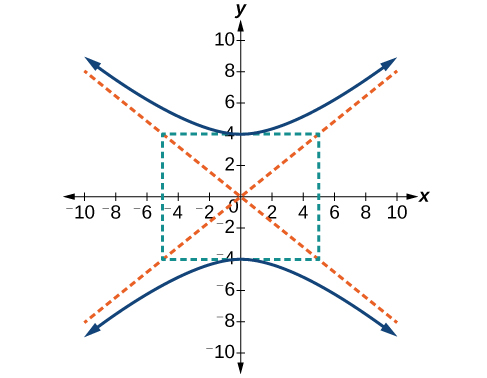
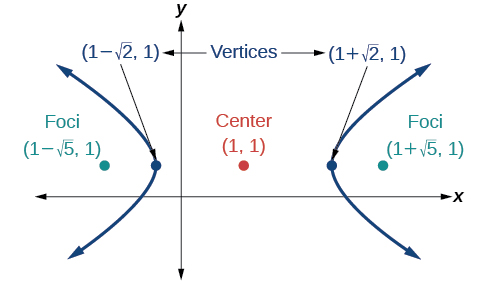
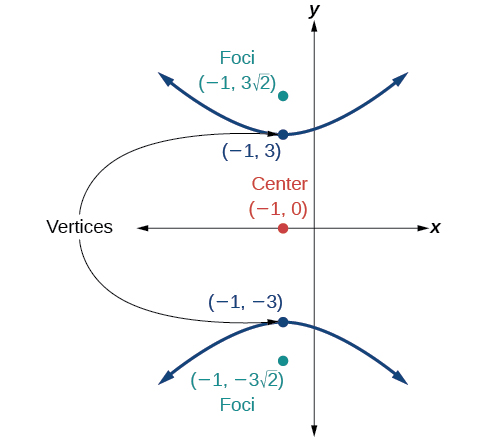
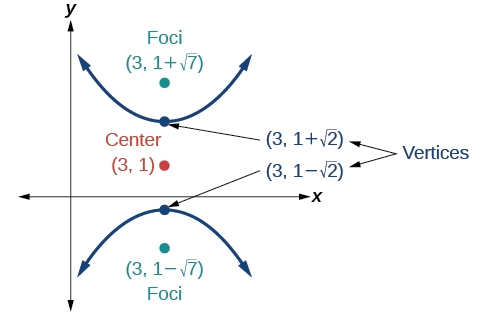
For the following exercises, given the graph of the hyperbola, find its equation.
51.
Solution (click to reveal)
\(\frac{y^{2}}{16} - \frac{x^{2}}{25} = 1\)
52.
53.
Solution (click to reveal)
\(\frac{y^{2}}{9} - \frac{\left( {x + 1} \right)^{2}}{9} = 1\)
54.
55.
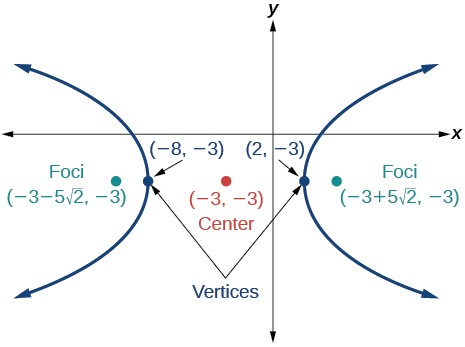
Solution (click to reveal)
\(\frac{\left( {x + 3} \right)^{2}}{25} - \frac{\left( {y + 3} \right)^{2}}{25} = 1\)
Extensions
For the following exercises, express the equation for the hyperbola as two functions, with \(y\) as a function of \(x.\) Express as simply as possible. Use a graphing calculator to sketch the graph of the two functions on the same axes.
56. \(\frac{x^{2}}{4} - \frac{y^{2}}{9} = 1\)
57. \(\frac{y^{2}}{9} - \frac{x^{2}}{1} = 1\)
Solution (click to reveal)
\(y(x) = 3\sqrt{x^{2} + 1},y(x) = - 3\sqrt{x^{2} + 1}\)
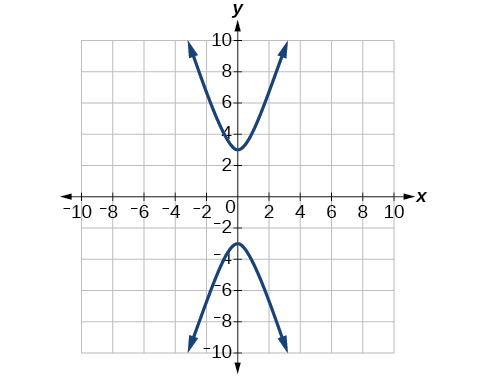
58. \(\frac{\left( {x - 2} \right)^{2}}{16} - \frac{\left( {y + 3} \right)^{2}}{25} = 1\)
59. \(- 4x^{2} - 16x + y^{2} - 2y - 19 = 0\)
Solution (click to reveal)
\(y(x) = 1 + 2\sqrt{x^{2} + 4x + 5},y(x) = 1 - 2\sqrt{x^{2} + 4x + 5}\)
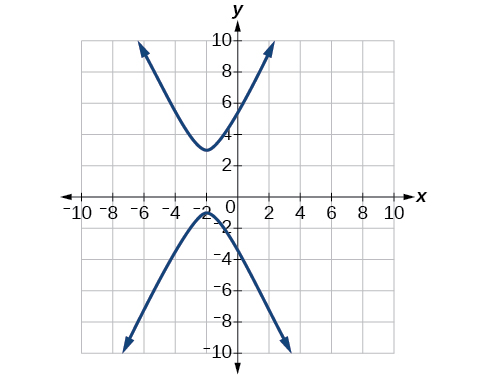
60. \(4x^{2} - 24x - y^{2} - 4y + 16 = 0\)
Real-World Applications
For the following exercises, a hedge is to be constructed in the shape of a hyperbola near a fountain at the center of the yard. Find the equation of the hyperbola and sketch the graph.
61. The hedge will follow the asymptotes \(y = x\mspace{9mu}\text{and~}y = - x,\) and its closest distance to the center fountain is 5 yards.
Solution (click to reveal)
\(\frac{x^{2}}{25} - \frac{y^{2}}{25} = 1\)
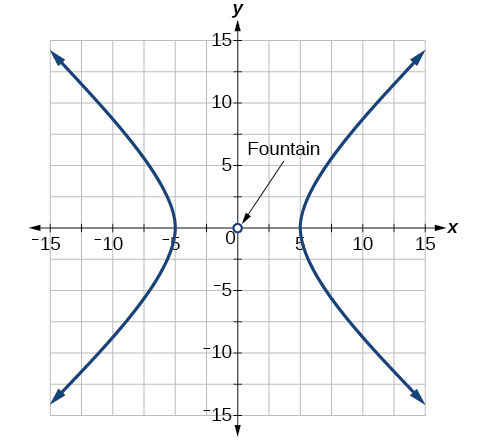
62. The hedge will follow the asymptotes \(y = 2x\mspace{9mu}\text{and~}y = -2x,\) and its closest distance to the center fountain is 6 yards.
63. The hedge will follow the asymptotes \(y = \frac{1}{2}x\) and \(y = - \frac{1}{2}x,\) and its closest distance to the center fountain is 10 yards.
Solution (click to reveal)
\(\frac{x^{2}}{100} - \frac{y^{2}}{25} = 1\)
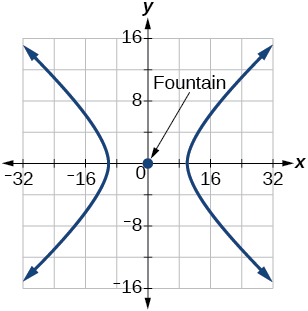
64. The hedge will follow the asymptotes \(y = \frac{2}{3}x\) and \(y = - \frac{2}{3}x,\) and its closest distance to the center fountain is 12 yards.
65. The hedge will follow the asymptotes \(y = \frac{3}{4}x\) and \(y = - \frac{3}{4}x,\) and its closest distance to the center fountain is 20 yards.
Solution (click to reveal)
\(\frac{x^{2}}{400} - \frac{y^{2}}{225} = 1\)
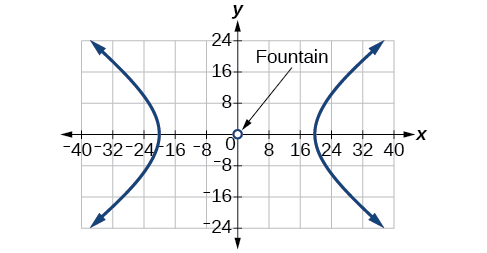
For the following exercises, assume an object enters our solar system and we want to graph its path on a coordinate system with the sun at the origin and the x-axis as the axis of symmetry for the object’s path. Give the equation of the flight path of each object using the given information.
66. The object enters along a path approximated by the line \(y = x - 2\) and passes within 1 au (astronomical unit) of the sun at its closest approach, so that the sun is one focus of the hyperbola. It then departs the solar system along a path approximated by the line \(y = - x + 2.\)
67. The object enters along a path approximated by the line \(y = 2x - 2\) and passes within 0.5 au of the sun at its closest approach, so the sun is one focus of the hyperbola. It then departs the solar system along a path approximated by the line \(y = -2x + 2.\)
Solution (click to reveal)
\(4(x - 1)^{2} - y2^{2} = 16\)
68. The object enters along a path approximated by the line \(y = 0.5x + 2\) and passes within 1 au of the sun at its closest approach, so the sun is one focus of the hyperbola. It then departs the solar system along a path approximated by the line \(y = -0.5x - 2.\)
69. The object enters along a path approximated by the line \(y = \frac{1}{3}x - 1\) and passes within 1 au of the sun at its closest approach, so the sun is one focus of the hyperbola. It then departs the solar system along a path approximated by the line \(y = - \frac{1}{3}x + 1.\)
Solution (click to reveal)
\(\frac{{(x - h)}^{2}}{a^{2}} - \frac{(y - k)^{2}}{b^{2}} = (x - 3)^{2} - 9y^{2} = 4\)
70. The object enters along a path approximated by the line \(y = 3x - 9\) and passes within 1 au of the sun at its closest approach, so the sun is one focus of the hyperbola. It then departs the solar system along a path approximated by the line \(y = -3x + 9.\)