12.1 The Ellipse
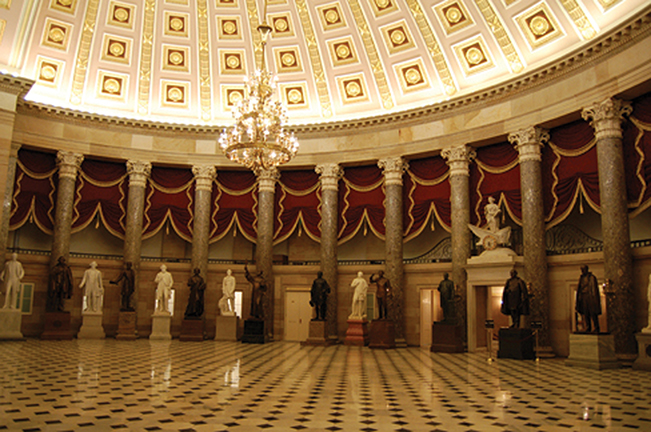
Figure 1 The National Statuary Hall in Washington, D.C. (credit: Greg Palmer, Flickr)
Can you imagine standing at one end of a large room and still being able to hear a whisper from a person standing at the other end? The National Statuary Hall in Washington, D.C., shown in Figure 1, is such a room. It is an semi-circular room called a whispering chamber because the shape makes it possible for sound to travel along the walls and dome. In this section, we will investigate the shape of this room and its real-world applications, including how far apart two people in Statuary Hall can stand and still hear each other whisper.
12.1.1 Writing Equations of Ellipses in Standard Form
A conic section, or conic, is a shape resulting from intersecting a right circular cone with a plane. The angle at which the plane intersects the cone determines the shape, as shown in Figure 2.
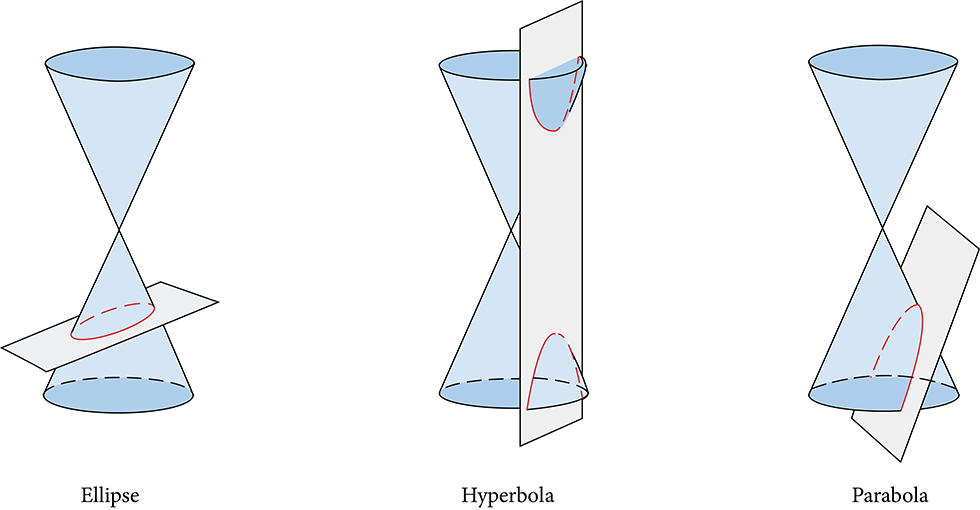
Figure 2
Conic sections can also be described by a set of points in the coordinate plane. Later in this chapter, we will see that the graph of any quadratic equation in two variables is a conic section. The signs of the equations and the coefficients of the variable terms determine the shape. This section focuses on the four variations of the standard form of the equation for the ellipse. An ellipse is the set of all points \(\left( {x,y} \right)\) in a plane such that the sum of their distances from two fixed points is a constant. Each fixed point is called a focus (plural: foci).
We can draw an ellipse using a piece of cardboard, two thumbtacks, a pencil, and string. Place the thumbtacks in the cardboard to form the foci of the ellipse. Cut a piece of string longer than the distance between the two thumbtacks (the length of the string represents the constant in the definition). Tack each end of the string to the cardboard, and trace a curve with a pencil held taut against the string. The result is an ellipse. See Figure 3.
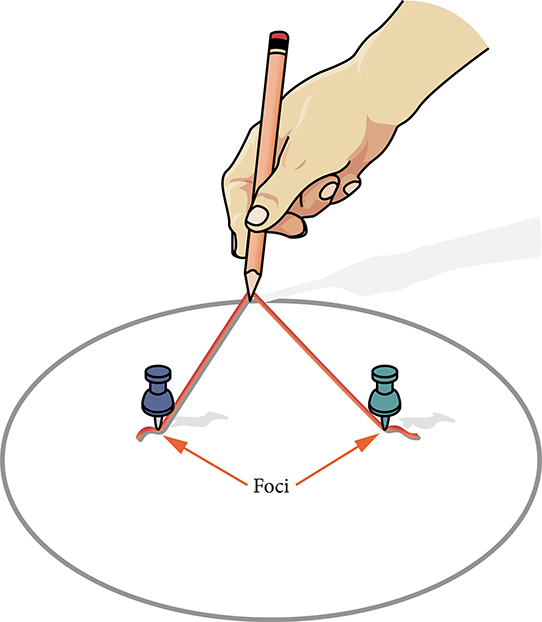
Figure 3
Every ellipse has two axes of symmetry. The longer axis is called the major axis, and the shorter axis is called the minor axis. Each endpoint of the major axis is the vertex of the ellipse (plural: vertices), and each endpoint of the minor axis is a co-vertex of the ellipse. The center of an ellipse is the midpoint of both the major and minor axes. The axes are perpendicular at the center. The foci always lie on the major axis, and the sum of the distances from the foci to any point on the ellipse (the constant sum) is greater than the distance between the foci. See Figure 4.
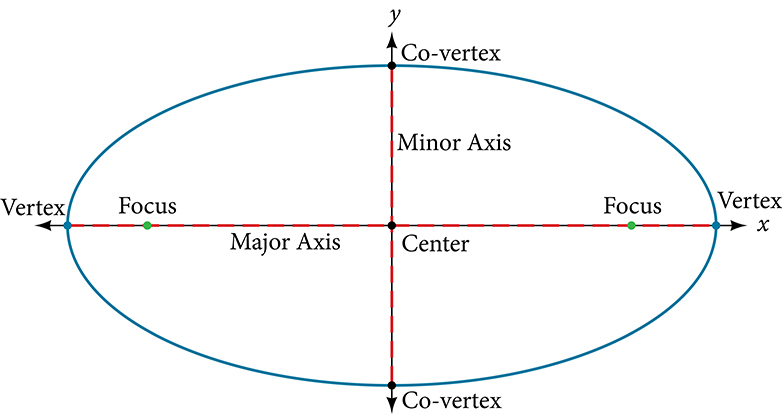
Figure 4
In this section, we restrict ellipses to those that are positioned vertically or horizontally in the coordinate plane. That is, the axes will either lie on or be parallel to the \(x\)- and \(y\)-axes. Later in the chapter, we will see ellipses that are rotated in the coordinate plane.
To work with horizontal and vertical ellipses in the coordinate plane, we consider two cases: those that are centered at the origin and those that are centered at a point other than the origin. First we will learn to derive the equations of ellipses, and then we will learn how to write the equations of ellipses in standard form. Later we will use what we learn to draw the graphs.
Deriving the Equation of an Ellipse Centered at the Origin
To derive the equation of an ellipse centered at the origin, we begin with the foci \(\left( {- c,0} \right)\) and \((c,0).\) The ellipse is the set of all points \(\left( {x,y} \right)\) such that the sum of the distances from \(\left( {x,y} \right)\) to the foci is constant, as shown in Figure 5.
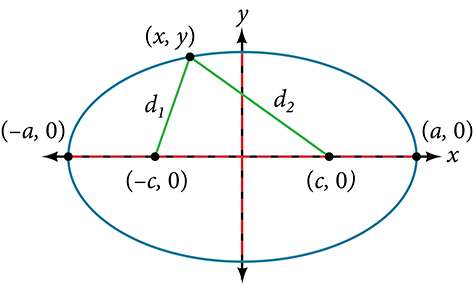
Figure 5
If \(\left( {a,0} \right)\) is a vertex of the ellipse, the distance from \(\left( {- c,0} \right)\) to \((a,0)\) is \(a - ( - c) = a + c.\) The distance from \(\left( {c,0} \right)\) to \(\left( {a,0} \right)\) is \(a - c\) . The sum of the distances from the foci to the vertex is
\[\left( {a + c} \right) + \left( {a - c} \right) = 2a\]
If \(\left( {x,y} \right)\) is a point on the ellipse, then we can define the following variables:
\[\begin{array}{l} {d_{1} = \text{the~distance~from~}(-c,0)\mspace{9mu}\text{to~}(x,y)} \\ {d_{2} = \text{the~distance~from~}(c,0)\mspace{9mu}\text{to~}(x,y)} \end{array}\]
By the definition of an ellipse, \(d_{1} + d_{2}\) is constant for any point \(\left( {x,y} \right)\) on the ellipse. We know that the sum of these distances is \(2a\) for the vertex \((a,0).\) It follows that \(d_{1} + d_{2} = 2a\) for any point on the ellipse. We will begin the derivation by applying the distance formula. The rest of the derivation is algebraic.
\[\begin{array}{ll} {d_{1} + d_{2} = \sqrt{{(x - ( - c))}^{2} + {(y - 0)}^{2}} + \sqrt{{(x - c)}^{2} + {(y - 0)}^{2}} = 2a} & \text{Distance~formula} \\ {\sqrt{{(x + c)}^{2} + y^{2}} + \sqrt{{(x - c)}^{2} + y^{2}} = 2a} & {\text{Simplify~expressions}\text{.}} \\ {\sqrt{{(x + c)}^{2} + y^{2}} = 2a - \sqrt{{(x - c)}^{2} + y^{2}}} & {\text{Move~radical~to~opposite~side}\text{.}} \\ {{(x + c)}^{2} + y^{2} = \left\lbrack {2a - \sqrt{{(x - c)}^{2} + y^{2}}} \right\rbrack^{2}} & {\text{Square~both~sides}\text{.}} \\ {x^{2} + 2cx + c^{2} + y^{2} = 4a^{2} - 4a\sqrt{{(x - c)}^{2} + y^{2}} + {(x - c)}^{2} + y^{2}} & {\text{Expand~the~squares}\text{.}} \\ {x^{2} + 2cx + c^{2} + y^{2} = 4a^{2} - 4a\sqrt{{(x - c)}^{2} + y^{2}} + x^{2} - 2cx + c^{2} + y^{2}} & {\text{Expand~remaining~squares}\text{.}} \\ {2cx = 4a^{2} - 4a\sqrt{{(x - c)}^{2} + y^{2}} - 2cx} & {\text{Combine~like~terms}\text{.}} \\ {4cx - 4a^{2} = - 4a\sqrt{{(x - c)}^{2} + y^{2}}} & {\text{Isolate~the~radical}\text{.}} \\ {cx - a^{2} = - a\sqrt{{(x - c)}^{2} + y^{2}}} & {\text{Divide~by~4}\text{.}} \\ {\left\lbrack {cx - a^{2}} \right\rbrack^{2} = a^{2}\left\lbrack \sqrt{{(x - c)}^{2} + y^{2}} \right\rbrack^{2}} & {\text{Square~both~sides}\text{.}} \\ {c^{2}x^{2} - 2a^{2}cx + a^{4} = a^{2}\left( {x^{2} - 2cx + c^{2} + y^{2}} \right)} & {\text{Expand~the~squares}\text{.}} \\ {c^{2}x^{2} - 2a^{2}cx + a^{4} = a^{2}x^{2} - 2a^{2}cx + a^{2}c^{2} + a^{2}y^{2}} & {\text{Distribute~}a^{2}.} \\ {a^{2}x^{2} - c^{2}x^{2} + a^{2}y^{2} = a^{4} - a^{2}c^{2}} & {\text{Rewrite}\text{.}} \\ {x^{2}\left( {a^{2} - c^{2}} \right) + a^{2}y^{2} = a^{2}\left( {a^{2} - c^{2}} \right)} & {\text{Factor~common~terms}\text{.}} \\ {x^{2}b^{2} + a^{2}y^{2} = a^{2}b^{2}} & {\text{Set~}b^{2} = a^{2} - c^{2}.} \\ {\frac{x^{2}b^{2}}{a^{2}b^{2}} + \frac{a^{2}y^{2}}{a^{2}b^{2}} = \frac{a^{2}b^{2}}{a^{2}b^{2}}} & {\text{Divide~both~sides~by~}a^{2}b^{2}.} \\ {\frac{x^{2}}{a^{2}} + \frac{y^{2}}{b^{2}} = 1} & {\text{Simplify}\text{.}} \end{array}\]
Thus, the standard equation of an ellipse is \(\frac{x^{2}}{a^{2}} + \frac{y^{2}}{b^{2}} = 1.\) This equation defines an ellipse centered at the origin. If \(a > b,\) the ellipse is stretched further in the horizontal direction, and if \(b > a,\) the ellipse is stretched further in the vertical direction.
Writing Equations of Ellipses Centered at the Origin in Standard Form
Standard forms of equations tell us about key features of graphs. Take a moment to recall some of the standard forms of equations we’ve worked with in the past: linear, quadratic, cubic, exponential, logarithmic, and so on. By learning to interpret standard forms of equations, we are bridging the relationship between algebraic and geometric representations of mathematical phenomena.
The key features of the ellipse are its center, vertices, co-vertices, foci, and lengths and positions of the major and minor axes. Just as with other equations, we can identify all of these features just by looking at the standard form of the equation. There are four variations of the standard form of the ellipse. These variations are categorized first by the location of the center (the origin or not the origin), and then by the position (horizontal or vertical). Each is presented along with a description of how the parts of the equation relate to the graph. Interpreting these parts allows us to form a mental picture of the ellipse.
The standard form of the equation of an ellipse with center \(\left( {0,0} \right)\) and major axis on the x-axis is
\[\frac{x^{2}}{a^{2}} + \frac{y^{2}}{b^{2}} = 1\]
where
- \(a > b\)
- the length of the major axis is \(2a\)
- the coordinates of the vertices are \(\left( {\pm a,0} \right)\)
- the length of the minor axis is \(2b\)
- the coordinates of the co-vertices are \(\left( {0, \pm b} \right)\)
- the coordinates of the foci are \(\left( {\pm c,0} \right)\) , where \(c^{2} = a^{2} - b^{2}.\) See Figure 6a
The standard form of the equation of an ellipse with center \(\left( {0,0} \right)\) and major axis on the y-axis is
\[\frac{x^{2}}{b^{2}} + \frac{y^{2}}{a^{2}} = 1\]
where
- \(a > b\)
- the length of the major axis is \(2a\)
- the coordinates of the vertices are \(\left( {0, \pm a} \right)\)
- the length of the minor axis is \(2b\)
- the coordinates of the co-vertices are \(\left( {\pm b,0} \right)\)
- the coordinates of the foci are \(\left( {0, \pm c} \right)\) , where \(c^{2} = a^{2} - b^{2}.\) See Figure 6b
Note that the vertices, co-vertices, and foci are related by the equation \(c^{2} = a^{2} - b^{2}.\) When we are given the coordinates of the foci and vertices of an ellipse, we can use this relationship to find the equation of the ellipse in standard form.
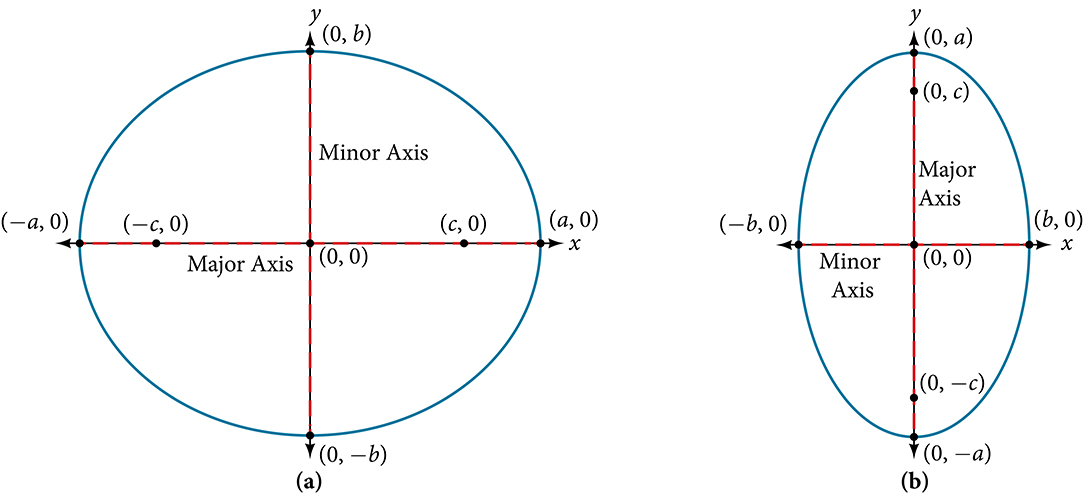
Figure 6 (a) Horizontal ellipse with center \(\left( {0,0} \right)\) (b) Vertical ellipse with center \(\left( {0,0} \right)\)
Writing Equations of Ellipses Not Centered at the Origin
Like the graphs of other equations, the graph of an ellipse can be translated. If an ellipse is translated \(h\) units horizontally and \(k\) units vertically, the center of the ellipse will be \(\left( {h,k} \right).\) This translation results in the standard form of the equation we saw previously, with \(x\) replaced by \(\left( {x - h} \right)\) and \(y\) replaced by \(\left( {y - k} \right).\)
The standard form of the equation of an ellipse with center \(\left( {h,\mspace{9mu} k} \right)\) and major axis parallel to the \(x\)-axis is
\[\frac{\left( {x - h} \right)^{2}}{a^{2}} + \frac{\left( {y - k} \right)^{2}}{b^{2}} = 1\]
where
- \(a > b\)
- the length of the major axis is \(2a\)
- the coordinates of the vertices are \(\left( {h \pm a,k} \right)\)
- the length of the minor axis is \(2b\)
- the coordinates of the co-vertices are \(\left( {h,k \pm b} \right)\)
- the coordinates of the foci are \(\left( {h \pm c,k} \right),\) where \(c^{2} = a^{2} - b^{2}.\) See Figure 7a
The standard form of the equation of an ellipse with center \(\left( {h,k} \right)\) and major axis parallel to the \(y\)-axis is
\[\frac{\left( {x - h} \right)^{2}}{b^{2}} + \frac{\left( {y - k} \right)^{2}}{a^{2}} = 1\]
where
- \(a > b\)
- the length of the major axis is \(2a\)
- the coordinates of the vertices are \(\left( {h,k \pm a} \right)\)
- the length of the minor axis is \(2b\)
- the coordinates of the co-vertices are \(\left( {h \pm b,k} \right)\)
- the coordinates of the foci are \(\left( {h,k \pm c} \right),\) where \(c^{2} = a^{2} - b^{2}.\) See Figure 7b
Just as with ellipses centered at the origin, ellipses that are centered at a point \(\left( {h,k} \right)\) have vertices, co-vertices, and foci that are related by the equation \(c^{2} = a^{2} - b^{2}.\) We can use this relationship along with the midpoint and distance formulas to find the equation of the ellipse in standard form when the vertices and foci are given.
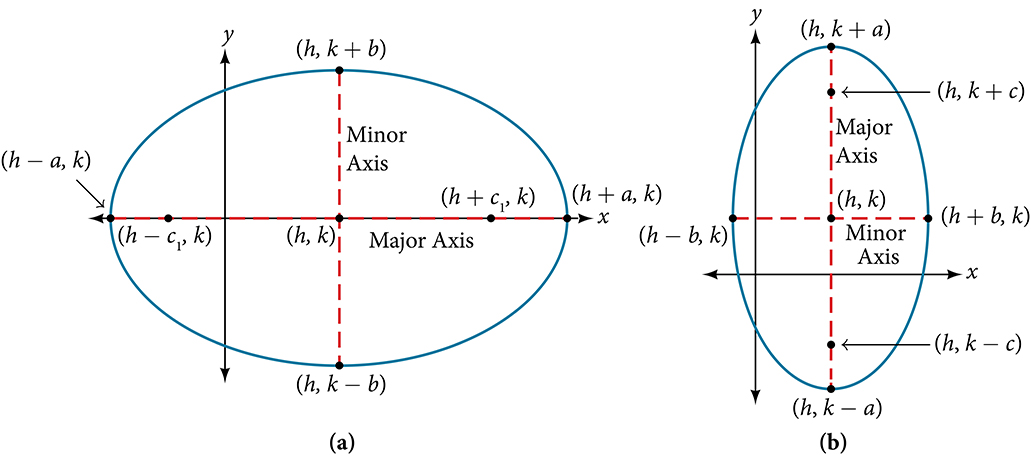
Figure 7 (a) Horizontal ellipse with center \(\left( {h,k} \right)\) (b) Vertical ellipse with center \(\left( {h,k} \right)\)
12.1.2 Graphing Ellipses Centered at the Origin
Just as we can write the equation for an ellipse given its graph, we can graph an ellipse given its equation. To graph ellipses centered at the origin, we use the standard form \(\frac{x^{2}}{a^{2}} + \frac{y^{2}}{b^{2}} = 1,\mspace{9mu} a > b\) for horizontal ellipses and \(\frac{x^{2}}{b^{2}} + \frac{y^{2}}{a^{2}} = 1,\mspace{9mu} a > b\) for vertical ellipses.
Graph the ellipse given by the equation, \(\frac{x^{2}}{9} + \frac{y^{2}}{25} = 1.\) Identify and label the center, vertices, co-vertices, and foci.
Solution (click to reveal)
First, we determine the position of the major axis. Because \(25 > 9,\) the major axis is on the \(y\)-axis. Therefore, the equation is in the form \(\frac{x^{2}}{b^{2}} + \frac{y^{2}}{a^{2}} = 1,\) where \(b^{2} = 9\) and \(a^{2} = 25.\) It follows that:
- the center of the ellipse is \(\left( {0,0} \right)\)
- the coordinates of the vertices are \(\left( {0, \pm a} \right) = \left( {0, \pm \sqrt{25}} \right) = \left( {0, \pm 5} \right)\)
- the coordinates of the co-vertices are \(\left( {\pm b,0} \right) = \left( {\pm \sqrt{9},0} \right) = \left( {\pm 3,0} \right)\)
- the coordinates of the foci are \(\left( {0, \pm c} \right),\) where \(c^{2} = a^{2} - b^{2}\) Solving for \(c,\) we have:
\[\begin{array}{l} {c = \pm \sqrt{a^{2} - b^{2}}} \\ {= \pm \sqrt{25 - 9}} \\ {= \pm \sqrt{16}} \\ {= \pm 4} \end{array}\]
Therefore, the coordinates of the foci are \(\left( {0, \pm 4} \right).\)
Next, we plot and label the center, vertices, co-vertices, and foci, and draw a smooth curve to form the ellipse. See Figure 8.
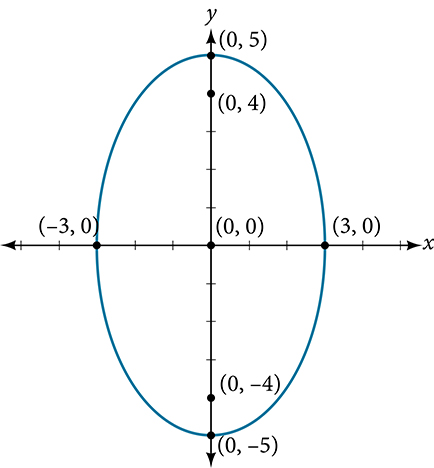
Figure 8
Graph the ellipse given by the equation \(\frac{x^{2}}{36} + \frac{y^{2}}{4} = 1.\) Identify and label the center, vertices, co-vertices, and foci.
Solution (click to reveal)
center: \(\left( {0,0} \right);\) vertices: \(\left( {\pm 6,0} \right);\) co-vertices: \(\left( {0, \pm 2} \right);\) foci: \(\left( {\pm 4\sqrt{2},0} \right)\)
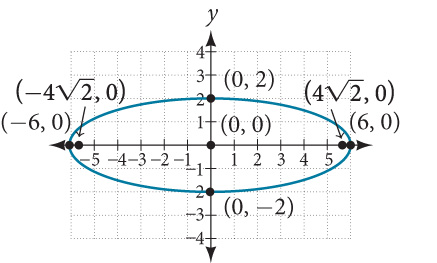
Graph the ellipse given by the equation \(4x^{2} + 25y^{2} = 100.\) Rewrite the equation in standard form. Then identify and label the center, vertices, co-vertices, and foci.
Solution (click to reveal)
First, use algebra to rewrite the equation in standard form.
\[\begin{array}{l} {~4x^{2} + 25y^{2} = 100} \\ {\ \frac{4x^{2}}{100} + \frac{25y^{2}}{100} = \frac{100}{100}} \\ {\text{~~~~~~~}\frac{x^{2}}{25} + \frac{y^{2}}{4} = 1} \end{array}\]
Next, we determine the position of the major axis. Because \(25 > 4,\) the major axis is on the \(x\)-axis. Therefore, the equation is in the form \(\frac{x^{2}}{a^{2}} + \frac{y^{2}}{b^{2}} = 1,\) where \(a^{2} = 25\) and \(b^{2} = 4.\) It follows that:
- the center of the ellipse is \(\left( {0,0} \right)\)
- the coordinates of the vertices are \(\left( {\pm a,0} \right) = \left( {\pm \sqrt{25},0} \right) = \left( {\pm 5,0} \right)\)
- the coordinates of the co-vertices are \(\left( {0, \pm b} \right) = \left( {0, \pm \sqrt{4}} \right) = \left( {0, \pm 2} \right)\)
- the coordinates of the foci are \(\left( {\pm c,0} \right),\) where \(c^{2} = a^{2} - b^{2}.\) Solving for \(c,\) we have:
\[\begin{array}{l} {c = \pm \sqrt{a^{2} - b^{2}}} \\ {= \pm \sqrt{25 - 4}} \\ {= \pm \sqrt{21}} \end{array}\]
Therefore the coordinates of the foci are \(\left( {\pm \sqrt{21},0} \right).\)
Next, we plot and label the center, vertices, co-vertices, and foci, and draw a smooth curve to form the ellipse.
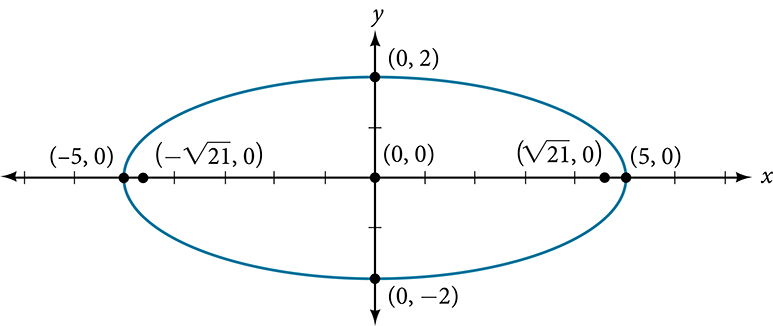
Figure 9
Graph the ellipse given by the equation \(49x^{2} + 16y^{2} = 784.\) Rewrite the equation in standard form. Then identify and label the center, vertices, co-vertices, and foci.
Solution (click to reveal)
Standard form: \(\frac{x^{2}}{16} + \frac{y^{2}}{49} = 1;\) center: \(\left( {0,0} \right);\) vertices: \(\left( {0, \pm 7} \right);\) co-vertices: \(\left( {\pm 4,0} \right);\) foci: \(\left( {0, \pm \sqrt{33}} \right)\)
12.1.3 Graphing Ellipses Not Centered at the Origin
When an ellipse is not centered at the origin, we can still use the standard forms to find the key features of the graph. When the ellipse is centered at some point, \(\left( {h,k} \right),\) we use the standard forms \(\frac{\left( {x - h} \right)^{2}}{a^{2}} + \frac{\left( {y - k} \right)^{2}}{b^{2}} = 1,\mspace{9mu} a > b\) for horizontal ellipses and \(\frac{\left( {x - h} \right)^{2}}{b^{2}} + \frac{\left( {y - k} \right)^{2}}{a^{2}} = 1,\mspace{9mu} a > b\) for vertical ellipses. From these standard equations, we can easily determine the center, vertices, co-vertices, foci, and positions of the major and minor axes.
Graph the ellipse given by the equation, \(\frac{\left( {x + 2} \right)^{2}}{4} + \frac{\left( {y - 5} \right)^{2}}{9} = 1.\) Identify and label the center, vertices, co-vertices, and foci.
Solution (click to reveal)
First, we determine the position of the major axis. Because \(9 > 4,\) the major axis is parallel to the \(y\)-axis. Therefore, the equation is in the form \(\frac{\left( {x - h} \right)^{2}}{b^{2}} + \frac{\left( {y - k} \right)^{2}}{a^{2}} = 1,\) where \(b^{2} = 4\) and \(a^{2} = 9.\) It follows that:
- the center of the ellipse is \(\left( {h,k} \right) = \left( {-2,\text{5}} \right)\)
- the coordinates of the vertices are \((h,k \pm a) = ( - 2,5 \pm \sqrt{9}) = ( - 2,5 \pm 3),\) or \(\left( {-2,\text{2}} \right)\) and \(\left( {-2,\text{8}} \right)\)
- the coordinates of the co-vertices are \((h \pm b,k) = ( - 2 \pm \sqrt{4},5) = ( - 2 \pm 2,5),\) or \(\left( {\operatorname{}-4,5} \right)\) and \(\left( {0,\text{5}} \right)\)
- the coordinates of the foci are \(\left( {h,k \pm c} \right),\) where \(c^{2} = a^{2} - b^{2}.\) Solving for \(c,\) we have:
\[\begin{array}{l} \begin{array}{l} \\ {c = \pm \sqrt{a^{2} - b^{2}}} \end{array} \\ {= \pm \sqrt{9 - 4}} \\ {= \pm \sqrt{5}} \end{array}\]
Therefore, the coordinates of the foci are \(\left( {-2,\text{5} - \sqrt{5}} \right)\) and \(\left( {-2,\text{5+}\sqrt{5}} \right).\)
Next, we plot and label the center, vertices, co-vertices, and foci, and draw a smooth curve to form the ellipse.
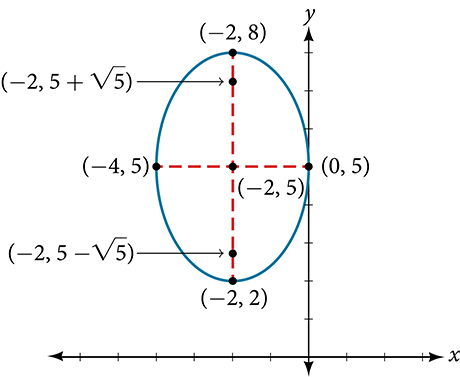
Figure 10
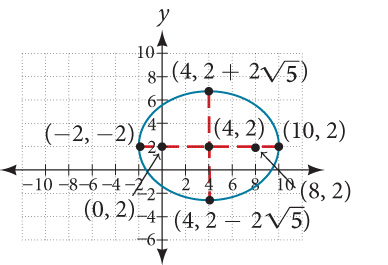
Graph the ellipse given by the equation \(\frac{\left( {x - 4} \right)^{2}}{36} + \frac{\left( {y - 2} \right)^{2}}{20} = 1.\) Identify and label the center, vertices, co-vertices, and foci.
Solution (click to reveal)
Center: \(\left( {4,2} \right);\) vertices: \(\left( {- 2,2} \right)\) and \(\left( {10,2} \right);\) co-vertices: \(\left( {4,2 - 2\sqrt{5}} \right)\) and \(\left( {4,2 + 2\sqrt{5}} \right);\) foci: \(\left( {0,2} \right)\) and \(\left( {8,2} \right)\)
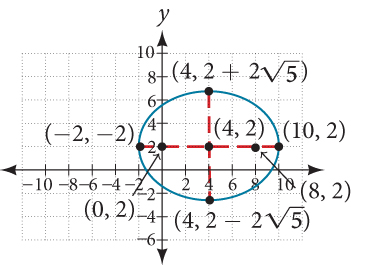
Graph the ellipse given by the equation \(4x^{2} + 9y^{2} - 40x + 36y + 100 = 0.\) Identify and label the center, vertices, co-vertices, and foci.
Solution (click to reveal)
We must begin by rewriting the equation in standard form.
\[4x^{2} + 9y^{2} - 40x + 36y + 100 = 0\]
Group terms that contain the same variable, and move the constant to the opposite side of the equation.
\[\left( {4x^{2} - 40x} \right) + \left( {9y^{2} + 36y} \right) = -100\]
Factor out the coefficients of the squared terms.
\[4\left( {x^{2} - 10x} \right) + 9\left( {y^{2} + 4y} \right) = -100\]
Complete the square twice. Remember to balance the equation by adding the same constants to each side.
\[4\left( {x^{2} - 10x + 25} \right) + 9\left( {y^{2} + 4y + 4} \right) = -100 + 100 + 36\]
Rewrite as perfect squares.
\[4\left( {x - 5} \right)^{2} + 9\left( {y + 2} \right)^{2} = 36\]
Divide both sides by the constant term to place the equation in standard form.
\[\frac{\left( {x - 5} \right)^{2}}{9} + \frac{\left( {y + 2} \right)^{2}}{4} = 1\]
Now that the equation is in standard form, we can determine the position of the major axis. Because \(9 > 4,\) the major axis is parallel to the \(x\)-axis. Therefore, the equation is in the form \(\frac{\left( {x - h} \right)^{2}}{a^{2}} + \frac{\left( {y - k} \right)^{2}}{b^{2}} = 1,\) where \(a^{2} = 9\) and \(b^{2} = 4.\) It follows that:
- the center of the ellipse is \(\left( {h,k} \right) = \left( {5,-2} \right)\)
- the coordinates of the vertices are \(\left( {h \pm a,k} \right) = \left( {5 \pm \sqrt{9},-2} \right) = \left( {5 \pm 3,-2} \right),\) or \(\left( {2,-2} \right)\) and \(\left( {8,-2} \right)\)
- the coordinates of the co-vertices are \(\left( {h,k \pm b} \right) = \left( {\text{5},-2 \pm \sqrt{4}} \right) = \left( {\text{5},-2 \pm 2} \right),\) or \(\left( {5,-4} \right)\) and \(\left( {5,\text{0}} \right)\)
- the coordinates of the foci are \(\left( {h \pm c,k} \right),\) where \(c^{2} = a^{2} - b^{2}.\) Solving for \(c,\) we have:
\[\begin{array}{l} {c = \pm \sqrt{a^{2} - b^{2}}} \\ {= \pm \sqrt{9 - 4}} \\ {= \pm \sqrt{5}} \end{array}\]
Therefore, the coordinates of the foci are \(\left( {\text{5} - \sqrt{5},-2} \right)\) and \(\left( {\text{5+}\sqrt{5},-2} \right).\)
Next we plot and label the center, vertices, co-vertices, and foci, and draw a smooth curve to form the ellipse as shown in Figure 11.
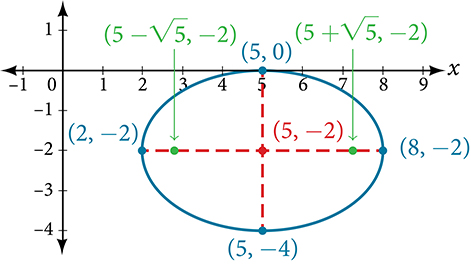
Figure 11
12.1.4 Solving Applied Problems Involving Ellipses
Many real-world situations can be represented by ellipses, including orbits of planets, satellites, moons and comets, and shapes of boat keels, rudders, and some airplane wings. A medical device called a lithotripter uses elliptical reflectors to break up kidney stones by generating sound waves. Some buildings, called whispering chambers, are designed with elliptical domes so that a person whispering at one focus can easily be heard by someone standing at the other focus. This occurs because of the acoustic properties of an ellipse. When a sound wave originates at one focus of a whispering chamber, the sound wave will be reflected off the elliptical dome and back to the other focus. See Figure 12. In the whisper chamber at the Museum of Science and Industry in Chicago, two people standing at the foci—about 43 feet apart—can hear each other whisper. When these chambers are placed in unexpected places, such as the ones inside Bush International Airport in Houston and Grand Central Terminal in New York City, they can induce surprised reactions among travelers.
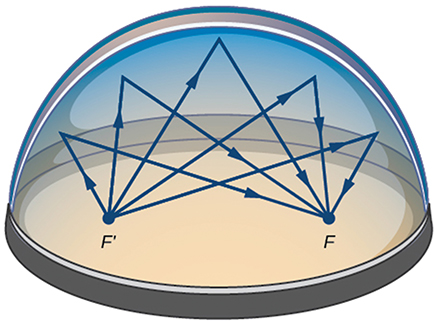
Figure 12 Sound waves are reflected between foci in an elliptical room, called a whispering chamber.
A large room in an art gallery is a whispering chamber. Its dimensions are 46 feet wide by 96 feet long as shown in Figure 13.
- What is the standard form of the equation of the ellipse representing the outline of the room? Hint: assume a horizontal ellipse, and let the center of the room be the point \(\left( {0,0} \right).\)
- If two visitors standing at the foci of this room can hear each other whisper, how far apart are the two visitors? Round to the nearest foot.
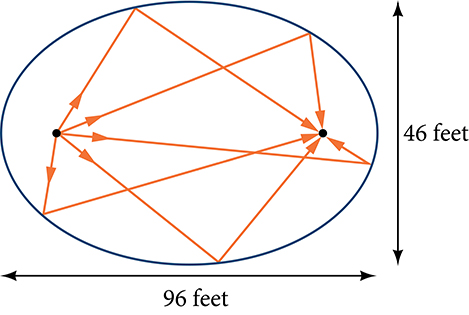
Figure 13
Solution (click to reveal)
- We are assuming a horizontal ellipse with center \(\left( {0,0} \right),\) so we need to find an equation of the form \(\frac{x^{2}}{a^{2}} + \frac{y^{2}}{b^{2}} = 1,\) where \(a > b.\) We know that the length of the major axis, \(2a,\) is longer than the length of the minor axis, \(2b.\) So the length of the room, 96, is represented by the major axis, and the width of the room, 46, is represented by the minor axis.
- Solving for \(a,\) we have \(2a = 96,\) so \(a = 48,\) and \(a^{2} = 2304.\)
- Solving for \(b,\) we have \(2b = 46,\) so \(b = 23,\) and \(b^{2} = 529.\)
Therefore, the equation of the ellipse is \(\frac{x^{2}}{2304} + \frac{y^{2}}{529} = 1.\)
- To find the distance between the senators, we must find the distance between the foci, \(\left( {\pm c,0} \right),\) where \(c^{2} = a^{2} - b^{2}.\) Solving for \(c,\) we have:
\[\begin{array}{ll} {c^{2} = a^{2} - b^{2}} & \\ {c^{2} = 2304 - 529} & {\begin{array}{llll} & & & \end{array}\text{Substitute~using~the~values~found~in~part~(a)}.} \\ {c = \pm \sqrt{2304 - 529}} & {\begin{array}{llll} & & & \end{array}\text{Take~the~square~root~of~both~sides}.} \\ {c = \pm \sqrt{1775}~} & {\begin{array}{llll} & & & \end{array}\text{Subtract}.} \\ {c \approx \pm 42} & {\begin{array}{llll} & & & \end{array}\text{Round~to~the~nearest~foot}.} \end{array}\]
The points \(\left( {\pm 42,0} \right)\) represent the foci. Thus, the distance between the senators is \(2(42) = 84\) feet.
Section Exercises
Verbal
1. Define an ellipse in terms of its foci.
Solution (click to reveal)
An ellipse is the set of all points in the plane the sum of whose distances from two fixed points, called the foci, is a constant.
2. Where must the foci of an ellipse lie?
3. What special case of the ellipse do we have when the major and minor axis are of the same length?
Solution (click to reveal)
This special case would be a circle.
4. For the special case mentioned in the previous question, what would be true about the foci of that ellipse?
5. What can be said about the symmetry of the graph of an ellipse with center at the origin and foci along the \(y\)-axis?
Solution (click to reveal)
It is symmetric about the \(x\)-axis, \(y\)-axis, and the origin.
Algebraic
For the following exercises, determine whether the given equations represent ellipses. If yes, write in standard form.
6. \(2x^{2} + y = 4\)
7. \(4x^{2} + 9y^{2} = 36\)
Solution (click to reveal)
yes; \(\frac{x^{2}}{3^{2}} + \frac{y^{2}}{2^{2}} = 1\)
8. \(4x^{2} - y^{2} = 4\)
9. \(4x^{2} + 9y^{2} = 1\)
Solution (click to reveal)
yes; \(\frac{x^{2}}{\left( \frac{1}{2} \right)^{2}} + \frac{y^{2}}{\left( \frac{1}{3} \right)^{2}} = 1\)
10. \(4x^{2} - 8x + 9y^{2} - 72y + 112 = 0\)
For the following exercises, write the equation of an ellipse in standard form, and identify the end points of the major and minor axes as well as the foci.
11. \(\frac{x^{2}}{4} + \frac{y^{2}}{49} = 1\)
Solution (click to reveal)
\(\frac{x^{2}}{2^{2}} + \frac{y^{2}}{7^{2}} = 1;\) Endpoints of major axis \(\left( {0,7} \right)\) and \(\left( {0, - 7} \right).\) Endpoints of minor axis \(\left( {2,0} \right)\) and \(\left( {- 2,0} \right).\) Foci at \(\left( {0,3\sqrt{5}} \right),\left( {0, - 3\sqrt{5}} \right).\)
12. \(\frac{x^{2}}{100} + \frac{y^{2}}{64} = 1\)
13. \(x^{2} + 9y^{2} = 1\)
Solution (click to reveal)
\(\frac{x^{2}}{(1)^{2}} + \frac{y^{2}}{\left( \frac{1}{3} \right)^{2}} = 1;\) Endpoints of major axis \(\left( {1,0} \right)\) and \(\left( {- 1,0} \right).\) Endpoints of minor axis \(\left( {0,\frac{1}{3}} \right),\left( {0, - \frac{1}{3}} \right).\) Foci at \(\left( {\frac{2\sqrt{2}}{3},0} \right),\left( {- \frac{2\sqrt{2}}{3},0} \right).\)
14. \(4x^{2} + 16y^{2} = 1\)
15. \(\frac{\left( {x - 2} \right)^{2}}{49} + \frac{\left( {y - 4} \right)^{2}}{25} = 1\)
Solution (click to reveal)
\(\frac{\left( {x - 2} \right)^{2}}{7^{2}} + \frac{\left( {y - 4} \right)^{2}}{5^{2}} = 1;\) Endpoints of major axis \(\left( {9,4} \right),\left( {- 5,4} \right).\) Endpoints of minor axis \(\left( {2,9} \right),\left( {2, - 1} \right).\) Foci at \(\left( {2 + 2\sqrt{6},4} \right),\left( {2 - 2\sqrt{6},4} \right).\)
16. \(\frac{\left( {x - 2} \right)^{2}}{81} + \frac{\left( {y + 1} \right)^{2}}{16} = 1\)
17. \(\frac{\left( {x + 5} \right)^{2}}{4} + \frac{\left( {y - 7} \right)^{2}}{9} = 1\)
Solution (click to reveal)
\(\frac{\left( {x + 5} \right)^{2}}{2^{2}} + \frac{\left( {y - 7} \right)^{2}}{3^{2}} = 1;\) Endpoints of major axis \(\left( {- 5,10} \right),\left( {- 5,4} \right).\) Endpoints of minor axis \(\left( {- 3,7} \right),\left( {- 7,7} \right).\) Foci at \(\left( {- 5,7 + \sqrt{5}} \right),\left( {- 5,7 - \sqrt{5}} \right).\)
18. \(\frac{\left( {x - 7} \right)^{2}}{49} + \frac{\left( {y - 7} \right)^{2}}{49} = 1\)
19. \(4x^{2} - 8x + 9y^{2} - 72y + 112 = 0\)
Solution (click to reveal)
\(\frac{\left( {x - 1} \right)^{2}}{3^{2}} + \frac{\left( {y - 4} \right)^{2}}{2^{2}} = 1;\) Endpoints of major axis \(\left( {4,4} \right),\left( {- 2,4} \right).\) Endpoints of minor axis \(\left( {1,6} \right),\left( {1,2} \right).\) Foci at \(\left( {1 + \sqrt{5},4} \right),\left( {1 - \sqrt{5},4} \right).\)
20. \(9x^{2} - 54x + 9y^{2} - 54y + 81 = 0\)
21. \(4x^{2} - 24x + 36y^{2} - 360y + 864 = 0\)
Solution (click to reveal)
\(\frac{\left( {x - 3} \right)^{2}}{\left( {3\sqrt{2}} \right)^{2}} + \frac{\left( {y - 5} \right)^{2}}{\left( \sqrt{2} \right)^{2}} = 1;\) Endpoints of major axis \(\left( {3 + 3\sqrt{2},5} \right),\left( {3 - 3\sqrt{2},5} \right).\) Endpoints of minor axis \(\left( {3,5 + \sqrt{2}} \right),\left( {3,5 - \sqrt{2}} \right).\) Foci at \(\left( {7,5} \right),\left( {- 1,5} \right).\)
22. \(4x^{2} + 24x + 16y^{2} - 128y + 228 = 0\)
23. \(4x^{2} + 40x + 25y^{2} - 100y + 100 = 0\)
Solution (click to reveal)
\(\frac{\left( {x + 5} \right)^{2}}{(5)^{2}} + \frac{\left( {y - 2} \right)^{2}}{(2)^{2}} = 1;\) Endpoints of major axis \(\left( {0,2} \right),\left( {- 10,2} \right).\) Endpoints of minor axis \(\left( {- 5,4} \right),\left( {- 5,0} \right).\) Foci at \(\left( {- 5 + \sqrt{21},2} \right),\left( {- 5 - \sqrt{21},2} \right).\)
24. \(x^{2} + 2x + 100y^{2} - 1000y + 2401 = 0\)
25. \(4x^{2} + 24x + 25y^{2} + 200y + 336 = 0\)
Solution (click to reveal)
\(\frac{\left( {x + 3} \right)^{2}}{(5)^{2}} + \frac{\left( {y + 4} \right)^{2}}{(2)^{2}} = 1;\) Endpoints of major axis \(\left( {2, - 4} \right),\left( {- 8, - 4} \right).\) Endpoints of minor axis \(\left( {- 3, - 2} \right),\left( {- 3, - 6} \right).\) Foci at \(\left( {- 3 + \sqrt{21}, - 4} \right),\left( {- 3 - \sqrt{21}, - 4} \right).\)
26. \(9x^{2} + 72x + 16y^{2} + 16y + 4 = 0\)
For the following exercises, find the foci for the given ellipses.
27. \(\frac{\left( {x + 3} \right)^{2}}{25} + \frac{\left( {y + 1} \right)^{2}}{36} = 1\)
Solution (click to reveal)
Foci \(\left( {- 3, - 1 + \sqrt{11}} \right),\left( {- 3, - 1 - \sqrt{11}} \right)\)
28. \(\frac{\left( {x + 1} \right)^{2}}{100} + \frac{\left( {y - 2} \right)^{2}}{4} = 1\)
29. \(x^{2} + y^{2} = 1\)
Solution (click to reveal)
Focus \(\left( {0,0} \right)\)
30. \(x^{2} + 4y^{2} + 4x + 8y = 1\)
31. \(10x^{2} + y^{2} + 200x = 0\)
Solution (click to reveal)
Foci \(\left( {- 10,30} \right),\left( {- 10, - 30} \right)\)
Graphical
For the following exercises, graph the given ellipses, noting center, vertices, and foci.
32. \(\frac{x^{2}}{25} + \frac{y^{2}}{36} = 1\)
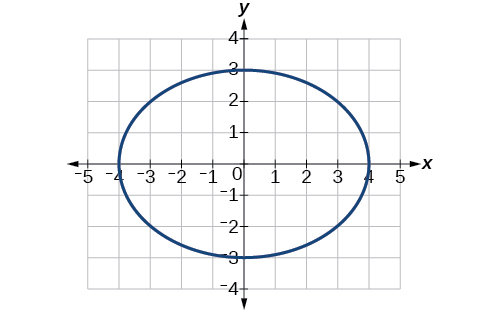
33. \(\frac{x^{2}}{16} + \frac{y^{2}}{9} = 1\)
Solution (click to reveal)
Center \(\left( {0,0} \right),\) Vertices \(\left( {4,0} \right),\left( {- 4,0} \right),(0,3),(0, - 3),\) Foci \(\left( {\sqrt{7},0} \right),\left( {- \sqrt{7},0} \right)\)
34. \(4x^{2} + 9y^{2} = 1\)
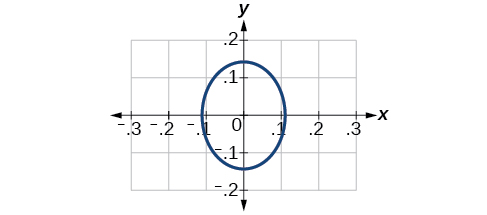
35. \(81x^{2} + 49y^{2} = 1\)
Solution (click to reveal)
Center \(\left( {0,0} \right),\) Vertices \(\left( {\frac{1}{9},0} \right),\left( {- \frac{1}{9},0} \right),\left( {0,\frac{1}{7}} \right),\left( {0, - \frac{1}{7}} \right),\) Foci \(\left( {0,\frac{4\sqrt{2}}{63}} \right),\left( {0, - \frac{4\sqrt{2}}{63}} \right)\)
36. \(\frac{\left( {x - 2} \right)^{2}}{64} + \frac{\left( {y - 4} \right)^{2}}{16} = 1\)
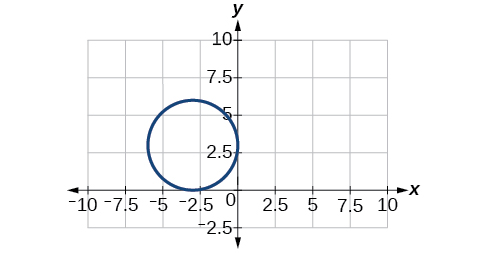
37. \(\frac{\left( {x + 3} \right)^{2}}{9} + \frac{\left( {y - 3} \right)^{2}}{9} = 1\)
Solution (click to reveal)
Center \(\left( {- 3,3} \right),\) Vertices \(\left( {0,3} \right),\left( {- 6,3} \right),\left( {- 3,0} \right),\left( {- 3,6} \right),\) Focus \(\left( {- 3,3} \right)\)
Note that this ellipse is a circle. The circle has only one focus, which coincides with the center.
38. \(\frac{x^{2}}{2} + \frac{\left( {y + 1} \right)^{2}}{5} = 1\)
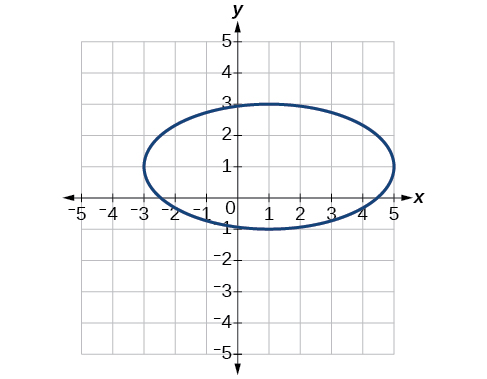
39. \(4x^{2} - 8x + 16y^{2} - 32y - 44 = 0\)
Solution (click to reveal)
Center \(\left( {1,1} \right),\) Vertices \(\left( {5,1} \right),\left( {- 3,1} \right),\left( {1,3} \right),\left( {1, - 1} \right),\) Foci \(\left( 1 + 2\sqrt{3},1 \right),\left( 1 - 2\sqrt{3},1 \right)\)
40. \(x^{2} - 8x + 25y^{2} - 100y + 91 = 0\)
41. \(x^{2} + 8x + 4y^{2} - 40y + 112 = 0\)
Solution (click to reveal)
Center \(\left( {- 4,5} \right),\) Vertices \(\left( {- 2,5} \right),\left( {- 6,5} \right),\left( {- 4,6} \right),\left( {- 4,4} \right),\) Foci \(\left( {- 4 + \sqrt{3},5} \right),\left( {- 4 - \sqrt{3},5} \right)\)
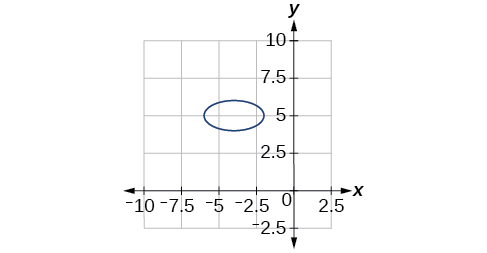
42. \(64x^{2} + 128x + 9y^{2} - 72y - 368 = 0\)
43. \(16x^{2} + 64x + 4y^{2} - 8y + 4 = 0\)
Solution (click to reveal)
Center \(\left( {- 2,1} \right),\) Vertices \(\left( {0,1} \right),\left( {- 4,1} \right),\left( {- 2,5} \right),\left( {- 2, - 3} \right),\) Foci \(\left( {- 2,1 + 2\sqrt{3}} \right),\left( {- 2,1 - 2\sqrt{3}} \right)\)
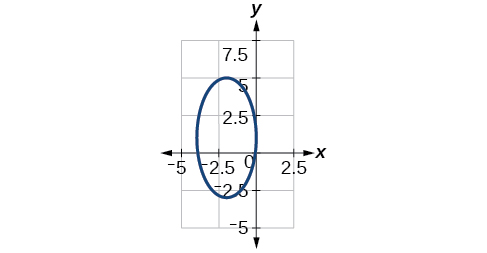
44. \(100x^{2} + 1000x + y^{2} - 10y + 2425 = 0\)
45. \(4x^{2} + 16x + 4y^{2} + 16y + 16 = 0\)
Solution (click to reveal)
Center \(\left( {- 2, - 2} \right),\) Vertices \(\left( {0, - 2} \right),\left( {- 4, - 2} \right),\left( {- 2,0} \right),\left( {- 2, - 4} \right),\) Focus \(\left( {- 2, - 2} \right)\)
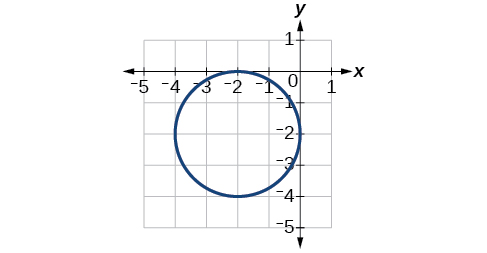
For the following exercises, use the given information about the graph of each ellipse to determine its equation.
46. Center at the origin, symmetric with respect to the \(x\)- and \(y\)-axes, focus at \((4,0),\) and point on graph \((0,3).\)
47. Center at the origin, symmetric with respect to the \(x\)- and \(y\)-axes, focus at \((0,-2),\) and point on graph \((5,0).\)
Solution (click to reveal)
\(\frac{x^{2}}{25} + \frac{y^{2}}{29} = 1\)
48. Center at the origin, symmetric with respect to the \(x\)- and \(y\)-axes, focus at \((3,0),\) and major axis is twice as long as minor axis.
49. Center \(\left( {4,2} \right)\) ; vertex \(\left( {9,2} \right)\) ; one focus: \(\left( {4 + 2\sqrt{6},2} \right)\) .
Solution (click to reveal)
\(\frac{\left( {x - 4} \right)^{2}}{25} + \frac{\left( {y - 2} \right)^{2}}{1} = 1\)
50. Center \(\left( {3,5} \right)\) ; vertex \(\left( {3,11} \right)\) ; one focus: \(\left( {3,\mspace{9mu}\text{5+4}\sqrt{\text{2}}} \right)\)
51. Center \(\left( {-3,4} \right)\) ; vertex \(\left( {1,4} \right)\) ; one focus: \(\left( {-3 + 2\sqrt{3},4} \right)\)
Solution (click to reveal)
\(\frac{\left( {x + 3} \right)^{2}}{16} + \frac{\left( {y - 4} \right)^{2}}{4} = 1\)
For the following exercises, given the graph of the ellipse, determine its equation.
52.
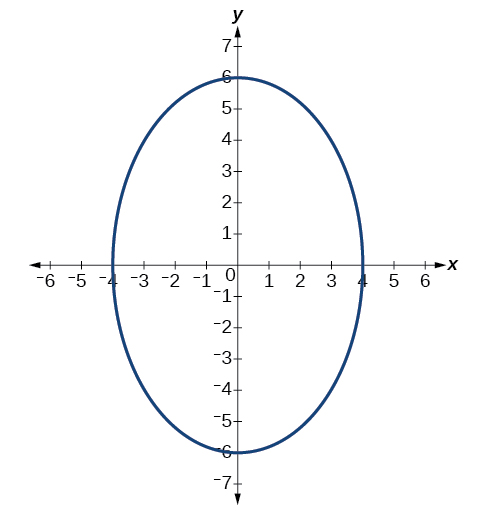
53.
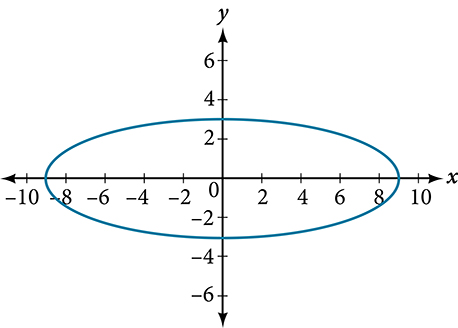
Solution (click to reveal)
\(\frac{x^{2}}{81} + \frac{y^{2}}{9} = 1\)
54.
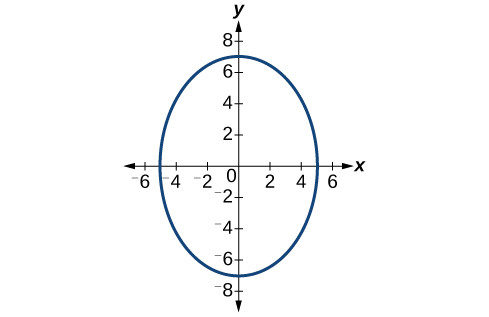
55.
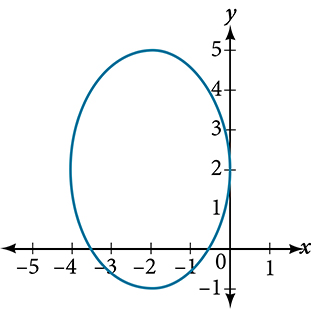
Solution (click to reveal)
\(\frac{\left( {x + 2} \right)^{2}}{4} + \frac{\left( {y - 2} \right)^{2}}{9} = 1\)
56.
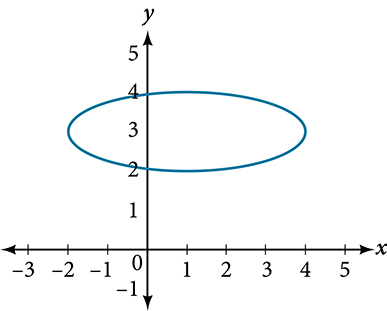
Extensions
For the following exercises, find the area of the ellipse. The area of an ellipse is given by the formula \(\text{Area} = a \cdot b \cdot \pi.\)
57. \(\frac{\left( {x - 3} \right)^{2}}{9} + \frac{\left( {y - 3} \right)^{2}}{16} = 1\)
Solution (click to reveal)
\(\text{Area~=~12π}\mspace{9mu}\text{square}\mspace{9mu}\text{units}\)
58. \(\frac{\left( {x + 6} \right)^{2}}{16} + \frac{\left( {y - 6} \right)^{2}}{36} = 1\)
59. \(\frac{\left( {x + 1} \right)^{2}}{4} + \frac{\left( {y - 2} \right)^{2}}{5} = 1\)
Solution (click to reveal)
\(\text{Area~=~2}\sqrt{\text{5}}\text{π}\) square units.
60. \(4x^{2} - 8x + 9y^{2} - 72y + 112 = 0\)
61. \(9x^{2} - 54x + 9y^{2} - 54y + 81 = 0\)
Solution (click to reveal)
\(\text{Area~=~9π}\) square units.
Real-World Applications
62. Find the equation of the ellipse that will just fit inside a box that is 8 units wide and 4 units high.
63. Find the equation of the ellipse that will just fit inside a box that is four times as wide as it is high. Express in terms of \(h,\) the height.
Solution (click to reveal)
\(\frac{x^{2}}{4h^{2}} + \frac{y^{2}}{\frac{1}{4}h^{2}} = 1\)
64. An arch has the shape of a semi-ellipse (the top half of an ellipse). The arch has a height of 8 feet and a span of 20 feet. Find an equation for the ellipse, and use that to find the height to the nearest 0.01 foot of the arch at a distance of 4 feet from the center.
65. An arch has the shape of a semi-ellipse. The arch has a height of 12 feet and a span of 40 feet. Find an equation for the ellipse, and use that to find the distance from the center to a point at which the height is 6 feet. Round to the nearest hundredth.
Solution (click to reveal)
\(\frac{x^{2}}{400} + \frac{y^{2}}{144} = 1\) . Distance = 17.32 feet
66. A bridge is to be built in the shape of a semi-elliptical arch and is to have a span of 120 feet. The height of the arch at a distance of 40 feet from the center is to be 8 feet. Find the height of the arch at its center.
67. A person in a whispering gallery standing at one focus of the ellipse can whisper and be heard by a person standing at the other focus because all the sound waves that reach the ceiling are reflected to the other person. If a whispering gallery has a length of 120 feet, and the foci are located 30 feet from the center, find the height of the ceiling at the center.
Solution (click to reveal)
Approximately 51.96 feet
68. A person is standing 8 feet from the nearest wall in a whispering gallery. If that person is at one focus, and the other focus is 80 feet away, what is the length and height at the center of the gallery?