10.3 Polar Coordinates
Over 12 kilometers from port, a sailboat encounters rough weather and is blown off course by a 16-knot wind (see Figure 1). How can the sailor indicate his location to the Coast Guard? In this section, we will investigate a method of representing location that is different from a standard coordinate grid.
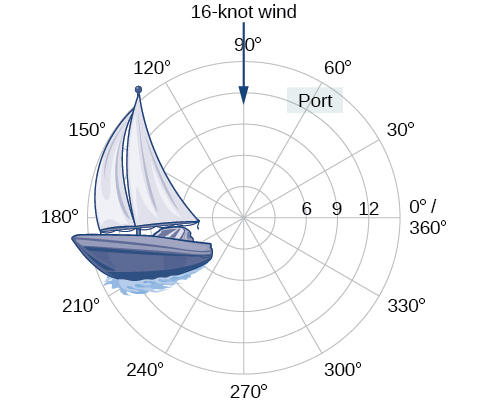
Figure 1
10.3.1 Plotting Points Using Polar Coordinates
When we think about plotting points in the plane, we usually think of rectangular coordinates \(\left( {x,y} \right)\) in the Cartesian coordinate plane. However, there are other ways of writing a coordinate pair and other types of grid systems. In this section, we introduce to polar coordinates, which are points labeled \(\left( {r,\theta} \right)\) and plotted on a polar grid. The polar grid is represented as a series of concentric circles radiating out from the pole, or the origin of the coordinate plane.
The polar grid is scaled as the unit circle with the positive \(x\)-axis now viewed as the polar axis and the origin as the pole. The first coordinate \(r\) is the radius or length of the directed line segment from the pole. The angle \(\theta,\) measured in radians, indicates the direction of \(r.\) We move counterclockwise from the polar axis by an angle of \(\theta,\) and measure a directed line segment the length of \(r\) in the direction of \(\theta.\) Even though we measure \(\theta\) first and then \(r,\) the polar point is written with the \(r\)-coordinate first. For example, to plot the point \(\left( {2,\frac{\pi}{4}} \right),\) we would move \(\frac{\pi}{4}\) units in the counterclockwise direction and then a length of 2 from the pole. This point is plotted on the grid in Figure 2.
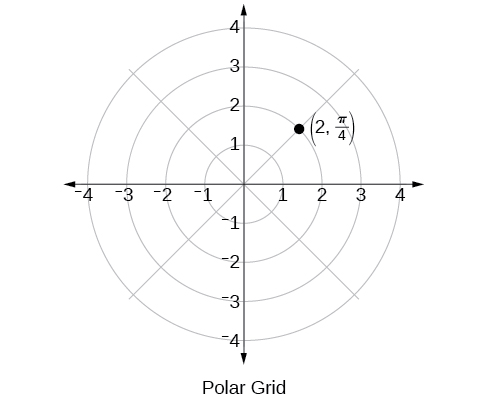
Figure 2
Plot the point \(\left( {3,\frac{\pi}{2}} \right)\) on the polar grid.
Solution (click to reveal)
The angle \(\frac{\pi}{2}\) is found by sweeping in a counterclockwise direction 90° from the polar axis. The point is located at a length of 3 units from the pole in the \(\frac{\pi}{2}\) direction, as shown in Figure 3.
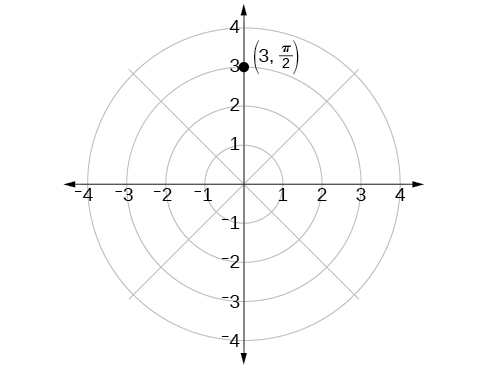
Figure 3
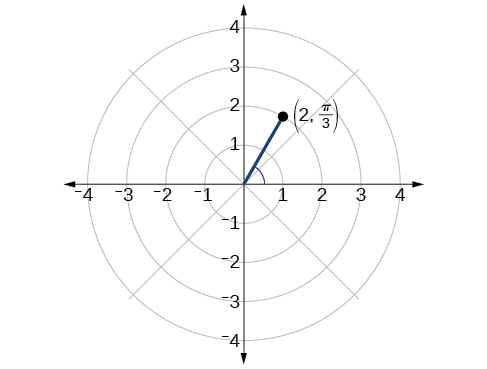
Plot the point \(\left( {2,\mspace{9mu}\frac{\pi}{3}} \right)\) in the polar grid.
Solution (click to reveal)
Plot the point \(\left( {- 2,\mspace{9mu}\frac{\pi}{6}} \right)\) on the polar grid.
Solution (click to reveal)
We know that \(\frac{\pi}{6}\) is located in the first quadrant. However, \(r = -2.\) We can approach plotting a point with a negative \(r\) in two ways:
- Plot the point \(\left( {2,\frac{\pi}{6}} \right)\) by moving \(\frac{\pi}{6}\) in the counterclockwise direction and extending a directed line segment 2 units into the first quadrant. Then retrace the directed line segment back through the pole, and continue 2 units into the third quadrant;
- Move \(\frac{\pi}{6}\) in the counterclockwise direction, and draw the directed line segment from the pole 2 units in the negative direction, into the third quadrant.
See Figure 4(a). Compare this to the graph of the polar coordinate \(\left( {2,\frac{\pi}{6}} \right)\) shown in Figure 4(b).
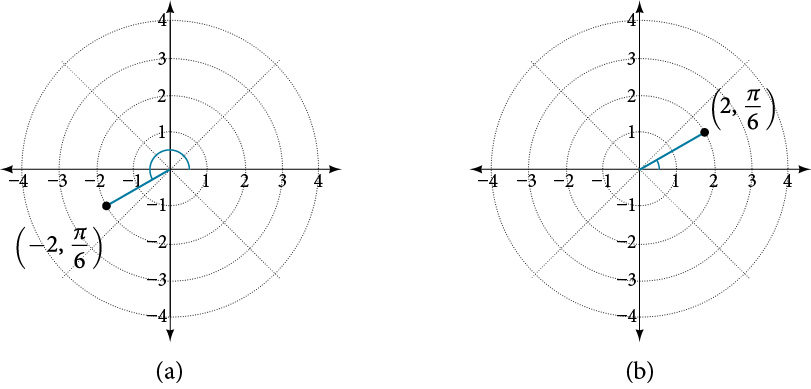
Figure 4
Plot the points \(\left( {3, - \frac{\pi}{6}} \right)\) and \(\left( {2,\frac{9\pi}{4}} \right)\) on the same polar grid.
Solution (click to reveal)
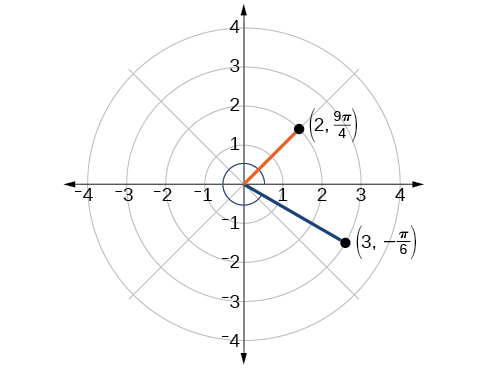
10.3.2 Converting from Polar Coordinates to Rectangular Coordinates
When given a set of polar coordinates, we may need to convert them to rectangular coordinates. To do so, we can recall the relationships that exist among the variables \(x,\mspace{9mu} y,\mspace{9mu} r,\) and \(\theta.\)
\[\begin{array}{l} \begin{array}{l} \\ {\cos\;\theta = \frac{x}{r}\rightarrow x = r\cos\;\theta} \end{array} \\ {\sin\;\theta = \frac{y}{r}\rightarrow y = r\sin\;\theta} \end{array}\]
Dropping a perpendicular from the point in the plane to the \(x\)-axis forms a right triangle, as illustrated in Figure 5. An easy way to remember the equations above is to think of \(\cos\;\theta\) as the adjacent side over the hypotenuse and \(\sin\;\theta\) as the opposite side over the hypotenuse.
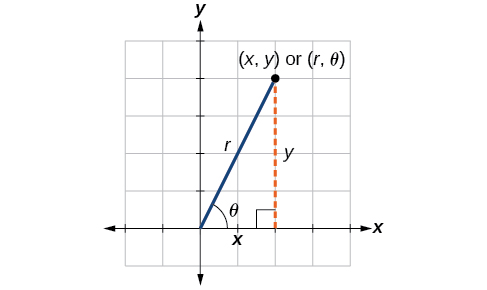
Figure 5
Write the polar coordinates \(\left( {3,\frac{\pi}{2}} \right)\) as rectangular coordinates.
Solution (click to reveal)
Use the equivalent relationships.
\[\begin{array}{l} {x = r\cos\;\theta} \\ {x = 3\cos\;\frac{\pi}{2} = 0} \\ {y = r\sin\;\theta} \\ {y = 3\sin\;\frac{\pi}{2} = 3} \end{array}\]
The rectangular coordinates are \(\left( {0,3} \right).\) See Figure 6.
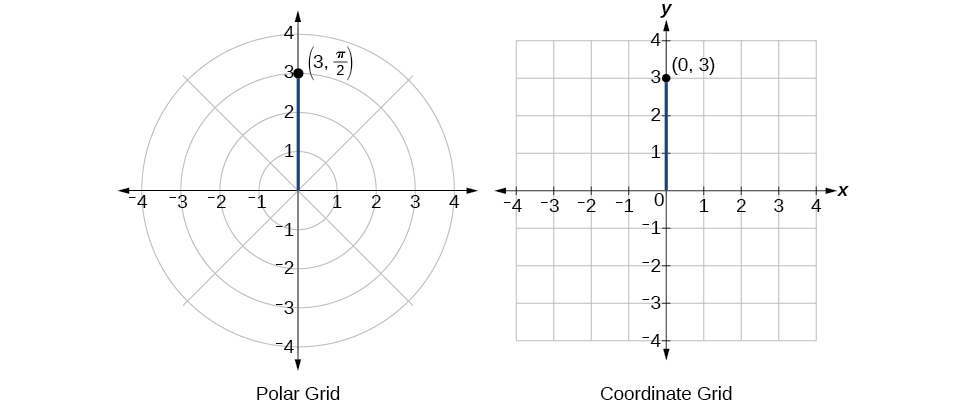
Figure 6
Write the polar coordinates \(\left( {- 2,0} \right)\) as rectangular coordinates.
Solution (click to reveal)
See Figure 7. Writing the polar coordinates as rectangular, we have
\[\begin{array}{l} {x = r\cos\;\theta} \\ {x = -2\cos(0) = -2} \\ \\ {y = r\sin\;\theta} \\ {y = -2\sin(0) = 0} \end{array}\]
The rectangular coordinates are also \(\left( {- 2,0} \right).\)
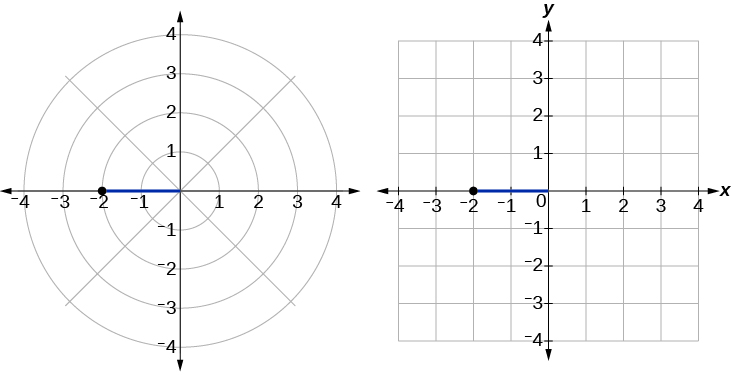
Figure 7
10.3.3 Converting from Rectangular Coordinates to Polar Coordinates
To convert rectangular coordinates to polar coordinates, we will use two other familiar relationships. With this conversion, however, we need to be aware that a set of rectangular coordinates will yield more than one polar point.
Converting from rectangular coordinates to polar coordinates requires the use of one or more of the relationships illustrated in Figure 8.
\[\begin{array}{l} {\cos\;\theta = \frac{x}{r}~{or}~x = r\cos\;\theta} \\ {\sin\;\theta = \frac{y}{r}\mspace{9mu}\text{~or}\mspace{9mu} y = r\sin\;\theta} \\ {r^{2} = x^{2} + y^{2}} \\ {\tan\;\theta = \frac{y}{x}} \end{array}\]
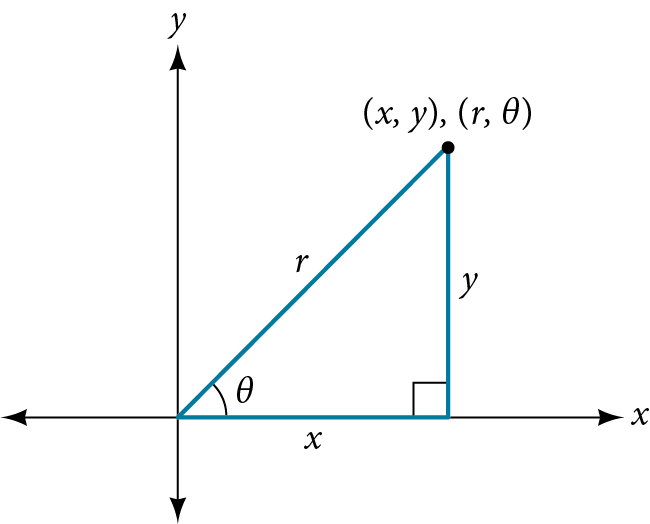
Figure 8
Convert the rectangular coordinates \(\left( {3,3} \right)\) to polar coordinates.
Solution (click to reveal)
We see that the original point \(\left( {3,3} \right)\) is in the first quadrant. To find \(\theta,\) use the formula \(\tan\;\theta = \frac{y}{x}.\) This gives
\[\begin{array}{l} {\tan\;\theta = \frac{3}{3}} \\ {\tan\;\theta = 1} \\ {\theta = \tan^{-1}(1)} \\ {\theta = \frac{\pi}{4}} \end{array}\]
To find \(r,\) we substitute the values for \(x\) and \(y\) into the formula \(r = \sqrt{x^{2} + y^{2}}.\) We know that \(r\) must be positive, as \(\frac{\pi}{4}\) is in the first quadrant. Thus
\[\begin{array}{l} {r = \sqrt{3^{2} + 3^{2}}} \\ {r = \sqrt{9 + 9}} \\ {r = \sqrt{18} = 3\sqrt{2}} \end{array}\]
So, \(r = 3\sqrt{2}\;\) and \(\theta\text{=}\frac{\pi}{4},\) giving us the polar point \(\left( {3\sqrt{2},\frac{\pi}{4}} \right).\) See Figure 9.
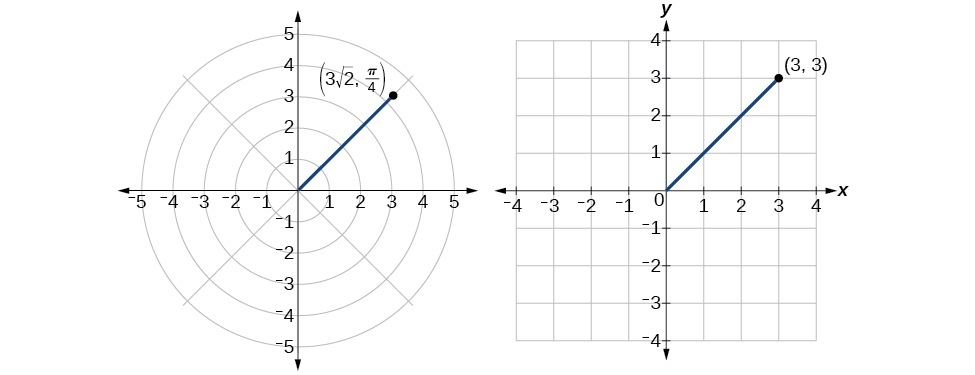
Figure 9
There are other sets of polar coordinates that will be the same as our first solution. For example, the points \(\left( {- 3\sqrt{2},\mspace{9mu}\frac{5\pi}{4}} \right)\) and \(\left( {3\sqrt{2}, - \frac{7\pi}{4}} \right)\) will coincide with the original solution of \(\left( {3\sqrt{2},\mspace{9mu}\frac{\pi}{4}} \right).\) The point \(\left( {- 3\sqrt{2},\mspace{9mu}\frac{5\pi}{4}} \right)\) indicates a move further counterclockwise by \(\pi,\) which is directly opposite \(\frac{\pi}{4}.\) The radius is expressed as \(- 3\sqrt{2}.\) However, the angle \(\frac{5\pi}{4}\) is located in the third quadrant and, as \(r\) is negative, we extend the directed line segment in the opposite direction, into the first quadrant. This is the same point as \(\left( {3\sqrt{2},\mspace{9mu}\frac{\pi}{4}} \right).\) The point \(\left( {3\sqrt{2},\mspace{9mu} - \frac{7\pi}{4}} \right)\) is a move further clockwise by \(- \frac{7\pi}{4},\) from \(\frac{\pi}{4}.\) The radius, \(3\sqrt{2},\) is the same.
10.3.4 Transforming Equations between Polar and Rectangular Forms
We can now convert coordinates between polar and rectangular form. Converting equations can be more difficult, but it can be beneficial to be able to convert between the two forms. Since there are a number of polar equations that cannot be expressed clearly in Cartesian form, and vice versa, we can use the same procedures we used to convert points between the coordinate systems. We can then use a graphing calculator to graph either the rectangular form or the polar form of the equation.
Write the Cartesian equation \(x^{2} + y^{2} = 9\) in polar form.
Solution (click to reveal)
The goal is to eliminate \(x\) and \(y\) from the equation and introduce \(r\) and \(\theta.\) Ideally, we would write the equation \(r\) as a function of \(\theta.\) To obtain the polar form, we will use the relationships between \(\left( {x,y} \right)\) and \(\left( {r,\theta} \right).\) Since \(x = r\cos\;\theta\) and \(y = r\sin\;\theta,\) we can substitute and solve for \(r.\)
\[\begin{array}{ll} {\text{~~~}{(r\cos\;\theta)}^{2} + {(r\sin\;\theta)}^{2} = 9} & \\ {\text{~~~}r^{2}\cos^{2}\theta + r^{2}\sin^{2}\theta = 9} & \\ {r^{2}(\cos^{2}\theta + \sin^{2}\theta) = 9} & \\ {r^{2}(1) = 9} & {\text{Substitute~cos}^{2}\theta + \sin^{2}\theta = 1.} \\ {\text{~~~~~~~~~~~~~~~~~~~~~~~~~~~~~~~~~}r = \pm 3\begin{array}{llll} & & & \end{array}} & {\text{Use~the~square~root~property}.} \end{array}\]
Thus, \(x^{2} + y^{2} = 9,r = 3,\) and \(r = - 3\) should generate the same graph. See Figure 10.
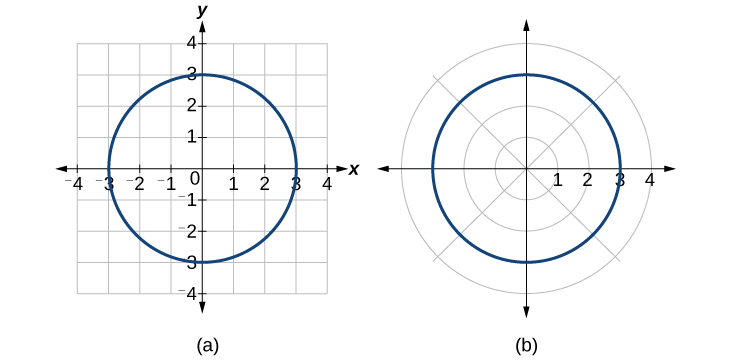
Figure 10 (a) Cartesian form \(x^{2} + y^{2} = 9\) (b) Polar form \(r = 3\)
To graph a circle in rectangular form, we must first solve for \(y.\)
\[\begin{array}{l} \begin{array}{l} \\ {x^{2} + y^{2} = 9} \end{array} \\ {\text{~~~~~~~~}y^{2} = 9 - x^{2}} \\ {\text{~~~~~~~~~~}y = \pm \sqrt{9 - x^{2}}} \end{array}\]
Note that this is two separate functions, since a circle fails the vertical line test. Therefore, we need to enter the positive and negative square roots into the calculator separately, as two equations in the form \(Y_{1} = \sqrt{9 - x^{2}}\) and \(Y_{2} = - \sqrt{9 - x^{2}}.\) Press GRAPH.
Rewrite the Cartesian equation \(x^{2} + y^{2} = 6y\) as a polar equation.
Solution (click to reveal)
This equation appears similar to the previous example, but it requires different steps to convert the equation.
We can still follow the same procedures we have already learned and make the following substitutions:
\[\begin{array}{ll} {r^{2} = 6y} & {\text{Use~}x^{2} + y^{2} = r^{2}.} \\ {r^{2} = 6r\sin\;\theta} & {\text{Substitute}\; y = r\sin\;\theta.} \\ {r^{2} - 6r\sin\;\theta = 0} & {\text{Set~equal~to~0}.} \\ {r(r - 6\sin\;\theta) = 0} & {\text{Factor~and~solve}.} \\ {r = 0} & {\text{We~reject~}r = 0,\mspace{9mu}\text{as~it~only~represents~one~point,~}(0,0).} \\ {r = 6\sin\;\theta\begin{array}{llll} & & & \end{array}} & \end{array}\]
Therefore, the equations \(x^{2} + y^{2} = 6y\) and \(r = 6\sin\;\theta\) should give us the same graph. See Figure 11.
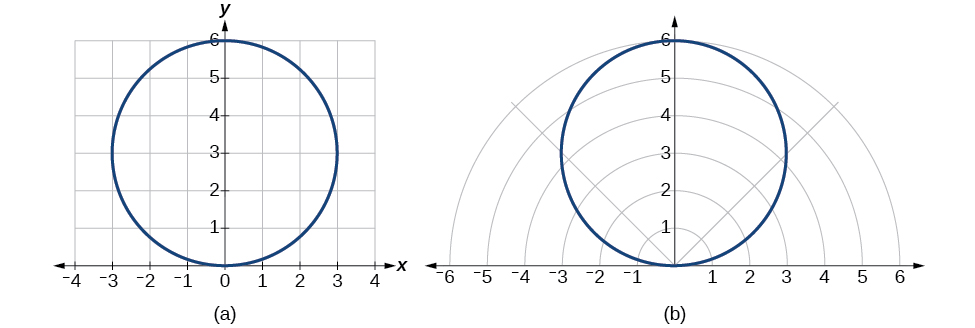
Figure 11 (a) Cartesian form \(x^{2} + y^{2} = 6y\) (b) polar form \(r = 6\sin\;\theta\)
The Cartesian or rectangular equation is plotted on the rectangular grid, and the polar equation is plotted on the polar grid. Clearly, the graphs are identical.
10.3.5 Identify and Graph Polar Equations by Converting to Rectangular Equations
We have learned how to convert rectangular coordinates to polar coordinates, and we have seen that the points are indeed the same. We have also transformed polar equations to rectangular equations and vice versa. Now we will demonstrate that their graphs, while drawn on different grids, are identical.
Covert the polar equation \(r = 2\sec\;\theta\) to a rectangular equation, and draw its corresponding graph.
Solution (click to reveal)
The conversion is
\[\begin{matrix} r & = & {2\sec\;\theta} \\ r & = & \frac{2}{\cos\;\theta} \\ {r\;\cos\;\theta} & = & 2 \\ x & = & 2 \end{matrix}\]
Notice that the equation \(r = 2\sec\;\theta\) drawn on the polar grid is clearly the same as the vertical line \(x = 2\) drawn on the rectangular grid (see Figure 12). Just as \(x = c\) is the standard form for a vertical line in rectangular form, \(r = c\sec\;\theta\) is the standard form for a vertical line in polar form.
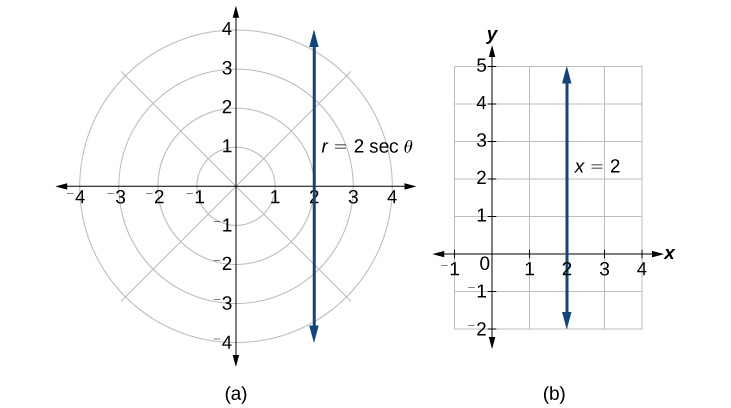
Figure 12 (a) Polar grid (b) Rectangular coordinate system
A similar discussion would demonstrate that the graph of the function \(r = 2\csc\;\theta\) will be the horizontal line \(y = 2.\) In fact, \(r = c\csc\;\theta\) is the standard form for a horizontal line in polar form, corresponding to the rectangular form \(y = c.\)
Rewrite the polar equation \(r = \frac{3}{1 - 2\cos\;\theta}\) as a Cartesian equation.
Solution (click to reveal)
The goal is to eliminate \(\theta\) and \(r,\) and introduce \(x\) and \(y.\) We clear the fraction, and then use substitution. In order to replace \(r\) with \(x\) and \(y,\) we must use the expression \(x^{2} + y^{2} = r^{2}.\)
\[\begin{matrix} r & = & \frac{3}{1 - 2\;\cos\;\theta} & \\ {r\left( 1 - 2\left( \frac{x}{r} \right) \right)} & = & 3 & \\ {r - 2x} & = & 3 & {\text{Use}\;\cos\;\theta = \frac{x}{r}\; to\;\text{eliminate}\;\theta} \\ {r - 2x} & = & 3 & \\ r & = & {3 + 2x} & {\text{Isolate}\; r} \\ r^{2} & = & (3 + 2x)^{2} & {\text{Square}\;\text{both}\;\text{sides}} \\ {x^{2} + y^{2}} & = & (3 + 2x)^{2} & {\text{Use}\; x^{2} + y^{2} = r^{2}} \end{matrix}\]
The Cartesian equation is \(x^{2} + y^{2} = \left( {3 + 2x} \right)^{2}.\) However, to graph it, especially using a graphing calculator or computer program, we want to isolate \(y.\)
\[\begin{array}{l} {x^{2} + y^{2} = \left( {3 + 2x} \right)^{2}} \\ {\text{~~~~~~~~}y^{2} = \left( {3 + 2x} \right)^{2} - x^{2}} \\ {\text{~~~~~~~~~~}y = \pm \sqrt{\left( {3 + 2x} \right)^{2} - x^{2}}} \end{array}\]
When our entire equation has been changed from \(r\) and \(\theta\) to \(x\) and \(y,\) we can stop, unless asked to solve for \(y\) or simplify. See Figure 13.
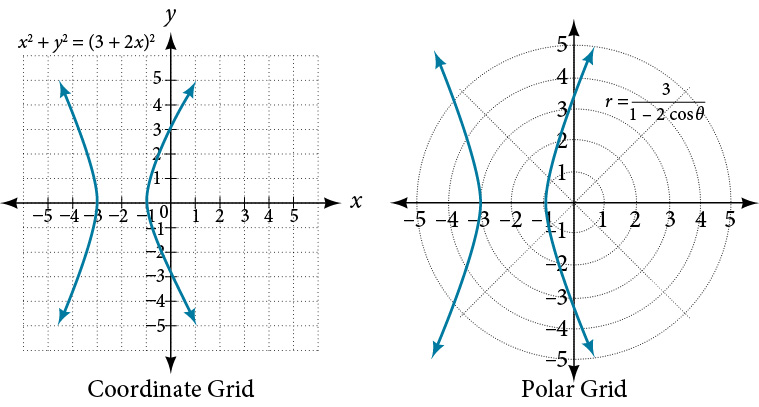
Figure 13
The “hour-glass” shape of the graph is called a hyperbola. Hyperbolas have many interesting geometric features and applications, which we will investigate further in Analytic Geometry.
In this example, the right side of the equation can be expanded and the equation simplified further, as shown above. However, the equation cannot be written as a single function in Cartesian form. We may wish to write the rectangular equation in the hyperbola’s standard form. To do this, we can start with the initial equation.
\[\begin{matrix} {x^{2} + y^{2}} & = & (3 + 2x)^{2} & \\ {x^{2} + y^{2} - (3 + 2x)^{2}} & = & 0 & \\ {x^{2} + y^{2} - \left( 9 + 12x + 4x^{2} \right)} & = & 0 & \\ {x^{2} + y^{2} - 9 - 12x - 4x^{2}} & = & 0 & \\ {- 3x^{2} - 12x + y^{2}} & = & 9 & {\text{Multiply}\;\text{through}\;\text{by}\; - 1} \\ {3x^{2} + 12x - y^{2}} & = & {- 9} & \\ {3\left( x^{2} + 4x + \right) - y^{2}} & = & {- 9} & \\ {3\left( x^{2} + 4x + 4 \right) - y^{2}} & = & {- 9 + 12} & {Organize\;\text{terms}\;\text{to}\;\text{complete}\;\text{the}\;\text{square}\;\text{for}\; x} \\ {3(x + 2)^{2} - y^{2}} & = & 3 & \\ {(x + 2)^{2} - \frac{y^{2}}{3}} & = & 1 & \end{matrix}\]
Section Exercises
Verbal
1. How are polar coordinates different from rectangular coordinates?
Solution (click to reveal)
For polar coordinates, the point in the plane depends on the angle from the positive \(x\)-axis and distance from the origin, while in Cartesian coordinates, the point represents the horizontal and vertical distances from the origin. For each point in the coordinate plane, there is one representation, but for each point in the polar plane, there are infinite representations.
2. How are the polar axes different from the \(x\)- and \(y\)-axes of the Cartesian plane?
3. Explain how polar coordinates are graphed.
Solution (click to reveal)
Determine \(\theta\) for the point, then move \(r\) units from the pole to plot the point. If \(r\) is negative, move \(r\) units from the pole in the opposite direction but along the same angle. The point is a distance of \(r\) away from the origin at an angle of \(\theta\) from the polar axis.
4. How are the points \(\left( {3,\frac{\pi}{2}} \right)\) and \(\left( {- 3,\frac{\pi}{2}} \right)\) related?
5. Explain why the points \(\left( {- 3,\frac{\pi}{2}} \right)\) and \(\left( {3, - \frac{\pi}{2}} \right)\) are the same.
Solution (click to reveal)
The point \(\left( {- 3,\frac{\pi}{2}} \right)\) has a positive angle but a negative radius and is plotted by moving to an angle of \(\frac{\pi}{2}\) and then moving 3 units in the negative direction. This places the point 3 units down the negative \(y\)-axis. The point \(\left( {3, - \frac{\pi}{2}} \right)\) has a negative angle and a positive radius and is plotted by first moving to an angle of \(- \frac{\pi}{2}\) and then moving 3 units down, which is the positive direction for a negative angle. The point is also 3 units down the negative \(y\)-axis.
Algebraic
For the following exercises, convert the given polar coordinates to Cartesian coordinates. Remember to consider the quadrant in which the given point is located when determining \(\theta\) for the point.
6. \(\left( {7,\frac{7\pi}{6}} \right)\)
7. \(\left( {5,\pi} \right)\)
Solution (click to reveal)
\(\left( {- 5,0} \right)\)
8. \(\left( {6, - \frac{\pi}{4}} \right)\)
9. \(\left( {- 3,\frac{\pi}{6}} \right)\)
Solution (click to reveal)
\(\left( {- \frac{3\sqrt{3}}{2}, - \frac{3}{2}} \right)\)
10. \(\left( {4,\frac{7\pi}{4}} \right)\)
For the following exercises, convert the given Cartesian coordinates to polar coordinates with \(r > 0,\mspace{9mu} 0 \leq \theta < 2\pi.\) Remember to consider the quadrant in which the given point is located.
11. \(\left( {4,2} \right)\)
Solution (click to reveal)
\(\left( {2\sqrt{5},\mspace{9mu} 0.464} \right)\)
12. \(\left( {- 4,6} \right)\)
13. \(\left( {3,-5} \right)\)
Solution (click to reveal)
\(\left( {\sqrt{34},5.253} \right)\)
14. \(\left( {-10,-13} \right)\)
15. \(\left( {8,8} \right)\)
Solution (click to reveal)
\(\left( {8\sqrt{2},\frac{\pi}{4}} \right)\)
For the following exercises, convert the given Cartesian equation to a polar equation.
16. \(x = 3\)
17. \(y = 4\)
Solution (click to reveal)
\(r = 4\csc\theta\)
18. \(y = 4x^{2}\)
19. \(y = 2x^{4}\)
Solution (click to reveal)
\(r = \sqrt[3]{\frac{sin\theta}{2cos^{4}\theta}}\)
20. \(x^{2} + y^{2} = 4y\)
21. \(x^{2} + y^{2} = 3x\)
Solution (click to reveal)
\(r = 3\cos\theta\)
22. \(x^{2} - y^{2} = x\)
23. \(x^{2} - y^{2} = 3y\)
Solution (click to reveal)
\(r = \frac{3\sin\theta}{\cos\left( {2\theta} \right)}\)
24. \(x^{2} + y^{2} = 9\)
25. \(x^{2} = 9y\)
Solution (click to reveal)
\(r = \frac{9\sin\theta}{\cos^{2}\theta}\)
26. \(y^{2} = 9x\)
27. \(9xy = 1\)
Solution (click to reveal)
\(r = \sqrt{\frac{1}{9\cos\theta\sin\theta}}\)
For the following exercises, convert the given polar equation to a Cartesian equation. Write in the standard form of a conic if possible, and identify the conic section represented.
28. \(r = 3\sin\;\theta\)
29. \(r = 4\cos\;\theta\)
Solution (click to reveal)
\(x^{2} + y^{2} = 4x\) or \(\frac{\left( {x - 2} \right)^{2}}{4} + \frac{y^{2}}{4} = 1;\) circle
30. \(r = \frac{4}{\sin\;\theta + 7\cos\;\theta}\)
31. \(r = \frac{6}{\cos\;\theta + 3\sin\;\theta}\)
Solution (click to reveal)
\(3y + x = 6;\) line
32. \(r = 2\sec\;\theta\)
33. \(r = 3\csc\;\theta\)
Solution (click to reveal)
\(y = 3;\) line
34. \(r = \sqrt{r\cos\;\theta + 2}\)
35. \(r^{2} = 4\sec\;\theta\;\csc\;\theta\)
Solution (click to reveal)
\(xy = 4;\) hyperbola
36. \(r = 4\)
37. \(r^{2} = 4\)
Solution (click to reveal)
\(x^{2} + y^{2} = 4;\) circle
38. \(r = \frac{1}{4\cos\;\theta - 3\sin\;\theta}\)
39. \(r = \frac{3}{\cos\;\theta - 5\sin\;\theta}\)
Solution (click to reveal)
\(x - 5y = 3;\) line
Graphical
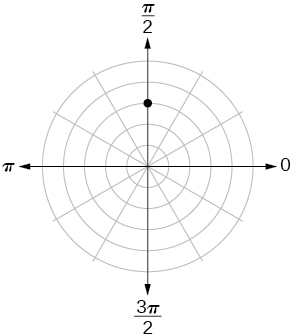
For the following exercises, find the polar coordinates of the point.
40.
41.
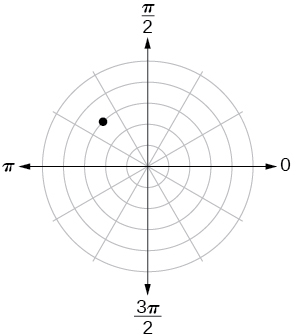
Solution (click to reveal)
\(\left( {3,\frac{3\pi}{4}} \right)\)
42.
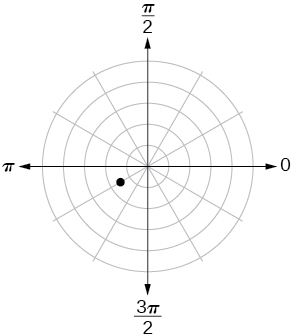
43.
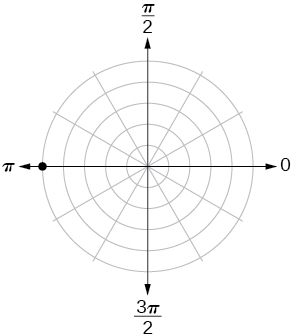
Solution (click to reveal)
\(\left( {5,\pi} \right)\)
44.
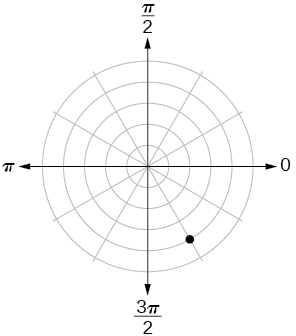
For the following exercises, plot the points.
45. \(\left( {- 2,\frac{\pi}{3}} \right)\)
Solution (click to reveal)
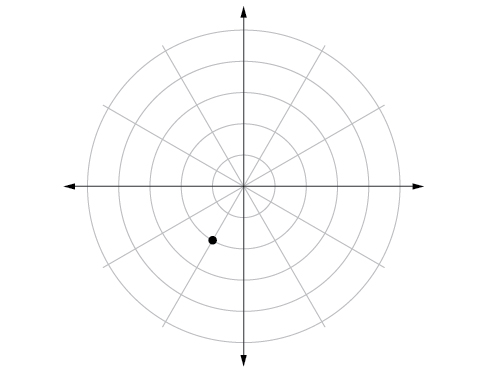
46. \(\left( {- 1, - \frac{\pi}{2}} \right)\)
47. \(\left( {3.5,\frac{7\pi}{4}} \right)\)
Solution (click to reveal)
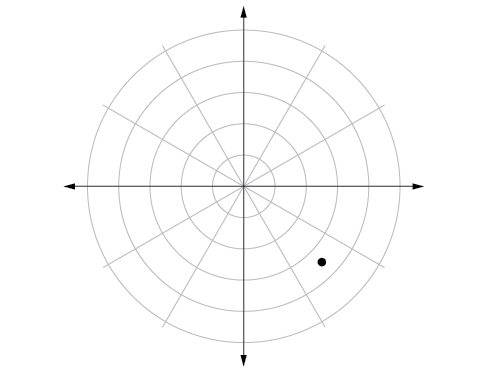
48. \(\left( {- 4,\frac{\pi}{3}} \right)\)
49. \(\left( {5,\frac{\pi}{2}} \right)\)
Solution (click to reveal)
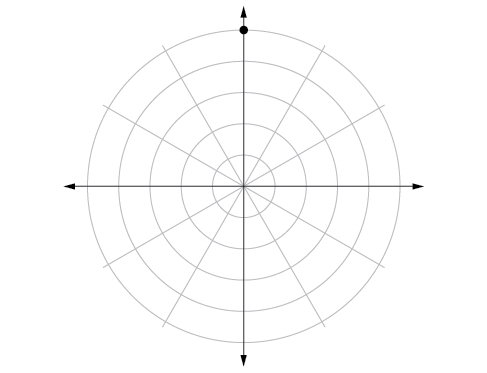
50. \(\left( {4,\frac{- 5\pi}{4}} \right)\)
51. \(\left( {3,\frac{5\pi}{6}} \right)\)
Solution (click to reveal)
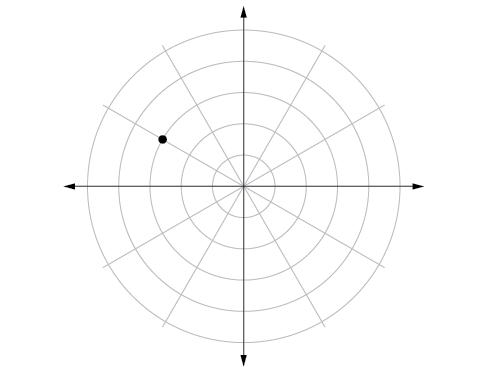
52. \(\left( {- 1.5,\frac{7\pi}{6}} \right)\)
53. \(\left( {- 2,\frac{\pi}{4}} \right)\)
Solution (click to reveal)
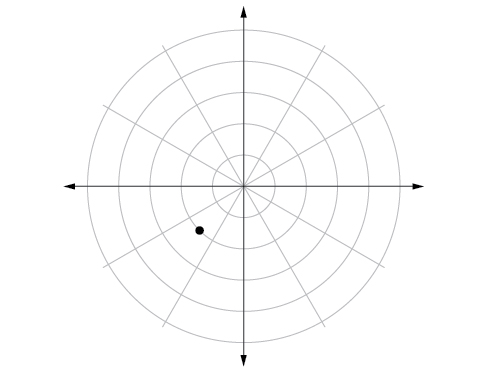
54. \(\left( {1,\frac{3\pi}{2}} \right)\)
For the following exercises, convert the equation from rectangular to polar form and graph on the polar axis.
55. \(5x - y = 6\)
Solution (click to reveal)
\(r = \frac{6}{5\cos\theta - \sin\theta}\)
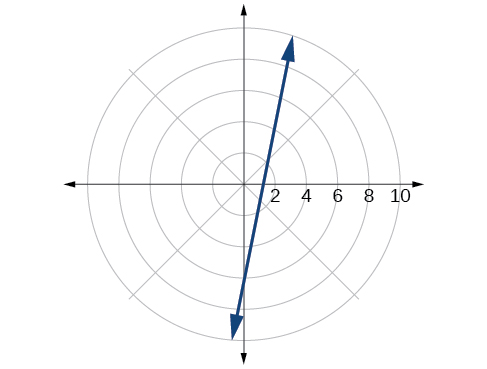
56. \(2x + 7y = - 3\)
57. \(x^{2} + \left( {y - 1} \right)^{2} = 1\)
Solution (click to reveal)
\(r = 2\sin\theta\)
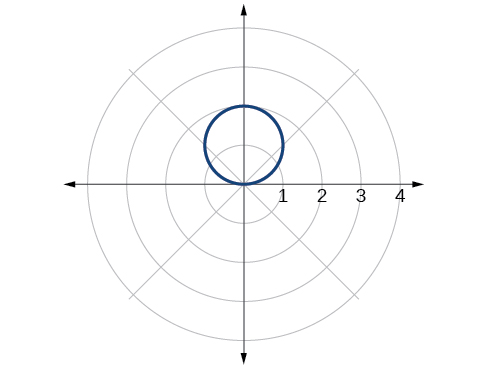
58. \(\left( {x + 2} \right)^{2} + \left( {y + 3} \right)^{2} = 13\)
59. \(x = 2\)
Solution (click to reveal)
\(r = \frac{2}{\cos\theta}\)
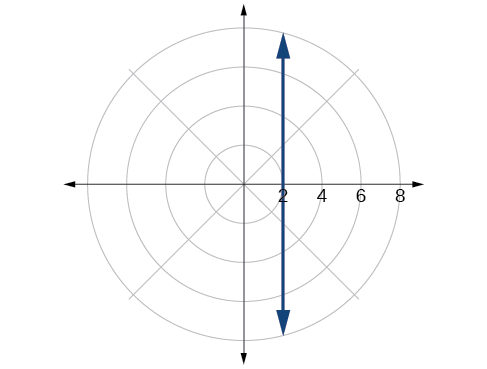
60. \(x^{2} + y^{2} = 5y\)
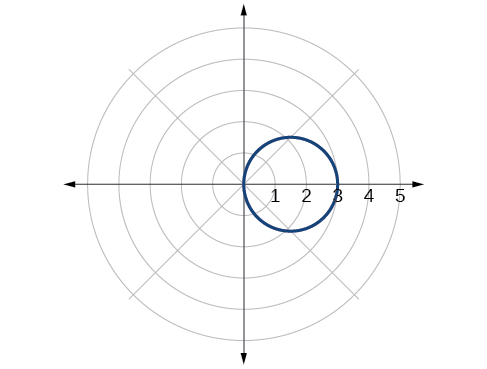
61. \(x^{2} + y^{2} = 3x\)
Solution (click to reveal)
\(r = 3\cos\theta\)
For the following exercises, convert the equation from polar to rectangular form and graph on the rectangular plane.
62. \(r = 6\)
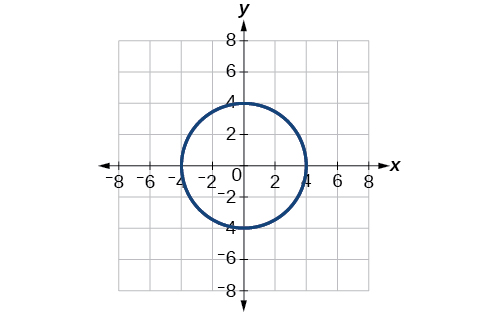
63. \(r = - 4\)
Solution (click to reveal)
\(x^{2} + y^{2} = 16\)
64. \(\theta = - \frac{2\pi}{3}\)
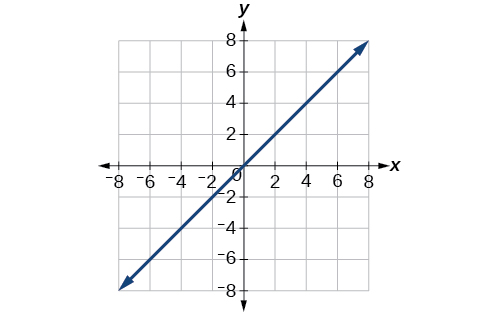
65. \(\theta = \frac{\pi}{4}\)
Solution (click to reveal)
\(y = x\)
66. \(r = \sec\;\theta\)
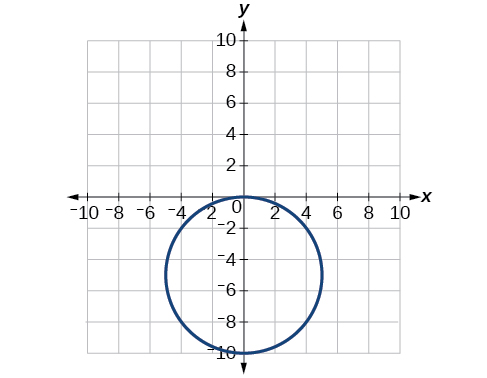
67. \(r = -10\sin\;\theta\)
Solution (click to reveal)
\(x^{2} + \left( {y + 5} \right)^{2} = 25\)
68. \(r = 3\cos\;\theta\)
Technology
69. Use a graphing calculator to find the rectangular coordinates of \(\left( {2, - \frac{\pi}{5}} \right).\) Round to the nearest thousandth.
Solution (click to reveal)
\(\left( {1.618, - 1.176} \right)\)
70. Use a graphing calculator to find the rectangular coordinates of \(\left( {- 3,\frac{3\pi}{7}} \right).\) Round to the nearest thousandth.
71. Use a graphing calculator to find the polar coordinates of \(\left( {- 7,8} \right)\) in degrees. Round to the nearest thousandth.
Solution (click to reveal)
\(\left( {10.630,131.186{^\circ}} \right)\)
72. Use a graphing calculator to find the polar coordinates of \(\left( {3, - 4} \right)\) in degrees. Round to the nearest hundredth.
73. Use a graphing calculator to find the polar coordinates of \(\left( {- 2,0} \right)\) in radians. Round to the nearest hundredth.
Solution (click to reveal)
\(\left( {2,3.14} \right)or\left( {2,\pi} \right)\)
Extensions
74. Describe the graph of \(r = a\sec\;\theta;a > 0.\)
75. Describe the graph of \(r = a\sec\;\theta;a < 0.\)
Solution (click to reveal)
A vertical line with \(a\) units left of the \(y\)-axis.
76. Describe the graph of \(r = a\csc\;\theta;a > 0.\)
77. Describe the graph of \(r = a\csc\;\theta;a < 0.\)
Solution (click to reveal)
A horizontal line with \(a\) units below the \(x\)-axis.
78. What polar equations will give an oblique line?
For the following exercise, graph the polar inequality.
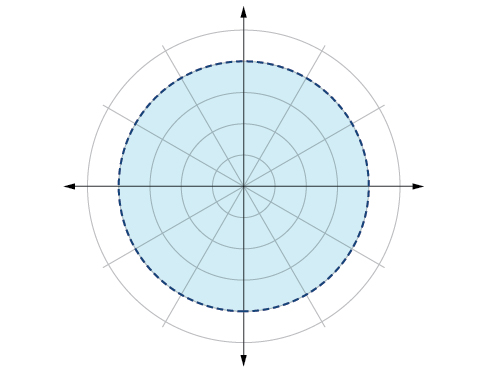
79. \(r < 4\)
Solution (click to reveal)
80. \(0 \leq \theta \leq \frac{\pi}{4}\)
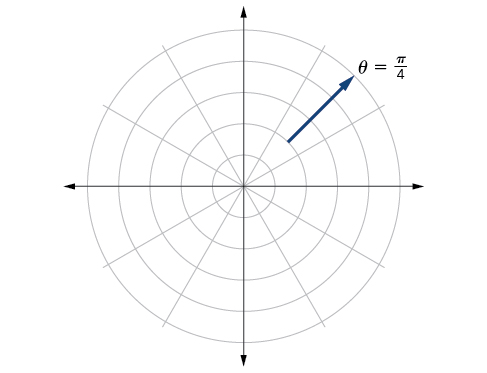
81. \(\theta = \frac{\pi}{4},\mspace{9mu} r\; \geq \; 2\)
Solution (click to reveal)
82. \(\theta = \frac{\pi}{4},\mspace{9mu} r\; \geq -3\)
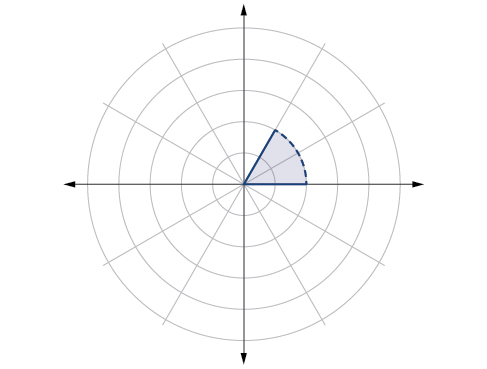
83. \(0 \leq \theta \leq \frac{\pi}{3},\mspace{9mu} r\; < \; 2\)
Solution (click to reveal)
84. \(\frac{- \pi}{6} < \theta \leq \frac{\pi}{3}, - 3 < r\; < \; 2\)