1.6 Rational Expressions
A pastry shop has fixed costs of \(\text{\$}280\) per week and variable costs of \(\text{\$}9\) per box of pastries. The shop’s costs per week in terms of \(x,\) the number of boxes made, is \(280 + 9x.\) We can divide the costs per week by the number of boxes made to determine the cost per box of pastries.
\[\frac{280 + 9x}{x}\]
Notice that the result is a polynomial expression divided by a second polynomial expression. In this section, we will explore quotients of polynomial expressions.
1.6.1 Simplifying Rational Expressions
The quotient of two polynomial expressions is called a rational expression. We can apply the properties of fractions to rational expressions, such as simplifying the expressions by canceling common factors from the numerator and the denominator. To do this, we first need to factor both the numerator and denominator. Let’s start with the rational expression shown.
\[\frac{x^{2} + 8x + 16}{x^{2} + 11x + 28}\]
We can factor the numerator and denominator to rewrite the expression.
\[\frac{{(x + 4)}^{2}}{(x + 4)(x + 7)}\]
Then we can simplify that expression by canceling the common factor \(\left( {x + 4} \right).\)
\[\frac{x + 4}{x + 7}\]
1.6.2 Multiplying Rational Expressions
Multiplication of rational expressions works the same way as multiplication of any other fractions. We multiply the numerators to find the numerator of the product, and then multiply the denominators to find the denominator of the product. Before multiplying, it is helpful to factor the numerators and denominators just as we did when simplifying rational expressions. We are often able to simplify the product of rational expressions.
1.6.3 Dividing Rational Expressions
Division of rational expressions works the same way as division of other fractions. To divide a rational expression by another rational expression, multiply the first expression by the reciprocal of the second. Using this approach, we would rewrite \(\frac{1}{x} \div \frac{x^{2}}{3}\) as the product \(\frac{1}{x} \cdot \frac{3}{x^{2}}.\) Once the division expression has been rewritten as a multiplication expression, we can multiply as we did before.
\[\frac{1}{x} \cdot \frac{3}{x^{2}} = \frac{3}{x^{3}}\]
1.6.4 Adding and Subtracting Rational Expressions
Adding and subtracting rational expressions works just like adding and subtracting numerical fractions. To add fractions, we need to find a common denominator. Let’s look at an example of fraction addition.
\[\begin{array}{ccl} {\frac{5}{24} + \frac{1}{40}} & = & {\frac{25}{120} + \frac{3}{120}} \\ & = & \frac{28}{120} \\ & = & \frac{7}{30} \end{array}\]
We have to rewrite the fractions so they share a common denominator before we are able to add. We must do the same thing when adding or subtracting rational expressions.
The easiest common denominator to use will be the least common denominator, or LCD. The LCD is the smallest multiple that the denominators have in common. To find the LCD of two rational expressions, we factor the expressions and multiply all of the distinct factors. For instance, if the factored denominators were \((x + 3)(x + 4)\) and \((x + 4)(x + 5),\) then the LCD would be \((x + 3)(x + 4)(x + 5).\)
Once we find the LCD, we need to multiply each expression by the form of 1 that will change the denominator to the LCD. We would need to multiply the expression with a denominator of \((x + 3)(x + 4)\) by \(\frac{x + 5}{x + 5}\) and the expression with a denominator of \((x + 4)(x + 5)\) by \(\frac{x + 3}{x + 3}.\)
1.6.5 Simplifying Complex Rational Expressions
A complex rational expression is a rational expression that contains additional rational expressions in the numerator, the denominator, or both. We can simplify complex rational expressions by rewriting the numerator and denominator as single rational expressions and dividing. The complex rational expression \(\frac{a}{\frac{1}{b} + c}\) can be simplified by rewriting the numerator as the fraction \(\frac{a}{1}\) and combining the expressions in the denominator as \(\frac{1 + bc}{b}.\) We can then rewrite the expression as a multiplication problem using the reciprocal of the denominator. We get \(\frac{a}{1} \cdot \frac{b}{1 + bc},\) which is equal to \(\frac{ab}{1 + bc}.\)
Section Exercises
Verbal
1. How can you use factoring to simplify rational expressions?
Solution (click to reveal)
You can factor the numerator and denominator to see if any of the terms can cancel one another out.
2. How do you use the LCD to combine two rational expressions?
3. Tell whether the following statement is true or false and explain why: You only need to find the LCD when adding or subtracting rational expressions.
Solution (click to reveal)
True. Multiplication and division do not require finding the LCD because the denominators can be combined through those operations, whereas addition and subtraction require like terms.
Algebraic
For the following exercises, simplify the rational expressions.
4. \(\frac{x^{2} - 16}{x^{2} - 5x + 4}\)
5. \(\frac{y^{2} + 10y + 25}{y^{2} + 11y + 30}\)
Solution (click to reveal)
\(\frac{y + 5}{y + 6}\)
6. \(\frac{6a^{2} - 24a + 24}{6a^{2} - 24}\)
7. \(\frac{9b^{2} + 18b + 9}{3b + 3}\)
Solution (click to reveal)
\(3b + 3\)
8. \(\frac{m - 12}{m^{2} - 144}\)
9. \(\frac{2x^{2} + 7x - 4}{4x^{2} + 2x - 2}\)
Solution (click to reveal)
\(\frac{x + 4}{2x + 2}\)
10. \(\frac{6x^{2} + 5x - 4}{3x^{2} + 19x + 20}\)
11. \(\frac{a^{2} + 9a + 18}{a^{2} + 3a - 18}\)
Solution (click to reveal)
\(\frac{a + 3}{a - 3}\)
12. \(\frac{3c^{2} + 25c - 18}{3c^{2} - 23c + 14}\)
13. \(\frac{12n^{2} - 29n - 8}{28n^{2} - 5n - 3}\)
Solution (click to reveal)
\(\frac{3n - 8}{7n - 3}\)
For the following exercises, multiply the rational expressions and express the product in simplest form.
14. \(\frac{x^{2} - x - 6}{2x^{2} + x - 6} \cdot \frac{2x^{2} + 7x - 15}{x^{2} - 9}\)
15. \(\frac{c^{2} + 2c - 24}{c^{2} + 12c + 36} \cdot \frac{c^{2} - 10c + 24}{c^{2} - 8c + 16}\)
Solution (click to reveal)
\(\frac{c - 6}{c + 6}\)
16. \(\frac{2d^{2} + 9d - 35}{d^{2} + 10d + 21} \cdot \frac{3d^{2} + 2d - 21}{3d^{2} + 14d - 49}\)
17. \(\frac{10h^{2} - 9h - 9}{2h^{2} - 19h + 24} \cdot \frac{h^{2} - 16h + 64}{5h^{2} - 37h - 24}\)
Solution (click to reveal)
\(1\)
18. \(\frac{6b^{2} + 13b + 6}{4b^{2} - 9} \cdot \frac{6b^{2} + 31b - 30}{18b^{2} - 3b - 10}\)
19. \(\frac{2d^{2} + 15d + 25}{4d^{2} - 25} \cdot \frac{2d^{2} - 15d + 25}{25d^{2} - 1}\)
Solution (click to reveal)
\(\frac{d^{2} - 25}{25d^{2} - 1}\)
20. \(\frac{6x^{2} - 5x - 50}{15x^{2} - 44x - 20} \cdot \frac{20x^{2} - 7x - 6}{2x^{2} + 9x + 10}\)
21. \(\frac{t^{2} - 1}{t^{2} + 4t + 3} \cdot \frac{t^{2} + 2t - 15}{t^{2} - 4t + 3}\)
Solution (click to reveal)
\(\frac{t + 5}{t + 3}\)
22. \(\frac{2n^{2} - n - 15}{6n^{2} + 13n - 5} \cdot \frac{12n^{2} - 13n + 3}{4n^{2} - 15n + 9}\)
23. \(\frac{36x^{2} - 25}{6x^{2} + 65x + 50} \cdot \frac{3x^{2} + 32x + 20}{18x^{2} + 27x + 10}\)
Solution (click to reveal)
\(\frac{6x - 5}{6x + 5}\)
For the following exercises, divide the rational expressions.
24. \(\frac{3y^{2} - 7y - 6}{2y^{2} - 3y - 9} \div \frac{y^{2} + y - 2}{2y^{2} + y - 3}\)
25. \(\frac{6p^{2} + p - 12}{8p^{2} + 18p + 9} \div \frac{6p^{2} - 11p + 4}{2p^{2} + 11p - 6}\)
Solution (click to reveal)
\(\frac{p + 6}{4p + 3}\)
26. \(\frac{q^{2} - 9}{q^{2} + 6q + 9} \div \frac{q^{2} - 2q - 3}{q^{2} + 2q - 3}\)
27. \(\frac{18d^{2} + 77d - 18}{27d^{2} - 15d + 2} \div \frac{3d^{2} + 29d - 44}{9d^{2} - 15d + 4}\)
Solution (click to reveal)
\(\frac{2d + 9}{d + 11}\)
28. \(\frac{16x^{2} + 18x - 55}{32x^{2} - 36x - 11} \div \frac{2x^{2} + 17x + 30}{4x^{2} + 25x + 6}\)
29. \(\frac{144b^{2} - 25}{72b^{2} - 6b - 10} \div \frac{18b^{2} - 21b + 5}{36b^{2} - 18b - 10}\)
Solution (click to reveal)
\(\frac{12b + 5}{3b-1}\)
30. \(\frac{16a^{2} - 24a + 9}{4a^{2} + 17a - 15} \div \frac{16a^{2} - 9}{4a^{2} + 11a + 6}\)
31. \(\frac{22y^{2} + 59y + 10}{12y^{2} + 28y - 5} \div \frac{11y^{2} + 46y + 8}{24y^{2} - 10y + 1}\)
Solution (click to reveal)
\(\frac{4y-1}{y + 4}\)
32. \(\frac{9x^{2} + 3x - 20}{3x^{2} - 7x + 4} \div \frac{6x^{2} + 4x - 10}{x^{2} - 2x + 1}\)
For the following exercises, add and subtract the rational expressions, and then simplify.
33. \(\frac{4}{x} + \frac{10}{y}\)
Solution (click to reveal)
\(\frac{10x + 4y}{xy}\)
34. \(\frac{12}{2q} - \frac{6}{3p}\)
35. \(\frac{4}{a + 1} + \frac{5}{a - 3}\)
Solution (click to reveal)
\(\frac{9a - 7}{a^{2} - 2a - 3}\)
36. \(\frac{c + 2}{3} - \frac{c - 4}{4}\)
37. \(\frac{y + 3}{y - 2} + \frac{y - 3}{y + 1}\)
Solution (click to reveal)
\(\frac{2y^{2} - y + 9}{y^{2} - y - 2}\)
38. \(\frac{x - 1}{x + 1} - \frac{2x + 3}{2x + 1}\)
39. \(\frac{3z}{z + 1} + \frac{2z + 5}{z - 2}\)
Solution (click to reveal)
\(\frac{5z^{2} + z + 5}{z^{2} - z - 2}\)
40. \(\frac{4p}{p + 1} - \frac{p + 1}{4p}\)
41. \(\frac{x}{x + 1} + \frac{y}{y + 1}\)
Solution (click to reveal)
\(\frac{x + 2xy + y}{x + xy + y + 1}\)
For the following exercises, simplify the rational expression.
42. \(\frac{\frac{6}{y} - \frac{4}{x}}{y}\)
43. \(\frac{\frac{2}{a} + \frac{7}{b}}{b}\)
Solution (click to reveal)
\(\frac{2b + 7a}{ab^{2}}\)
44. \(\frac{\frac{x}{4} - \frac{p}{8}}{p}\)
45. \(\frac{\frac{3}{a} + \frac{b}{6}}{\frac{2b}{3a}}\)
Solution (click to reveal)
\(\frac{18 + ab}{4b}\)
46. \(\frac{\frac{3}{x + 1} + \frac{2}{x - 1}}{\frac{x - 1}{x + 1}}\)
47. \(\frac{\frac{a}{b} - \frac{b}{a}}{\frac{a + b}{ab}}\)
Solution (click to reveal)
\(a - b\)
48. \(\frac{\frac{2x}{3} + \frac{4x}{7}}{\frac{x}{2}}\)
49. \(\frac{\frac{2c}{c + 2} + \frac{c - 1}{c + 1}}{\frac{2c + 1}{c + 1}}\)
Solution (click to reveal)
\(\frac{3c^{2} + 3c - 2}{2c^{2} + 5c + 2}\)
50. \(\frac{\frac{x}{y} - \frac{y}{x}}{\frac{x}{y} + \frac{y}{x}}\)
Real-World Applications
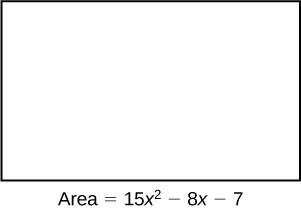
51. Brenda is placing tile on her bathroom floor. The area of the floor is \(15x^{2} - 8x - 7\) ft2. The area of one tile is \(x^{2} - 2x + 1\text{ft}^{2}.\) To find the number of tiles needed, simplify the rational expression: \(\frac{15x^{2} - 8x - 7}{x^{2} - 2x + 1}.\)
Solution (click to reveal)
\(\frac{15x + 7}{x-1}\)
52. The area of Lijuan’s yard is \(25x^{2} - 625\) ft2. A patch of sod has an area of \(x^{2} - 10x + 25\) ft2. Divide the two areas and simplify to find how many pieces of sod Lijuan needs to cover her yard.
53. Elroi wants to mulch his garden. His garden is \(x^{2} + 18x + 81\) ft2. One bag of mulch covers \(x^{2} - 81\) ft2. Divide the expressions and simplify to find how many bags of mulch Elroi needs to mulch his garden.
Solution (click to reveal)
\(\frac{x + 9}{x-9}\)
Extensions
For the following exercises, perform the given operations and simplify.
54. \(\frac{x^{2} + x - 6}{x^{2} - 2x - 3} \cdot \frac{2x^{2} - 3x - 9}{x^{2} - x - 2} \div \frac{10x^{2} + 27x + 18}{x^{2} + 2x + 1}\)
55. \(\frac{\frac{3y^{2} - 10y + 3}{3y^{2} + 5y - 2} \cdot \frac{2y^{2} - 3y - 20}{2y^{2} - y - 15}}{y - 4}\)
Solution (click to reveal)
\(\frac{1}{y + 2}\)
56. \(\frac{\frac{4a + 1}{2a - 3} + \frac{2a - 3}{2a + 3}}{\frac{4a^{2} + 9}{a}}\)
57. \(\frac{x^{2} + 7x + 12}{x^{2} + x - 6} \div \frac{3x^{2} + 19x + 28}{8x^{2} - 4x - 24} \div \frac{2x^{2} + x - 3}{3x^{2} + 4x - 7}\)
Solution (click to reveal)
\(4\)