Chapter Review
Key Terms
altitude — a perpendicular line from one vertex of a triangle to the opposite side, or in the case of an obtuse triangle, to the line containing the opposite side, forming two right triangles
ambiguous case — a scenario in which more than one triangle is a valid solution for a given oblique SSA triangle
Archimedes’ spiral — a polar curve given by \(r = \theta.\) When multiplied by a constant, the equation appears as \(r = a\theta.\) As \(r = \theta,\) the curve continues to widen in a spiral path over the domain.
argument — the angle associated with a complex number; the angle between the line from the origin to the point and the positive real axis
cardioid — a member of the limaçon family of curves, named for its resemblance to a heart; its equation is given as \(r = a \pm b\cos\;\theta\) and \(r = a \pm b\sin\;\theta,\) where \(\frac{a}{b} = 1\)
convex limaҫon — a type of one-loop limaçon represented by \(r = a \pm b\cos\;\theta\) and \(r = a \pm b\sin\;\theta\) such that \(\frac{a}{b} \geq 2\)
De Moivre’s Theorem — formula used to find the \(n\text{th}\) power or \(n\)th roots of a complex number; states that, for a positive integer \(n,z^{n}\) is found by raising the modulus to the \(n\text{th}\) power and multiplying the angles by \(n\)
dimpled limaҫon — a type of one-loop limaçon represented by \(r = a \pm b\cos\;\theta\) and \(r = a \pm b\sin\;\theta\) such that \(1 < \frac{a}{b} < 2\)
dot product — given two vectors, the sum of the product of the horizontal components and the product of the vertical components
Generalized Pythagorean Theorem — an extension of the Law of Cosines; relates the sides of an oblique triangle and is used for SAS and SSS triangles
initial point — the origin of a vector
inner-loop limaçon — a polar curve similar to the cardioid, but with an inner loop; passes through the pole twice; represented by \(r = a \pm b\cos\;\theta\) and \(r = a \pm b\;\sin\;\theta\) where \(a < b\)
Law of Cosines — states that the square of any side of a triangle is equal to the sum of the squares of the other two sides minus twice the product of the other two sides and the cosine of the included angle
Law of Sines — states that the ratio of the measurement of one angle of a triangle to the length of its opposite side is equal to the remaining two ratios of angle measure to opposite side; any pair of proportions may be used to solve for a missing angle or side
lemniscate — a polar curve resembling a figure 8 and given by the equation \(r^{2} = a^{2}\cos\; 2\theta\) and \(r^{2} = a^{2}\sin\; 2\theta,\) \(a \neq 0\)
magnitude — the length of a vector; may represent a quantity such as speed, and is calculated using the Pythagorean Theorem
modulus — the absolute value of a complex number, or the distance from the origin to the point \(\left( {x,y} \right);\) also called the amplitude
oblique triangle — any triangle that is not a right triangle
one-loop limaҫon — a polar curve represented by \(r = a \pm b\cos\;\theta\) and \(r = a \pm b\sin\;\theta\) such that \(a > 0,b > 0,\) and \(\frac{a}{b} > 1;\) may be dimpled or convex; does not pass through the pole
parameter — a variable, often representing time, upon which \(x\) and \(y\) are both dependent
polar axis — on the polar grid, the equivalent of the positive \(x\)-axis on the rectangular grid
polar coordinates — on the polar grid, the coordinates of a point labeled \(\left( {r,\theta} \right),\) where \(\theta\) indicates the angle of rotation from the polar axis and \(r\) represents the radius, or the distance of the point from the pole in the direction of \(\theta\)
polar equation — an equation describing a curve on the polar grid.
polar form of a complex number — a complex number expressed in terms of an angle \(\theta\) and its distance from the origin \(r;\) can be found by using conversion formulas \(x = r\cos\;\theta,\quad y = r\sin\;\theta,\) and \(r = \sqrt{x^{2} + y^{2}}\)
pole — the origin of the polar grid
resultant — a vector that results from addition or subtraction of two vectors, or from scalar multiplication
rose curve — a polar equation resembling a flower, given by the equations \(r = a\cos\; n\theta\) and \(r = a\sin\; n\theta;\) when \(n\) is even there are \(2n\) petals, and the curve is highly symmetrical; when \(n\) is odd there are \(n\) petals.
scalar — a quantity associated with magnitude but not direction; a constant
scalar multiplication — the product of a constant and each component of a vector
standard position — the placement of a vector with the initial point at \(\left( {0,0} \right)\) and the terminal point \((a,\mathbf{b}),\) represented by the change in the \(x\)-coordinates and the change in the \(y\)-coordinates of the original vector
terminal point — the end point of a vector, usually represented by an arrow indicating its direction
unit vector — a vector that begins at the origin and has magnitude of 1; the horizontal unit vector runs along the \(x\)-axis and is defined as \(\mathbf{i} = \left\langle {1,0} \right\rangle\) the vertical unit vector runs along the \(y\)-axis and is defined as \(\mathbf{j} = \left\langle {0,1} \right\rangle.\)
vector — a quantity associated with both magnitude and direction, represented as a directed line segment with a starting point (initial point) and an end point (terminal point)
vector addition — the sum of two vectors, found by adding corresponding components
Key Equations
| Law of Sines | \(\begin{array}{l} {\frac{\sin\;\alpha}{a} = \frac{\sin\;\beta}{b} = \frac{\sin\;\gamma}{c}} \\ {\frac{a}{\sin\;\alpha} = \frac{b}{\sin\;\beta} = \frac{c}{\sin\;\gamma}} \end{array}\) |
| Area for oblique triangles | \(\begin{array}{r} {\text{Area} = \frac{1}{2}bc\sin\;\alpha} \\ {\quad = \frac{1}{2}ac\sin\;\beta} \\ {\quad = \frac{1}{2}ab\sin\;\gamma} \end{array}\) |
| Law of Cosines | \(\begin{array}{l} {a^{2} = b^{2} + c^{2} - 2bc\cos\;\alpha} \\ {b^{2} = a^{2} + c^{2} - 2ac\cos\;\beta} \\ {c^{2} = a^{2} + b^{2} - 2abcos\;\gamma} \end{array}\) |
| Heron’s formula | \(\begin{array}{l} {\text{Area} = \sqrt{s(s - a)(s - b)(s - c)}} \\ {\text{where~}s = \frac{(a + b + c)}{2}} \end{array}\) |
| Conversion formulas | \(\begin{array}{ll} & {\cos\;\theta = \frac{x}{r}\rightarrow x = r\cos\;\theta} \\ & {\sin\;\theta = \frac{y}{r}\rightarrow y = r\sin\;\theta} \\ & {r^{2} = x^{2} + y^{2}} \\ & {\tan\;\theta = \frac{y}{x}} \end{array}\) |
Key Concepts
10.1 Non-right Triangles: Law of Sines
- The Law of Sines can be used to solve oblique triangles, which are non-right triangles.
- According to the Law of Sines, the ratio of the measurement of one of the angles to the length of its opposite side equals the other two ratios of angle measure to opposite side.
- There are three possible cases: ASA, AAS, SSA. Depending on the information given, we can choose the appropriate equation to find the requested solution. See Example 1.
- The ambiguous case arises when an oblique triangle can have different outcomes.
- There are three possible cases that arise from SSA arrangement—a single solution, two possible solutions, and no solution. See Example 2 and Example 3.
- The Law of Sines can be used to solve triangles with given criteria. See Example 4.
- The general area formula for triangles translates to oblique triangles by first finding the appropriate height value. See Example 5.
- There are many trigonometric applications. They can often be solved by first drawing a diagram of the given information and then using the appropriate equation. See Example 6.
10.2 Non-right Triangles: Law of Cosines
- The Law of Cosines defines the relationship among angle measurements and lengths of sides in oblique triangles.
- The Generalized Pythagorean Theorem is the Law of Cosines for two cases of oblique triangles: SAS and SSS. Dropping an imaginary perpendicular splits the oblique triangle into two right triangles or forms one right triangle, which allows sides to be related and measurements to be calculated. See Example 1 and Example 2.
- The Law of Cosines is useful for many types of applied problems. The first step in solving such problems is generally to draw a sketch of the problem presented. If the information given fits one of the three models (the three equations), then apply the Law of Cosines to find a solution. See Example 3 and Example 4.
- Heron’s formula allows the calculation of area in oblique triangles. All three sides must be known to apply Heron’s formula. See Example 5 and See Example 6.
10.3 Polar Coordinates
- The polar grid is represented as a series of concentric circles radiating out from the pole, or origin.
- To plot a point in the form \(\left( {r,\theta} \right),\mspace{9mu}\theta > 0,\) move in a counterclockwise direction from the polar axis by an angle of \(\theta,\) and then extend a directed line segment from the pole the length of \(r\) in the direction of \(\theta.\) If \(\theta\) is negative, move in a clockwise direction, and extend a directed line segment the length of \(r\) in the direction of \(\theta.\) See Example 1.
- If \(r\) is negative, extend the directed line segment in the opposite direction of \(\theta.\) See Example 2.
- To convert from polar coordinates to rectangular coordinates, use the formulas \(x = r\cos\;\theta\) and \(y = r\sin\;\theta.\) See Example 3 and Example 4.
- To convert from rectangular coordinates to polar coordinates, use one or more of the formulas: \(\cos\;\theta = \frac{x}{r},\sin\;\theta = \frac{y}{r},\tan\;\theta = \frac{y}{x},\) and \(r = \sqrt{x^{2} + y^{2}}.\) See Example 5.
- Transforming equations between polar and rectangular forms means making the appropriate substitutions based on the available formulas, together with algebraic manipulations. See Example 6, Example 7, and Example 8.
- Using the appropriate substitutions makes it possible to rewrite a polar equation as a rectangular equation, and then graph it in the rectangular plane. See Example 9, Example 10, and Example 11.
10.4 Polar Coordinates: Graphs
- It is easier to graph polar equations if we can test the equations for symmetry with respect to the line \(\theta = \frac{\pi}{2},\) the polar axis, or the pole.
- There are three symmetry tests that indicate whether the graph of a polar equation will exhibit symmetry. If an equation fails a symmetry test, the graph may or may not exhibit symmetry. See Example 1.
- Polar equations may be graphed by making a table of values for \(\theta\) and \(r.\)
- The maximum value of a polar equation is found by substituting the value \(\theta\) that leads to the maximum value of the trigonometric expression.
- The zeros of a polar equation are found by setting \(r = 0\) and solving for \(\theta.\) See Example 2.
- Some formulas that produce the graph of a circle in polar coordinates are given by \(r = a\cos\;\theta\) and \(r = a\sin\;\theta.\) See Example 3.
- The formulas that produce the graphs of a cardioid are given by \(r = a \pm b\cos\;\theta\) and \(r = a \pm b\sin\;\theta,\) for \(a > 0,\) \(b > 0,\) and \(\frac{a}{b} = 1.\) See Example 4.
- The formulas that produce the graphs of a one-loop limaçon are given by \(r = a \pm b\cos\;\theta\) and \(r = a \pm b\sin\;\theta\) for \(1 < \frac{a}{b} < 2.\) See Example 5.
- The formulas that produce the graphs of an inner-loop limaçon are given by \(r = a \pm b\cos\;\theta\) and \(r = a \pm b\sin\;\theta\) for \(a > 0,\) \(b > 0,\) and \(a < b.\) See Example 6.
- The formulas that produce the graphs of a lemniscates are given by \(r^{2} = a^{2}\cos\; 2\theta\) and \(r^{2} = a^{2}\sin\; 2\theta,\) where \(a \neq 0.\) See Example 7.
- The formulas that produce the graphs of rose curves are given by \(r = a\cos\; n\theta\) and \(r = a\sin\; n\theta,\) where \(a \neq 0;\) if \(n\) is even, there are \(2n\) petals, and if \(n\) is odd, there are \(n\) petals. See Example 8 and Example 9.
- The formula that produces the graph of an Archimedes’ spiral is given by \(r = \theta,\) \(\theta \geq 0.\) See Example 10.
10.5 Polar Form of Complex Numbers
- Complex numbers in the form \(a + bi\) are plotted in the complex plane similar to the way rectangular coordinates are plotted in the rectangular plane. Label the \(x\)-axis as the real axis and the \(y\)-axis as the imaginary axis. See Example 1.
- The absolute value of a complex number is the same as its magnitude. It is the distance from the origin to the point: \(|z| = \sqrt{a^{2} + b^{2}}.\) See Example 2 and Example 3.
- To write complex numbers in polar form, we use the formulas \(x = r\cos\;\theta,y = r\sin\;\theta,\) and \(r = \sqrt{x^{2} + y^{2}}.\) Then, \(z = r\left( {\cos\;\theta + i\sin\;\theta} \right).\) See Example 4 and Example 5.
- To convert from polar form to rectangular form, first evaluate the trigonometric functions. Then, multiply through by \(r.\) See Example 6 and Example 7.
- To find the product of two complex numbers, multiply the two moduli and add the two angles. Evaluate the trigonometric functions, and multiply using the distributive property. See Example 8.
- To find the quotient of two complex numbers in polar form, find the quotient of the two moduli and the difference of the two angles. See Example 9.
- To find the power of a complex number \(z^{n},\) raise \(r\) to the power \(n,\) and multiply \(\theta\) by \(n.\) See Example 10.
- Finding the roots of a complex number is the same as raising a complex number to a power, but using a rational exponent. See Example 11.
10.6 Parametric Equations
- Parameterizing a curve involves translating a rectangular equation in two variables, \(x\) and \(y,\) into two equations in three variables, \(x\), \(y\), and \(t\). Often, more information is obtained from a set of parametric equations. See Example 1, Example 2, and Example 3.
- Sometimes equations are simpler to graph when written in rectangular form. By eliminating \(t,\) an equation in \(x\) and \(y\) is the result.
- To eliminate \(t,\) solve one of the equations for \(t,\) and substitute the expression into the second equation. See Example 4, Example 5, Example 6, and Example 7.
- Finding the rectangular equation for a curve defined parametrically is basically the same as eliminating the parameter. Solve for \(t\) in one of the equations, and substitute the expression into the second equation. See Example 8.
- There are an infinite number of ways to choose a set of parametric equations for a curve defined as a rectangular equation.
- Find an expression for \(x\) such that the domain of the set of parametric equations remains the same as the original rectangular equation. See Example 9.
10.7 Parametric Equations: Graphs
- When there is a third variable, a third parameter on which \(x\) and \(y\) depend, parametric equations can be used.
- To graph parametric equations by plotting points, make a table with three columns labeled \(t,x(t),\) and \(y(t).\) Choose values for \(t\) in increasing order. Plot the last two columns for \(x\) and \(y.\) See Example 1 and Example 2.
- When graphing a parametric curve by plotting points, note the associated \(t\)-values and show arrows on the graph indicating the orientation of the curve. See Example 3 and Example 4.
- Parametric equations allow the direction or the orientation of the curve to be shown on the graph. Equations that are not functions can be graphed and used in many applications involving motion. See Example 5.
- Projectile motion depends on two parametric equations: \(x = (v_{0}\cos\;\theta)t\) and \(y = - 16t^{2} + (v_{0}\sin\;\theta)t + h.\) Initial velocity is symbolized as \(v_{0}.\;\theta\) represents the initial angle of the object when thrown, and \(h\) represents the height at which the object is propelled.
10.8 Vectors
- The position vector has its initial point at the origin. See Example 1.
- If the position vector is the same for two vectors, they are equal. See Example 2.
- Vectors are defined by their magnitude and direction. See Example 3.
- If two vectors have the same magnitude and direction, they are equal. See Example 4.
- Vector addition and subtraction result in a new vector found by adding or subtracting corresponding elements. See Example 5.
- Scalar multiplication is multiplying a vector by a constant. Only the magnitude changes; the direction stays the same. See Example 6 and Example 7.
- Vectors are comprised of two components: the horizontal component along the positive \(x\)-axis, and the vertical component along the positive \(y\)-axis. See Example 8.
- The unit vector in the same direction of any nonzero vector is found by dividing the vector by its magnitude.
- The magnitude of a vector in the rectangular coordinate system is \(\left| \mathbf{v} \right| = \sqrt{a^{2} + b^{2}}.\) See Example 9.
- In the rectangular coordinate system, unit vectors may be represented in terms of \(\mathbf{i}\) and \(\mathbf{j}\) where \(\mathbf{i}\) represents the horizontal component and \(\mathbf{j}\) represents the vertical component. Then, \(v\) = a\(i\) + b\(j\) is a scalar multiple of \(\mathbf{v}\) by real numbers \(a\;\text{and}\; b.\) See Example 10 and Example 11.
- Adding and subtracting vectors in terms of \(i\) and \(j\) consists of adding or subtracting corresponding coefficients of \(i\) and corresponding coefficients of \(j\). See Example 12.
- A vector \(v\) = ai + bj is written in terms of magnitude and direction as \(\mathbf{v} = \left| \mathbf{v} \right|\cos\;\theta\mathbf{i} + \left| \mathbf{v} \right|\sin\;\theta\mathbf{j}.\) See Example 13.
- The dot product of two vectors is the product of the \(\mathbf{i}\) terms plus the product of the \(\mathbf{j}\) terms. See Example 14.
- We can use the dot product to find the angle between two vectors. Example 15 and Example 16.
- Dot products are useful for many types of physics applications. See Example 17.
Chapter Review Exercises
Non-right Triangles: Law of Sines
For the following exercises, assume \(\alpha\) is opposite side \(a,\beta\) is opposite side \(\mathbf{b},\) and \(\gamma\) is opposite side \(c.\) Solve each triangle, if possible. Round each answer to the nearest tenth.
1. \(\beta = 50{^\circ},a = 105,\mathbf{b} = 45\)
Solution (click to reveal)
Not possible
2. \(\alpha = 43.1{^\circ},a = 184.2,\mathbf{b} = 242.8\)
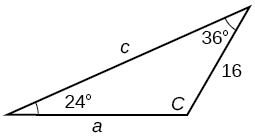
3. Solve the triangle.
Solution (click to reveal)
\(C = 120{^\circ},a = 23.1,c = 34.1\)
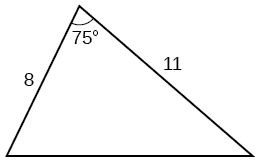
4. Find the area of the triangle.
5. A pilot is flying over a straight highway. He determines the angles of depression to two mileposts, 2.1 km apart, to be 25° and 49°, as shown in Figure 20. Find the distance of the plane from point \(A\) and the elevation of the plane.
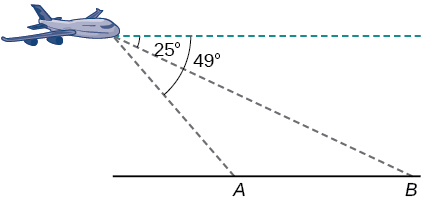
Figure 20
Solution (click to reveal)
distance of the plane from point \(A:\) 2.2 km, elevation of the plane: 1.6 km
Non-right Triangles: Law of Cosines
6. Solve the triangle, rounding to the nearest tenth, assuming \(\alpha\) is opposite side \(a,\beta\) is opposite side \(b,\) and \(\gamma\) is opposite side \(c:\; a = 4,\mspace{9mu}\mathbf{b} = 6,c = 8.\)
7. Solve the triangle in Figure 21, rounding to the nearest tenth.
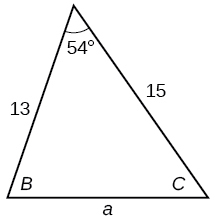
Figure 21
Solution (click to reveal)
\(\mathbf{b} = 71.0{^\circ},C = 55.0{^\circ},a = 12.8\)
8. Find the area of a triangle with sides of length 8.3, 6.6, and 9.1.
9. To find the distance between two cities, a satellite calculates the distances and angle shown in Figure 22 (not to scale). Find the distance between the cities. Round answers to the nearest tenth.
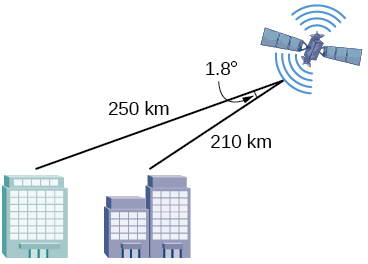
Figure 22
Solution (click to reveal)
40.6 km
Polar Coordinates
10. Plot the point with polar coordinates \(\left( {3,\frac{\pi}{6}} \right).\)
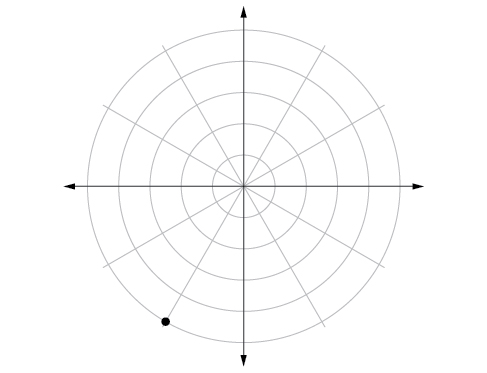
11. Plot the point with polar coordinates \(\left( {5, - \frac{2\pi}{3}} \right)\)
Solution (click to reveal)
12. Convert \(\left( {6, - \frac{3\pi}{4}} \right)\) to rectangular coordinates.
13. Convert \(\left( {- 2,\frac{3\pi}{2}} \right)\) to rectangular coordinates.
Solution (click to reveal)
\(\left( {0,2} \right)\)
14. Convert \(\left( {7, - 2} \right)\) to polar coordinates.
15. Convert \(\left( {- 9, - 4} \right)\) to polar coordinates.
Solution (click to reveal)
\(\left( {9.8489,203.96{^\circ}} \right)\)
For the following exercises, convert the given Cartesian equation to a polar equation.
16. \(x = - 2\)
17. \(x^{2} + y^{2} = 64\)
Solution (click to reveal)
\(r = 8\)
18. \(x^{2} + y^{2} = - 2y\)
For the following exercises, convert the given polar equation to a Cartesian equation.
19. \(r = 7\text{cos}\;\theta\)
Solution (click to reveal)
\(x^{2} + y^{2} = 7x\)
20. \(r = \frac{- 2}{4\cos\;\theta + \sin\;\theta}\)
For the following exercises, convert to rectangular form and graph.
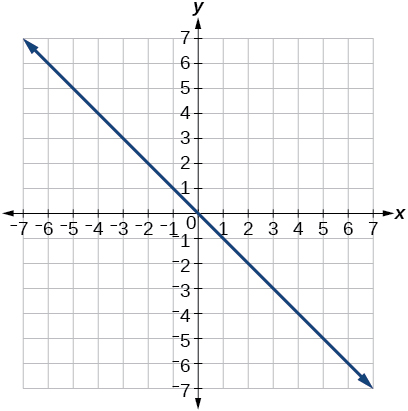
21. \(\theta = \frac{3\pi}{4}\)
Solution (click to reveal)
\(y = - x\)
22. \(r = 5\sec\;\theta\)
Polar Coordinates: Graphs
For the following exercises, test each equation for symmetry.
23. \(r = 4 + 4\sin\;\theta\)
Solution (click to reveal)
symmetric with respect to the line \(\theta = \frac{\pi}{2}\)
24. \(r = 7\)
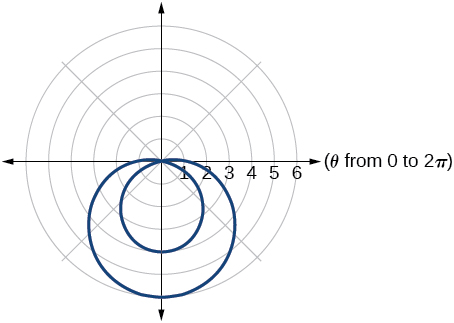
25. Sketch a graph of the polar equation \(r = 1 - 5\sin\;\theta.\) Label the axis intercepts.
Solution (click to reveal)
26. Sketch a graph of the polar equation \(r = 5\sin\left( {7\theta} \right).\)
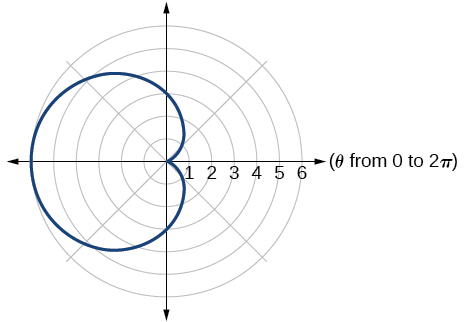
27. Sketch a graph of the polar equation \(r = 3 - 3\cos\;\theta\)
Solution (click to reveal)
Polar Form of Complex Numbers
For the following exercises, find the absolute value of each complex number.
28. \(- 2 + 6\mathbf{i}\)
29. \(4 - 3\mathbf{i}\)
Solution (click to reveal)
5
Write the complex number in polar form.
30. \(5 + 9\mathbf{i}\)
31. \(\frac{1}{2} - \frac{\sqrt{3}}{2}\mathbf{i}\)
Solution (click to reveal)
\({cis}\left( {- \frac{\pi}{3}} \right)\)
For the following exercises, convert the complex number from polar to rectangular form.
32. \(z = 5{cis}\left( \frac{5\pi}{6} \right)\)
33. \(z = 3{cis}(40{^\circ})\)
Solution (click to reveal)
\(2.3 + 1.9\mathbf{i}\)
For the following exercises, find the product \(z_{1}z_{2}\) in polar form.
34. \(z_{1} = 2{cis}(89{^\circ})\)
\(z_{2} = 5{cis}(23{^\circ})\)
35. \(z_{1} = 10{cis}\left( \frac{\pi}{6} \right)\)
\(z_{2} = 6{cis}\left( \frac{\pi}{3} \right)\)
Solution (click to reveal)
\(60{cis}\left( \frac{\pi}{2} \right)\)
For the following exercises, find the quotient \(\frac{z_{1}}{z_{2}}\) in polar form.
36. \(z_{1} = 12{cis}(55{^\circ})\)
\(z_{2} = 3{cis}(18{^\circ})\)
37. \(z_{1} = 27{cis}\left( \frac{5\pi}{3} \right)\)
\(z_{2} = 9{cis}\left( \frac{\pi}{3} \right)\)
Solution (click to reveal)
\(3{cis}\left( \frac{4\pi}{3} \right)\)
For the following exercises, find the powers of each complex number in polar form.
38. Find \(z^{4}\) when \(z = 2{cis}(70{^\circ})\)
39. Find \(z^{2}\) when \(z = 5{cis}\left( \frac{3\pi}{4} \right)\)
Solution (click to reveal)
\(25{cis}\left( \frac{3\pi}{2} \right)\)
For the following exercises, evaluate each root.
40. Evaluate the cube root of \(z\) when \(z = 64{cis}(210{^\circ}).\)
41. Evaluate the square root of \(z\) when \(z = 25{cis}\left( \frac{3\pi}{2} \right).\)
Solution (click to reveal)
\(5{cis}\left( \frac{3\pi}{4} \right),5{cis}\left( \frac{7\pi}{4} \right)\)
For the following exercises, plot the complex number in the complex plane.
42. \(6 - 2\mathbf{i}\)
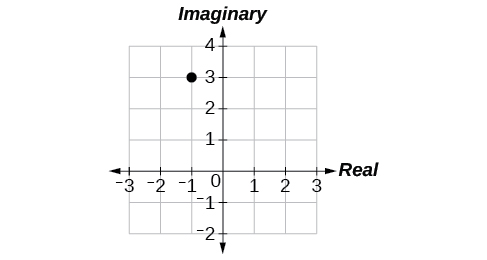
43. \(- 1 + 3\mathbf{i}\)
Solution (click to reveal)
Parametric Equations
For the following exercises, eliminate the parameter \(t\) to rewrite the parametric equation as a Cartesian equation.
44. \(\left\{ \begin{array}{l} {x(t) = 3t - 1} \\ {y(t) = \sqrt{t}} \end{array} \right.\)
45. \(\left\{ \begin{array}{l} {x(t) = - \cos\; t} \\ {y(t) = 2\sin^{2}t} \end{array} \right.\)
Solution (click to reveal)
\(x^{2} + \frac{1}{2}y = 1\)
46. Parameterize (write a parametric equation for) each Cartesian equation by using \(x(t) = a\cos\; t\) and \(y(t) = \mathbf{b}\sin\; t\) for \(\frac{x^{2}}{25} + \frac{y^{2}}{16} = 1.\)
47. Parameterize the line from \(( - 2,3)\) to \((4,7)\) so that the line is at \(( - 2,3)\) at \(t = 0\) and \((4,7)\) at \(t = 1.\)
Solution (click to reveal)
\(\left\{ \begin{array}{l} {x(t) = - 2 + 6t} \\ {y(t) = 3 + 4t} \end{array} \right.\)
Parametric Equations: Graphs
For the following exercises, make a table of values for each set of parametric equations, graph the equations, and include an orientation; then write the Cartesian equation.
48. \(\left\{ \begin{array}{l} {x(t) = 3t^{2}} \\ {y(t) = 2t - 1} \end{array} \right.\)
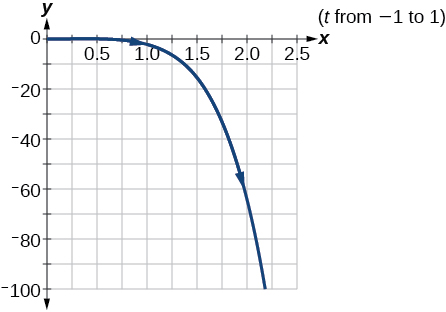
49. \(\left\{ \begin{array}{l} {x(t) = e^{t}} \\ {y(t) = - 2e^{5\; t}} \end{array} \right.\)
Solution (click to reveal)
\(y = - 2x^{5}\)
50. \(\left\{ \begin{array}{l} {x(t) = 3\cos\; t} \\ {y(t) = 2\sin\; t} \end{array} \right.\)
51. A ball is launched with an initial velocity of 80 feet per second at an angle of 40° to the horizontal. The ball is released at a height of 4 feet above the ground.
ⓐ Find the parametric equations to model the path of the ball.
ⓑ Where is the ball after 3 seconds?
ⓒ How long is the ball in the air?
Solution (click to reveal)
- \(\left\{ \begin{array}{l} {x(t) = \left( {80\cos(40{^\circ})} \right)t} \\ {y(t) = - 16t^{2} + \left( {80\sin(40{^\circ})} \right)t + 4} \end{array} \right.\)
- The ball is 14 feet high and 184 feet from where it was launched.
- 3.3 seconds
Vectors
For the following exercises, determine whether the two vectors, \(\mathbf{u}\) and \(\mathbf{v},\) are equal, where \(\mathbf{u}\) has an initial point \(P_{1}\) and a terminal point \(P_{2},\) and \(\mathbf{v}\) has an initial point \(P_{3}\) and a terminal point \(P_{4}.\)
52. \(P_{1} = \left( {- 1,4} \right),P_{2} = \left( {3,1} \right),P_{3} = \left( {5,5} \right)\) and \(P_{4} = \left( {9,2} \right)\)
53. \(P_{1} = \left( {6,11} \right),P_{2} = \left( {- 2,8} \right),P_{3} = \left( {0, - 1} \right)\) and \(P_{4} = \left( {- 8,2} \right)\)
Solution (click to reveal)
not equal
For the following exercises, use the vectors \(\mathbf{u}\mathbf{=}2\mathbf{i} - \mathbf{j}\text{,}\mathbf{v} = 4\mathbf{i} - 3\mathbf{j}\text{,}\) and \(w = - 2\mathbf{i} + 5\mathbf{j}\) to evaluate the expression.
54. \(u\) − \(v\)
55. 2\(v\) − \(u\) + \(w\)
Solution (click to reveal)
4\(i\)
For the following exercises, find a unit vector in the same direction as the given vector.
56. \(a\) = 8\(i\) − 6\(j\)
57. \(b\) = −3\(i\) − \(j\)
Solution (click to reveal)
\(- \frac{3\sqrt{10}}{10}\) \(i\) \(- \frac{\sqrt{10}}{10}\) \(j\)
For the following exercises, find the magnitude and direction of the vector.
58. \(\left\langle {6,-2} \right\rangle\)
59. \(\left\langle {-3,-3} \right\rangle\)
Solution (click to reveal)
Magnitude: \(3\sqrt{2},\) Direction: \(\text{225°}\)
For the following exercises, calculate \(\mathbf{u} \cdot \mathbf{v}\text{.}\)
60. \(u\) = −2\(i\) + \(j\) and \(v\) = 3\(i\) + 7\(j\)
61. \(u\) = \(i\) + 4\(j\) and \(v\) = 4\(i\) + 3\(j\)
Solution (click to reveal)
\(\text{16}\)
62. Given \(v\) \(= {\langle{-3,4}\rangle}\) draw \(v\), 2\(v\), and \(\frac{1}{2}\) \(v\).
63. Given the vectors shown in Figure 23, sketch \(u\) + \(v\), \(u\) − \(v\) and 3\(v\).
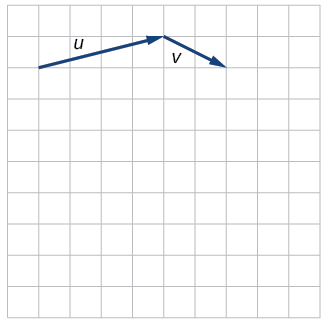
Figure 23
Solution (click to reveal)
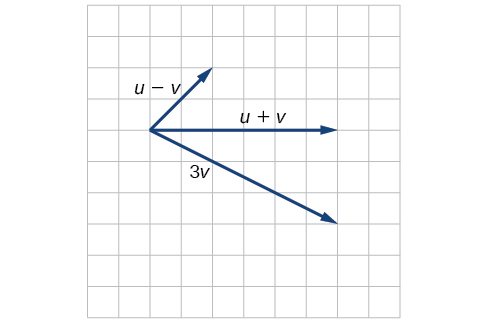
64. Given initial point \(P_{1} = \left( {3,2} \right)\) and terminal point \(P_{2} = \left( {- 5, - 1} \right),\) write the vector \(\mathbf{v}\) in terms of \(\mathbf{i}\) and \(\mathbf{j}.\) Draw the points and the vector on the graph.
Practice Test
1. Assume \(\alpha\) is opposite side \(a,\beta\) is opposite side \(b,\) and \(\gamma\) is opposite side \(c.\) Solve the triangle, if possible, and round each answer to the nearest tenth, given \(\beta = 68{^\circ},b = 21,c = 16.\)
Solution (click to reveal)
\(\alpha = 67.1{^\circ},\gamma = 44.9{^\circ},a = 20.9\)
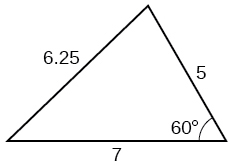
2. Find the area of the triangle in . Round each answer to the nearest tenth.
3. A pilot flies in a straight path for 2 hours. He then makes a course correction, heading 15° to the right of his original course, and flies 1 hour in the new direction. If he maintains a constant speed of 575 miles per hour, how far is he from his starting position?
Solution (click to reveal)
\(\text{1712~miles}\)
4. Convert \(\left( {2,2} \right)\) to polar coordinates, and then plot the point.
5. Convert \(\left( {2,\frac{\pi}{3}} \right)\) to rectangular coordinates.
Solution (click to reveal)
\(\left( {1,\sqrt{3}} \right)\)
6. Convert the polar equation to a Cartesian equation: \(x^{2} + y^{2} = 5{y.}\)
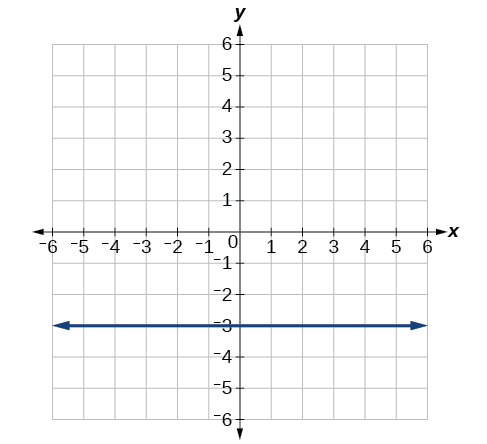
7. Convert to rectangular form and graph: \(r = - 3\csc\;\theta.\)
Solution (click to reveal)
\(y = - 3\)
8. Test the equation for symmetry: \(r = - 4\sin\left( {2\theta}\operatorname{).} \right.\)
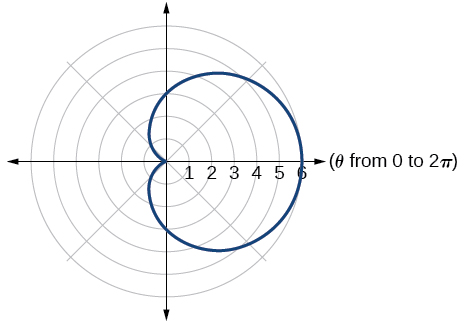
9. Graph \(r = 3 + 3\cos\;\theta.\)
Solution (click to reveal)
10. Graph \(r = 3 - 5\text{sin}\;\theta.\)
11. Find the absolute value of the complex number \(5 - 9i.\)
Solution (click to reveal)
\(\sqrt{106}\)
12. Write the complex number in polar form: \(4 + i\text{.}\)
13. Convert the complex number from polar to rectangular form: \(z = 5\text{cis}\left( \frac{2\pi}{3} \right).\)
Solution (click to reveal)
\(\frac{- 5}{2} + \mathbf{i}\frac{5\sqrt{3}}{2}\)
Given \(z_{1} = 8{cis}(36{^\circ})\) and \(z_{2} = 2{cis}(15{^\circ}),\) evaluate each expression.
14. \(z_{1}z_{2}\)
15. \(\frac{z_{1}}{z_{2}}\)
Solution (click to reveal)
\(4{cis}(21{^\circ})\)
16. \(\left( z_{2} \right)^{3}\)
17. \(\sqrt{z_{1}}\)
Solution (click to reveal)
\(2\sqrt{2}{cis}(18{^\circ}),2\sqrt{2}{cis}(198{^\circ})\)
18. Plot the complex number \(-5 - \mathbf{i}\) in the complex plane.
19. Eliminate the parameter \(t\) to rewrite the following parametric equations as a Cartesian equation: \(\left\{ \begin{array}{l} {x(t) = t + 1} \\ {y(t) = 2t^{2}} \end{array} \right..\)
Solution (click to reveal)
\(y = 2\left( {x - 1} \right)^{2}\)
20. Parameterize (write a parametric equation for) the following Cartesian equation by using \(x(t) = a\cos\; t\) and \(y(t) = \mathbf{b}\sin\; t:\) \(\frac{x^{2}}{36} + \frac{y^{2}}{100} = 1.\)
21. Graph the set of parametric equations and find the Cartesian equation: \(\left\{ \begin{array}{l} {x(t) = - 2\sin\; t} \\ {y(t) = 5\cos\; t} \end{array} \right..\)
Solution (click to reveal)
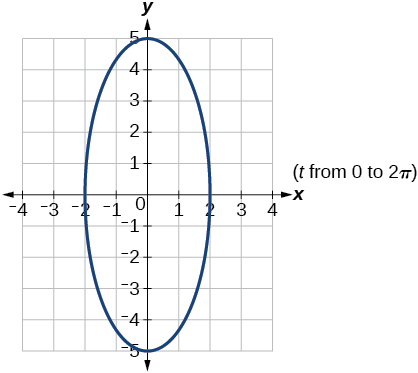
22. A ball is launched with an initial velocity of 95 feet per second at an angle of 52° to the horizontal. The ball is released at a height of 3.5 feet above the ground.
ⓐ Find the parametric equations to model the path of the ball.
ⓑ Where is the ball after 2 seconds?
ⓒ How long is the ball in the air?
For the following exercises, use the vectors \(u\) = \(i\) − 3\(j\) and \(v\) = 2\(i\) + 3\(j\).
23. Find 2\(u\) − 3\(v\).
Solution (click to reveal)
−4\(i\) − 15\(j\)
24. Calculate \(\mathbf{u} \cdot \mathbf{v}.\)
25. Find a unit vector in the same direction as \(\mathbf{v}.\)
Solution (click to reveal)
\(\frac{2\sqrt{13}}{13}\mathbf{i} + \frac{3\sqrt{13}}{13}\mathbf{j}\)
26. Given vector \(\mathbf{v}\) has an initial point \(P_{1} = \left( {2,2} \right)\) and terminal point \(P_{2} = \left( {- 1,0} \right),\) write the vector \(\mathbf{v}\) in terms of \(\mathbf{i}\) and \(\mathbf{j}.\) On the graph, draw \(\mathbf{v},\) and \(- \mathbf{v}.\)