Chapter Review
Key Terms
adjacent side — in a right triangle, the side between a given angle and the right angle
angle — the union of two rays having a common endpoint
angle of depression — the angle between the horizontal and the line from the object to the observer’s eye, assuming the object is positioned lower than the observer
angle of elevation — the angle between the horizontal and the line from the object to the observer’s eye, assuming the object is positioned higher than the observer
angular speed — the angle through which a rotating object travels in a unit of time
arc length — the length of the curve formed by an arc
area of a sector — area of a portion of a circle bordered by two radii and the intercepted arc; the fraction \(\frac{\theta}{2\pi}.\) multiplied by the area of the entire circle
cosecant — the reciprocal of the sine function: on the unit circle, \(\text{csc}\; t = \frac{1}{y},y \neq 0\)
cosine function — the \(x\)-value of the point on a unit circle corresponding to a given angle
cotangent — the reciprocal of the tangent function: on the unit circle, \(\text{cot}\; t = \frac{x}{y},y \neq 0\)
coterminal angles — description of positive and negative angles in standard position sharing the same terminal side
degree — a unit of measure describing the size of an angle as one-360th of a full revolution of a circle
hypotenuse — the side of a right triangle opposite the right angle
identities — statements that are true for all values of the input on which they are defined
initial side — the side of an angle from which rotation begins
linear speed — the distance along a straight path a rotating object travels in a unit of time; determined by the arc length
measure of an angle — the amount of rotation from the initial side to the terminal side
negative angle — description of an angle measured clockwise from the positive \(x\)-axis
opposite side — in a right triangle, the side most distant from a given angle
period — the smallest interval \(P\) of a repeating function \(f\) such that \(f(x + P) = f(x)\)
positive angle — description of an angle measured counterclockwise from the positive \(x\)-axis
Pythagorean Identity — a corollary of the Pythagorean Theorem stating that the square of the cosine of a given angle plus the square of the sine of that angle equals 1
quadrantal angle — an angle whose terminal side lies on an axis
radian — the measure of a central angle of a circle that intercepts an arc equal in length to the radius of that circle
radian measure — the ratio of the arc length formed by an angle divided by the radius of the circle
ray — one point on a line and all points extending in one direction from that point; one side of an angle
reference angle — the measure of the acute angle formed by the terminal side of the angle and the horizontal axis
secant — the reciprocal of the cosine function: on the unit circle, \(\sec\; t = \frac{1}{x},x \neq 0\)
sine function — the \(y\)-value of the point on a unit circle corresponding to a given angle
standard position — the position of an angle having the vertex at the origin and the initial side along the positive \(x\)-axis
tangent — the quotient of the sine and cosine: on the unit circle, \(\tan\; t = \frac{y}{x},x \neq 0\)
terminal side — the side of an angle at which rotation ends
unit circle — a circle with a center at \((0,0)\) and radius 1
vertex — the common endpoint of two rays that form an angle
Key Equations
| arc length | \(s = r\theta\) |
| area of a sector | \(A = \frac{1}{2}\theta r^{2}\) |
| angular speed | \(\omega = \frac{\theta}{t}\) |
| linear speed | \(v = \frac{s}{t}\) |
| linear speed related to angular speed | \(v = r\omega\) |
| Trigonometric Functions | \(\begin{array}{ll} \text{Sine} & {\quad\text{sin~}t = \frac{\text{opposite}}{\text{hypotenuse}}} \\ \text{Cosine} & {\quad\text{cos~}t = \frac{\text{adjacent}}{\text{hypotenuse}}} \\ \text{Tangent} & {\quad\text{tan~}t = \frac{\text{opposite}}{\text{adjacent}}} \\ \text{Secant} & {\quad\text{sec~}t = \frac{\text{hypotenuse}}{\text{adjacent}}} \\ \text{Cosecant} & {\quad\text{csc~}t = \frac{\text{hypotenuse}}{\text{opposite}}} \\ \text{Cotangent} & {\quad\text{cot~}t = \frac{\text{adjacent}}{\text{opposite}}} \end{array}\) |
| Reciprocal Trigonometric Functions | \(\begin{array}{ll} {\text{sin~}t = \frac{1}{\text{csc~}t}} & {\quad\text{csc~}t = \frac{1}{\text{sin~}t}} \\ {\text{cos~}t = \frac{1}{\text{sec~}t}} & {\quad\text{sec~}t = \frac{1}{\text{cos~}t}} \\ {\text{tan~}t = \frac{1}{\text{cot~}t}} & {\quad\text{cot~}t = \frac{1}{\text{tan~}t}} \end{array}\) |
| Cofunction Identities | \(\begin{array}{l} {\text{cos~}t = \sin\left( {\frac{\pi}{2} - t} \right)} \\ {\text{sin~}t = \cos\left( {\frac{\pi}{2} - t} \right)} \\ {\text{tan~}t = \cot\left( {\frac{\pi}{2} - t} \right)} \\ {\text{cot~}t = \tan\left( {\frac{\pi}{2} - t} \right)} \\ {\text{sec~}t = \csc\left( {\frac{\pi}{2} - t} \right)} \end{array}\) |
| Cosine | \(\cos\; t = x\) |
| Sine | \(\sin\; t = y\) |
| Pythagorean Identity | \(\cos^{2}t + \sin^{2}t = 1\) |
| Tangent function | \(\tan\; t = \frac{\sin\; t}{\cos\; t}\) |
| Secant function | \(\sec\; t = \frac{1}{\cos\; t}\) |
| Cosecant function | \(\csc\; t = \frac{1}{\sin\; t}\) |
| Cotangent function | \(\text{cot}\; t = \frac{1}{\text{tan}\; t} = \frac{\text{cos}\; t}{\text{sin}\; t}\) |
Key Concepts
7.1 Angles
- An angle is formed from the union of two rays, by keeping the initial side fixed and rotating the terminal side. The amount of rotation determines the measure of the angle.
- An angle is in standard position if its vertex is at the origin and its initial side lies along the positive \(x\)-axis. A positive angle is measured counterclockwise from the initial side and a negative angle is measured clockwise.
- To draw an angle in standard position, draw the initial side along the positive \(x\)-axis and then place the terminal side according to the fraction of a full rotation the angle represents. See Example 1.
- In addition to degrees, the measure of an angle can be described in radians. See Example 2.
- To convert between degrees and radians, use the proportion \(\frac{\theta}{180} = \frac{\theta_{R}}{\pi}.\) See Example 3 and Example 4.
- Two angles that have the same terminal side are called coterminal angles.
- We can find coterminal angles by adding or subtracting \(360{^\circ}\) or \(2\pi.\) See Example 5 and Example 6.
- Coterminal angles can be found using radians just as they are for degrees. See Example 7.
- The length of a circular arc is a fraction of the circumference of the entire circle. See Example 8.
- The area of sector is a fraction of the area of the entire circle. See Example 9.
- An object moving in a circular path has both linear and angular speed.
- The angular speed of an object traveling in a circular path is the measure of the angle through which it turns in a unit of time. See Example 10.
- The linear speed of an object traveling along a circular path is the distance it travels in a unit of time. See Example 11.
7.2 Right Triangle Trigonometry
- We can define trigonometric functions as ratios of the side lengths of a right triangle. See Example 1.
- The same side lengths can be used to evaluate the trigonometric functions of either acute angle in a right triangle. See Example 2.
- We can evaluate the trigonometric functions of special angles, knowing the side lengths of the triangles in which they occur. See Example 3.
- Any two complementary angles could be the two acute angles of a right triangle.
- If two angles are complementary, the cofunction identities state that the sine of one equals the cosine of the other and vice versa. See Example 4.
- We can use trigonometric functions of an angle to find unknown side lengths.
- Select the trigonometric function representing the ratio of the unknown side to the known side. See Example 5.
- Right-triangle trigonometry facilitates the measurement of inaccessible heights and distances.
- The unknown height or distance can be found by creating a right triangle in which the unknown height or distance is one of the sides, and another side and angle are known. See Example 6.
7.3 Unit Circle
- Finding the function values for the sine and cosine begins with drawing a unit circle, which is centered at the origin and has a radius of 1 unit.
- Using the unit circle, the sine of an angle \(t\) equals the \(y\)-value of the endpoint on the unit circle of an arc of length \(t\) whereas the cosine of an angle \(t\) equals the \(x\)-value of the endpoint. See Example 1.
- The sine and cosine values are most directly determined when the corresponding point on the unit circle falls on an axis. See Example 2.
- When the sine or cosine is known, we can use the Pythagorean Identity to find the other. The Pythagorean Identity is also useful for determining the sines and cosines of special angles. See Example 3.
- Calculators and graphing software are helpful for finding sines and cosines if the proper procedure for entering information is known. See Example 4.
- The domain of the sine and cosine functions is all real numbers.
- The range of both the sine and cosine functions is \(\lbrack-1,1\rbrack.\)
- The sine and cosine of an angle have the same absolute value as the sine and cosine of its reference angle.
- The signs of the sine and cosine are determined from the \(x\)- and \(y\)-values in the quadrant of the original angle.
- An angle’s reference angle is the size angle, \(t,\) formed by the terminal side of the angle \(t\) and the horizontal axis. See Example 5.
- Reference angles can be used to find the sine and cosine of the original angle. See Example 6.
- Reference angles can also be used to find the coordinates of a point on a circle. See Example 7.
7.4 The Other Trigonometric Functions
- The tangent of an angle is the ratio of the \(y\)-value to the \(x\)-value of the corresponding point on the unit circle.
- The secant, cotangent, and cosecant are all reciprocals of other functions. The secant is the reciprocal of the cosine function, the cotangent is the reciprocal of the tangent function, and the cosecant is the reciprocal of the sine function.
- The six trigonometric functions can be found from a point on the unit circle. See Example 1.
- Trigonometric functions can also be found from an angle. See Example 2.
- Trigonometric functions of angles outside the first quadrant can be determined using reference angles. See Example 3.
- A function is said to be even if \(f(-x) = f(x)\) and odd if \(f\left( {- x} \right) = -f(x)\) for all \(x\) in the domain of \(f\).
- Cosine and secant are even; sine, tangent, cosecant, and cotangent are odd.
- Even and odd properties can be used to evaluate trigonometric functions. See Example 4.
- The Pythagorean Identity makes it possible to find a cosine from a sine or a sine from a cosine.
- Identities can be used to evaluate trigonometric functions. See Example 5 and Example 6.
- Fundamental identities such as the Pythagorean Identity can be manipulated algebraically to produce new identities. See Example 7.
- The trigonometric functions repeat at regular intervals.
- The period \(P\) of a repeating function \(f\) is the smallest interval such that \(f(x + P) = f(x)\) for any value of \(x.\)
- The values of trigonometric functions can be found by mathematical analysis. See Example 8 and Example 9.
- To evaluate trigonometric functions of other angles, we can use a calculator or computer software. See Example 10.
Chapter Review Exercises
Angles
For the following exercises, convert the angle measures to degrees.
1. \(\frac{\pi}{4}\)
Solution (click to reveal)
\(45{^\circ}\)
2. \(- \frac{5\pi}{3}\)
For the following exercises, convert the angle measures to radians.
3. \(-210{^\circ}\)
Solution (click to reveal)
\(- \frac{7\pi}{6}\)
4. \(180{^\circ}\)
5. Find the length of an arc in a circle of radius 7 meters subtended by the central angle of \(85{^\circ}.\)
Solution (click to reveal)
10.385 meters
6. Find the area of the sector of a circle with diameter 32 feet and an angle of \(\frac{3\pi}{5}\) radians.
For the following exercises, find the angle between \(0{^\circ}\) and \(\text{360°}\) that is coterminal with the given angle.
7. \(420{^\circ}\)
Solution (click to reveal)
\(60{^\circ}\)
8. \(-80{^\circ}\)
For the following exercises, find the angle between 0 and \(2\pi\) in radians that is coterminal with the given angle.
9. \(- \;\frac{20\pi}{11}\)
Solution (click to reveal)
\(\frac{2\pi}{11}\)
10. \(\frac{14\pi}{5}\)
For the following exercises, draw the angle provided in standard position on the Cartesian plane.
11. \(-210{^\circ}\)
Solution (click to reveal)
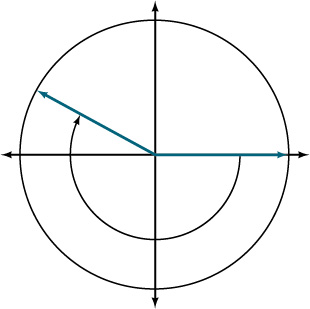
12. \(75{^\circ}\)
13. \(\frac{5\pi}{4}\)
Solution (click to reveal)
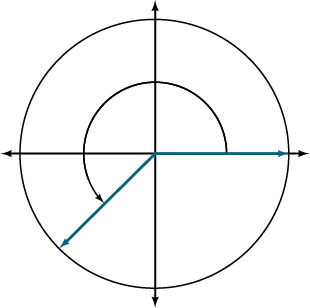
14. \(- \frac{\pi}{3}\)
15. Find the linear speed of a point on the equator of the earth if the earth has a radius of 3,960 miles and the earth rotates on its axis every 24 hours. Express answer in miles per hour. Round to the nearest hundredth.
Solution (click to reveal)
1036.73 miles per hour
16. A car wheel with a diameter of 18 inches spins at the rate of 10 revolutions per second. What is the car’s speed in miles per hour? Round to the nearest hundredth.
Right Triangle Trigonometry
For the following exercises, use side lengths to evaluate.
17. \(\cos\;\frac{\pi}{4}\)
Solution (click to reveal)
\(\frac{\sqrt{2}}{2}\)
18. \(\cot\;\frac{\pi}{3}\)
19. \(\tan\;\frac{\pi}{6}\)
Solution (click to reveal)
\(\frac{\sqrt{3}}{3}\)
20. \(\cos\left( \frac{\pi}{2} \right) = \sin\left( \operatorname{\_\_\_{^\circ}} \right)\)
21. \(\csc(18{^\circ}) = \sec\left( \operatorname{\_\_\_{^\circ}} \right)\)
Solution (click to reveal)
\(72{^\circ}\)
For the following exercises, use the given information to find the lengths of the other two sides of the right triangle.
22. \(\cos\; B = \frac{3}{5},a = 6\)
23. \(\tan\; A = \frac{5}{9},b = 6\)
Solution (click to reveal)
\(a = \frac{10}{3},c = \frac{2\sqrt{106}}{3}\)
For the following exercises, use Figure 11 to evaluate each trigonometric function.
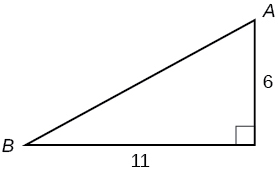
Figure 11
24. \(\sin\; A\)
25. \(\tan\; B\)
Solution (click to reveal)
\(\frac{6}{11}\)
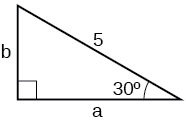
For the following exercises, solve for the unknown sides of the given triangle.
26.
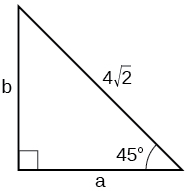
27.
Solution (click to reveal)
\(a = \frac{5\sqrt{3}}{2},b = \frac{5}{2}\)
28. A 15-ft ladder leans against a building so that the angle between the ground and the ladder is \(70{^\circ}.\) How high does the ladder reach up the side of the building? Find the answer to four decimal places.
29. The angle of elevation to the top of a building in Baltimore is found to be 4 degrees from the ground at a distance of 1 mile from the base of the building. Using this information, find the height of the building. Find the answer to four decimal places.
Solution (click to reveal)
369.2136 ft
Unit Circle
30. Find the exact value of \(\sin\;\frac{\pi}{3}.\)
31. Find the exact value of \(\cos\;\frac{\pi}{4}.\)
Solution (click to reveal)
\(\frac{\sqrt{2}}{2}\)
32. Find the exact value of \(\cos\;\pi.\)
33. State the reference angle for \(300{^\circ}.\)
Solution (click to reveal)
\(60{^\circ}\)
34. State the reference angle for \(\frac{3\pi}{4}.\)
35. Compute cosine of \(330{^\circ}.\)
Solution (click to reveal)
\(\frac{\sqrt{3}}{2}\)
36. Compute sine of \(\frac{5\pi}{4}.\)
37. State the domain of the sine and cosine functions.
Solution (click to reveal)
all real numbers
38. State the range of the sine and cosine functions.
The Other Trigonometric Functions
For the following exercises, find the exact value of the given expression.
39. \(\cos\;\frac{\pi}{6}\)
Solution (click to reveal)
\(\frac{\sqrt{3}}{2}\)
40. \(\tan\;\frac{\pi}{4}\)
41. \(\csc\;\frac{\pi}{3}\)
Solution (click to reveal)
\(\frac{2\sqrt{3}}{3}\)
42. \(\sec\;\frac{\pi}{4}\)
For the following exercises, use reference angles to evaluate the given expression.
43. \(\sec\;\frac{11\pi}{3}\)
Solution (click to reveal)
2
44. \(\sec\; 315{^\circ}\)
45. If \(\sec(t) = -2.5,\) what is the \(\text{sec}( - t)?\)
Solution (click to reveal)
–2.5
46. If \(\text{tan}(t) = -0.6,\) what is the \(\text{tan}( - t)?\)
47. If \(\text{tan}(t) = \frac{1}{3},\) find \(\text{tan}(t - \pi).\)
Solution (click to reveal)
\(\frac{1}{3}\)
48. If \(\text{cos}(t) = \frac{\sqrt{2}}{2},\) find \(\text{sin}(t + 2\pi).\) There are two possible solutions.
49. Which trigonometric functions are even?
Solution (click to reveal)
cosine, secant
50. Which trigonometric functions are odd?
Chapter Practice Test
1. Convert \(\frac{5\pi}{6}\) radians to degrees.
Solution (click to reveal)
\(150{^\circ}\)
2. Convert \(-620{^\circ}\) to radians.
3. Find the length of a circular arc with a radius 12 centimeters subtended by the central angle of \(30{^\circ}.\)
Solution (click to reveal)
6.283 centimeters
4. Find the area of the sector with radius of 8 feet and an angle of \(\frac{5\pi}{4}\) radians.
5. Find the angle between \(0{^\circ}\) and \(\text{360°}\) that is coterminal with \(375{^\circ}.\)
Solution (click to reveal)
\(15{^\circ}\)
6. Find the angle between 0 and \(2\pi\) in radians that is coterminal with \(- \frac{4\pi}{7}.\)
7. Draw the angle \(315{^\circ}\) in standard position on the Cartesian plane.
Solution (click to reveal)
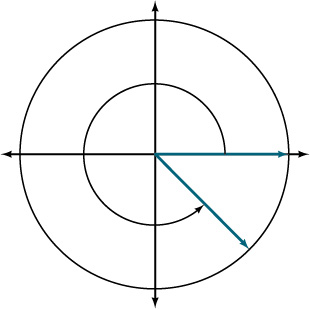
8. Draw the angle \(- \frac{\pi}{6}\) in standard position on the Cartesian plane.
9. A carnival has a Ferris wheel with a diameter of 80 feet. The time for the Ferris wheel to make one revolution is 75 seconds. What is the linear speed in feet per second of a point on the Ferris wheel? What is the angular speed in radians per second?
Solution (click to reveal)
3.351 feet per second, \(\frac{2\pi}{75}\) radians per second
10. Find the missing sides of the triangle \(ABC:\sin\; B = \frac{3}{4},c = 12.\)
11. Find the missing sides of the triangle.
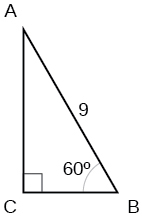
Solution (click to reveal)
\(a = \frac{9}{2},b = \frac{9\sqrt{3}}{2}\)
12. The angle of elevation to the top of a building in Chicago is found to be 9 degrees from the ground at a distance of 2000 feet from the base of the building. Using this information, find the height of the building.
13. Find the exact value of \(\sin\;\frac{\pi}{6}.\)
Solution (click to reveal)
\(\frac{1}{2}\)
14. Compute sine of \(240{^\circ}.\)
15. State the domain of the sine and cosine functions.
Solution (click to reveal)
real numbers
16. State the range of the sine and cosine functions.
17. Find the exact value of \(\cot\;\frac{\pi}{4}.\)
Solution (click to reveal)
1
18. Find the exact value of \(\tan\;\frac{\pi}{3}.\)
19. Use reference angles to evaluate \(\csc\;\frac{7\pi}{4}.\)
Solution (click to reveal)
\(- \sqrt{2}\)
20. Use reference angles to evaluate \(\tan\; 210{^\circ}.\)
21. If \(\text{csc}\; t = 0.68,\) what is the \(\text{csc}( - t)?\)
Solution (click to reveal)
–0.68
22. If \(\text{cos}\; t = \frac{\sqrt{3}}{2},\) find \(\text{cos}(t - 2\pi).\)
23. Find the missing angle: \(\cos\left( \frac{\pi}{6} \right) = \sin\left( \operatorname{\_\_\_} \right)\)
Solution (click to reveal)
\(\frac{\pi}{3}\)