6.3 Double-Angle, Half-Angle, and Reduction Formulas
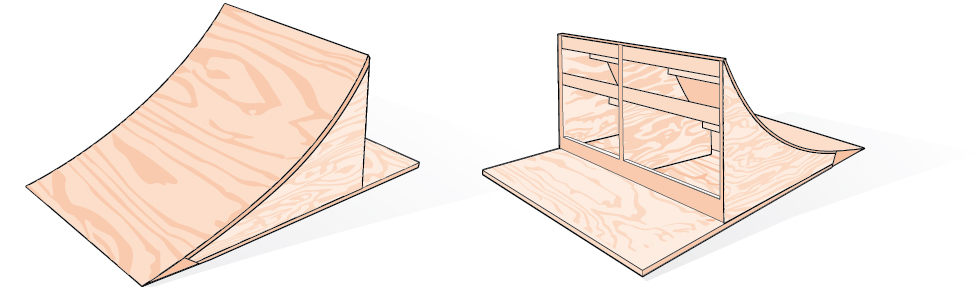
Figure 6.3.1: Bicycle and skateboard ramps for advanced riders have a steeper incline than those designed for novices.
Bicycle and skateboard ramps made for competition (see Figure 6.3.1) must vary in height depending on the skill level of the competitors. For advanced competitors, the angle formed by the ramp and the ground should be \(\theta\) such that \(\tan\;\theta = \frac{5}{3}.\) The angle is divided in half for novices. What is the steepness of the ramp for novices? In this section, we will investigate three additional categories of identities that we can use to answer questions such as this one.
6.3.1 Using Double-Angle Formulas to Find Exact Values
In the previous section, we used addition and subtraction formulas for trigonometric functions. Now, we take another look at those same formulas. The double-angle formulas are a special case of the sum formulas, where \(\alpha = \beta.\) Deriving the double-angle formula for sine begins with the sum formula,
\[\sin\left( {\alpha + \beta} \right) = \sin\;\alpha\;\cos\;\beta + \cos\;\alpha\;\sin\;\beta\]
If we let \(\alpha = \beta = \theta,\) then we have
\[\begin{array}{rcl} {\sin(\theta + \theta)} & = & {\sin\;\theta\;\cos\;\theta + \cos\;\theta\;\sin\;\theta} \\ {\sin(2\theta)} & = & {2\sin\;\theta\;\cos\;\theta} \end{array}\]
Deriving the double-angle for cosine gives us three options. First, starting from the sum formula, \(\cos\left( {\alpha + \beta} \right) = \cos\;\alpha\;\cos\;\beta - \sin\;\alpha\;\sin\;\beta,\) and letting \(\alpha = \beta = \theta,\) we have
\[\begin{array}{rcl} {\cos(\theta + \theta)} & = & {\cos\;\theta\;\cos\;\theta - \sin\;\theta\;\sin\;\theta} \\ {\cos(2\theta)} & = & {\cos^{2}\theta - \sin^{2}\theta} \end{array}\]
Using the Pythagorean properties, we can expand this double-angle formula for cosine and get two more variations. The first variation is:
\[\begin{array}{ccl} {\cos(2\theta)} & = & {\cos^{2}\theta - \sin^{2}\theta} \\ & = & {\left( {1 - \sin^{2}\theta} \right) - \sin^{2}\theta} \\ & = & {1 - 2\sin^{2}\theta} \end{array}\]
The second variation is:
\[\begin{array}{ccl} {\cos(2\theta)} & = & {\cos^{2}\theta - \sin^{2}\theta} \\ & = & {\cos^{2}\theta - \left( {1 - \cos^{2}\theta} \right)} \\ & = & {2\;\cos^{2}\theta - 1} \end{array}\]
Similarly, to derive the double-angle formula for tangent, replacing \(\alpha = \beta = \theta\) in the sum formula gives
\[\begin{array}{rcl} {\tan(\alpha + \beta)} & = & \frac{\tan\;\alpha + \tan\;\beta}{1 - \tan\;\alpha\;\tan\;\beta} \\ {\tan(\theta + \theta)} & = & \frac{\tan\;\theta + \tan\;\theta}{1 - \tan\;\theta\;\tan\;\theta} \\ {\tan(2\theta)} & = & \frac{2\tan\;\theta}{1 - \tan^{2}\theta} \end{array}\]
Given that \(\tan\;\theta = - \frac{3}{4}\) and \(\theta\) is in quadrant II, find the following:
ⓐ \(\sin\left( {2\theta} \right)\)
ⓑ \(\cos\left( {2\theta} \right)\)
ⓒ \(\tan\left( {2\theta} \right)\)
Solution (click to reveal)
If we draw a triangle to reflect the information given, we can find the values needed to solve the problems on the image. We are given \(\tan\;\theta = - \frac{3}{4},\) such that \(\theta\) is in quadrant II. The tangent of an angle is equal to the opposite side over the adjacent side, and because \(\theta\) is in the second quadrant, the adjacent side is on the \(x\)-axis and is negative. Use the Pythagorean Theorem to find the length of the hypotenuse:
\[\begin{array}{rcl} {{(-4)}^{2} + {(3)}^{2}} & = & c^{2} \\ {16 + 9} & = & c^{2} \\ 25 & = & c^{2} \\ c & = & 5 \end{array}\]
Now we can draw a triangle similar to the one shown in Figure 2.
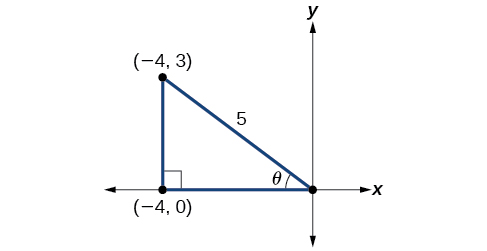
Figure 2
ⓐ Let’s begin by writing the double-angle formula for sine.
\[\sin(2\theta) = 2\;\sin\;\theta\;\cos\;\theta\]
We see that we to need to find \(\sin\;\theta\) and \(\cos\;\theta.\) Based on Figure 2, we see that the hypotenuse equals 5, so \(\sin\;\theta = \frac{3}{5},\) and \(\cos\;\theta = - \frac{4}{5}.\) Substitute these values into the equation, and simplify.Thus,
\[\begin{array}{ccl} {\sin(2\theta)} & = & {2\left( \frac{3}{5} \right)\left( {- \frac{4}{5}} \right)} \\ & = & {- \frac{24}{25}} \end{array}\]
ⓑ Write the double-angle formula for cosine.
\[\cos\left( {2\theta} \right) = \cos^{2}\theta - \sin^{2}\theta\]
Again, substitute the values of the sine and cosine into the equation, and simplify.
\[\begin{array}{ccl} {\cos(2\theta)} & = & {\left( {- \frac{4}{5}} \right)^{2} - \left( \frac{3}{5} \right)^{2}} \\ & = & {\frac{16}{25} - \frac{9}{25}} \\ & = & \frac{7}{25} \end{array}\]
ⓒ Write the double-angle formula for tangent.
\[\tan(2\theta) = \frac{2\;\tan\;\theta}{1 - \tan^{2}\theta}\]
In this formula, we need the tangent, which we were given as \(\tan\;\theta = - \frac{3}{4}.\) Substitute this value into the equation, and simplify.
\[\begin{array}{ccl} {\tan(2\theta)} & = & \frac{2\left( {- \frac{3}{4}} \right)}{1 - \left( {- \frac{3}{4}} \right)^{2}} \\ & = & \frac{- \frac{3}{2}}{1 - \frac{9}{16}} \\ & = & {- \frac{3}{2}\left( \frac{16}{7} \right)} \\ & = & {- \frac{24}{7}} \end{array}\]
6.3.2 Using Double-Angle Formulas to Verify Identities
Establishing identities using the double-angle formulas is performed using the same steps we used to derive the sum and difference formulas. Choose the more complicated side of the equation and rewrite it until it matches the other side.
6.3.3 Use Reduction Formulas to Simplify an Expression
The double-angle formulas can be used to derive the reduction formulas, which are formulas we can use to reduce the power of a given expression involving even powers of sine or cosine. They allow us to rewrite the even powers of sine or cosine in terms of the first power of cosine. These formulas are especially important in higher-level math courses, calculus in particular. Also called the power-reducing formulas, three identities are included and are easily derived from the double-angle formulas.
We can use two of the three double-angle formulas for cosine to derive the reduction formulas for sine and cosine. Let’s begin with \(\cos\left( {2\theta} \right) = 1 - 2\;\sin^{2}\theta.\) Solve for \(\sin^{2}\theta:\)
\[\begin{array}{rcl} {\cos(2\theta)} & = & {1 - 2\;\sin^{2}\theta} \\ {2\;\sin^{2}\theta} & = & {1 - \cos(2\theta)} \\ {\sin^{2}\theta} & = & \frac{1 - \cos(2\theta)}{2} \end{array}\]
Next, we use the formula \(\cos\left( {2\theta} \right) = 2\;\cos^{2}\theta - 1.\) Solve for \(\cos^{2}\theta:\)
\[\begin{array}{rcl} {\cos(2\theta)} & = & {\ 2\;\cos^{2}\theta - 1} \\ {1 + \cos(2\theta)} & = & {2\;\cos^{2}\theta} \\ \frac{1 + \cos(2\theta)}{2} & = & {\cos^{2}\theta} \end{array}\]
The last reduction formula is derived by writing tangent in terms of sine and cosine:
\[\begin{array}{cclc} {\tan^{2}\theta} & = & \frac{\sin^{2}\theta}{\cos^{2}\theta} & \\ & = & \frac{\frac{1 - \cos(2\theta)}{2}}{\frac{1 + \cos(2\theta)}{2}} & {\qquad\text{Substitute~the~reduction~formulas}\text{.}} \\ & = & {\left( \frac{1 - \cos(2\theta)}{2} \right)\left( \frac{2}{1 + \cos(2\theta)} \right)} & \\ & = & \frac{1 - \cos(2\theta)}{1 + \cos(2\theta)} & \end{array}\]
6.3.4 Using Half-Angle Formulas to Find Exact Values
The next set of identities is the set of half-angle formulas, which can be derived from the reduction formulas and we can use when we have an angle that is half the size of a special angle. If we replace \(\theta\) with \(\frac{\alpha}{2},\) the half-angle formula for sine is found by simplifying the equation and solving for \(\sin\left( \frac{\alpha}{2} \right).\) Note that the half-angle formulas are preceded by a \(\pm\) sign. This does not mean that both the positive and negative expressions are valid. Rather, it depends on the quadrant in which \(\frac{\alpha}{2}\) terminates.
The half-angle formula for sine is derived as follows:
\[\begin{array}{ccl} {\sin^{2}\theta} & = & \frac{1 - \cos(2\theta)}{2} \\ {\sin^{2}\left( \frac{\alpha}{2} \right)} & = & \frac{1 - \left( {\cos 2 \cdot \frac{\alpha}{2}} \right)}{2} \\ & = & \frac{1 - \cos\;\alpha}{2} \\ {\sin\left( \frac{\alpha}{2} \right)} & = & {\pm \sqrt{\frac{1 - \cos\;\alpha}{2}}} \end{array}\]
To derive the half-angle formula for cosine, we have
\[\begin{array}{ccl} {\cos^{2}\theta} & = & \frac{1 + \cos(2\theta)}{2} \\ {\cos^{2}\left( \frac{\alpha}{2} \right)} & = & \frac{1 + \cos\left( {2 \cdot \frac{\alpha}{2}} \right)}{2} \\ & = & \frac{1 + \cos\;\alpha}{2} \\ {\cos\left( \frac{\alpha}{2} \right)} & = & {\pm \sqrt{\frac{1 + \cos\;\alpha}{2}}} \end{array}\]
For the tangent identity, we have
\[\begin{array}{ccl} {\tan^{2}\theta} & = & \frac{1 - \cos(2\theta)}{1 + \cos(2\theta)} \\ {\tan^{2}\left( \frac{\alpha}{2} \right)} & = & \frac{1 - \cos\left( 2 \cdot \frac{\alpha}{2} \right)}{1 + \cos\left( 2 \cdot \frac{\alpha}{2} \right)} \\ & = & \frac{1 - \cos\;\alpha}{1 + \cos\;\alpha} \\ {\tan\left( \frac{\alpha}{2} \right)} & = & {\pm \sqrt{\frac{1 - \cos\;\alpha}{1 + \cos\;\alpha}}} \end{array}\]
Given that \(\tan\;\alpha = \frac{8}{15}\) and \(\alpha\) lies in quadrant III, find the exact value of the following:
ⓐ \(\sin\left( \frac{\alpha}{2} \right)\)
ⓑ \(\cos\left( \frac{\alpha}{2} \right)\)
ⓒ \(\tan\left( \frac{\alpha}{2} \right)\)
Solution (click to reveal)
Using the given information, we can draw the triangle shown in Figure 3. Using the Pythagorean Theorem, we find the hypotenuse to be 17. Therefore, we can calculate \(\sin\;\alpha = - \frac{8}{17}\) and \(\cos\;\alpha = - \frac{15}{17}.\)
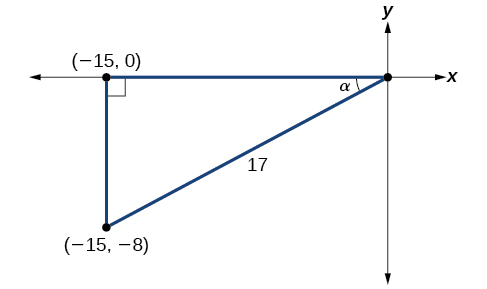
Figure 3
ⓐ Before we start, we must remember that if \(\alpha\) is in quadrant III, then \(180{^\circ} < \alpha < 270{^\circ},\) so \(\frac{180{^\circ}\operatorname{}}{2} < \frac{\alpha}{2} < \frac{270{^\circ}}{2}.\) This means that the terminal side of \(\frac{\alpha}{2}\) is in quadrant II, since \(90{^\circ} < \frac{\alpha}{2} < 135{^\circ}.\) To find \(\sin\;\frac{\alpha}{2},\) we begin by writing the half-angle formula for sine. Then we substitute the value of the cosine we found from the triangle in Figure 3 and simplify.
\[\begin{array}{ccl} {\sin\;\frac{\alpha}{2}} & = & {\pm \sqrt{\frac{1 - \cos\;\alpha}{2}}} \\ & = & {\pm \sqrt{\frac{1 - \left( {- \frac{15}{17}} \right)}{2}}} \\ & = & {\pm \sqrt{\frac{\frac{32}{17}}{2}}} \\ & = & {\pm \sqrt{\frac{32}{17} \cdot \frac{1}{2}}} \\ & = & {\pm \sqrt{\frac{16}{17}}} \\ & = & {\pm \frac{4}{\sqrt{17}}} \\ & = & \frac{4\sqrt{17}}{17} \end{array}\]
We choose the positive value of \(\sin\;\frac{\alpha}{2}\) because the angle terminates in quadrant II and sine is positive in quadrant II.
ⓑ To find \(\cos\;\frac{\alpha}{2},\) we will write the half-angle formula for cosine, substitute the value of the cosine we found from the triangle in Figure 3, and simplify.
\[\begin{array}{ccl} {\cos\;\frac{\alpha}{2}} & = & {\pm \sqrt{\frac{1 + \cos\;\alpha}{2}}} \\ & = & {\pm \sqrt{\frac{1 + \left( {- \frac{15}{17}} \right)}{2}}} \\ & = & {\pm \sqrt{\frac{\frac{2}{17}}{2}}} \\ & = & {\pm \sqrt{\frac{2}{17} \cdot \frac{1}{2}}} \\ & = & {\pm \sqrt{\frac{1}{17}}} \\ & = & {- \frac{\sqrt{17}}{17}} \end{array}\]
We choose the negative value of \(\cos\;\frac{\alpha}{2}\) because the angle is in quadrant II because cosine is negative in quadrant II.
ⓒ To find \(\tan\;\frac{\alpha}{2},\) we write the half-angle formula for tangent. Again, we substitute the value of the cosine we found from the triangle in Figure 3 and simplify.
\[\begin{array}{ccl} {\tan\;\frac{\alpha}{2}} & = & {\pm \sqrt{\frac{1 - \cos\;\alpha}{1 + \cos\;\alpha}}} \\ & = & {\pm \sqrt{\frac{1 - ( - \frac{15}{17})}{1 + ( - \frac{15}{17})}}} \\ & = & {\pm \sqrt{\frac{\frac{32}{17}}{\frac{2}{17}}}} \\ & = & {\pm \sqrt{\frac{32}{2}}} \\ & = & {- \sqrt{16}} \\ & = & -4 \end{array}\]
We choose the negative value of \(\tan\;\frac{\alpha}{2}\) because \(\frac{\alpha}{2}\) lies in quadrant II, and tangent is negative in quadrant II.
Now, we will return to the problem posed at the beginning of the section. A bicycle ramp is constructed for high-level competition with an angle of \(\theta\) formed by the ramp and the ground. Another ramp is to be constructed half as steep for novice competition. If \(\tan\;\theta = \frac{5}{3}\) for higher-level competition, what is the measurement of the angle for novice competition?
Solution (click to reveal)
Since the angle for novice competition measures half the steepness of the angle for the high level competition, and \(\tan\;\theta = \frac{5}{3}\) for high competition, we can find \(\cos\;\theta\) from the right triangle and the Pythagorean theorem so that we can use the half-angle identities. See Figure 4.
\[\begin{array}{rcl} {3^{2} + 5^{2}} & = & 34 \\ c & = & \sqrt{34} \end{array}\]
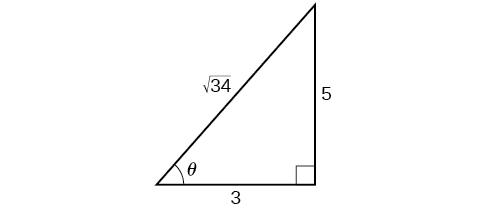
Figure 4
We see that \(\cos\;\theta = \frac{3}{\sqrt{34}} = \frac{3\sqrt{34}}{34}.\) We can use the half-angle formula for tangent: \(\tan\;\frac{\theta}{2} = \sqrt{\frac{1 - \cos\;\theta}{1 + \cos\;\theta}}.\) Since \(\tan\;\theta\) is in the first quadrant, so is \(\tan\;\frac{\theta}{2}.\)
\[\begin{array}{ccl} {\tan\;\frac{\theta}{2}} & = & \sqrt{\frac{1 - \frac{3\sqrt{34}}{34}}{1 + \frac{3\sqrt{34}}{34}}} \\ & = & \sqrt{\frac{\frac{34 - 3\sqrt{34}}{34}}{\frac{34 + 3\sqrt{34}}{34}}} \\ & = & \sqrt{\frac{34 - 3\sqrt{34}}{34 + 3\sqrt{34}}} \\ & \approx & 0.57 \end{array}\]
We can take the inverse tangent to find the angle: \(\tan^{- 1}(0.57) \approx 29.7{^\circ}.\) So the angle of the ramp for novice competition is \(\approx 29.7{^\circ}.\)