3.5 Logarithmic Properties
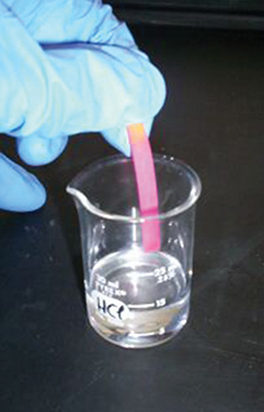
Figure 3.5.1: The pH of hydrochloric acid is tested with litmus paper. (credit: David Berardan)
In chemistry, pH is used as a measure of the acidity or alkalinity of a substance. The pH scale runs from 0 to 14. Substances with a pH less than 7 are considered acidic, and substances with a pH greater than 7 are said to be basic. Our bodies, for instance, must maintain a pH close to 7.35 in order for enzymes to work properly. To get a feel for what is acidic and what is basic, consider the following pH levels of some common substances:
- Battery acid: 0.8
- Stomach acid: 2.7
- Orange juice: 3.3
- Pure water: 7 (at 25° C)
- Human blood: 7.35
- Fresh coconut: 7.8
- Sodium hydroxide (lye): 14
To determine whether a solution is acidic or basic, we find its pH, which is a measure of the number of active positive hydrogen ions in the solution. The pH is defined by the following formula, where \(H^{+}\) is the concentration of hydrogen ion in the solution
\[\begin{array}{l} {\text{pH} = - \log(\lbrack H^{+}\rbrack)} \\ {= \log\left( \frac{1}{\lbrack H^{+}\rbrack} \right)} \end{array}\]
The equivalence of \(- \log\left( \left\lbrack H^{+} \right\rbrack \right)\) and \(\log\left( \frac{1}{\left\lbrack H^{+} \right\rbrack} \right)\) is one of the logarithm properties we will examine in this section.
3.5.1 Using the Product Rule for Logarithms
Recall that the logarithmic and exponential functions “undo” each other. This means that logarithms have similar properties to exponents. Some important properties of logarithms are given here. First, the following properties are easy to prove.
\[\begin{array}{l} {\log_{b}1 = 0} \\ {\log_{b}b = 1} \end{array}\]
For example, \(\log_{5}1 = 0\) since \(5^{0} = 1.\) And \(\log_{5}5 = 1\) since \(5^{1} = 5.\)
Next, we have the inverse property.
\[\begin{array}{l} \\ {\log_{b}(b^{x}) = x} \\ {\mspace{9mu}\text{~~}b^{\log_{b}x} = x,x > 0} \end{array}\]
For example, to evaluate \(\log(100),\) we can rewrite the logarithm as \(\log_{10}\left( 10^{2} \right),\) and then apply the inverse property \(\log_{b}\left( b^{x} \right) = x\) to get \(\log_{10}\left( 10^{2} \right) = 2.\)
To evaluate \(e^{\ln{(7)}},\) we can rewrite the logarithm as \(e^{\log_{e}7},\) and then apply the inverse property \(b^{\log_{b}x} = x\) to get \(e^{\log_{e}7} = 7.\)
Finally, we have the one-to-one property.
\[\log_{b}M = \log_{b}N\mspace{9mu}\mspace{9mu}\text{if~and~only~if}\mspace{9mu}\mspace{9mu} M = N\]
We can use the one-to-one property to solve the equation \(\log_{3}\left( {3x} \right) = \log_{3}\left( {2x + 5} \right)\) for \(x.\) Since the bases are the same, we can apply the one-to-one property by setting the arguments equal and solving for \(x:\)
\[\begin{array}{ll} {3x = 2x + 5\mspace{9mu}\mspace{9mu}\mspace{9mu}\mspace{9mu}\mspace{9mu}} & {\text{Set~the~arguments~equal}\text{.}} \\ {\mspace{9mu}\mspace{9mu}\mspace{9mu}\mspace{9mu} x = 5} & {\text{Subtract~2}x\text{.}} \end{array}\]
But what about the equation \(\log_{3}\left( {3x} \right) + \log_{3}\left( {2x + 5} \right) = 2?\) The one-to-one property does not help us in this instance. Before we can solve an equation like this, we need a method for combining terms on the left side of the equation.
Recall that we use the product rule of exponents to combine the product of powers by adding exponents: \(x^{a}x^{b} = x^{a + b}.\) We have a similar property for logarithms, called the product rule for logarithms, which says that the logarithm of a product is equal to a sum of logarithms. Because logs are exponents, and we multiply like bases, we can add the exponents. We will use the inverse property to derive the product rule below.
Given any real number \(x\) and positive real numbers \(M,N,\) and \(b,\) where \(b \neq 1,\) we will show
\[\log_{b}\left( {MN} \right)\text{=}\log_{b}(M) + \log_{b}(N).\]
Let \(m = \log_{b}M\) and \(n = \log_{b}N.\) In exponential form, these equations are \(b^{m} = M\) and \(b^{n} = N.\) It follows that
\[\begin{array}{lll} {\log_{b}\left( {MN} \right)} & {= \log_{b}\left( {b^{m}b^{n}} \right)\mspace{9mu}\mspace{9mu}\mspace{9mu}\mspace{9mu}\mspace{9mu}\mspace{9mu}} & {\text{Substitute~for~}M\mspace{9mu}\text{and~}N.} \\ & {= \log_{b}\left( b^{m + n} \right)} & {\text{Apply~the~product~rule~for~exponents}.} \\ & {= m + n} & {\text{Apply~the~inverse~property~of~logs}.} \\ & {= \log_{b}(M) + \log_{b}(N)} & {\text{Substitute~for~}m\mspace{9mu}\text{and~}n.} \end{array}\]
Note that repeated applications of the product rule for logarithms allow us to simplify the logarithm of the product of any number of factors. For example, consider \(\log_{b}(wxyz).\) Using the product rule for logarithms, we can rewrite this logarithm of a product as the sum of logarithms of its factors:
\[\log_{b}(wxyz) = \log_{b}w + \log_{b}x + \log_{b}y + \log_{b}z\]
3.5.2 Using the Quotient Rule for Logarithms
For quotients, we have a similar rule for logarithms. Recall that we use the quotient rule of exponents to combine the quotient of exponents by subtracting: \(\frac{x^{a}}{x^{b}} = x^{a - b}.\) The quotient rule for logarithms says that the logarithm of a quotient is equal to a difference of logarithms. Just as with the product rule, we can use the inverse property to derive the quotient rule.
Given any real number \(x\) and positive real numbers \(M,\) \(N,\) and \(b,\) where \(b \neq 1,\) we will show
\[\log_{b}\left( \frac{M}{N} \right)\text{=}\log_{b}(M) - \log_{b}(N).\]
Let \(m = \log_{b}M\) and \(n = \log_{b}N.\) In exponential form, these equations are \(b^{m} = M\) and \(b^{n} = N.\) It follows that
\[\begin{array}{lll} {\log_{b}\left( \frac{M}{N} \right)} & {= \log_{b}\left( \frac{b^{m}}{b^{n}} \right)\mspace{9mu}\mspace{9mu}\mspace{9mu}\mspace{9mu}\mspace{9mu}} & {\text{Substitute~for~}M\mspace{9mu}\text{and~}N.} \\ & {= \log_{b}\left( b^{m - n} \right)} & {\text{Apply~the~quotient~rule~for~exponents}.} \\ & {= m - n} & {\text{Apply~the~inverse~property~of~logs}.} \\ & {= \log_{b}(M) - \log_{b}(N)} & {\text{Substitute~for~}m\mspace{9mu}\text{and~}n.} \end{array}\]
For example, to expand \(\log\left( \frac{2x^{2} + 6x}{3x + 9} \right),\) we must first express the quotient in lowest terms. Factoring and canceling we get,
\[\begin{array}{ll} {\log\left( \frac{2x^{2} + 6x}{3x + 9} \right) = \log\left( \frac{2x(x + 3)}{3(x + 3)} \right)} & {\text{Factor~the~numerator~and~denominator}.} \\ {\mspace{9mu}\text{~~~~~~~~~~~~~~~~~~~~~~} = \log\left( \frac{2x}{3} \right)} & {\text{Cancel~the~common~factors}.} \end{array}\]
Next we apply the quotient rule by subtracting the logarithm of the denominator from the logarithm of the numerator. Then we apply the product rule.
\[\begin{array}{l} {\log\left( \frac{2x}{3} \right) = \log(2x) - \log(3)} \\ {\mspace{9mu}\text{~~~~~~~~~~~~} = \log(2) + \log(x) - \log(3)} \end{array}\]
3.5.3 Using the Power Rule for Logarithms
We’ve explored the product rule and the quotient rule, but how can we take the logarithm of a power, such as \(x^{2}?\) One method is as follows:
\[\begin{array}{ll} {\log_{b}\left( x^{2} \right)} & {= \log_{b}\left( {x \cdot x} \right)} \\ & {= \log_{b}x + \log_{b}x} \\ & {= 2\log_{b}x} \end{array}\]
Notice that we used the product rule for logarithms to find a solution for the example above. By doing so, we have derived the power rule for logarithms, which says that the log of a power is equal to the exponent times the log of the base. Keep in mind that, although the input to a logarithm may not be written as a power, we may be able to change it to a power. For example,
\[\begin{array}{lll} {100 = 10^{2}\mspace{9mu}\mspace{9mu}\mspace{9mu}\mspace{9mu}\mspace{9mu}} & {\sqrt{3} = 3^{\frac{1}{2}}\mspace{9mu}\mspace{9mu}\mspace{9mu}\mspace{9mu}\mspace{9mu}} & {\frac{1}{e} = e^{- 1}} \end{array}\]
3.5.4 Expanding Logarithmic Expressions
Taken together, the product rule, quotient rule, and power rule are often called “laws of logs.” Sometimes we apply more than one rule in order to simplify an expression. For example:
\[\begin{array}{ll} {\log_{b}\left( \frac{6x}{y} \right)} & {= \log_{b}\left( {6x} \right) - \log_{b}y} \\ & {= \log_{b}6 + \log_{b}x - \log_{b}y} \end{array}\]
We can use the power rule to expand logarithmic expressions involving negative and fractional exponents. Here is an alternate proof of the quotient rule for logarithms using the fact that a reciprocal is a negative power:
\[\begin{array}{ll} {\log_{b}\left( \frac{A}{C} \right)} & {= \log_{b}\left( {AC^{- 1}} \right)} \\ & {= \log_{b}(A) + \log_{b}\left( C^{- 1} \right)} \\ & {= \log_{b}A + ( - 1)\log_{b}C} \\ & {= \log_{b}A - \log_{b}C} \end{array}\]
We can also apply the product rule to express a sum or difference of logarithms as the logarithm of a product.
With practice, we can look at a logarithmic expression and expand it mentally, writing the final answer. Remember, however, that we can only do this with products, quotients, powers, and roots—never with addition or subtraction inside the argument of the logarithm.
3.5.5 Condensing Logarithmic Expressions
We can use the rules of logarithms we just learned to condense sums, differences, and products with the same base as a single logarithm. It is important to remember that the logarithms must have the same base to be combined. We will learn later how to change the base of any logarithm before condensing.
3.5.6 Using the Change-of-Base Formula for Logarithms
Most calculators can evaluate only common and natural logs. In order to evaluate logarithms with a base other than 10 or \(e,\) we use the change-of-base formula to rewrite the logarithm as the quotient of logarithms of any other base; when using a calculator, we would change them to common or natural logs.
To derive the change-of-base formula, we use the one-to-one property and power rule for logarithms.
Given any positive real numbers \(M,b,\) and \(n,\) where \(n \neq 1~\) and \(b \neq 1,\) we show
\[\log_{b}M\text{=}\frac{\log_{n}M}{\log_{n}b}\]
Let \(y = \log_{b}M.\)By exponentiating both sides with base\(b\), we arrive at an exponential form, namely \(b^{y} = M.\) It follows that
\[\begin{array}{lll} {\log_{n}(b^{y})} & {= \log_{n}M} & {\text{Apply~the~one-to-one~property}.} \\ {y\log_{n}b} & {= \log_{n}M~} & \text{Apply~the~power~rule~for~logarithms.} \\ y & {= \frac{\log_{n}M}{\log_{n}b}} & {\text{Isolate~}y.} \\ {\log_{b}M} & {= \frac{\log_{n}M}{\log_{n}b}} & {\text{Substitute~for~}y.} \end{array}\]
For example, to evaluate \(\log_{5}36\) using a calculator, we must first rewrite the expression as a quotient of common or natural logs. We will use the common log.
\[\begin{array}{lll} {\log_{5}36} & {= \frac{\log(36)}{\log(5)}\mspace{9mu}\mspace{9mu}} & {\text{Apply~the~change~of~base~formula~using~base~10}\text{.}} \\ & {\approx 2.2266\mspace{9mu}} & {\text{Use~a~calculator~to~evaluate~to~4~decimal~places}\text{.}} \end{array}\]