5.1 Quadratic Functions and Equations
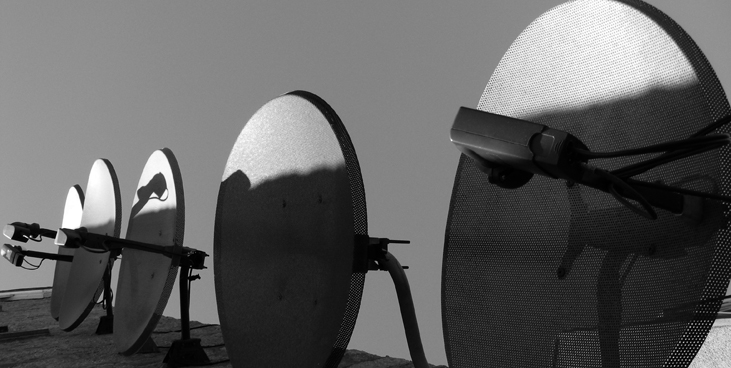
Figure 5.1.1: Each of these satellite dishes has a parabolic cross-section — the same curve we get from any quadratic function. The mathematics of quadratic functions and the equations that produce them is at the heart of fields ranging from engineering and physics to economics.
A quadratic function or its associated equation appears throughout mathematics, science, and engineering: the trajectory of a thrown ball, the cross-section of a satellite dish or the cables of a suspension bridge, the optimal sales price for maximum revenue, and the impact-vs-time profile of a projectile. In this section we develop the four standard methods for solving quadratic equations — factoring, the square root property, completing the square, and the quadratic formula — and then study quadratic functions and their parabolic graphs alongside them, so the algebra and the geometry develop together.
5.1.1 Solving Quadratic Equations by Factoring
An equation containing a second-degree polynomial is called a quadratic equation. For example, equations such as \(2x^{2} + 3x - 1 = 0\) and \(x^{2} - 4 = 0\) are quadratic equations. They are used in countless ways in the fields of engineering, architecture, finance, biological science, and, of course, mathematics.
Often the easiest method of solving a quadratic equation is factoring. Factoring means finding expressions that can be multiplied together to give the expression on one side of the equation.
If a quadratic equation can be factored, it is written as a product of linear terms. Solving by factoring depends on the zero-product property, which states that if \(a \cdot b = 0,\) then \(a = 0\) or \(b = 0,\) where \(a\) and \(b\) are real numbers or algebraic expressions. In other words, if the product of two numbers or two expressions equals zero, then one of the numbers or one of the expressions must equal zero because zero multiplied by anything equals zero.
Multiplying the factors expands the equation to a string of terms separated by plus or minus signs. So, in that sense, the operation of multiplication undoes the operation of factoring. For example, expand the factored expression \(\left( {x - 2} \right)\left( {x + 3} \right)\) by multiplying the two factors together.
\[\begin{array}{ccl} {\left( {x - 2} \right)\left( {x + 3} \right)} & = & {x^{2} + 3x - 2x - 6} \\ & = & {x^{2} + x - 6} \end{array}\]
The product is a quadratic expression. Set equal to zero, \(x^{2} + x - 6 = 0\) is a quadratic equation. If we were to factor the equation, we would get back the factors we multiplied.
The process of factoring a quadratic equation depends on the leading coefficient, whether it is 1 or another integer. We will look at both situations; but first, we want to confirm that the equation is written in standard form, \(ax^{2} + bx + c = 0,\) where \(a\), \(b\), and \(c\) are real numbers, and \(a \neq 0.\) The equation \(x^{2} + x - 6 = 0\) is in standard form.
We can use the zero-product property to solve quadratic equations in which we first have to factor out the greatest common factor (GCF), and for equations that have special factoring formulas as well, such as the difference of squares, both of which we will see later in this section.
Factor and solve the equation: \(x^{2} + x - 6 = 0.\)
Solution
To factor \(x^{2} + x - 6 = 0,\) we look for two numbers whose product equals \(-6\) and whose sum equals 1. Begin by looking at the possible factors of \(-6.\)
\[\begin{matrix} {1 \cdot (-6)} \\ {(-6) \cdot 1} \\ {2 \cdot (-3)} \\ {3 \cdot (-2)} \end{matrix}\]
The last pair, \(3 \cdot (-2)\) sums to 1, so these are the numbers. Note that only one pair of numbers will work. Then, write the factors.
\[\left( {x - 2} \right)\left( {x + 3} \right) = 0\]
To solve this equation, we use the zero-product property. Set each factor equal to zero and solve.
\[\begin{array}{rcl} {\left( {x - 2} \right)\left( {x + 3} \right)} & = & 0 \\ \left( {x - 2} \right) & = & 0 \\ x & = & 2 \\ \left( {x + 3} \right) & = & 0 \\ x & = & -3 \end{array}\]
The two solutions are \(2\) and \(-3.\) We can see how the solutions relate to the graph below. The solutions are the x-intercepts of \(y = x^{2} + x - 6 = 0.\)
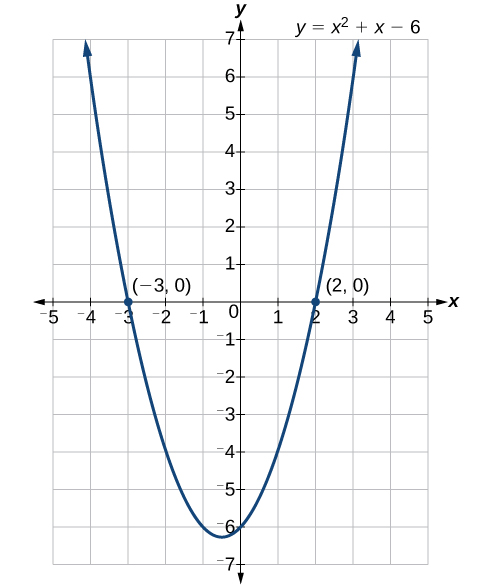
Figure: Coordinate plane with a parabola crossing the x-axis at the points negative 3 and 2.
Solving a Quadratic Equation by Factoring when the Leading Coefficient is not 1
When the leading coefficient is not 1, we factor a quadratic equation using the method called grouping, which requires four terms. With the equation in standard form, let’s review the grouping procedures:
- With the quadratic in standard form, \(ax^{2} + bx + c = 0,\) multiply \(a \cdot c.\)
- Find two numbers whose product equals \(ac\) and whose sum equals \(b.\)
- Rewrite the equation replacing the \(bx\) term with two terms using the numbers found in step 2 as coefficients of x.
- Factor the first two terms and then factor the last two terms. The expressions in parentheses must be exactly the same to use grouping.
- Factor out the expression in parentheses.
- Set the expressions equal to zero and solve for the variable.
Use grouping to factor and solve the quadratic equation: \(4x^{2} + 15x + 9 = 0.\)
Solution
First, multiply \(ac:4(9) = 36.\) Then list the factors of \(36.\)
\[\begin{array}{l} {1 \cdot 36} \\ {2 \cdot 18} \\ {3 \cdot 12} \\ {4 \cdot 9} \\ {6 \cdot 6} \end{array}\]
The only pair of factors that sums to \(15\) is \(3 + 12.\) Rewrite the equation replacing the \(b\) term, \(15x,\) with two terms using 3 and 12 as coefficients of \(x\). Factor the first two terms, and then factor the last two terms.
\[\begin{array}{rcl} {4x^{2} + 3x + 12x + 9} & = & 0 \\ {x(4x + 3) + 3(4x + 3)} & = & 0 \\ {(4x + 3)(x + 3)} & = & 0 \end{array}\]
Solve using the zero-product property.
\[\begin{array}{rcl} {(4x + 3)(x + 3)} & = & 0 \\ {(4x + 3)} & = & 0 \\ x & = & {- \frac{3}{4}} \\ {(x + 3)} & = & 0 \\ x & = & {- 3} \end{array}\]
The solutions are \(- \frac{3}{4},\) and \(-3.\) See the figure below.
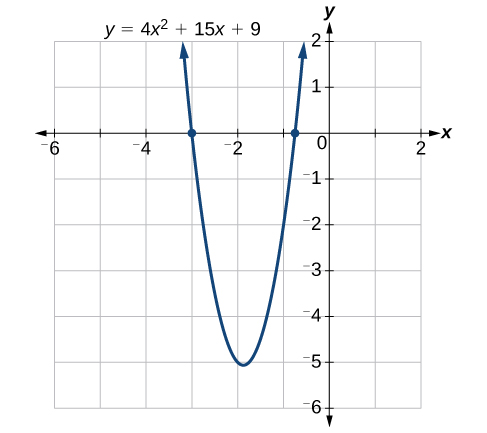
Figure: Coordinate plane with a parabola crossing the x-axis at the points negative three-fourths and negative 3.
5.1.2 Using the Square Root Property
When there is no linear term in the equation, another method of solving a quadratic equation is by using the square root property, in which we isolate the \(x^{2}\) term and take the square root of the number on the other side of the equals sign. Keep in mind that sometimes we may have to manipulate the equation to isolate the \(x^{2}\) term so that the square root property can be used.
5.1.3 Completing the Square
Not all quadratic equations can be factored or can be solved in their original form using the square root property. In these cases, we may use a method for solving a quadratic equation known as completing the square. Using this method, we add or subtract terms to both sides of the equation until we have a perfect square trinomial on one side of the equal sign. We then apply the square root property. To complete the square, the leading coefficient, \(a\), must equal 1. If it does not, then divide the entire equation by \(a\). Then, we can use the following procedures to solve a quadratic equation by completing the square.
We will use the example \(x^{2} + 4x + 1 = 0\) to illustrate each step.
Given a quadratic equation that cannot be factored, and with \(a = 1,\) first add or subtract the constant term to the right side of the equal sign.
\[x^{2} + 4x = -1\]
Multiply the \(b\) term by \(\frac{1}{2}\) and square it.
\[\begin{array}{rcl} {\frac{1}{2}(4)} & = & 2 \\ 2^{2} & = & 4 \end{array}\]
Add \(\left( {\frac{1}{2}b} \right)^{2}\) to both sides of the equal sign and simplify the right side. We have
\[\begin{array}{rcl} {x^{2} + 4x + 4} & = & {- 1 + 4} \\ {x^{2} + 4x + 4} & = & 3 \end{array}\]
The left side of the equation can now be factored as a perfect square.
\[\begin{array}{rcl} {x^{2} + 4x + 4} & = & 3 \\ {(x + 2)}^{2} & = & 3 \end{array}\]
Use the square root property and solve.
\[\begin{array}{rcl} \sqrt{{(x + 2)}^{2}} & = & {\pm \sqrt{3}} \\ {x + 2} & = & {\pm \sqrt{3}} \\ x & = & {-2 \pm \sqrt{3}} \end{array}\]
The solutions are \(-2 + \sqrt{3},\operatorname{}\) and \(-2 - \sqrt{3}.\)
5.1.4 Using the Quadratic Formula
The fourth method of solving a quadratic equation is by using the quadratic formula, a formula that will solve all quadratic equations. Although the quadratic formula works on any quadratic equation in standard form, it is easy to make errors in substituting the values into the formula. Pay close attention when substituting, and use parentheses when inserting a negative number.
We can derive the quadratic formula by completing the square. We will assume that the leading coefficient is positive; if it is negative, we can multiply the equation by \(-1\) and obtain a positive \(a\). Given \(ax^{2} + bx + c = 0,\) \(a \neq 0,\) we will complete the square as follows:
First, move the constant term to the right side of the equal sign:
\[ax^{2} + bx = - c\]
As we want the leading coefficient to equal 1, divide through by \(a\):
\[x^{2} + \frac{b}{a}x = - \frac{c}{a}\]
Then, find \(\frac{1}{2}\) of the middle term, and add \(\left( {\frac{1}{2}\frac{b}{a}} \right)^{2} = \frac{b^{2}}{4a^{2}}\) to both sides of the equal sign:
\[x^{2} + \frac{b}{a}x + \frac{b^{2}}{4a^{2}} = \frac{b^{2}}{4a^{2}} - \frac{c}{a}\]
Next, write the left side as a perfect square. Find the common denominator of the right side and write it as a single fraction:
\[\left( {x + \frac{b}{2a}} \right)^{2} = \frac{b^{2} - 4ac}{4a^{2}}\]
Now, use the square root property, which gives
\[\begin{array}{rcl} {x + \frac{b}{2a}} & = & {\pm \sqrt{\frac{b^{2} - 4ac}{4a^{2}}}} \\ {x + \frac{b}{2a}} & = & \frac{\pm \sqrt{b^{2} - 4ac}}{2a} \end{array}\]
Finally, add \(- \frac{b}{2a}\) to both sides of the equation and combine the terms on the right side. Thus,
\[x = \frac{- b \pm \sqrt{b^{2} - 4ac}}{2a}\]
5.1.5 The Discriminant
The quadratic formula not only generates the solutions to a quadratic equation, it tells us about the nature of the solutions when we consider the discriminant, or the expression under the radical, \(b^{2} - 4ac.\) The discriminant tells us whether the solutions are real numbers or complex numbers, and how many solutions of each type to expect. Table 5.1.26 relates the value of the discriminant to the solutions of a quadratic equation.
| Value of Discriminant | Results |
|---|---|
| \(b^{2} - 4ac = 0\) | One rational solution (double solution) |
| \(b^{2} - 4ac > 0,\) perfect square | Two rational solutions |
| \(b^{2} - 4ac > 0,\) not a perfect square | Two irrational solutions |
| \(b^{2} - 4ac < 0\) | Two complex solutions |
Table 5.1.26: Value of the discriminant and corresponding solutions to the quadratic equation \(ax^2+bx+c=0\).
5.1.6 Using the Pythagorean Theorem
One of the most famous formulas in mathematics is the Pythagorean Theorem. It is based on a right triangle, and states the relationship among the lengths of the sides as \(a^{2} + b^{2} = c^{2},\) where \(a\) and \(b\) refer to the legs of a right triangle adjacent to the \(90{^\circ}\) angle, and \(c\) refers to the hypotenuse. It has immeasurable uses in architecture, engineering, the sciences, geometry, trigonometry, and algebra, and in everyday applications.
We use the Pythagorean Theorem to solve for the length of one side of a triangle when we have the lengths of the other two. Because each of the terms is squared in the theorem, when we are solving for a side of a triangle, we have a quadratic equation. We can use the methods for solving quadratic equations that we learned in this section to solve for the missing side.
The Pythagorean Theorem is given as
\[a^{2} + b^{2} = c^{2}\]
where \(a\) and \(b\) refer to the legs of a right triangle adjacent to the \(90^{\circ}\) angle, and \(c\) refers to the hypotenuse, as shown below.
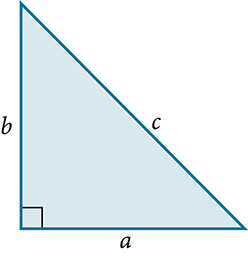
Figure 5.1.29: Right triangle with legs labeled \(a\) and \(b\) and hypotenuse labeled \(c\).
Find the length of the missing side of the right triangle shown below.
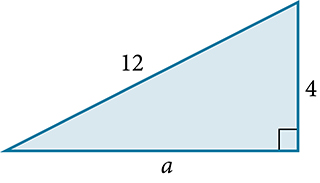
Figure 5.1.31: Right triangle with one leg of length \(a\), the other leg labeled 4, and the hypotenuse labeled 12.
Solution
As we have measurements for side \(b\) and the hypotenuse, the missing side is a.
\[\begin{array}{ccl} {a^{2} + b^{2}} & = & c^{2} \\ {a^{2} + {(4)}^{2}} & = & {(12)}^{2} \\ {a^{2} + 16} & = & 144 \\ a^{2} & = & 128 \\ a & = & \sqrt{128} \\ & = & {8\sqrt{2}} \end{array}\]
5.1.7 Recognizing Characteristics of Parabolas
The graph of a quadratic function is a U-shaped curve called a parabola. One important feature of the graph is that it has an extreme point, called the vertex. If the parabola opens up, the vertex represents the lowest point on the graph, or the minimum value of the quadratic function. If the parabola opens down, the vertex represents the highest point on the graph, or the maximum value. In either case, the vertex is a turning point on the graph. The graph is also symmetric with a vertical line drawn through the vertex, called the axis of symmetry. These features are illustrated below.
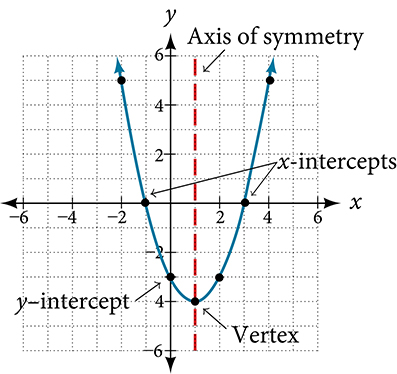
Figure 5.1.33: An upward-opening parabola with key features marked: vertex, axis of symmetry, \(x\)-intercepts, and \(y\)-intercept.
The \(y\)-intercept is the point at which the parabola crosses the \(y\)-axis. The \(x\)-intercepts are the points at which the parabola crosses the \(x\)-axis. If they exist, the \(x\)-intercepts represent the zeros, or roots, of the quadratic function, the values of \(x\) at which \(y = 0.\)
Determine the vertex, axis of symmetry, zeros, and \(y\ \text{-}\) intercept of the parabola shown below.
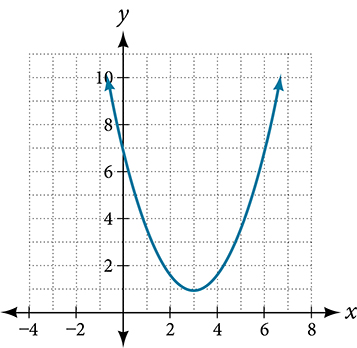
Figure 5.1.35: An upward-opening parabola with vertex at \((3,\, 1)\) and \(y\)-intercept at \((0,\, 7)\); the parabola sits entirely above the \(x\)-axis.
Solution
The vertex is the turning point of the graph. We can see that the vertex is at \(\left( {3,1} \right).\) Because this parabola opens upward, the axis of symmetry is the vertical line that intersects the parabola at the vertex. So the axis of symmetry is \(x = 3.\) This parabola does not cross the \(x\ \text{-}\) axis, so it has no zeros. It crosses the \(y\ \text{-}\) axis at \(\left( {0,7} \right)\) so this is the \(y\)-intercept.
5.1.8 Understanding How the Graphs of Parabolas are Related to Their Quadratic Functions
The general form of a quadratic function presents the function in the form
\[f(x) = ax^{2} + bx + c\]
where \(a,b,\) and \(c\) are real numbers and \(a \neq 0.\) If \(a > 0,\) the parabola opens upward. If \(a < 0,\) the parabola opens downward. We can use the general form of a parabola to find the equation for the axis of symmetry.
The axis of symmetry is defined by \(x = - \frac{b}{2a}.\) If we use the quadratic formula, \(x = \frac{- b \pm \sqrt{b^{2} - 4ac}}{2a},\) to solve \(ax^{2} + bx + c = 0\) for the \(x\ \text{-}\) intercepts, or zeros, we find the value of \(x\) halfway between them is always \(x = - \frac{b}{2a},\) the equation for the axis of symmetry.
The figure below represents the graph of the quadratic function written in general form as \(y = x^{2} + 4x + 3.\) In this form, \(a = 1,b = 4,\) and \(c = 3.\) Because \(a > 0,\) the parabola opens upward. The axis of symmetry is \(x = - \frac{4}{2(1)} = -2.\) This also makes sense because we can see from the graph that the vertical line \(x = -2\) divides the graph in half. The vertex always occurs along the axis of symmetry. For a parabola that opens upward, the vertex occurs at the lowest point on the graph, in this instance, \((-2,-1).\) The \(x\ \text{-}\) intercepts, those points where the parabola crosses the \(x\ \text{-}\) axis, occur at \((-3,0)\) and \((-1,0).\)
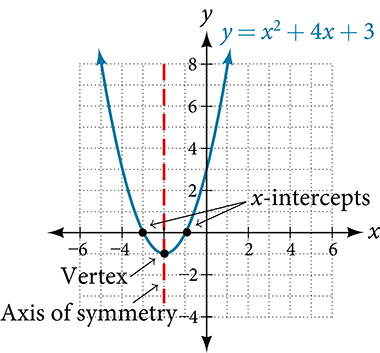
Figure 5.1.36: Graph of \(y = x^2 + 4x + 3\) showing its vertex, \(x\)-intercepts, and \(y\)-intercept.
The standard form of a quadratic function presents the function in the form
\[f(x) = a{(x - h)}^{2} + k\]
where \(\left( {h,\mspace{9mu} k} \right)\) is the vertex. Because the vertex appears in the standard form of the quadratic function, this form is also known as the vertex form of a quadratic function.
As with the general form, if \(a > 0,\) the parabola opens upward and the vertex is a minimum. If \(a < 0,\) the parabola opens downward, and the vertex is a maximum. The figure below shows the graph of the quadratic function written in standard form as \(y = -3\left( {x + 2} \right)^{2} + 4.\) Since \(x–h = x + 2\) in this example, \(h = –2.\) In this form, \(a = -3,h = -2,\) and \(k = 4.\) Because \(a < 0,\) the parabola opens downward. The vertex is at \(\left( {- 2,\mspace{9mu}\text{4}} \right).\)
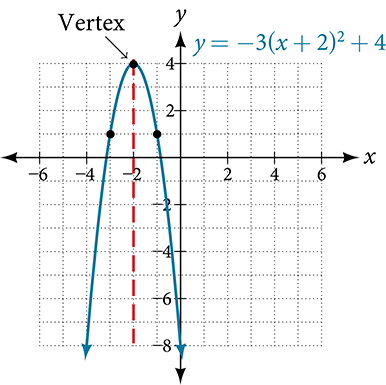
Figure 5.1.37: \(y = -3(x + 2)^{2} + 4\), with vertex \((-2,\, 4)\) and axis of symmetry \(x = -2\).
The standard form is useful for determining how the graph is transformed from the graph of \(y = x^{2}.\) The figure below is the graph of this basic function.
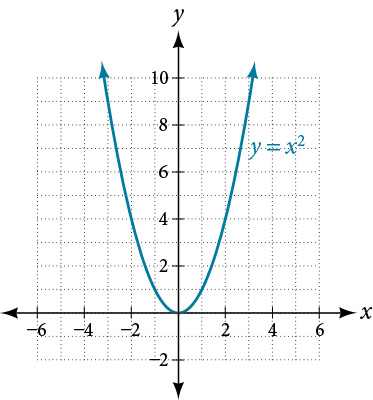
Figure 5.1.38: Graph of the toolkit quadratic function \(y = x^2\), an upward-opening parabola with vertex at the origin.
If \(k > 0,\) the graph shifts upward, whereas if \(k < 0,\) the graph shifts downward. In the graph of \(y = -3(x+2)^{2} + 4\) above, \(k > 0,\) so the graph is shifted 4 units upward. If \(h > 0,\) the graph shifts toward the right and if \(h < 0,\) the graph shifts to the left. There, \(h < 0,\) so the graph is shifted 2 units to the left. The magnitude of \(a\) indicates the stretch of the graph. If \(|a| > 1,\) the point associated with a particular \(x\ \text{-}\) value shifts farther from the x-axis, so the graph appears to become narrower, and there is a vertical stretch. But if \(|a| < 1,\) the point associated with a particular \(x\ \text{-}\) value shifts closer to the x-axis, so the graph appears to become wider, but in fact there is a vertical compression. In our case, \(|a| = 3 > 1,\) so the graph becomes narrower.
The standard form and the general form are equivalent methods of describing the same function. We can see this by expanding out the general form and setting it equal to the standard form.
\[\begin{array}{rcl} {a{(x - h)}^{2} + k} & = & {ax^{2} + bx + c} \\ {ax^{2} - 2ahx + (ah^{2} + k)} & = & {ax^{2} + bx + c} \end{array}\]
For the linear terms to be equal, the coefficients must be equal.
\[–2ah = b,\mspace{9mu}\text{so~}h = - \frac{b}{2a}\]
This is the axis of symmetry we defined earlier. Setting the constant terms equal:
\[\begin{array}{ccl} {ah^{2} + k} & = & c \\ k & = & {c - ah^{2}} \\ & = & {c - a\left( \frac{b}{2a} \right)^{2}} \\ & = & {c - \frac{b^{2}}{4a}} \end{array}\]
In practice, though, it is usually easier to remember that \(k\) is the output value of the function when the input is \(h,\) so \(f(h) = k.\)
Write an equation for the quadratic function \(g\) shown below as a transformation of \(f(x) = x^{2},\) and then expand the formula, and simplify terms to write the equation in general form.
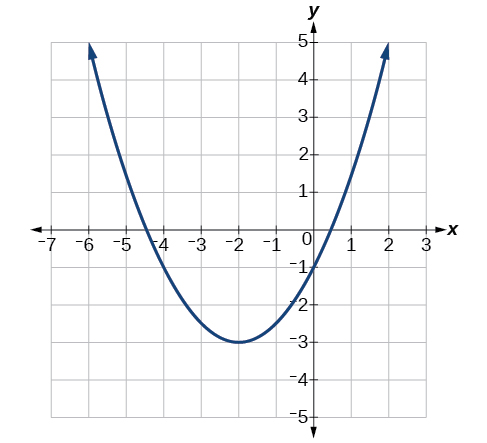
Figure 5.1.42: An upward-opening parabola with vertex at \((-2,\, -3)\).
Solution
We can see the graph of \(g\) is the graph of \(f(x) = x^{2}\) shifted to the left 2 and down 3, giving a formula in the form \(g(x) = a{(x - (-2))}^{2} - 3 = a{(x + 2)}^{2}–3.\)
Substituting the coordinates of a point on the curve, such as \((0,-1),\) we can solve for the stretch factor.
\[\begin{array}{rcl} {-1} & = & {a\left( {0 + 2} \right)^{2} - 3} \\ 2 & = & {4a} \\ a & = & \frac{1}{2} \end{array}\]
In standard form, the algebraic model for this graph is \(g(x) = \frac{1}{2}{(x + 2)}^{2}–3.\)
To write this in general polynomial form, we can expand the formula and simplify terms.
\[\begin{array}{ccl} {g(x)} & = & {\frac{1}{2}{(x + 2)}^{2} - 3} \\ & = & {\frac{1}{2}(x + 2)(x + 2) - 3} \\ & = & {\frac{1}{2}(x^{2} + 4x + 4) - 3} \\ & = & {\frac{1}{2}x^{2} + 2x + 2 - 3} \\ & = & {\frac{1}{2}x^{2} + 2x - 1} \end{array}\]
Notice that the horizontal and vertical shifts of the basic graph of the quadratic function determine the location of the vertex of the parabola; the vertex is unaffected by stretches and compressions.
Analysis. We can check our work using the table feature on a graphing utility. First enter \(\text{Y1} = \frac{1}{2}{(x + 2)}^{2} - 3.\) Next, select \(\text{TBLSET,}\) then use \(\text{TblStart} = –6\) and \(\Delta\ \text{Tbl~=~2,}\) and select \(\text{TABLE}\text{.}\) See the table below.
| \(x\) | \(-6\) | \(-4\) | \(-2\) | \(0\) | \(2\) |
|---|---|---|---|---|---|
| \(y\) | \(5\) | \(-1\) | \(-3\) | \(-1\) | \(5\) |
Table: Output values of \(y = \tfrac{1}{2}(x+2)^2 - 3\) at \(x = -6,\, -4,\, -2,\, 0,\, 2\).
The ordered pairs in the table correspond to points on the graph.
A coordinate grid has been superimposed over the quadratic path of a basketball shown below. Assume that the point (–4, 7) is the highest point of the basketball’s trajectory. Find an equation for the path of the ball. Does the shooter make the basket?
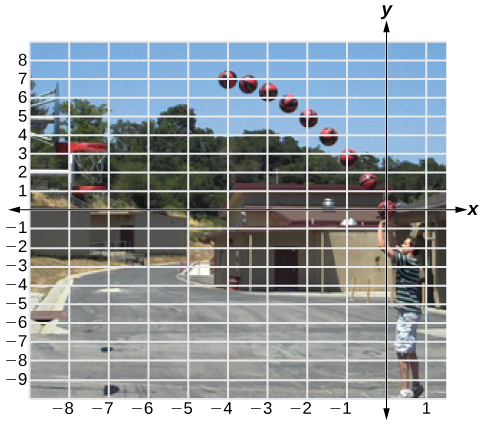
Figure 5.1.44: Stop-motion image of a basketball trajectory showing a parabolic path.
5.1.9 Finding the Domain and Range of a Quadratic Function
Any number can be the input value of a quadratic function. Therefore, the domain of any quadratic function is all real numbers. Because parabolas have a maximum or a minimum point, the range is restricted. Since the vertex of a parabola will be either a maximum or a minimum, the range will consist of all \(y\)-values greater than or equal to the \(y\)-coordinate at the turning point or less than or equal to the \(y\)-coordinate at the turning point, depending on whether the parabola opens up or down.
5.1.10 Determining the Maximum and Minimum Values of Quadratic Functions
The output of the quadratic function at the vertex is the maximum or minimum value of the function, depending on the orientation of the parabola. We can see the maximum and minimum values below.
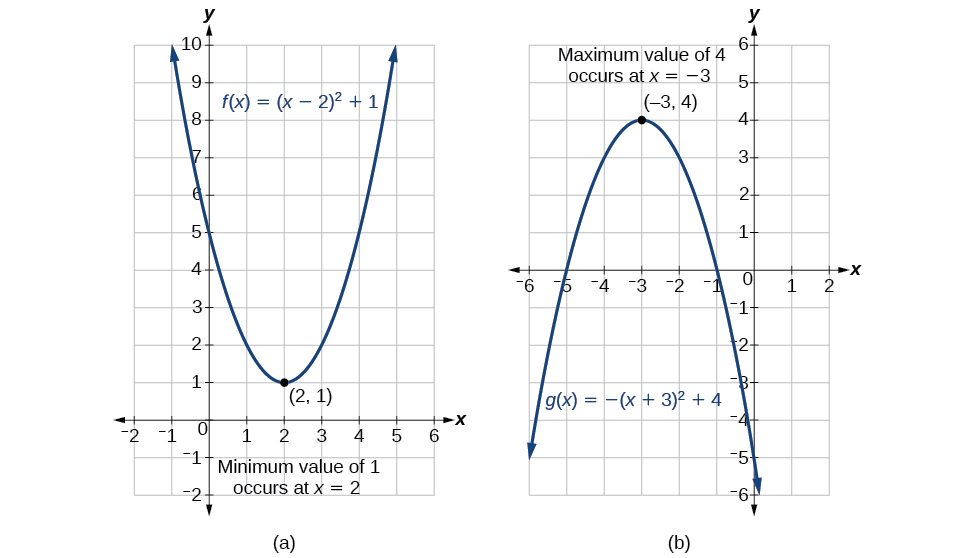
Figure 5.1.52: Two parabola graphs side by side showing how the vertex gives the maximum value (downward-opening) or minimum value (upward-opening) of a quadratic function.
There are many real-world scenarios that involve finding the maximum or minimum value of a quadratic function, such as applications involving area and revenue.
A backyard farmer wants to enclose a rectangular space for a new garden within her fenced backyard. She has purchased 80 feet of wire fencing to enclose three sides, and she will use a section of the backyard fence as the fourth side.
- Find a formula for the area enclosed by the fence if the sides of fencing perpendicular to the existing fence have length \(L.\)
- What dimensions should she make her garden to maximize the enclosed area?
Solution
Let’s use a diagram such as the one below to record the given information. It is also helpful to introduce a temporary variable, \(W,\) to represent the width of the garden and the length of the fence section parallel to the backyard fence.
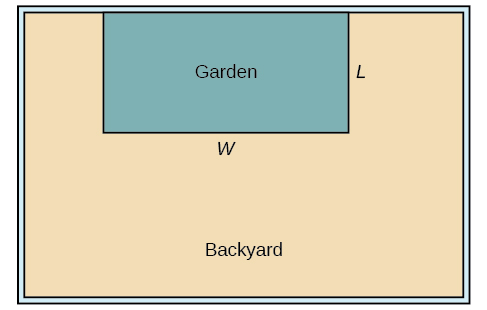
Figure: Diagram of a rectangular garden bordered by a backyard, with three sides fenced and one side along the back; the side along the back has length L and each perpendicular side has length W.
We know we have only 80 feet of fence available, and \(L + W + L = 80,\) or more simply, \(2L + W = 80.\) This allows us to represent the width, \(W,\) in terms of \(L.\)
\[W = 80 - 2L\]
Now we are ready to write an equation for the area the fence encloses. We know the area of a rectangle is length multiplied by width, so
\[\begin{array}{rcl} A & = & {LW = L(80 - 2L)} \\ {A(L)} & = & {80L - 2L^{2}} \end{array}\]
This formula represents the area of the fence in terms of the variable length \(L.\) The function, written in general form, is
\[A(L) = -2L^{2} + 80L.\]
The quadratic has a negative leading coefficient, so the graph will open downward, and the vertex will be the maximum value for the area. In finding the vertex, we must be careful because the equation is not written in standard polynomial form with decreasing powers. This is why we rewrote the function in general form above. Since \(a\) is the coefficient of the squared term, \(a = -2,b = 80,\) and \(c = 0.\)
To find the vertex:
\[\begin{aligned} h &= -\frac{b}{2a} & &\text{and} & k &= A(20) \\ &= -\frac{80}{2(-2)} & & & &= 80(20) - 2(20)^{2} \\ &= 20 & & & &= 800. \end{aligned}\]
The maximum value of the function is an area of 800 square feet, which occurs when \(L = 20\) feet. When the shorter sides are 20 feet, there is 40 feet of fencing left for the longer side. To maximize the area, she should enclose the garden so the two shorter sides have length 20 feet and the longer side parallel to the existing fence has length 40 feet.
Analysis. This problem also could be solved by graphing the quadratic function. We can see where the maximum area occurs on the graph below.
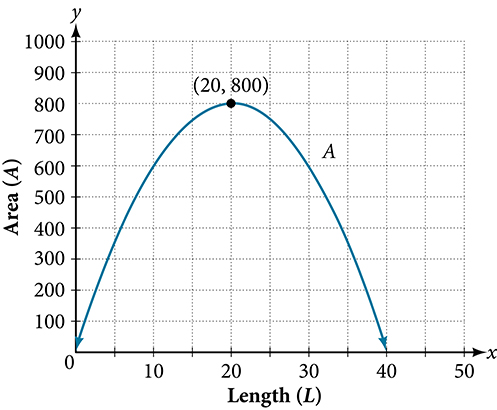
Figure: Graph of the area function \(A(L) = -\tfrac{1}{2}L^2 + 40L\), an upside-down parabola with vertex at \((40, 800)\).
The unit price of an item affects its supply and demand. That is, if the unit price goes up, the demand for the item will usually decrease. For example, a local newspaper currently has 84,000 subscribers at a quarterly charge of $30. Market research has suggested that if the owners raise the price to $32, they would lose 5,000 subscribers. Assuming that subscriptions are linearly related to the price, what price should the newspaper charge for a quarterly subscription to maximize their revenue?
Solution
Revenue is the amount of money a company brings in. In this case, the revenue can be found by multiplying the price per subscription times the number of subscribers, or quantity. We can introduce variables, \(p\) for price per subscription and \(Q\) for quantity, giving us the equation \(\text{Revenue} = pQ.\)
Because the number of subscribers changes with the price, we need to find a relationship between the variables. We know that currently \(p = 30\) and \(Q = 84{,}000.\) We also know that if the price rises to $32, the newspaper would lose 5,000 subscribers, giving a second pair of values, \(p = 32\) and \(Q = 79,000.\) From this we can find a linear equation relating the two quantities. The slope will be
\[\begin{array}{ccl} m & = & \frac{79{,}000 - 84{,}000}{32 - 30} \\ & = & \frac{-5{,}000}{2} \\ & = & -2{,}500 \end{array}\]
This tells us the paper will lose 2,500 subscribers for each dollar they raise the price. We can then solve for the \(y\)-intercept.
\[\begin{array}{rclc} Q & = & {-2500p + b} & {\quad \text{Substitute in the point}\ Q = 84{,}000\mspace{9mu}\text{and~}p = 30} \\ 84{,}000 & = & {-2500(30) + b} & {\quad \text{Solve for}\ b} \\ b & = & 159{,}000 & \end{array}\]
This gives us the linear equation \(Q = -2{,}500p + 159{,}000\) relating cost and subscribers. We now return to our revenue equation.
\[\begin{array}{rcl} {Revenue} & = & {pQ} \\ {Revenue} & = & {p(-2{,}500p + 159{,}000)} \\ {Revenue} & = & {-2{,}500p^{2} + 159{,}000p} \end{array}\]
We now have a quadratic function for revenue as a function of the subscription charge. To find the price that will maximize revenue for the newspaper, we can find the vertex.
\[\begin{array}{ccl} h & = & {- \frac{159{,}000}{2(-2{,}500)}} \\ & = & 31.8 \end{array}\]
The model tells us that the maximum revenue will occur if the newspaper charges $31.80 for a subscription. To find what the maximum revenue is, we evaluate the revenue function.
\[\begin{array}{ccl} \text{maximum revenue} & = & {-2{,}500{(31.8)}^{2} + 159{,}000(31.8)} \\ & = & 2{,}528{,}100 \end{array}\]
Analysis. This could also be solved by graphing the quadratic as shown below. We can see the maximum revenue on a graph of the quadratic function.
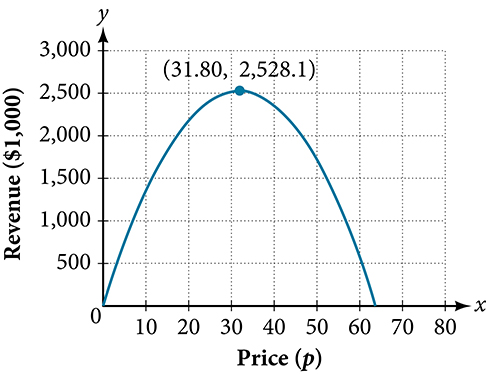
Figure: Graph of the newspaper-revenue quadratic with vertex at the price 31.80 dollars and revenue 2,528,100 dollars.
Finding the \(x\)- and \(y\)-Intercepts of a Quadratic Function
Much as we did in the application problems above, we also need to find intercepts of quadratic equations for graphing parabolas. Recall that we find the \(y\ \text{-}\) intercept of a quadratic by evaluating the function at an input of zero, and we find the \(x\ \text{-}\) intercepts at locations where the output is zero. The figure below illustrates that the number of \(x\ \text{-}\) intercepts can vary depending upon the location of the graph.
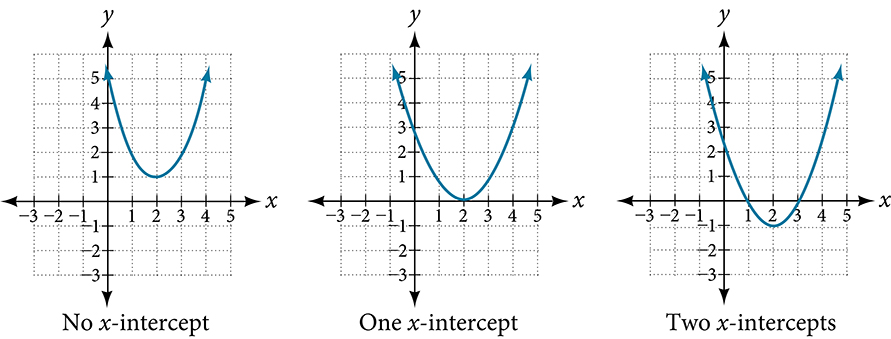
Figure: Three side-by-side parabolas illustrating zero, one, and two x-intercepts (the discriminant cases).
Find the \(y\)- and \(x\)-intercepts of the quadratic \(f(x) = 3x^{2} + 5x - 2.\)
Solution
We find the \(y\)-intercept by evaluating \(f(0).\)
\[\begin{array}{ccl} {f(0)} & = & {3{(0)}^{2} + 5(0) - 2} \\ & = & -2 \end{array}\]
So the \(y\)-intercept is at \(\left( {0,-2} \right).\)
For the \(x\)-intercepts, we find all solutions of \(f(x) = 0.\)
\[0 = 3x^{2} + 5x - 2\]
In this case, the quadratic can be factored easily, providing the simplest method for solution.
\[0 = (3x - 1)(x + 2)\]
So the \(x\)-intercepts are at \(\left( {\frac{1}{3},0} \right)\) and \(\left( {- 2,0} \right).\)
Analysis. By graphing the function, we can confirm that the graph crosses the \(y\)-axis at \((0,-2).\) We can also confirm that the graph crosses the \(x\)-axis at \(\left( {\frac{1}{3},0} \right)\) and \((-2,0).\) See the figure below
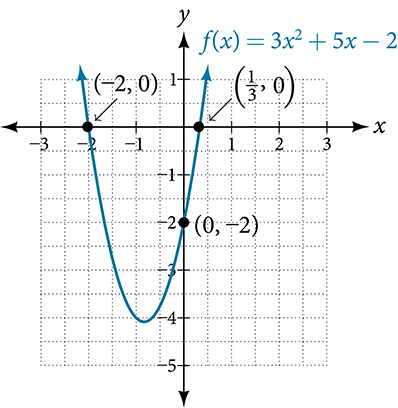
Figure: Parabola crossing the x-axis at the points \((-2, 0)\) and \((1/3, 0)\), and crossing the y-axis at \((0, -2)\).
Rewriting Quadratics in Standard Form
In Example 7, the quadratic was easily solved by factoring. However, there are many quadratics that cannot be factored. We can solve these quadratics by first rewriting them in standard form.
Find the \(x\ \text{-}\) intercepts of the quadratic function \(f(x) = 2x^{2} + 4x - 4.\)
Solution
We begin by solving for when the output will be zero.
\[0 = 2x^{2} + 4x - 4\]
Because the quadratic is not easily factorable in this case, we solve for the intercepts by first rewriting the quadratic in standard form.
\[f(x) = a\left( {x - h} \right)^{2} + k\]
We know that \(a = 2.\) Then we solve for \(h\) and \(k.\)
\[\begin{array}{cclccl} h & = & {- \frac{b}{2a}} & {\qquad k} & = & {f(-1)} \\ & = & {- \frac{4}{2(2)}} & & = & {2{(-1)}^{2} + 4(-1) - 4} \\ & = & -1 & & = & {\operatorname{}-6} \end{array}\]
So now we can rewrite in standard form.
\[f(x) = 2{(x + 1)}^{2} - 6\]
We can now solve for when the output will be zero.
\[\begin{array}{l} {0 = 2{(x + 1)}^{2} - 6} \\ {6 = 2{(x + 1)}^{2}} \\ {3 = {(x + 1)}^{2}} \\ {x + 1 = \pm \sqrt{3}} \\ {x = - 1 \pm \sqrt{3}} \end{array}\]
The graph has \(x\)-intercepts at \((-1 - \sqrt{3},0)\) and \((-1 + \sqrt{3},0).\)
We can check our work by graphing the given function on a graphing utility and observing the \(x\ \text{-}\) intercepts. See the figure below.
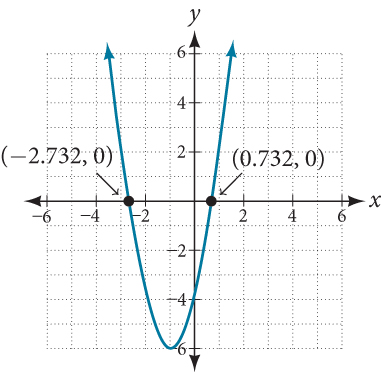
Figure: Parabola with x-intercepts at approximately \((-2.732, 0)\) and \((0.732, 0)\).
Analysis. We could have achieved the same results using the quadratic formula. Identify \(a = 2,b = 4\) and \(c = -4.\)
\[\begin{array}{ccl} x & = & \frac{- b \pm \sqrt{b^{2} - 4ac}}{2a} \\ & = & \frac{-4 \pm \sqrt{4^{2} - 4(2)(-4)}}{2(2)} \\ & = & \frac{-4 \pm \sqrt{48}}{4} \\ & = & \frac{-4 \pm \sqrt{3(16)}}{4} \\ & = & {-1 \pm \sqrt{3}} \end{array}\]
So the \(x\)-intercepts occur at \(\left( {- 1 - \sqrt{3},0} \right)\) and \(\left( {- 1 + \sqrt{3},0} \right).\)
A ball is thrown upward from the top of a 40 foot high building at a speed of 80 feet per second. The ball’s height above ground can be modeled by the equation \(H(t) = - 16t^{2} + 80t + 40.\)
- When does the ball reach the maximum height?
- What is the maximum height of the ball?
- When does the ball hit the ground?
Solution
The ball reaches the maximum height at the vertex of the parabola.
\[\begin{array}{ccl} h & = & {- \frac{80}{2(-16)}} \\ & = & \frac{80}{32} \\ & = & \frac{5}{2} \\ & = & 2.5 \end{array}\]
The ball reaches a maximum height after 2.5 seconds.
To find the maximum height, find the \(y\ \text{-}\) coordinate of the vertex of the parabola.
\[\begin{array}{ccl} k & = & {H\left( {- \frac{b}{2a}} \right)} \\ & = & {H(2.5)} \\ & = & {-16(2.5)^{2} + 80(2.5) + 40} \\ & = & 140 \end{array}\]
The ball reaches a maximum height of 140 feet.
To find when the ball hits the ground, we need to determine when the height is zero, \(H(t) = 0.\)
We use the quadratic formula.
\[\begin{array}{ccl} t & = & \frac{-80 \pm \sqrt{80^{2} - 4(-16)(40)}}{2(-16)} \\ & = & \frac{-80 \pm \sqrt{8960}}{-32} \end{array}\]
Because the square root does not simplify nicely, we can use a calculator to approximate the values of the solutions.
\[\begin{array}{lll} {t = \frac{- 80 - \sqrt{8960}}{- 32} \approx 5.458} & \text{or} & {t = \frac{- 80 + \sqrt{8960}}{- 32} \approx - 0.458} \end{array}\]
The second answer is outside the reasonable domain of our model, so we conclude the ball will hit the ground after about 5.458 seconds. See the figure below.
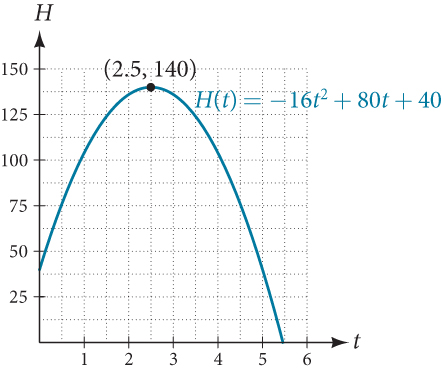
Figure: Graph of \(H(t) = -16t^{2} + 80t + 40.\)
Note that the graph does not represent the physical path of the ball upward and downward. Keep the quantities on each axis in mind while interpreting the graph.
5.1.11 Summary
- Solving quadratic equations. Four methods, in roughly increasing generality:
- Factoring + zero product property: fast when the trinomial factors over the integers.
- Square root property: when there is no linear term.
- Completing the square: works always; converts to a perfect square.
- Quadratic formula \(x = \tfrac{-b \pm \sqrt{b^2 - 4ac}}{2a}\): works always.
- The discriminant \(\Delta = b^2 - 4ac\) tells you the number of real solutions: two if positive, one if zero, none (only complex) if negative.
- Quadratic functions. Graph is a parabola opening up if \(a > 0\), down if \(a < 0\). Vertex at \((h, k)\) with \(h = -\tfrac{b}{2a}\) and \(k = f(h)\). Axis of symmetry \(x = h\). \(y\)-intercept \((0, c)\).
- Standard form. \(f(x) = a(x - h)^2 + k\) exposes the vertex; convert via completing the square.
- Domain and range. Domain \((-\infty, \infty)\); range \([k, \infty)\) if \(a > 0\), \((-\infty, k]\) if \(a < 0\).
- Optimisation. When a quantity is modelled by a quadratic, the vertex gives the optimum.