3.6 Exponential and Logarithmic Equations
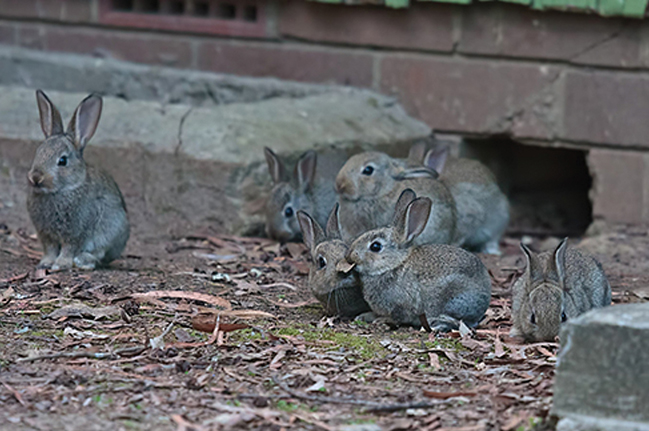
Figure 3.6.1: Wild rabbits in Australia. The rabbit population grew so quickly in Australia that the event became known as the “rabbit plague.” (credit: Richard Taylor, Flickr)
In 1859, an Australian landowner named Thomas Austin released 24 rabbits into the wild for hunting. Because Australia had few predators and ample food, the rabbit population exploded. In fewer than ten years, the rabbit population numbered in the millions.
Uncontrolled population growth, as in the wild rabbits in Australia, can be modeled with exponential functions. Equations resulting from those exponential functions can be solved to analyze and make predictions about exponential growth. In this section, we will learn techniques for solving exponential functions.
3.6.1 Using Like Bases to Solve Exponential Equations
The first technique involves two functions with like bases. Recall that the one-to-one property of exponential functions tells us that, for any real numbers \(b,\) \(S,\) and \(T,\) where \(b > 0,\mspace{9mu} b \neq 1,\) \(b^{S} = b^{T}\) if and only if \(S = T.\)
In other words, when an exponential equation has the same base on each side, the exponents must be equal. This also applies when the exponents are algebraic expressions. Therefore, we can solve many exponential equations by using the rules of exponents to rewrite each side as a power with the same base. Then, we use the fact that exponential functions are one-to-one to set the exponents equal to one another, and solve for the unknown.
For example, consider the equation \(3^{4x - 7} = \frac{3^{2x}}{3}.\) To solve for \(x,\) we use the division property of exponents to rewrite the right side so that both sides have the common base, \(3.\) Then we apply the one-to-one property of exponents by setting the exponents equal to one another and solving for \(x\):
\[\begin{array}{lll} 3^{4x - 7} & {= \frac{3^{2x}}{3}} & \\ 3^{4x - 7} & {= \frac{3^{2x}}{3^{1}}} & {\text{Rewrite~3~as~3}^{1}.} \\ 3^{4x - 7} & {= 3^{2x - 1}} & {\text{Use~the~division~property~of~exponents}\text{.}} \\ {4x - 7} & {= 2x - 1\mspace{9mu}\mspace{9mu}\mspace{9mu}} & {\text{Apply~the~one-to-one~property~of~exponents}\text{.}} \\ {2x} & {= 6} & {\text{Subtract~2}x\mspace{7mu}\text{and~add~7~to~both~sides}\text{.}} \\ x & {= 3} & {\text{Divide~by~2}\text{.}} \end{array}\]
Rewriting Equations So All Powers Have the Same Base
Sometimes the common base for an exponential equation is not explicitly shown. In these cases, we simply rewrite the terms in the equation as powers with a common base, and solve using the one-to-one property.
For example, consider the equation \(256 = 4^{x - 5}.\) We can rewrite both sides of this equation as a power of \(2.\) Then we apply the rules of exponents, along with the one-to-one property, to solve for \(x:\)
\[\begin{array}{ll} {256 = 4^{x - 5}} & \\ {2^{8} = \left( 2^{2} \right)^{x - 5}} & {\text{Rewrite~each~side~as~a~power~with~base~2}.} \\ {2^{8} = 2^{2x - 10}} & {\text{Use~the~one-to-one~property~of~exponents}.} \\ {8 = 2x - 10\begin{array}{llll} & & & \end{array}} & {\text{Apply~the~one-to-one~property~of~exponents}.} \\ {18 = 2x} & {\text{Add~10~to~both~sides}.} \\ {x = 9} & {\text{Divide~by~2}.} \end{array}\]
Solve \(3^{x + 1} = -2.\)
Solution (click to reveal)
This equation has no solution. There is no real value of \(x\) that will make the equation a true statement because any power of a positive number is positive.
Figure 3.6.13 shows that the two graphs do not cross so the left side is never equal to the right side. Thus the equation has no solution.
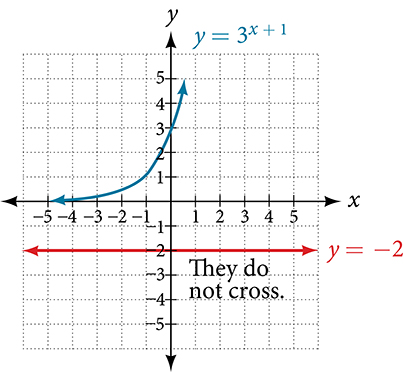
Figure 3.6.13:
3.6.2 Solving Exponential Equations Using Logarithms
Sometimes the terms of an exponential equation cannot be rewritten with a common base. In these cases, we solve by taking the logarithm of each side. Recall, since \(\log(a) = \log(b)\) is equivalent to \(a = b,\) we may apply logarithms with the same base on both sides of an exponential equation.
Equations Containing \(e\)
One common type of exponential equations are those with base \(e.\) This constant occurs again and again in nature, in mathematics, in science, in engineering, and in finance. When we have an equation with a base \(e\) on either side, we can use the natural logarithm to solve it.
Extraneous Solutions
Sometimes the methods used to solve an equation introduce an extraneous solution, which is a solution that is correct algebraically but does not satisfy the conditions of the original equation. One such situation arises in solving when the logarithm is taken on both sides of the equation. In such cases, remember that the argument of the logarithm must be positive. If the number we are evaluating in a logarithm function is negative, there is no output.
3.6.3 Using the Definition of a Logarithm to Solve Logarithmic Equations
We have already seen that every logarithmic equation \(\log_{b}(x) = y\) is equivalent to the exponential equation \(b^{y} = x.\) We can use this fact, along with the rules of logarithms, to solve logarithmic equations where the argument is an algebraic expression.
For example, consider the equation \(\log_{2}(2) + \log_{2}\left( {3x - 5} \right) = 3.\) To solve this equation, we can use rules of logarithms to rewrite the left side in compact form and then apply the definition of logs to solve for \(x:\)
\[\begin{array}{ll} {\log_{2}(2) + \log_{2}(3x - 5) = 3} & \\ {\log_{2}(2(3x - 5)) = 3} & \text{Apply the product rule of logarithms.} \\ {\log_{2}(6x - 10) = 3} & {\text{Distribute}.} \\ {2^{3} = 6x - 10} & {\text{Apply the definition of a logarithm}.} \\ {8 = 6x - 10\begin{array}{llll} & & & \end{array}} & {\text{Calculate}2^{3}.} \\ {18 = 6x} & {\text{Add 10 to both sides}.} \\ {x = 3} & {\text{Divide by 6}.} \end{array}\]
Solve \(\ln x = 3.\)
Solution (click to reveal)
\[\begin{array}{ll} {\ln x = 3} & \\ {x = e^{3}} & {\text{Use~the~definition~of~the~natural~logarithm}\text{.}} \end{array}\]
Figure 3 represents the graph of the equation. On the graph, the \(x\)-coordinate of the point at which the two graphs intersect is close to 20. In other words \(e^{3} \approx 20.\) A calculator gives a better approximation: \(e^{3} \approx 20.0855.\)
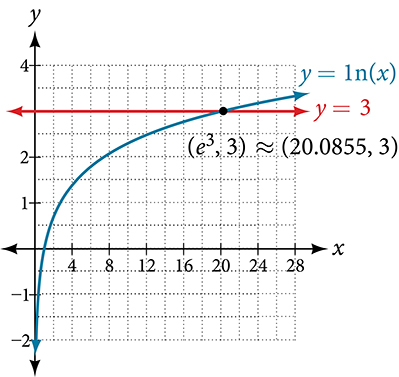
Figure 3 The graphs of \(y = \ln x\) and \(y = 3\) cross at the point \(\text{(e}^{3},3),\) which is approximately (20.0855, 3).
3.6.4 Using the One-to-One Property of Logarithms to Solve Logarithmic Equations
As with exponential equations, we can use the one-to-one property to solve logarithmic equations. The one-to-one property of logarithmic functions tells us that, for any real numbers \(x > 0,\) \(S > 0,\) \(T > 0\) and any positive real number \(b,\) where \(b \neq 1,\)
\[\log_{b}S = \log_{b}T\mspace{9mu}\text{if~and~only~if~}S = T.\]
For example,
\[\text{If~~}\log_{2}(x - 1) = \log_{2}(8),\text{then~}x - 1 = 8.\]
So, if \(x - 1 = 8,\) then we can solve for \(x,\) and we get \(x = 9.\) To check, we can substitute \(x = 9\) into the original equation: \(\log_{2}\left( {9 - 1} \right) = \log_{2}(8) = 3.\) In other words, when a logarithmic equation has the same base on each side, the arguments must be equal. This also applies when the arguments are algebraic expressions. Therefore, when given an equation with logs of the same base on each side, we can use rules of logarithms to rewrite each side as a single logarithm. Then we use the fact that logarithmic functions are one-to-one to set the arguments equal to one another and solve for the unknown.
For example, consider the equation \(\log\left( {3x - 2} \right) - \log(2) = \log\left( {x + 4} \right).\) To solve this equation, we can use the rules of logarithms to rewrite the left side as a single logarithm, and then apply the one-to-one property to solve for \(x:\)
\[\begin{array}{ll} {\log(3x - 2) - \log(2) = \log(x + 4)} & \\ {\log\left( \frac{3x - 2}{2} \right) = \log(x + 4)} & {\text{Apply~the~quotient~rule~of~logarithms}.} \\ {\frac{3x - 2}{2} = x + 4} & {\text{Apply~the~one~to~one~property~of~a~logarithm}.} \\ {3x - 2 = 2x + 8} & {\text{Multiply~both~sides~of~the~equation~by~}2.} \\ {x = 10} & {\text{Subtract~2}x\mspace{9mu}\text{and~add~2}.} \end{array}\]
To check the result, substitute \(x = 10\) into \(\log\left( {3x - 2} \right) - \log(2) = \log\left( {x + 4} \right).\)
\[\begin{array}{ll} {\log(3(10) - 2) - \log(2) = \log((10) + 4)} & \\ {\log(28) - \log(2) = \log(14)} & \\ {\log\left( \frac{28}{2} \right) = \log(14)} & {\text{The~solution~checks}.} \end{array}\]
3.6.5 Solving Applied Problems Using Exponential and Logarithmic Equations
In previous sections, we learned the properties and rules for both exponential and logarithmic functions. We have seen that any exponential function can be written as a logarithmic function and vice versa. We have used exponents to solve logarithmic equations and logarithms to solve exponential equations. We are now ready to combine our skills to solve equations that model real-world situations, whether the unknown is in an exponent or in the argument of a logarithm.
One such application is in science, in calculating the time it takes for half of the unstable material in a sample of a radioactive substance to decay, called its half-life. Table 3.6.37 lists the half-life for several of the more common radioactive substances.
| Substance | Use | Half-life |
|---|---|---|
| gallium-67 | nuclear medicine | 80 hours |
| cobalt-60 | manufacturing | 5.3 years |
| technetium-99m | nuclear medicine | 6 hours |
| americium-241 | construction | 432 years |
| carbon-14 | archeological dating | 5,730 years |
| uranium-235 | atomic power | 703,800,000 years |
Table 3.6.37:
We can see how widely the half-lives for these substances vary. Knowing the half-life of a substance allows us to calculate the amount remaining after a specified time. We can use the formula for radioactive decay:
\[\begin{array}{l} {A(t) = A_{0}e^{\frac{\ln(0.5)}{T}t}} \\ {A(t) = A_{0}e^{\ln(0.5)\frac{t}{T}}} \\ {A(t) = A_{0}{(e^{\ln(0.5)})}^{\frac{t}{T}}} \\ {A(t) = A_{0}\left( \frac{1}{2} \right)^{\frac{t}{T}}} \end{array}\]
where
- \(A_{0}\) is the amount initially present
- \(T\) is the half-life of the substance
- \(t\) is the time period over which the substance is studied
- \(A(t)\) is the amount of the substance present after time \(t\)