4.2 Right Triangle Trigonometry
Mt. Everest, which straddles the border between China and Nepal, is the tallest mountain in the world. Measuring its height is no easy task. In fact, the actual measurement has been a source of controversy for hundreds of years. The measurement process involves the use of triangles and a branch of mathematics known as trigonometry. In this section, we will define a new group of functions known as trigonometric functions, and find out how they can be used to measure heights, such as those of the tallest mountains.
4.2.1 Using Right Triangles to Evaluate Trigonometric Functions
Figure 4.2.1 shows a right triangle with a vertical side of length \(y\) and a horizontal side has length \(x.\) Notice that the triangle is inscribed in a circle of radius 1. Such a circle, with a center at the origin and a radius of 1, is known as a unit circle.
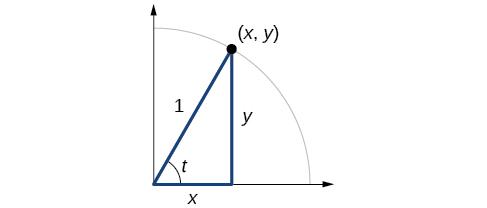
Figure 4.2.1:
We can define the trigonometric functions in terms an angle \(t\) and the lengths of the sides of the triangle. The adjacent side is the side closest to the angle, \(x\). (Adjacent means “next to.”) The opposite side is the side across from the angle, \(y\). The hypotenuse is the side of the triangle opposite the right angle, 1. These sides are labeled in Figure 4.2.2.
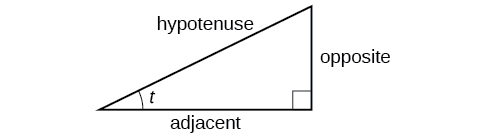
Figure 4.2.2: The sides of a right triangle in relation to angle \(t\)
Given a right triangle with an acute angle of \(t,\) the first three trigonometric functions are listed.
\[\begin{array}{lll} {\mspace{45mu}\text{Sine}} & {\quad\text{sin~}t} & {= \frac{\text{opposite}}{\text{hypotenuse}}} \end{array}\]
\[\begin{array}{lll} {\mspace{27mu}\text{Cosine}} & {\quad\text{cos~}t} & {= \frac{\text{adjacent}}{\text{hypotenuse}}} \end{array}\]
\[\begin{array}{rll} \text{Tangent} & {\quad\text{tan~}t} & {= \frac{\text{opposite}}{\text{adjacent}}} \end{array}\]
A common mnemonic for remembering these relationships is SohCahToa, formed from the first letters of “\(\mathbf{S}\)ine is \(\mathbf{o}\)pposite over \(\mathbf{h}\)ypotenuse, \(\mathbf{C}\)osine is \(\mathbf{a}\)djacent over \(\mathbf{h}\)ypotenuse, \(\mathbf{T}\)angent is \(\mathbf{o}\)pposite over \(\mathbf{a}\)djacent.”
For the triangle shown in Figure 4.2.1, we have the following.
\[\begin{array}{rcl} {\text{sin~}t} & = & \frac{y}{1} \\ {\text{cos~}t} & = & \frac{x}{1} \\ {\text{tan~}t} & = & \frac{y}{x} \end{array}\]
Given the triangle shown in Figure 4.2.5, find the value of \(\cos\;\alpha.\)
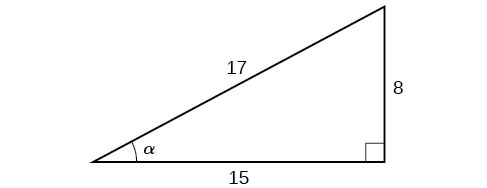
Figure 4.2.5:
Solution (click to reveal)
The side adjacent to the angle is 15, and the hypotenuse of the triangle is 17.
\[\begin{array}{ccl} {\cos(\alpha)} & = & \frac{\text{adjacent}}{\text{hypotenuse}} \\ & = & \frac{15}{17} \end{array}\]
Given the triangle shown in Figure 4.2.7, find the value of \(\text{sin}\; t.\)
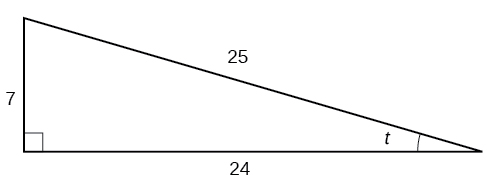
Figure 4.2.7:
Solution (click to reveal)
\(\frac{7}{25}\)
Reciprocal Functions
In addition to sine, cosine, and tangent, there are three more functions. These too are defined in terms of the sides of the triangle.
\[\begin{array}{lll} {\qquad\text{Secant}} & {\quad\text{sec~}t} & {= \frac{\text{hypotenuse}}{\text{adjacent}}} \end{array}\]
\[\begin{array}{rrl} {\mspace{23mu}\text{Cosecant}} & {\quad\text{csc~}t} & {= \frac{\text{hypotenuse}}{\text{opposite}}} \end{array}\]
\[\begin{array}{rcl} \text{Cotangent} & {\quad\text{cot~}t} & {= \frac{\text{adjacent}}{\text{opposite}}} \end{array}\]
Take another look at these definitions. These functions are the reciprocals of the first three functions.
\[\begin{array}{rclrcl} {\text{sin~}t} & = & \frac{1}{\text{csc~}t} & {\qquad\text{csc~}t} & = & \frac{1}{\text{sin~}t} \\ {\text{cos~}t} & = & \frac{1}{\text{sec~}t} & {\qquad\text{sec~}t} & = & \frac{1}{\text{cos~}t} \\ {\text{tan~}t} & = & \frac{1}{\text{cot~}t} & {\qquad\text{cot~}t} & = & \frac{1}{\text{tan~}t} \end{array}\]
When working with right triangles, keep in mind that the same rules apply regardless of the orientation of the triangle. In fact, we can evaluate the six trigonometric functions of either of the two acute angles in the triangle in Figure 4.2.8. The side opposite one acute angle is the side adjacent to the other acute angle, and vice versa.
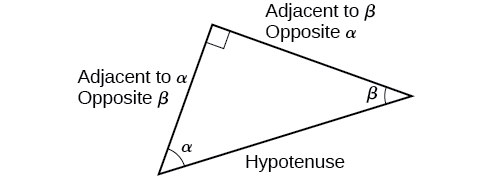
Figure 4.2.8: The side adjacent to one angle is opposite the other angle.
Many problems ask for all six trigonometric functions for a given angle in a triangle. A possible strategy to use is to find the sine, cosine, and tangent of the angles first. Then, find the other trigonometric functions easily using the reciprocals.
Using the triangle shown in Figure 4.2.11, evaluate \(\sin\;\alpha,\cos\;\alpha,\tan\;\alpha,\text{sec}\;\alpha,\csc\;\alpha,\text{and}\;\cot\;\alpha.\)
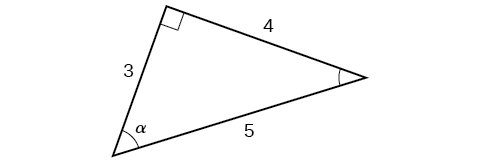
Figure 4.2.11:
Solution (click to reveal)
\[\begin{array}{rll} {\text{sin~}\alpha} & {= \frac{\text{opposite~}\alpha}{\text{hypotenuse}}} & {= \frac{4}{5}} \\ {\text{cos~}\alpha} & {= \frac{\text{adjacent~to~}\alpha}{\text{hypotenuse}}} & {= \frac{3}{5}} \\ {\text{tan~}\alpha} & {= \frac{\text{opposite~}\alpha}{\text{adjacent~to~}\alpha}} & {= \frac{4}{3}} \\ {\text{sec~}\alpha} & {= \frac{\text{hypotenuse}}{\text{adjacent~to~}\alpha}} & {= \frac{5}{3}} \\ {\text{csc~}\alpha} & {= \frac{\text{hypotenuse}}{\text{opposite~}\alpha}} & {= \frac{5}{4}} \\ {\text{cot~}\alpha} & {= \frac{\text{adjacent~to~}\alpha}{\text{opposite~}\alpha}} & {= \frac{3}{4}} \end{array}\]
Another approach would have been to find sine, cosine, and tangent first. Then find their reciprocals to determine the other functions.
\[\text{sec~}\alpha = \frac{1}{\text{cos~}\alpha} = \frac{1}{\frac{3}{5}} = \frac{5}{3}\]
\[\text{csc~}\alpha = \frac{1}{\text{sin~}\alpha} = \frac{1}{\frac{4}{5}} = \frac{5}{4}\]
\[\text{cot~}\alpha = \frac{1}{\text{tan~}\alpha} = \frac{1}{\frac{4}{3}} = \frac{3}{4}\]
Using the triangle shown in Figure 4.2.13,evaluate \(\text{sin}\; t,\text{cos}\; t,\text{tan}\; t,\text{sec}\; t,\text{csc}\; t,\text{and}\;\text{cot}\; t.\)
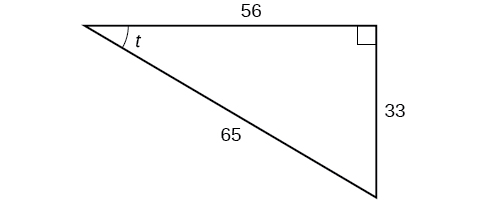
Figure 4.2.13:
Solution (click to reveal)
\(\begin{array}{rclrclrcl} {\text{sin~}t} & = & {\frac{33}{65},} & {\text{cos~}t} & = & {\frac{56}{65},} & {\text{tan~}t} & = & {\frac{33}{56},} \\ {\text{sec~}t} & = & {\frac{65}{56},} & {\text{csc~}t} & = & {\frac{65}{33},} & {\text{cot~}t} & = & \frac{56}{33} \end{array}\)
Finding Trigonometric Functions of Special Angles Using Side Lengths
It is helpful to evaluate the trigonometric functions as they relate to the special angles—multiples of \(30{^\circ},60{^\circ},\) and \(45{^\circ}.\) Remember, however, that when dealing with right triangles, we are limited to angles between \(0{^\circ}\text{~and~90°}\text{.}\)
Suppose we have a \(30{^\circ},60{^\circ},90{^\circ}\) triangle, which can also be described as a \(\frac{\pi}{6},\frac{\pi}{3},\frac{\pi}{2}\) triangle. The sides have lengths in the relation \(s,\sqrt{3}s,2s.\) The sides of a \(45{^\circ},45{^\circ}\operatorname{},90{^\circ}\) triangle, which can also be described as a \(\frac{\pi}{4},\frac{\pi}{4},\frac{\pi}{2}\) triangle, have lengths in the relation \(s,s,\sqrt{2}s.\) These relations are shown in Figure 4.2.14.
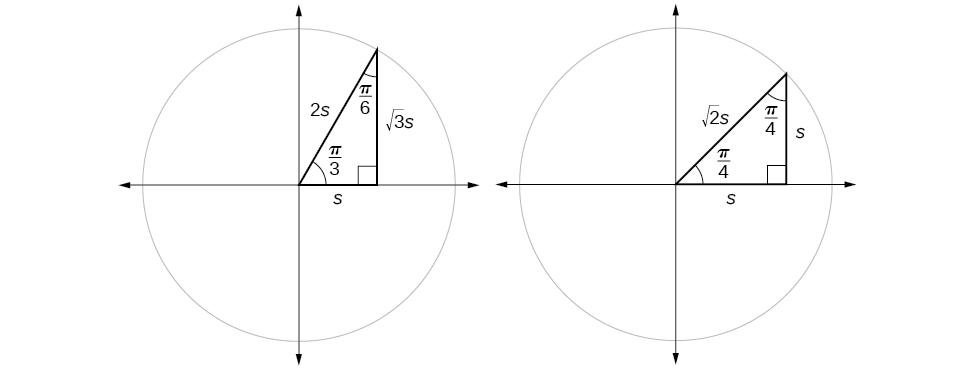
Figure 4.2.14: Side lengths of special triangles
We can then use the ratios of the side lengths to evaluate trigonometric functions of special angles.
4.2.2 Using Equal Cofunction of Complements
If we look more closely at the relationship between the sine and cosine of the special angles, we notice a pattern. In a right triangle with angles of \(\frac{\pi}{6}\) and \(\frac{\pi}{3},\) we see that the sine of \(\frac{\pi}{3},\) namely \(\frac{\sqrt{3}}{2},\) is also the cosine of \(\frac{\pi}{6},\) while the sine of \(\frac{\pi}{6},\) namely \(\frac{1}{2},\) is also the cosine of \(\frac{\pi}{3}.\)
\[\begin{array}{rlll} {\sin\frac{\pi}{3}} & {= \cos\frac{\pi}{6}} & {= \frac{\sqrt{3}s}{2s}} & {= \frac{\sqrt{3}}{2}} \\ {\sin\frac{\pi}{6}} & {= \cos\frac{\pi}{3}} & {= \frac{s}{2s}} & {= \frac{1}{2}} \end{array}\]
See Figure 4.2.18.
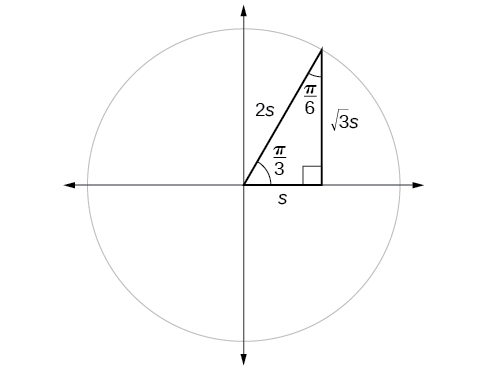
Figure 4.2.18: The sine of \(\frac{\pi}{3}\) equals the cosine of \(\frac{\pi}{6}\) and vice versa.
This result should not be surprising because, as we see from Figure 4.2.18, the side opposite the angle of \(\frac{\pi}{3}\) is also the side adjacent to \(\frac{\pi}{6},\) so \(\sin\left( \frac{\pi}{3} \right)\) and \(\cos\left( \frac{\pi}{6} \right)\) are exactly the same ratio of the same two sides, \(\sqrt{3}s\) and \(2s.\) Similarly, \(\cos\left( \frac{\pi}{3} \right)\) and \(\sin\left( \frac{\pi}{6} \right)\) are also the same ratio using the same two sides, \(s\) and \(2s.\)
The interrelationship between the sines and cosines of \(\frac{\pi}{6}\) and \(\frac{\pi}{3}\) also holds for the two acute angles in any right triangle, since in every case, the ratio of the same two sides would constitute the sine of one angle and the cosine of the other. Since the three angles of a triangle add to \(\pi,\) and the right angle is \(\frac{\pi}{2},\) the remaining two angles must also add up to \(\frac{\pi}{2}.\) That means that a right triangle can be formed with any two angles that add to \(\frac{\pi}{2}\) —in other words, any two complementary angles. So we may state a cofunction identity: If any two angles are complementary, the sine of one is the cosine of the other, and vice versa. This identity is illustrated in Figure 4.2.19.
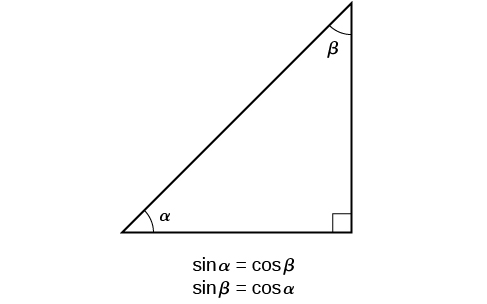
Figure 4.2.19: Cofunction identity of sine and cosine of complementary angles
Using this identity, we can state without calculating, for instance, that the sine of \(\frac{\pi}{12}\) equals the cosine of \(\frac{5\pi}{12},\) and that the sine of \(\frac{5\pi}{12}\) equals the cosine of \(\frac{\pi}{12}.\) We can also state that if, for a given angle \(t,\cos\; t = \frac{5}{13},\) then \(\sin\left( {\frac{\pi}{2} - t} \right) = \frac{5}{13}\) as well.
4.2.3 Using Trigonometric Functions
In previous examples, we evaluated the sine and cosine in triangles where we knew all three sides. But the real power of right-triangle trigonometry emerges when we look at triangles in which we know an angle but do not know all the sides.
Find the unknown sides of the triangle in Figure 4.2.27.
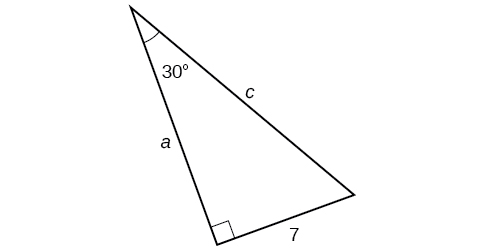
Figure 4.2.27:
Solution (click to reveal)
We know the angle and the opposite side, so we can use the tangent to find the adjacent side.
\[\tan(30{^\circ}) = \frac{7}{a}\]
We rearrange to solve for \(a.\)
\[\begin{array}{ccl} a & = & \frac{7}{\tan(30{^\circ})} \\ & \approx & 12.1 \end{array}\]
We can use the sine to find the hypotenuse.
\[\sin(30{^\circ}) = \frac{7}{c}\]
Again, we rearrange to solve for \(c.\)
\[\begin{array}{ccl} c & = & \frac{7}{\sin(30{^\circ})} \\ & = & 14 \end{array}\]
4.2.4 Using Right Triangle Trigonometry to Solve Applied Problems
Right-triangle trigonometry has many practical applications. For example, the ability to compute the lengths of sides of a triangle makes it possible to find the height of a tall object without climbing to the top or having to extend a tape measure along its height. We do so by measuring a distance from the base of the object to a point on the ground some distance away, where we can look up to the top of the tall object at an angle. The angle of elevation of an object above an observer relative to the observer is the angle between the horizontal and the line from the object to the observer’s eye. The right triangle this position creates has sides that represent the unknown height, the measured distance from the base, and the angled line of sight from the ground to the top of the object. Knowing the measured distance to the base of the object and the angle of the line of sight, we can use trigonometric functions to calculate the unknown height.
Similarly, we can form a triangle from the top of a tall object by looking downward. The angle of depression of an object below an observer relative to the observer is the angle between the horizontal and the line from the object to the observer’s eye. See Figure 4.2.29.
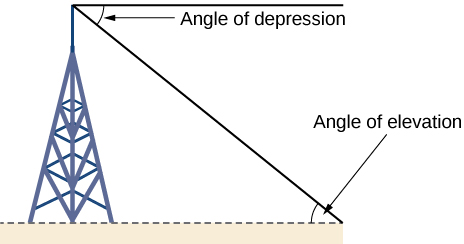
Figure 4.2.29:
To find the height of a tree, a person walks to a point 30 feet from the base of the tree. She measures an angle of \(57{^\circ}\) between a line of sight to the top of the tree and the ground, as shown in Figure 4.2.32. Find the height of the tree.
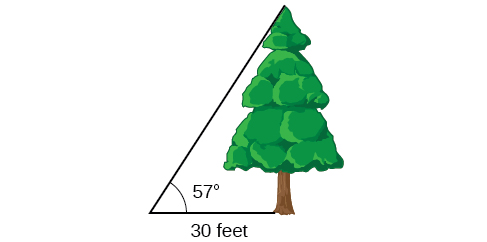
Figure 4.2.32:
Solution (click to reveal)
We know that the angle of elevation is \(57{^\circ}\) and the adjacent side is 30 ft long. The opposite side is the unknown height.
The trigonometric function relating the side opposite to an angle and the side adjacent to the angle is the tangent. So we will state our information in terms of the tangent of \(57{^\circ},\) letting \(h\) be the unknown height.
\[\begin{array}{rclc} {\text{tan~}\theta} & = & \frac{\text{opposite}}{\text{adjacent}} & \\ {\text{tan}(57{^\circ})} & = & \frac{h}{30} & {\quad\text{Solve~for~}h.} \\ h & = & {\text{30tan}\left( \text{57°} \right)} & {\quad\text{Multiply}\text{.}} \\ h & \approx & 46.2 & {\quad\text{Use~a~calculator}\text{.}} \end{array}\]
The tree is approximately 46 feet tall.