1.6 Absolute Value Functions and Inequalities
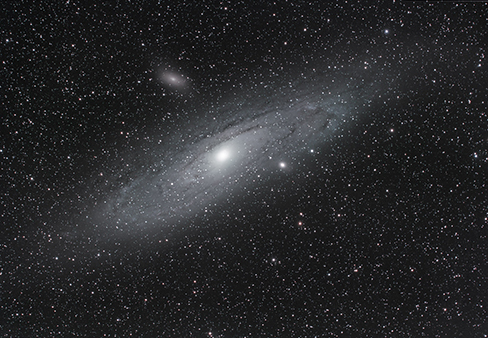
Figure 1.6.1: Distances in deep space can be measured in all directions. As such, it is useful to consider distance in terms of absolute values. (credit: “s58y”/Flickr)
Until the 1920s, the so-called spiral nebulae were believed to be clouds of dust and gas in our own galaxy, some tens of thousands of light years away. Then, astronomer Edwin Hubble proved that these objects are galaxies in their own right, at distances of millions of light years. Today, astronomers can detect galaxies that are billions of light years away. Distances in the universe can be measured in all directions. As such, it is useful to consider distance as an absolute value function. In this section, we will continue our investigation of absolute value functions.
1.6.1 Understanding Absolute Value
Recall that in its basic form \(f(x) = |x|,\) the absolute value function is one of our toolkit functions. The absolute value function is commonly thought of as providing the distance the number is from zero on a number line. Algebraically, for whatever the input value is, the output is the value without regard to sign. Knowing this, we can use absolute value functions to solve some kinds of real-world problems.
1.6.2 Graphing an Absolute Value Function
The most significant feature of the absolute value graph is the corner point at which the graph changes direction. This point is shown at the origin in the figure below.
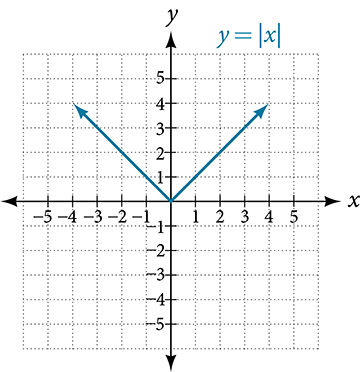
Figure 1.6.2: The toolkit absolute value function \(f(x) = |x|\).
The figure below shows the graph of \(y = 2\left| {x–3} \right| + 4.\) The graph of \(y = |x|\) has been shifted right 3 units, vertically stretched by a factor of 2, and shifted up 4 units. This means that the corner point is located at \(\left( {3,4} \right)\) for this transformed function.
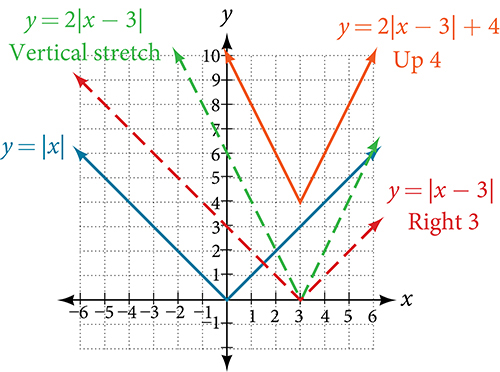
Figure 1.6.3: Transformations of the absolute value function.
Write an equation for the function graphed in the figure below.
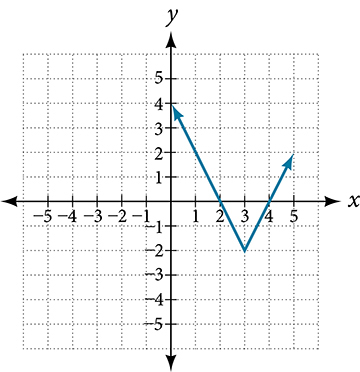
Figure 1.6.4: Graph for Example 1.6.7.
Solution
The basic absolute value function changes direction at the origin, so this graph has been shifted to the right 3 units and down 2 units from the basic toolkit function. See the figure below.
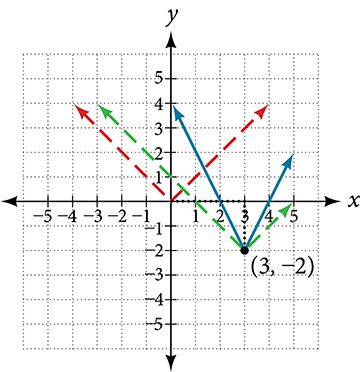
Figure: Step 1 — shift the toolkit V to vertex \((3,\, -2)\).
We also notice that the graph appears vertically stretched, because the width of the final graph on a horizontal line is not equal to 2 times the vertical distance from the corner to this line, as it would be for an unstretched absolute value function. Instead, the width is equal to 1 times the vertical distance as shown in the figure below.
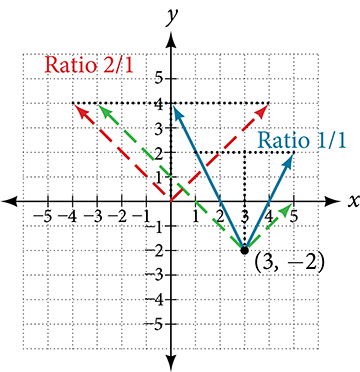
Figure: Step 2 — vertical stretch by factor \(2\).
From this information we can write the equation
\[\begin{array}{rcll} {f(x)} & = & \left. 2 \middle| x - 3 \middle| - 2, \right. & {\quad\ \text{treating~the~stretch~as~}a\mspace{9mu}\text{vertical~stretch,or}} \\ {f(x)} & = & \left| 2(x - 3) \middle| - 2, \right. & {\quad\ \text{treating~the~stretch~as~}a\mspace{9mu}\text{horizontal~compression}.} \end{array}\]
Analysis. Note that these equations are algebraically equivalent—the stretch for an absolute value function can be written interchangeably as a vertical or horizontal stretch or compression. Note also that if the vertical stretch factor is negative, there is also a reflection about the x-axis.
Do the graphs of absolute value functions always intersect the vertical axis? The horizontal axis?
Yes, they always intersect the vertical axis. The graph of an absolute value function will intersect the vertical axis when the input is zero.
No, they do not always intersect the horizontal axis. The graph may or may not intersect the horizontal axis, depending on how the graph has been shifted and reflected. It is possible for the absolute value function to intersect the horizontal axis at zero, one, or two points (see the figure below).
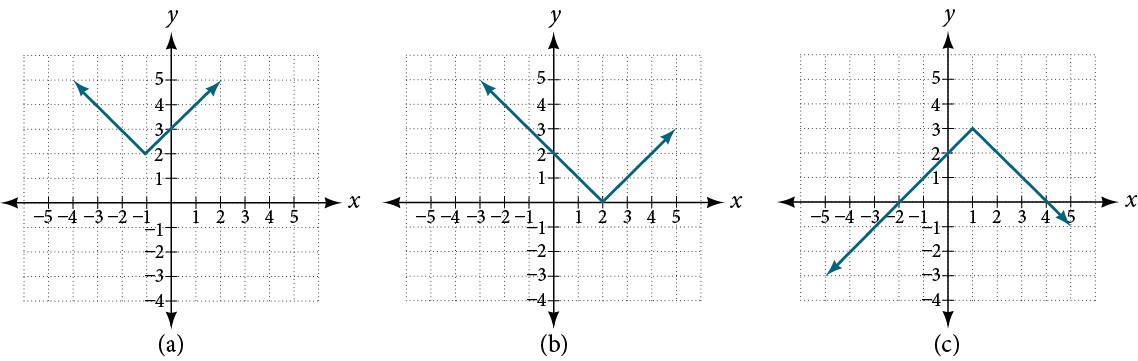
Figure 1.6.5: The three intersection scenarios for \(|A| = B\): zero, one, or two solutions.
1.6.3 Solving an Absolute Value Equation
Earlier, we touched on the concepts of absolute value equations. Now that we understand a little more about their graphs, we can take another look at these types of equations. Now that we can graph an absolute value function, we will learn how to solve an absolute value equation. To solve an equation such as \(8 = \left| {2x - 6} \right|,\) we notice that the absolute value will be equal to 8 if the quantity inside the absolute value is 8 or -8. This leads to two different equations we can solve independently.
\[\begin{aligned} 2x - 6 &= 8 & &\text{or} & 2x - 6 &= -8 \\ 2x &= 14 & & & 2x &= -2 \\ x &= 7 & & & x &= -1 \end{aligned}\]
Knowing how to solve problems involving absolute value functions is useful. For example, we may need to identify numbers or points on a line that are at a specified distance from a given reference point.
An absolute value equation is an equation in which the unknown variable appears in absolute value bars. For example,
\[\begin{array}{l} \left| x \middle| = 4, \right. \\ \left| 2x - 1 \middle| = 3,\text{or} \right. \\ \left| 5x + 2 \middle| - 4 = 9 \right. \end{array}\]
For the function \(\left. f(x) = \middle| 4x + 1 \middle| - 7, \right.\) find the values of \(x\) such that \(f(x) = 0.\)
Solution
First, isolate the absolute value:
\[\begin{aligned} 0 &= |4x + 1| - 7 \\ 7 &= |4x + 1| \end{aligned}\]
Next, break the absolute-value equation into two separate equations and solve each:
\[\begin{aligned} 4x + 1 &= 7 & &\text{or} & 4x + 1 &= -7 \\ 4x &= 6 & & & 4x &= -8 \\ x &= \tfrac{6}{4} = \tfrac{3}{2} & & & x &= \tfrac{-8}{4} = -2 \end{aligned}\]
The function outputs \(0\) when \(x = \tfrac{3}{2}\) or \(x = -2.\) See the figure below.
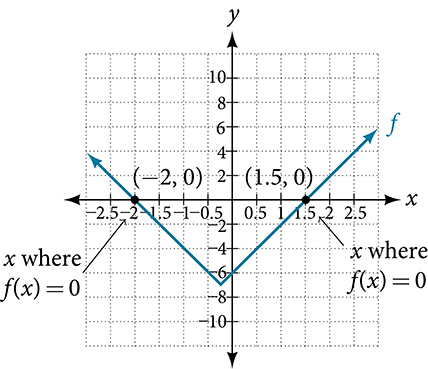
Figure: The graph of \(f(x) = |4x + 1| - 7\), with x-intercepts at \(x = -2\) and \(x = \tfrac{3}{2}\).
1.6.4 Solving Absolute Value Inequalities
As we know, the absolute value of a quantity is a positive number or zero. From the origin, a point located at \(\left( {- x,0} \right)\) has an absolute value of \(x,\) as it is \(x\) units away. Consider absolute value as the distance from one point to another point. Regardless of direction, positive or negative, the distance between the two points is represented as a positive number or zero.
An absolute value inequality is an equation of the form
\[\left| A \middle| < B,\mspace{9mu} \middle| A \middle| \leq B,\mspace{9mu}\mspace{9mu} \middle| A \middle| > B,\mspace{9mu}\text{or}\mspace{9mu}\mspace{9mu} \middle| A \middle| \geq B, \right.\]
Where \(A,\) and sometimes \(B,\) represents an algebraic expression dependent on a variable \(x.\) Solving the inequality means finding the set of all \(x\)-values that satisfy the problem. Usually this set will be an interval or the union of two intervals and will include a range of values.
There are two basic approaches to solving absolute value inequalities: graphical and algebraic. The advantage of the graphical approach is we can read the solution by interpreting the graphs of two equations. The advantage of the algebraic approach is that solutions are exact, as precise solutions are sometimes difficult to read from a graph.
Suppose we want to know all possible returns on an investment if we could earn some amount of money within $200 of $600. We can solve algebraically for the set of x-values such that the distance between \(x\) and 600 is less than or equal to 200. We represent the distance between \(x\) and 600 as \(\left| {x - 600} \right|,\) and therefore, \(\left| {x - 600} \right| \leq 200\) or
\[\begin{matrix} {-200 \leq x - 600 \leq 200} \\ {-200 + 600 \leq x - 600 + 600 \leq 200 + 600} \\ {400 \leq x \leq 800} \end{matrix}\]
This means our returns would be between $400 and $800.
To solve absolute value inequalities, just as with absolute value equations, we write two inequalities and then solve them independently.
Describe all values \(x\) within a distance of 4 from the number 5.
Solution
We want the distance between \(x\) and 5 to be less than or equal to 4. We can draw a number line, such as the one below to represent the condition to be satisfied.
![The values of $x$ within distance $4$ of $5$ form the interval $[1,, 9]$.](../images/fig-3-6-09-distance.png)
Figure: The values of \(x\) within distance \(4\) of \(5\) form the interval \([1,\, 9]\).
The distance from \(x\) to 5 can be represented using an absolute value symbol, \(\left| {x - 5} \right|.\) Write the values of \(x\) that satisfy the condition as an absolute value inequality.
\[\left| {x - 5} \right| \leq 4\]
We need to write two inequalities as there are always two solutions to an absolute value equation.
\[\begin{array}{lll} {x - 5 \leq 4} & {\quad \text{and}\qquad} & {x - 5 \geq - 4} \\ {\quad x \leq 9} & & {\quad x \geq 1} \end{array}\]
If the solution set is \(x \leq 9\) and \(x \geq 1,\) then the solution set is an interval including all real numbers between and including 1 and 9.
So \(\left| {x - 5} \right| \leq 4\) is equivalent to \(\left\lbrack {1,9} \right\rbrack\) in interval notation.
Given the equation \(\left. y = - \frac{1}{2} \middle| 4x - 5 \middle| + 3, \right.\) determine the \(x\)-values for which the \(y\)-values are negative.
Solution
We are trying to determine where \(y < 0,\) which is when \(\left. - \frac{1}{2} \middle| 4x - 5 \middle| + 3 < 0. \right.\) We begin by isolating the absolute value.
\[\begin{array}{ll} \left. - \frac{1}{2} \middle| 4x - 5 \middle| < - 3 \right. & {\quad \text{Multiply both sides by –2, and reverse the inequality}.} \\ {\mspace{27mu}\left| 4x - 5 \middle| > 6 \right.} & \end{array}\]
Next, we solve for the equality \(\left| 4x - 5 \middle| = 6. \right.\)
\[\begin{array}{lll} {4x - 5 = 6} & & {4x - 5 = - 6} \\ {\quad 4x = 11} & {\quad \text{or}\qquad} & {\quad 4x = - 1} \\ {\qquad x = \frac{11}{4}} & & {\qquad x = - \frac{1}{4}} \end{array}\]
Now, we can examine the graph to observe where the y-values are negative. We observe where the branches are below the x-axis. Notice that it is not important exactly what the graph looks like, as long as we know that it crosses the horizontal axis at \(x = - \frac{1}{4}\) and \(x = \frac{11}{4},\) and that the graph opens downward. See the figure below.
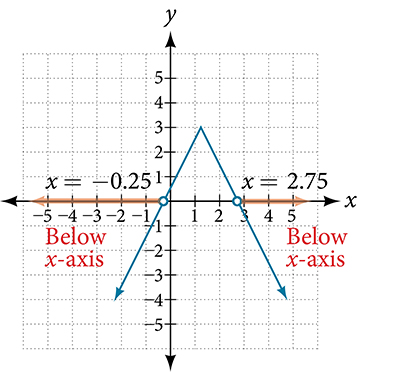
Figure: \(y = -\tfrac{1}{2}|4x - 5| + 3\). The function is negative on \((-\infty,\, -\tfrac{1}{4}) \cup (\tfrac{11}{4},\, \infty)\).
1.6.5 Summary
- Absolute value \(|x|\) measures the distance from \(x\) to \(0\) on the number line.
- The toolkit absolute value function \(f(x) = |x|\) has a V-shaped graph with vertex at the origin. The transformed form \(f(x) = a\,|x - h| + k\) has vertex \((h,\, k)\).
- Absolute value equations. \(|A| = B\) (with \(B \geq 0\)) is equivalent to \(A = B\) or \(A = -B\). If \(B < 0\), no solution exists.
- Absolute value inequalities.
- \(|X| < k\) is equivalent to \(-k < X < k\) (interval).
- \(|X| > k\) is equivalent to \(X < -k\) or \(X > k\) (union of two rays).
- The geometric reading. \(|x - c| < k\) describes points within distance \(k\) of \(c\); \(|x - c| > k\) describes points farther than \(k\) from \(c\).