3.4 Derivatives as Rates of Change
In this section we look at some applications of the derivative by focusing on the interpretation of the derivative as the rate of change of a function. Whenever you check how quickly something is increasing or decreasing—whether it’s the speed of a falling object, the concentration of a chemical in a reaction, or the size of a growing population—you are thinking about a rate of change. The derivative gives us a way to make that idea precise.
A key distinction runs through everything that follows: the average rate of change of a function \(f\) over an interval tells us how much \(f\) changed on average between two points, while the instantaneous rate of change \(f'(a)\) tells us how fast \(f\) is changing at the single moment \(t = a\). Whenever we compute a derivative and evaluate it at a point, we are finding an instantaneous rate of change.
We begin with a general estimation technique, then spend most of the section exploring what the derivative tells us in several concrete settings: the motion of objects, the progress of chemical reactions, the cooling of hot objects, and the growth of populations.
3.4.1 Amount of Change Formula
One application for derivatives is to estimate an unknown value of a function at a point by using a known value of a function at some given point together with its rate of change at the given point. If \(f(x)\) is a function defined on an interval \([a, a+h]\), then the amount of change of \(f(x)\) over the interval is the change in the \(y\) values of the function over that interval and is given by
\[f(a+h) - f(a).\]
The average rate of change of the function \(f\) over that same interval is the ratio of the amount of change over that interval to the corresponding change in the \(x\) values. It is given by
\[\frac{f(a+h) - f(a)}{h}.\]
As we already know, the instantaneous rate of change of \(f(x)\) at \(a\) is its derivative
\[f'(a) = \lim_{h \to 0} \frac{f(a+h) - f(a)}{h}.\]
For small enough values of \(h\), \(f'(a) \approx \frac{f(a+h) - f(a)}{h}\). We can then solve for \(f(a+h)\) to get the amount of change formula:
\[f(a+h) \approx f(a) + f'(a) \cdot h. \tag{3.4.1}\]
We can use this formula if we know only \(f(a)\) and \(f'(a)\) and wish to estimate the value of \(f(a+h)\). For example, we may use the current population of a city and the rate at which it is growing to estimate its population in the near future. As we can see in Figure 3.4.2, we are approximating \(f(a+h)\) by the \(y\) coordinate at \(a+h\) on the line tangent to \(f(x)\) at \(x = a\). Observe that the accuracy of this estimate depends on the value of \(h\) as well as the value of \(f'(a)\).
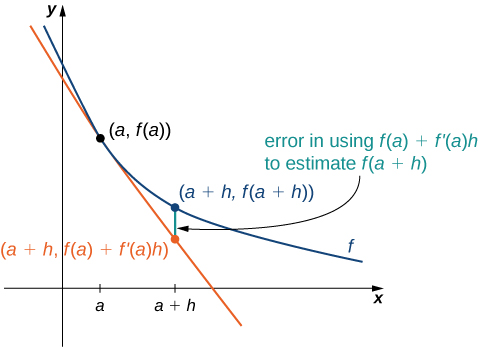
Figure 3.4.2: The new value of a changed quantity equals the original value plus the rate of change times the interval of change: \(f(a+h) \approx f(a) + f'(a) \cdot h\).
The following example illustrates how the amount of change formula works in practice.
3.4.2 Motion Along a Line
Another use for the derivative is to analyze motion along a line. If you have ever watched a speedometer needle climb as you accelerate onto a highway, you have an intuitive sense of what it means for velocity to change over time. In this subsection, we make that intuition precise.
Suppose an object moves along a straight line (imagine a car on a long, straight road, or a ball tossed straight up into the air). We describe the object’s location at time \(t\) by a position function \(s(t)\), which tells us how far the object is from some reference point. The derivative of position with respect to time gives us velocity—the instantaneous rate of change of position. And the derivative of velocity gives us acceleration—the instantaneous rate of change of velocity.
A few things to notice about these definitions. Velocity can be positive or negative: a positive velocity means the object is moving in the positive direction (to the right, or upward, depending on the context), while a negative velocity means it is moving in the negative direction. Speed, on the other hand, is always nonnegative—it tells you how fast the object is moving without regard to direction. And acceleration tells you whether the object is speeding up or slowing down: when velocity and acceleration have the same sign, the object is speeding up; when they have opposite signs, the object is slowing down.
A ball is dropped from a height of 64 feet. Its height above ground (in feet) \(t\) seconds later is given by \(s(t) = -16t^2 + 64\).
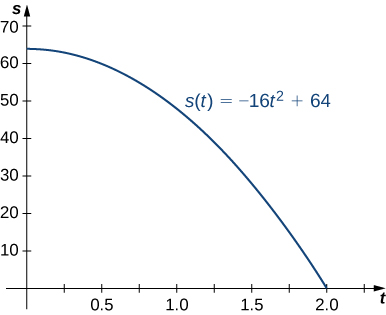
Figure 3.4.7: Height of the ball as a function of time.
- What is the instantaneous velocity of the ball when it hits the ground?
- What is the average velocity during its fall?
Solution (click to reveal)
The first thing to do is determine how long it takes the ball to reach the ground. To do this, set \(s(t) = 0\). Solving \(-16t^2 + 64 = 0\), we get \(t = 2\), so it takes 2 seconds for the ball to reach the ground.
The instantaneous velocity of the ball as it strikes the ground is \(v(2)\). Since \(v(t) = s'(t) = -32t\), we obtain \(v(2) = -64\) ft/s. (The negative sign indicates the ball is moving downward.)
The average velocity of the ball during its fall is
\[v_{\text{avg}} = \frac{s(2) - s(0)}{2 - 0} = \frac{0 - 64}{2} = -32 \text{ ft/s}.\]
Notice that the instantaneous velocity at impact (\(-64\) ft/s) is twice the average velocity (\(-32\) ft/s). This makes sense: the ball starts with zero velocity and steadily accelerates, so by the time it hits the ground it is moving much faster than its average. The average velocity tells us the overall rate of descent; the instantaneous velocity tells us the speed at the exact moment of impact.
In the previous example, we compared instantaneous and average velocity for an object with a simple position function. The next example explores a more subtle situation: what happens when velocity and acceleration point in opposite directions?
Now let’s put these ideas together in a more complete analysis. In the next example, we use the velocity function to determine when a particle is at rest, when it is moving left versus right, and how to trace out its entire path.
The position of a particle moving along a coordinate axis is given by \(s(t) = t^3 - 9t^2 + 24t + 4\), \(t \geq 0\).
- Find \(v(t)\).
- At what time(s) is the particle at rest?
- On what time intervals is the particle moving from left to right? From right to left?
- Use the information obtained to sketch the path of the particle along a coordinate axis.
Solution (click to reveal)
The velocity is the derivative of the position function:
\[v(t) = s'(t) = 3t^2 - 18t + 24.\]
The particle is at rest when \(v(t) = 0\), so set \(3t^2 - 18t + 24 = 0\). Factoring the left-hand side of the equation produces \(3(t - 2)(t - 4) = 0\). Solving, we find that the particle is at rest at \(t = 2\) and \(t = 4\).
The particle is moving from left to right when \(v(t) > 0\) and from right to left when \(v(t) < 0\). The figure below gives the analysis of the sign of \(v(t)\) for \(t \geq 0\), but it does not represent the axis along which the particle is moving.

Figure: The sign of \(v(t)\) determines the direction of the particle.
Since \(3t^2 - 18t + 24 > 0\) on \([0, 2) \cup (4, +\infty)\), the particle is moving from left to right on these intervals. Since \(3t^2 - 18t + 24 < 0\) on \((2, 4)\), the particle is moving from right to left on this interval.
Before we can sketch the path of the particle, we need to know its position at the time it starts moving (\(t = 0\)) and at the times that it changes direction (\(t = 2, 4\)). We have \(s(0) = 4\), \(s(2) = 24\), and \(s(4) = 20\). This means that the particle begins on the coordinate axis at 4, moves to the right until it reaches 24 at \(t = 2\), then reverses direction and moves left until it reaches 20 at \(t = 4\), and then reverses direction again and moves to the right indefinitely. The path of the particle is shown on a coordinate axis in the figure below.
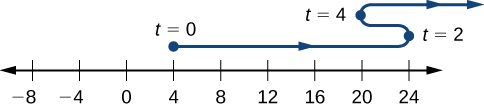
Figure: The path of the particle can be determined by analyzing \(v(t)\).
3.4.3 Reaction Rates in Chemistry
The derivative doesn’t only describe physical motion—it captures the rate of change of any quantity. One of the most striking examples comes from chemistry.
If you have taken a chemistry course, you may already be familiar with the ideas in this subsection. If you haven’t, here’s all you need to know: in a chemical reaction, one or more starting substances (called reactants) transform into new substances (called products). Think of baking soda and vinegar fizzing in a science-fair volcano—the baking soda and vinegar are reactants, and the carbon dioxide gas bubbling out is a product. As the reaction proceeds, the amount of reactant decreases while the amount of product increases. Chemists track this by measuring concentration—the amount of a substance dissolved in a given volume of solution, typically measured in moles per liter (mol/L). You can think of concentration as a measure of “how much stuff is packed into the liquid.”
The natural question from a calculus perspective is: how fast is that concentration changing at a given instant? This is called the reaction rate. If \(C(t)\) denotes the concentration of a reactant at time \(t\), then the instantaneous rate of change of concentration is \(C'(t)\). Because the concentration of a reactant decreases as it gets used up, \(C'(t)\) is typically negative during a reaction. By convention, chemists define the rate of the reaction as \(-C'(t)\) so that the rate is reported as a positive number.
In practice, chemists often model reactions using exponential functions, but those require differentiation rules we develop later in the course (the chain rule in Section 3.6 and derivatives of exponential functions in Section 3.9). For now, rational functions capture the same essential behavior—rapid change early, tapering off later—using only the differentiation rules we already have.
The concentration (in mol/L) of a reactant in a chemical reaction is modeled by
\[C(t) = \frac{1}{2t + 1}\]
where \(t\) is measured in minutes after the reaction begins.
- Find the instantaneous rate of change of concentration at \(t = 0\) and \(t = 3\) minutes.
- Is the concentration decreasing faster at the start of the reaction or after 3 minutes? Why does this make physical sense?
Solution (click to reveal)
We differentiate using the quotient rule with numerator \(1\) and denominator \(2t + 1\):
\[C'(t) = \frac{(0)(2t + 1) - (1)(2)}{(2t + 1)^2} = \frac{-2}{(2t + 1)^2}.\]
At \(t = 0\):
\[C'(0) = \frac{-2}{(2(0) + 1)^2} = \frac{-2}{1} = -2 \text{ mol/L per minute}.\]
At \(t = 3\):
\[C'(3) = \frac{-2}{(2(3) + 1)^2} = \frac{-2}{49} \approx -0.041 \text{ mol/L per minute}.\]
The magnitude of the instantaneous rate of change at \(t = 0\) is \(|C'(0)| = 2\), while at \(t = 3\) it is \(|C'(3)| \approx 0.041\). The concentration is decreasing much faster at the start of the reaction.
This makes physical sense: early in the reaction, there are many reactant molecules present, so collisions between them are frequent and the reaction proceeds quickly. As the reactant is consumed, fewer molecules remain, collisions become less frequent, and the reaction slows down. You can see this visually in the figure below—the tangent line at \(t = 0\) is steep, while the tangent line at \(t = 3\) is nearly flat.
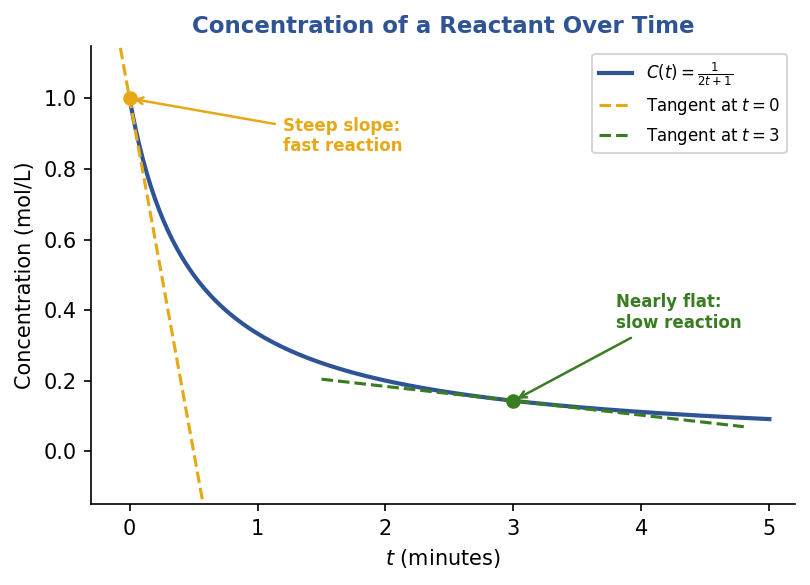
Figure: The concentration \(C(t) = \frac{1}{2t+1}\) with tangent lines at \(t = 0\) and \(t = 3\). The steep tangent at \(t = 0\) reflects a fast reaction rate; the nearly flat tangent at \(t = 3\) reflects a slow one.
3.4.4 Temperature Change and Cooling
Here is a situation everyone has experienced: you pour a cup of hot coffee and set it on the counter. At first it cools rapidly, but as its temperature gets closer to room temperature, the cooling slows down. You may have also noticed the reverse: a cold drink taken out of the refrigerator warms up quickly at first, then more and more slowly as it approaches room temperature.
Physicists describe this pattern with Newton’s Law of Cooling, which states that the instantaneous rate at which an object’s temperature changes is proportional to the difference between the object’s temperature and the surrounding temperature. In other words, a large temperature gap produces rapid temperature change, while a small gap produces slow change. The precise formulation and derivation of Newton’s Law of Cooling involves exponential functions, the chain rule (Section 3.6), and derivatives of exponential functions (Section 3.9); the full treatment appears in Section 6.8. For now, we can capture the same qualitative behavior—rapid change early, slower change later, approaching the surrounding temperature—with a simpler model that requires only the quotient rule.
A function of the form
\[T(t) = T_{\text{env}} + \frac{k}{t + b}\]
exhibits exactly this behavior: it starts at \(T_{\text{env}} + \frac{k}{b}\) when \(t = 0\), decreases over time, and approaches the environmental temperature \(T_{\text{env}}\) as \(t \to \infty\).
A metal rod heated to \(200°\text{C}\) is placed in a room where the temperature is \(25°\text{C}\). Suppose the temperature of the rod at time \(t\) (in minutes) is modeled by
\[T(t) = 25 + \frac{700}{t + 4}.\]
- Verify that \(T(0) = 200°\text{C}\) and describe the long-term behavior of \(T(t)\).
- Find the instantaneous rate of change of temperature at \(t = 0\) and \(t = 20\) minutes.
- Interpret the results.
Solution (click to reveal)
At \(t = 0\): \(T(0) = 25 + \frac{700}{4} = 25 + 175 = 200°\text{C}\). ✓
As \(t \to \infty\), the fraction \(\frac{700}{t + 4} \to 0\), so \(T(t) \to 25°\text{C}\)—the rod’s temperature approaches room temperature, which is exactly what we expect.
Differentiate using the quotient rule (with numerator \(700\) and denominator \(t + 4\)):
\[T'(t) = \frac{(0)(t + 4) - (700)(1)}{(t + 4)^2} = \frac{-700}{(t + 4)^2}.\]
At \(t = 0\):
\[T'(0) = \frac{-700}{(4)^2} = \frac{-700}{16} = -43.75°\text{C per minute}.\]
At \(t = 20\):
\[T'(20) = \frac{-700}{(24)^2} = \frac{-700}{576} \approx -1.22°\text{C per minute}.\]
At the instant the rod is placed in the room, it is cooling at an instantaneous rate of \(43.75°\text{C}\) per minute—extremely rapid. After 20 minutes, the instantaneous cooling rate has slowed dramatically to about \(1.22°\text{C}\) per minute.
This makes sense: at \(t = 0\), the temperature difference between the rod and the room is \(200° - 25° = 175°\text{C}\), which is enormous, so the rod sheds heat quickly. By \(t = 20\) minutes, \(T(20) = 25 + \frac{700}{24} \approx 54.2°\text{C}\), so the temperature difference has shrunk to about \(29°\text{C}\)—and the cooling rate has shrunk accordingly. You can see this in the figure below: the tangent line at \(t = 0\) is steep, while the tangent line at \(t = 20\) is much more gentle.
Compare these instantaneous rates with the average rate of change over the entire 20-minute interval:
\[\frac{T(20) - T(0)}{20 - 0} = \frac{54.2 - 200}{20} = \frac{-145.8}{20} \approx -7.29°\text{C per minute}.\]
The average rate (\(-7.29°\text{C/min}\)) falls between the fast instantaneous rate at the start (\(-43.75°\text{C/min}\)) and the slow one at \(t = 20\) (\(-1.22°\text{C/min}\)), just as we would expect.
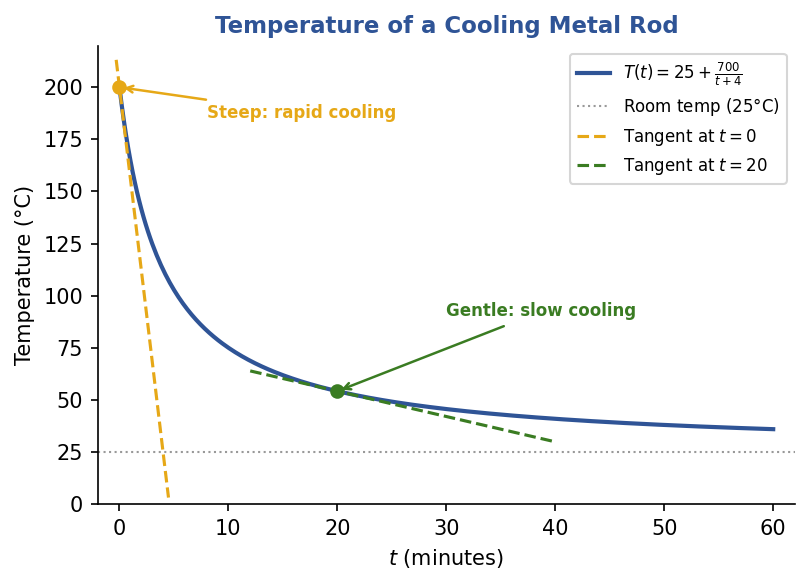
Figure: The temperature \(T(t) = 25 + \frac{700}{t+4}\) with tangent lines at \(t = 0\) and \(t = 20\). The rod cools rapidly at first, then more slowly as it approaches room temperature (\(25°\text{C}\), dotted line).
3.4.5 Further Applications in the Physical Sciences
The examples above—reaction rates and temperature change—illustrate how the derivative captures rates of change in chemistry and physics. But these are far from the only settings where the idea applies. Any time a physical quantity changes with respect to time, distance, pressure, or any other variable, the derivative tells us how fast that change is happening. Here are two more examples from different corners of the physical sciences.
3.4.6 Population Change
We have now seen the derivative at work in physics and chemistry. Our final application in this section comes from biology: how fast is a population growing?
If you’ve ever watched a nature documentary that tracks a species recovering from near-extinction, or read a news article about a booming city, you’ve encountered the idea of a growth rate. In mathematical terms, if \(P(t)\) is the number of entities present in a population at time \(t\), then the instantaneous population growth rate is simply the derivative \(P'(t)\). A large positive value of \(P'(t)\) means the population is growing rapidly; a value near zero means it is relatively stable; and a negative value means the population is declining. We can use a current population, together with a growth rate, to estimate the size of a population in the future.
Combined with the amount of change formula from Section 3.4.1, this definition gives us a practical way to estimate future population sizes.