Chapter 3 Review
Key Terms
acceleration — is the rate of change of the velocity, that is, the derivative of velocity
amount of change — the amount of a function \(f(x)\) over an interval \(\left\lbrack {x,x + h} \right\rbrack\) is \(f\left( {x + h} \right) - f(x)\)
average rate of change — is a function \(f(x)\) over an interval \(\left\lbrack {x,x + h} \right\rbrack\) is \(\frac{f\left( {a + h} \right) - f(a)}{h}\)
chain rule — the chain rule defines the derivative of a composite function as the derivative of the outer function evaluated at the inner function times the derivative of the inner function
constant multiple rule — the derivative of a constant \(c\) multiplied by a function \(f\) is the same as the constant multiplied by the derivative: \(\frac{d}{dx}\left( {cf(x)} \right) = cf'(x)\)
constant rule — the derivative of a constant function is zero: \(\frac{d}{dx}(c) = 0,\) where \(c\) is a constant
derivative — the slope of the tangent line to a function at a point, calculated by taking the limit of the difference quotient, is the derivative
derivative function — gives the derivative of a function at each point in the domain of the original function for which the derivative is defined
difference quotient — of a function \(f(x)\) at \(a\) is given by
\[\frac{f\left( {a + h} \right) - f(a)}{h}\ \text{or}\ \frac{f(x) - f(a)}{x - a} \tag{1}\]
difference rule — the derivative of the difference of a function \(f\) and a function \(g\) is the same as the difference of the derivative of \(f\) and the derivative of \(g\): \(\frac{d}{dx}\left( {f(x) - g(x)} \right) = f'(x) - g'(x)\)
differentiable at a**** — a function for which \(f'(a)\) exists is differentiable at \(a\)
differentiable function — a function for which \(f'(x)\) exists is a differentiable function
differentiable on \(\mathbf{S}\) — a function for which \(f'(x)\) exists for each \(x\) in the open set \(S\) is differentiable on \(S\)
differentiation — the process of taking a derivative
higher-order derivative — a derivative of a derivative, from the second derivative to the \(n\)th derivative, is called a higher-order derivative
implicit differentiation — is a technique for computing \(\frac{dy}{dx}\) for a function defined by an equation, accomplished by differentiating both sides of the equation (remembering to treat the variable \(y\) as a function) and solving for \(\frac{dy}{dx}\)
instantaneous rate of change — the rate of change of a function at any point along the function \(a,\) also called \(f'(a),\) or the derivative of the function at \(a\)
logarithmic differentiation — is a technique that allows us to differentiate a function by first taking the natural logarithm of both sides of an equation, applying properties of logarithms to simplify the equation, and differentiating implicitly
marginal cost — is the derivative of the cost function, or the approximate cost of producing one more item
marginal profit — is the derivative of the profit function, or the approximate profit obtained by producing and selling one more item
marginal revenue — is the derivative of the revenue function, or the approximate revenue obtained by selling one more item
population growth rate — is the derivative of the population with respect to time
power rule — the derivative of a power function is a function in which the power on \(x\) becomes the coefficient of the term and the power on \(x\) in the derivative decreases by 1: If \(n\) is an integer, then \(\frac{d}{dx}x^{n} = nx^{n - 1}\)
product rule — the derivative of a product of two functions is the derivative of the first function times the second function plus the derivative of the second function times the first function: \(\frac{d}{dx}\left( {f(x)g(x)} \right) = f'(x)g(x) + g'(x)f(x)\)
quotient rule — the derivative of the quotient of two functions is the derivative of the first function times the second function minus the derivative of the second function times the first function, all divided by the square of the second function: \(\frac{d}{dx}\left( \frac{f(x)}{g(x)} \right) = \frac{f'(x)g(x) - g'(x)f(x)}{\left( {g(x)} \right)^{2}}\)
speed — is the absolute value of velocity, that is, \(\left| {v(t)} \right|\) is the speed of an object at time \(t\) whose velocity is given by \(v(t)\)
sum rule — the derivative of the sum of a function \(f\) and a function \(g\) is the same as the sum of the derivative of \(f\) and the derivative of \(g\): \(\frac{d}{dx}\left( {f(x) + g(x)} \right) = f'(x) + g'(x)\)
Key Equations
| Difference quotient | \(Q = \frac{f(x) - f(a)}{x - a}\) |
| Difference quotient with increment \(h\) | \(Q = \frac{f\left( {a + h} \right) - f(a)}{a + h - a} = \frac{f\left( {a + h} \right) - f(a)}{h}\) |
| Slope of tangent line | \(m_{\text{tan}} = \underset{x\rightarrow a}{\text{lim}}\frac{f(x) - f(a)}{x - a}\) \(m_{\text{tan}} = \underset{h\rightarrow 0}{\text{lim}}\frac{f\left( {a + h} \right) - f(a)}{h}\) |
| Derivative of \(f(x)\) at \(a\) | \(f'(a) = \underset{x\rightarrow a}{\text{lim}}\frac{f(x) - f(a)}{x - a}\) \(f'(a) = \underset{h\rightarrow 0}{\text{lim}}\frac{f\left( {a + h} \right) - f(a)}{h}\) |
| Average velocity | \(v_{a\text{ve}} = \frac{s(t) - s(a)}{t - a}\) |
| Instantaneous velocity | \(v(a) = s'(a) = \underset{t\rightarrow a}{\text{lim}}\frac{s(t) - s(a)}{t - a}\) |
| The derivative function | \(f'(x) = \underset{h\rightarrow 0}{\text{lim}}\frac{f\left( {x + h} \right) - f(x)}{h}\) |
| Derivative of sine function | \(\frac{d}{dx}(\text{sin}\mspace{2mu} x) = \text{cos}\mspace{2mu} x\) |
| Derivative of cosine function | \(\frac{d}{dx}(\text{cos}\mspace{2mu} x) = \text{−}\text{sin}\mspace{2mu} x\) |
| Derivative of tangent function | \(\frac{d}{dx}\left( {\text{tan}\mspace{2mu} x} \right) = \text{sec}^{2}x\) |
| Derivative of cotangent function | \(\frac{d}{dx}(\text{cot}\mspace{2mu} x) = \text{−}\text{csc}^{2}x\) |
| Derivative of secant function | \(\frac{d}{dx}(\text{sec}\mspace{2mu} x) = \text{sec}\mspace{2mu} x\mspace{2mu}\text{tan}\mspace{2mu} x\) |
| Derivative of cosecant function | \(\frac{d}{dx}(\text{csc}\mspace{2mu} x) = \text{−}\text{csc}\mspace{2mu} x\mspace{2mu}\text{cot}\mspace{2mu} x\) |
| The chain rule | \(h'(x) = f'\left( {g(x)} \right)g'(x)\) |
| The power rule for functions | \(h'(x) = n\left( {g(x)} \right)^{n - 1}g'(x)\) |
| Inverse function theorem | \(\left( f^{-1} \right)'(x) = \frac{1}{f'\left( {f^{-1}(x)} \right)}\) whenever \(f'\left( {f^{-1}(x)} \right) \neq 0\) and \(f(x)\) is differentiable. |
| Power rule with rational exponents | \(\frac{d}{dx}\left( x^{m\text{/}n} \right) = \frac{m}{n}x^{{({m\text{/}n})} - 1}.\) |
| Derivative of inverse sine function | \(\frac{d}{dx}\mspace{2mu}\text{sin}^{-1}x = \frac{1}{\sqrt{1 - (x)^{2}}}\) |
| Derivative of inverse cosine function | \(\frac{d}{dx}\mspace{2mu}\text{cos}^{-1}x = \frac{-1}{\sqrt{1 - (x)^{2}}}\) |
| Derivative of inverse tangent function | \(\frac{d}{dx}\mspace{2mu}\text{tan}^{-1}x = \frac{1}{1 + (x)^{2}}\) |
| Derivative of inverse cotangent function | \(\frac{d}{dx}\mspace{2mu}\text{cot}^{-1}x = \frac{-1}{1 + (x)^{2}}\) |
| Derivative of inverse secant function | \(\frac{d}{dx}\mspace{2mu}\text{sec}^{-1}x = \frac{1}{|x|\sqrt{{(x)}^{2} - 1}}\) |
| Derivative of inverse cosecant function | \(\frac{d}{dx}\mspace{2mu}\text{csc}^{-1}x = \frac{-1}{|x|\sqrt{{(x)}^{2} - 1}}\) |
| Derivative of the natural exponential function | \(\frac{d}{dx}\left( e^{g(x)} \right) = e^{g(x)}g'(x)\) |
| Derivative of the natural logarithmic function | \(\frac{d}{dx}\left( {\text{ln}\mspace{2mu} g(x)} \right) = \frac{1}{g(x)}g'(x)\) |
| Derivative of the general exponential function | \(\frac{d}{dx}\left( b^{g{(x)}} \right) = b^{g(x)}g'(x)\mspace{2mu}\text{ln}\mspace{2mu} b\) |
| Derivative of the general logarithmic function | \(\frac{d}{dx}\left( {\text{log}_{b}g(x)} \right) = \frac{g'(x)}{g(x)\mspace{2mu}\text{ln}\mspace{2mu} b}\) |
Key Concepts
3.1 Defining the Derivative
The slope of the tangent line to a curve measures the instantaneous rate of change of a curve. We can calculate it by finding the limit of the difference quotient or the difference quotient with increment \(h.\)
The derivative of a function \(f(x)\) at a value \(a\) is found using either of the definitions for the slope of the tangent line.
Velocity is the rate of change of position. As such, the velocity \(v(t)\) at time \(t\) is the derivative of the position \(s(t)\) at time \(t.\) Average velocity is given by
\[v_{\text{ave}} = \frac{s(t) - s(a)}{t - a}. \tag{2}\]
Instantaneous velocity is given by
\[v(a) = s'(a) = \underset{t\rightarrow a}{\text{lim}}\frac{s(t) - s(a)}{t - a}. \tag{3}\]
We may estimate a derivative by using a table of values.
3.2 The Derivative as a Function
- The derivative of a function \(f(x)\) is the function whose value at \(x\) is \(f'(x).\)
- The graph of a derivative of a function \(f(x)\) is related to the graph of \(f(x).\) Where \(f(x)\) has a tangent line with positive slope, \(f'(x) > 0.\) Where \(f(x)\) has a tangent line with negative slope, \(f'(x) < 0.\) Where \(f(x)\) has a horizontal tangent line, \(f'(x) = 0.\)
- If a function is differentiable at a point, then it is continuous at that point. A function is not differentiable at a point if it is not continuous at the point, if it has a vertical tangent line at the point, or if the graph has a sharp corner or cusp.
- Higher-order derivatives are derivatives of derivatives, from the second derivative to the \(n\text{th}\) derivative.
3.3 Differentiation Rules
- The derivative of a constant function is zero.
- The derivative of a power function is a function in which the power on \(x\) becomes the coefficient of the term and the power on \(x\) in the derivative decreases by 1.
- The derivative of a constant \(c\) multiplied by a function \(f\) is the same as the constant multiplied by the derivative.
- The derivative of the sum of a function \(f\) and a function \(g\) is the same as the sum of the derivative of \(f\) and the derivative of \(g\).
- The derivative of the difference of a function \(f\) and a function \(g\) is the same as the difference of the derivative of \(f\) and the derivative of \(g\).
- The derivative of a product of two functions is the derivative of the first function times the second function plus the derivative of the second function times the first function.
- The derivative of the quotient of two functions is the derivative of the first function times the second function minus the derivative of the second function times the first function, all divided by the square of the second function.
- We used the limit definition of the derivative to develop formulas that allow us to find derivatives without resorting to the definition of the derivative. These formulas can be used singly or in combination with each other.
3.4 Derivatives as Rates of Change
- Using \(f\left( {a + h} \right) \approx f(a) + f'(a)h,\) it is possible to estimate \(f\left( {a + h} \right)\) given \(f'(a)\) and \(f(a).\)
- The rate of change of position is velocity, and the rate of change of velocity is acceleration. Speed is the absolute value, or magnitude, of velocity.
- The population growth rate and the present population can be used to predict the size of a future population.
- Marginal cost, marginal revenue, and marginal profit functions can be used to predict, respectively, the cost of producing one more item, the revenue obtained by selling one more item, and the profit obtained by producing and selling one more item.
3.5 Derivatives of Trigonometric Functions
We can find the derivatives of sin \(x\) and cos \(x\) by using the definition of derivative and the limit formulas found earlier. The results are
\[\frac{d}{dx}\mspace{2mu}\text{sin}\mspace{2mu} x = \text{cos}\mspace{2mu} x\ \frac{d}{dx}\mspace{2mu}\text{cos}\mspace{2mu} x = \text{−}\text{sin}\mspace{2mu} x. \tag{4}\]
With these two formulas, we can determine the derivatives of all six basic trigonometric functions.
3.6 The Chain Rule
The chain rule allows us to differentiate compositions of two or more functions. It states that for \(h(x) = f\left( {g(x)} \right),\)
\[h'(x) = f'\left( {g(x)} \right)g'(x). \tag{5}\]
In Leibniz’s notation this rule takes the form
\[\frac{dy}{dx} = \frac{dy}{du} \cdot \frac{du}{dx}. \tag{6}\]
We can use the chain rule with other rules that we have learned, and we can derive formulas for some of them.
The chain rule combines with the power rule to form a new rule:
\[\text{If}\ h(x) = \left( {g(x)} \right)^{n},\text{then}\ h'(x) = n\left( {g(x)} \right)^{n - 1}g'(x). \tag{7}\]
When applied to the composition of three functions, the chain rule can be expressed as follows: If \(h(x) = f\left( {g\left( {k(x)} \right)} \right),\) then \(h'(x) = f'(g\left( {k(x)} \right)g'\left( {k(x)} \right)k'(x).\)
3.7 Derivatives of Inverse Functions
- The inverse function theorem allows us to compute derivatives of inverse functions without using the limit definition of the derivative.
- We can use the inverse function theorem to develop differentiation formulas for the inverse trigonometric functions.
3.8 Implicit Differentiation
- We use implicit differentiation to find derivatives of implicitly defined functions (functions defined by equations).
- By using implicit differentiation, we can find the equation of a tangent line to the graph of a curve.
3.9 Derivatives of Exponential and Logarithmic Functions
- On the basis of the assumption that the exponential function \(y = b^{x},b > 0\) is continuous everywhere and differentiable at 0, this function is differentiable everywhere and there is a formula for its derivative.
- We can use a formula to find the derivative of \(y = \text{ln}\mspace{2mu} x,\) and the relationship \(\text{log}_{b}x = \frac{\text{ln}\mspace{2mu} x}{\text{ln}\mspace{2mu} b}\) allows us to extend our differentiation formulas to include logarithms with arbitrary bases.
- Logarithmic differentiation allows us to differentiate functions of the form \(y = g{(x)}^{f(x)}\) or very complex functions by taking the natural logarithm of both sides and exploiting the properties of logarithms before differentiating.
Chapter Review Exercises
True or False? Justify the answer with a proof or a counterexample.
1. Every function has a derivative.
Solution (click to reveal)
False.
2. A continuous function has a continuous derivative.
3. A continuous function has a derivative.
Solution (click to reveal)
False
4. If a function is differentiable, it is continuous.
Use the limit definition of the derivative to exactly evaluate the derivative.
5. \(f(x) = \sqrt{x + 4}\)
Solution (click to reveal)
\(\frac{1}{2\sqrt{x + 4}}\)
6. \(f(x) = \frac{3}{x}\)
Find the derivatives of the following functions.
7. \(f(x) = 3x^{3} - \frac{4}{x^{2}}\)
Solution (click to reveal)
\(9x^{2} + \frac{8}{x^{3}}\)
8. \(f(x) = \left( {4 - x^{2}} \right)^{3}\)
9. \(f(x) = e^{\text{sin}\mspace{2mu} x}\)
Solution (click to reveal)
\(e^{\text{sin}\mspace{2mu} x}\text{cos}\mspace{2mu} x\)
10. \(f(x) = \text{ln}\mspace{2mu}\left( {x + 2} \right)\)
11. \(f(x) = x^{2}\text{cos}\mspace{2mu} x + x\mspace{2mu}\text{tan}\mspace{2mu}(x)\)
Solution (click to reveal)
\(x\mspace{2mu}\text{sec}^{2}(x) + 2x\mspace{2mu}\text{cos}\mspace{2mu}(x) + \text{tan}\mspace{2mu}(x) - x^{2}\text{sin}\mspace{2mu}(x)\)
12. \(f(x) = \sqrt{3x^{2} + 2}\)
13. \(f(x) = \frac{x}{4}\mspace{2mu}\text{sin}^{-1}(x)\)
Solution (click to reveal)
\(\frac{1}{4}\left( {\frac{x}{\sqrt{1 - x^{2}}} + \text{sin}^{-1}(x)} \right)\)
14. \(x^{2}y = \left( {y + 2} \right) + xy\mspace{2mu}\text{sin}\mspace{2mu}(x)\)
Find the following derivatives of various orders.
15. First derivative of \(y = x\mspace{2mu}\text{ln}\mspace{2mu}(x)\mspace{2mu}\text{cos}\mspace{2mu} x\)
Solution (click to reveal)
\(\text{cos}\mspace{2mu} x \cdot \left( {\text{ln}\mspace{2mu} x + 1} \right) - x\mspace{2mu}\text{ln}\mspace{2mu}(x)\mspace{2mu}\text{sin}\mspace{2mu} x\)
16. Third derivative of \(y = \left( {3x + 2} \right)^{2}\)
17. Second derivative of \(y = 4^{x} + x^{2}\text{sin}\mspace{2mu}(x)\)
Solution (click to reveal)
\(4^{x}\left( {\text{ln}\mspace{2mu} 4} \right)^{2} + 2\mspace{2mu}\text{sin}\mspace{2mu} x + 4x\mspace{2mu}\text{cos}\mspace{2mu} x - x^{2}\text{sin}\mspace{2mu} x\)
Find an equation of the tangent line to the following equations at the specified point.
18. \(y = \text{cos}^{-1}(x) + x\) at \(x = 0\)
19. \(y = x + e^{x} - \frac{1}{x}\) at \(x = 1\)
Solution (click to reveal)
\(T = \left( {2 + e} \right)x - 2\)
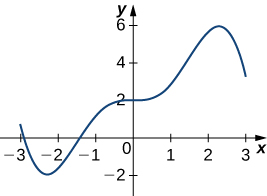
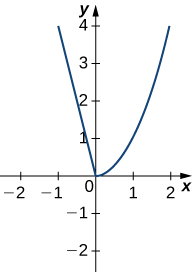
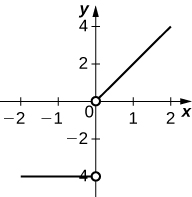
Draw the derivative for the following graphs.
20.
21.
Solution (click to reveal)
The following questions concern the water level in Ocean City, New Jersey, in January, which can be approximated by \(w(t) = 1.9 + 2.9\mspace{2mu}\text{cos}\mspace{2mu}\left( {\frac{\pi}{6}t} \right),\) where \(t\) is measured in hours after midnight, and the height is measured in feet.
22. Find and graph the derivative. What is the physical meaning?
23. Find \(w'(3).\) What is the physical meaning of this value?
Solution (click to reveal)
\(w'(3) = - \frac{2.9\pi}{6}.\) At 3 a.m. the tide is decreasing at a rate of 1.518 ft/hr.
The following questions consider the wind speeds of Hurricane Katrina, which affected New Orleans, Louisiana, in August 2005. The data are displayed in a table.
| Hours after Midnight, August 26 | Wind Speed (mph) |
|---|---|
| 1 | 45 |
| 5 | 75 |
| 11 | 100 |
| 29 | 115 |
| 49 | 145 |
| 58 | 175 |
| 73 | 155 |
| 81 | 125 |
| 85 | 95 |
| 107 | 35 |
Table 4 Wind Speeds of Hurricane Katrina
24. Using the table, estimate the derivative of the wind speed at hour 39. What is the physical meaning?
25. Estimate the derivative of the wind speed at hour 83. What is the physical meaning?
Solution (click to reveal)
\(-7.5.\) The wind speed is decreasing at a rate of 7.5 mph/hr