1 The Language of Functions
1.1 What Makes a Relationship a Function?
You walk up to a vending machine, press B4, and out drops a bag of pretzels. Press B4 again tomorrow—same pretzels. The machine is reliable: one button, one result. Now imagine a vending machine that dispensed a random item every time you pressed B4. One day pretzels, next day a candy bar, the day after that a granola bar. You’d never trust it. Mathematics demands the same kind of reliability, and the concept that captures it is called a function.
In this section, we’ll make the leap from informal relationships—like “taller people tend to weigh more”—to the precise mathematical idea of a function, where every input determines exactly one output. Along the way, we’ll introduce function notation, explore multiple ways to represent functions, and develop tools for identifying which relationships qualify as functions and which do not.
1.1.1 Relations: Pairing Inputs and Outputs
Before we can say what makes a relationship a function, we need to be clear about what a relationship is in mathematical terms.
A relation can be described by a list of ordered pairs, a table, a graph, or a mapping diagram. Figure 1.1.2 shows two relations represented as mapping diagrams. In Relation A, every input maps to exactly one output—this is the kind of reliable, predictable pairing we want. In Relation B, the input \(1\) maps to two different outputs (\(a\) and \(b\)), which means we can’t predict a single result from that input.
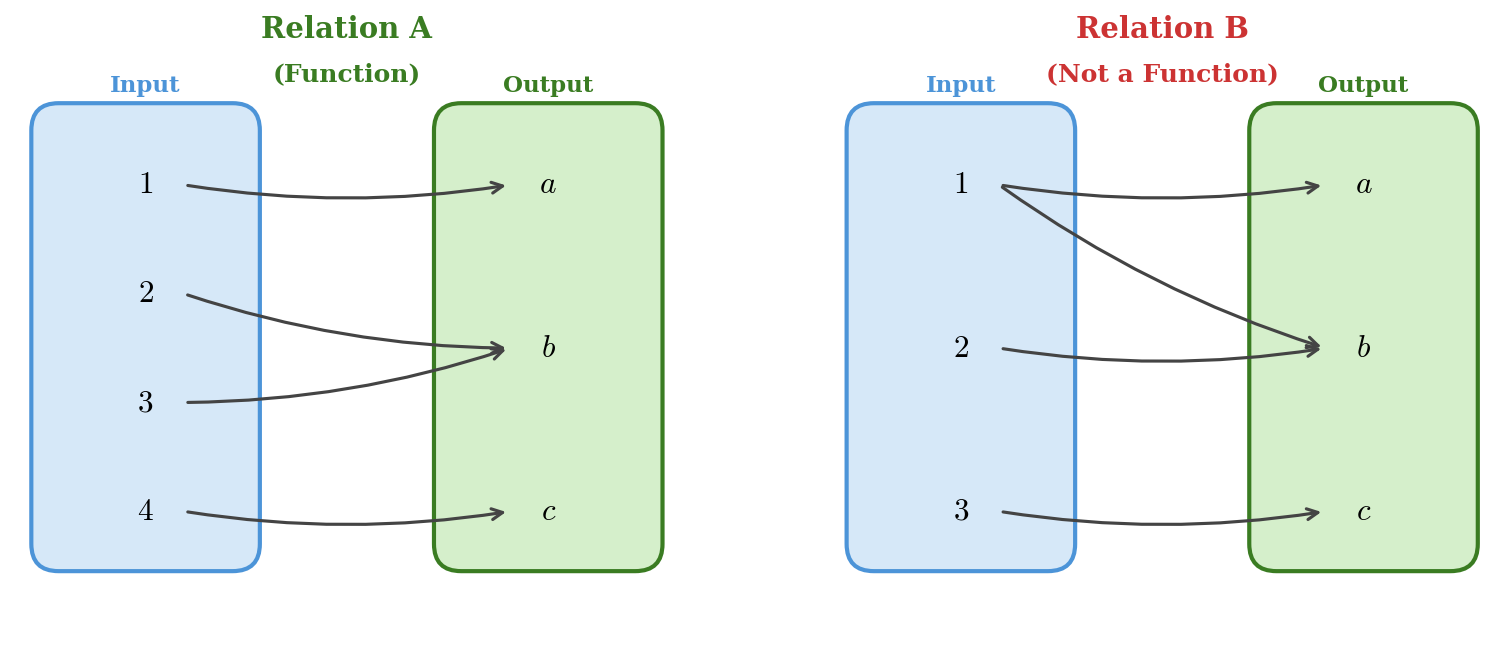
Figure 1.1.2: Two relations shown as mapping diagrams. Relation A is a function; Relation B is not.
The distinction between these two diagrams is the entire point of this section: Relation A is a function, and Relation B is not. Let’s make that idea precise.
1.1.2 Functions and Function Notation
The notation \(f(x)\) does not mean “\(f\) times \(x\).” It means “the output of function \(f\) when the input is \(x\).” Think of \(f\) as the name of the machine, \(x\) as what you feed in, and \(f(x)\) as what comes out.
Different letters can name different functions—\(g\), \(h\), \(C\), \(T\)—just as different vending machines dispense different products. The input variable doesn’t have to be \(x\) either; a function tracking temperature over time might be written \(T(t)\), where \(t\) represents hours.
1.1.3 Representations of Functions
Functions can be described in four main ways: by a formula, a table, a graph, or a verbal description. Each representation has its strengths, and the ability to move between them is one of the most valuable skills in mathematics.
When a function is represented as a graph, we read it by looking up input values on the horizontal axis and finding the corresponding output on the curve. Figure 1.1.8 shows the temperature in a city over a \(24\)-hour period.
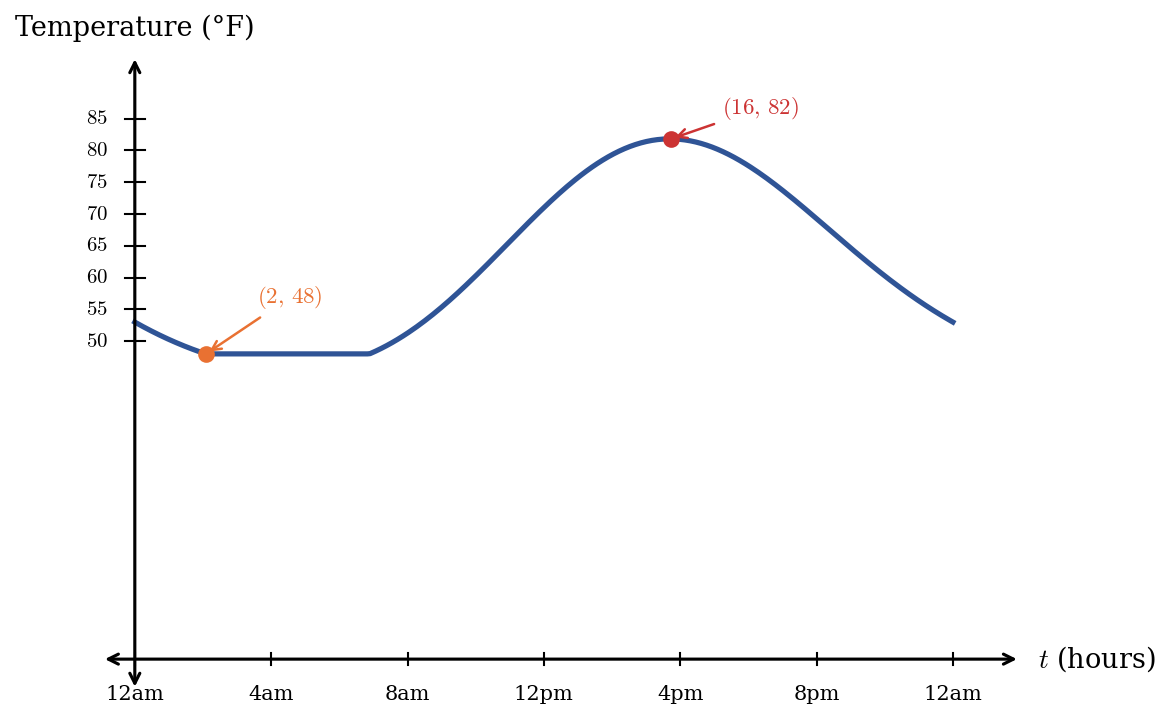
Figure 1.1.8: Outdoor temperature (°F) over a \(24\)-hour period. The low occurs around \(t = 2\) (2:00 AM) and the high around \(t = 16\) (4:00 PM).
1.1.4 The Vertical Line Test
When a relation is given as a graph, there is a quick visual test for whether it is a function.
The logic is straightforward: a vertical line through \(x = a\) hits the graph at every point whose input is \(a\). If the line hits the curve twice, then the input \(a\) produces two different outputs—and that violates the definition of a function.
Figure 1.1.11 shows two curves. On the left, every vertical line crosses the cubic curve at most once, so it represents a function. On the right, the vertical line crosses the circle at two points, confirming that the circle is not the graph of a function.
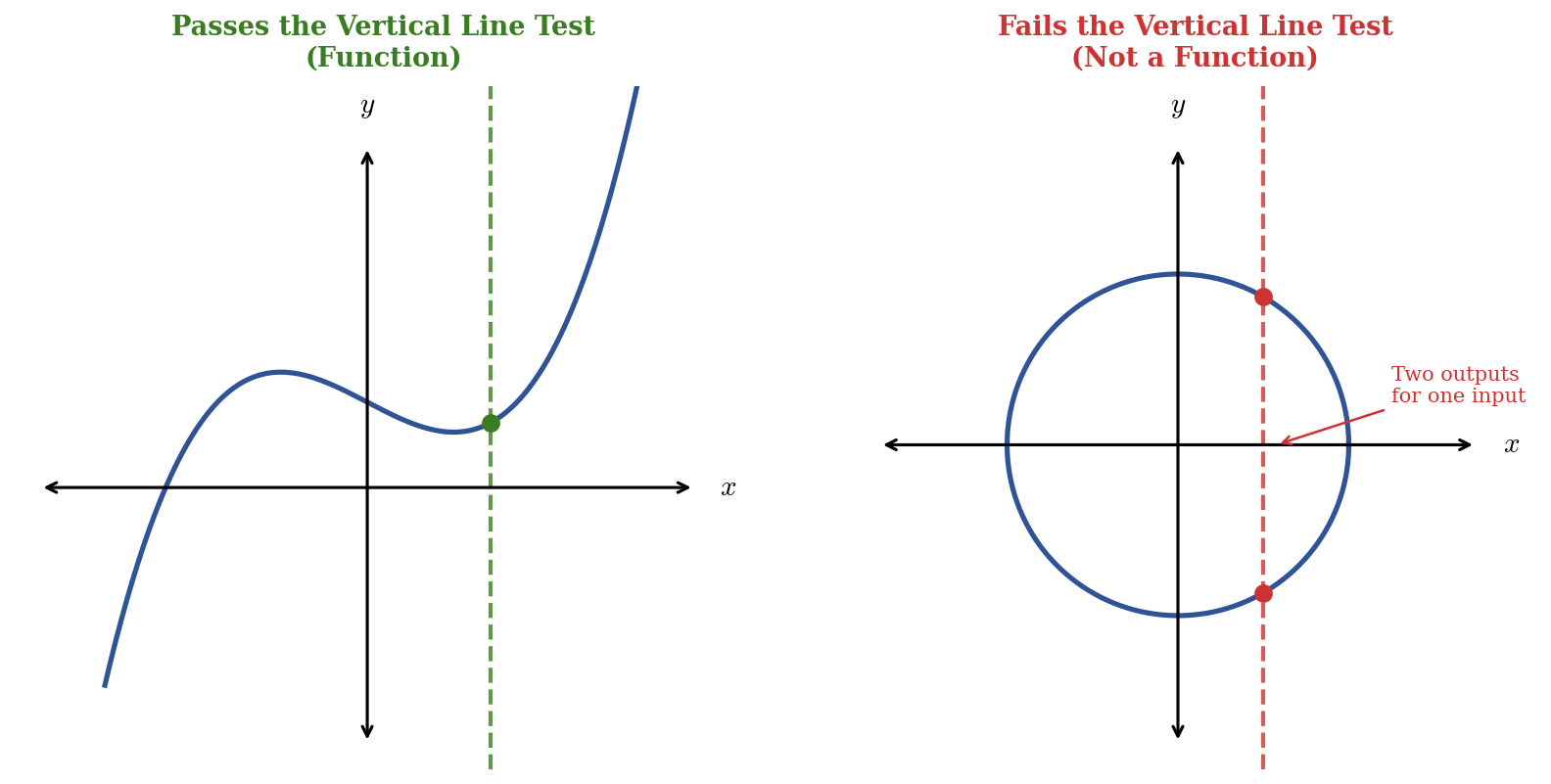
Figure 1.1.11: The vertical line test. Left: a function (each vertical line hits the curve once). Right: not a function (a vertical line hits the circle twice).
1.1.5 Domain and Range
When a function is defined by a formula with no real-world context, the domain consists of all real numbers for which the formula produces a real output. Two common restrictions arise:
- Division by zero is undefined: Exclude input values that make a denominator equal to zero.
- Square roots of negative numbers are not real: Exclude input values that make the expression under an even root negative.
We express domains using interval notation: \((a, b)\) means all numbers strictly between \(a\) and \(b\); \([a, b]\) includes the endpoints; and \((-\infty, \infty)\) means all real numbers. A union symbol \(\cup\) joins disconnected intervals: for example, \((-\infty, 2) \cup (2, \infty)\) means all real numbers except \(2\).
When working from a graph, the domain is the set of \(x\)-values covered by the curve, and the range is the set of \(y\)-values.
A patient undergoes a cardiac stress test. Figure 1.1.17 shows the patient’s heart rate \(H(t)\) (in beats per minute) as a function of time \(t\) (in minutes).
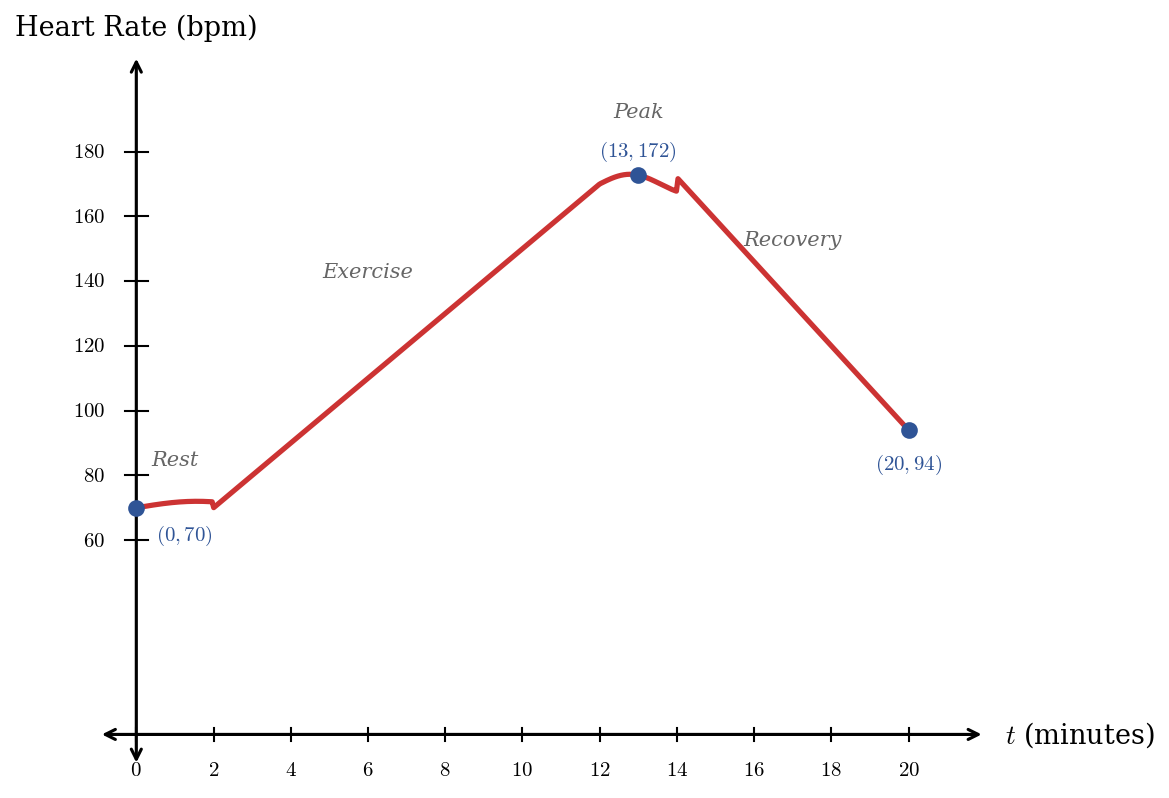
Figure 1.1.17: Heart rate during a cardiac stress test.
- What are the domain and range of \(H\)?
- Interpret \(H(13) = 172\) in context.
- During which time interval is the heart rate increasing?
Solution.
The graph spans from \(t = 0\) to \(t = 20\), so the domain is \([0, 20]\). The heart rate ranges from a resting value of about \(70\) bpm to a peak of about \(172\) bpm, so the range is approximately \([70, 172]\).
After \(13\) minutes of the stress test, the patient’s heart rate reached its peak of \(172\) beats per minute.
The heart rate is increasing from \(t = 0\) to approximately \(t = 13\), during the rest, exercise, and peak phases.
1.1.6 Piecewise-Defined Functions
Sometimes a single formula isn’t enough to describe how a function behaves across its entire domain. When different rules apply to different input ranges, we use a piecewise-defined function.
The key skill with piecewise functions is choosing the right formula: look at the input value, determine which piece of the domain it falls into, then use the corresponding rule.
Let
\[ f(x) = \begin{cases} x^2 & \text{if } x < 1 \\ 3x - 1 & \text{if } x \geq 1 \end{cases} \]
Evaluate \(f(-2)\), \(f(1)\), and \(f(4)\).
Solution.
For \(f(-2)\): Since \(-2 < 1\), use the first rule: \(f(-2) = (-2)^2 = 4\).
For \(f(1)\): Since \(1 \geq 1\), use the second rule: \(f(1) = 3(1) - 1 = 2\).
For \(f(4)\): Since \(4 \geq 1\), use the second rule: \(f(4) = 3(4) - 1 = 11\).
The graph of this function, shown in Figure 1.1.20, consists of a parabola to the left of \(x = 1\) and a line from \(x = 1\) onward. The open circle at \((1, 1)\) indicates that the parabola does not include that endpoint, while the closed circle at \((1, 2)\) shows that the linear piece does.
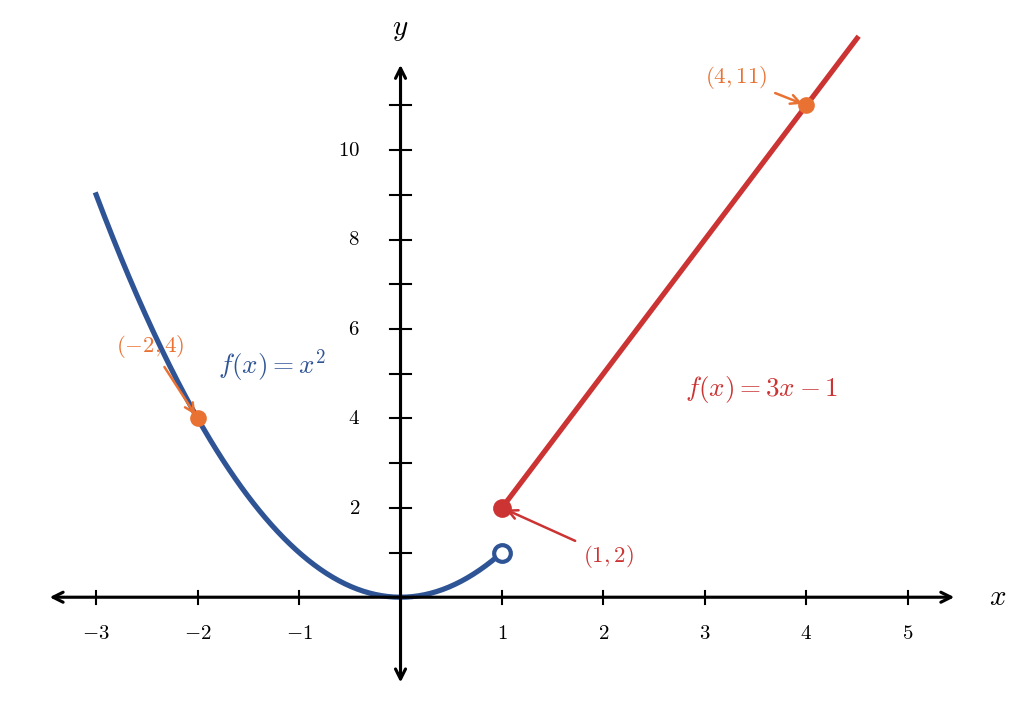
Figure 1.1.20: Graph of \(f(x) = x^2\) for \(x < 1\) and \(f(x) = 3x - 1\) for \(x \geq 1\).
A wireless carrier offers a data plan that charges a flat fee of $45 per month for up to \(5\) GB of data. Each additional gigabyte beyond \(5\) GB costs $10. The monthly cost \(C(d)\) (in dollars) as a function of data usage \(d\) (in GB) is:
\[ C(d) = \begin{cases} 45 & \text{if } 0 \leq d \leq 5 \\ 45 + 10(d - 5) & \text{if } d > 5 \end{cases} \]
- Find \(C(3)\) and \(C(8)\) and interpret each.
- A customer’s bill is $75. How many gigabytes did they use?
- What are the domain and range of \(C\)?
Solution.
Since \(3 \leq 5\), we use the first rule: \(C(3) = 45\). A customer using \(3\) GB pays $45. Since \(8 > 5\), we use the second rule: \(C(8) = 45 + 10(8 - 5) = 45 + 30 = 75\). A customer using \(8\) GB pays $75.
Since the bill exceeds $45, the customer used more than \(5\) GB. Setting the second rule equal to \(75\): \[45 + 10(d - 5) = 75 \quad \Longrightarrow \quad 10(d - 5) = 30 \quad \Longrightarrow \quad d = 8 \text{ GB}\]
The input \(d\) represents data usage, so \(d \geq 0\) and the domain is \([0, \infty)\). The minimum cost is $45 (for \(0\)–\(5\) GB) and there is no upper limit, so the range is \([45, \infty)\).
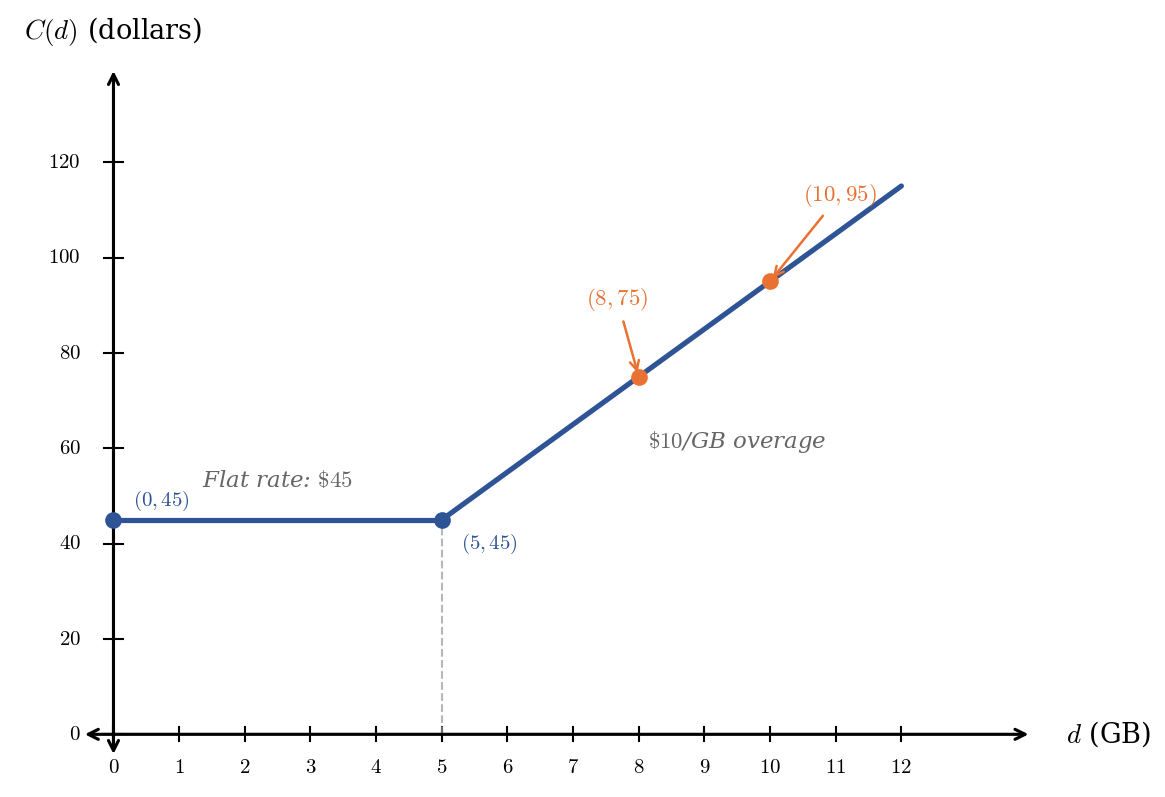
Figure 1.1.22: Monthly cost of the data plan as a function of data usage.
1.1.7 Summary
- A relation is any set of ordered pairs. A function is a relation in which each input has exactly one output.
- We write \(f(x)\) for the output of function \(f\) at input \(x\). This is called function notation.
- Functions can be represented by formulas, tables, graphs, or verbal descriptions.
- The vertical line test determines whether a graph represents a function: if any vertical line crosses the graph more than once, it is not a function.
- The domain is the set of all allowable inputs; the range is the set of all resulting outputs.
- When finding the domain from a formula, exclude values that cause division by zero or square roots of negative numbers.
- A piecewise-defined function uses different formulas for different parts of the domain.
1.2 Measuring Change: Secant Lines and the Difference Quotient
Your car’s speedometer reads \(65\) mph, but you’ve been stuck in stop-and-go traffic for the last hour and only covered \(30\) miles. The speedometer measures your speed right now; the \(30\)-miles-in-one-hour figure measures your average speed. This distinction—between instantaneous and average rates of change—is one of the most important ideas in mathematics. In this section, we develop tools for measuring average rates of change: the secant line and the difference quotient.
Every time you compute “how much something changed divided by how long it took,” you’re computing an average rate of change. Gas mileage, grade point averages, even batting averages—all of these are ratios of change. We’ll make this idea precise using function notation and build the algebraic skills you’ll need when these ideas resurface in calculus.
1.2.1 Secant Lines and Average Rate of Change
Given a function \(f\) and two points on its graph, \((a, f(a))\) and \((b, f(b))\), the secant line is the straight line connecting these points. The slope of this secant line measures how much the output changes, on average, as the input moves from \(a\) to \(b\).
Figure 1.2.3 illustrates this relationship. The horizontal distance \(b - a\) represents the change in input, while the vertical distance \(f(b) - f(a)\) represents the change in output. Their ratio gives the slope of the secant line.
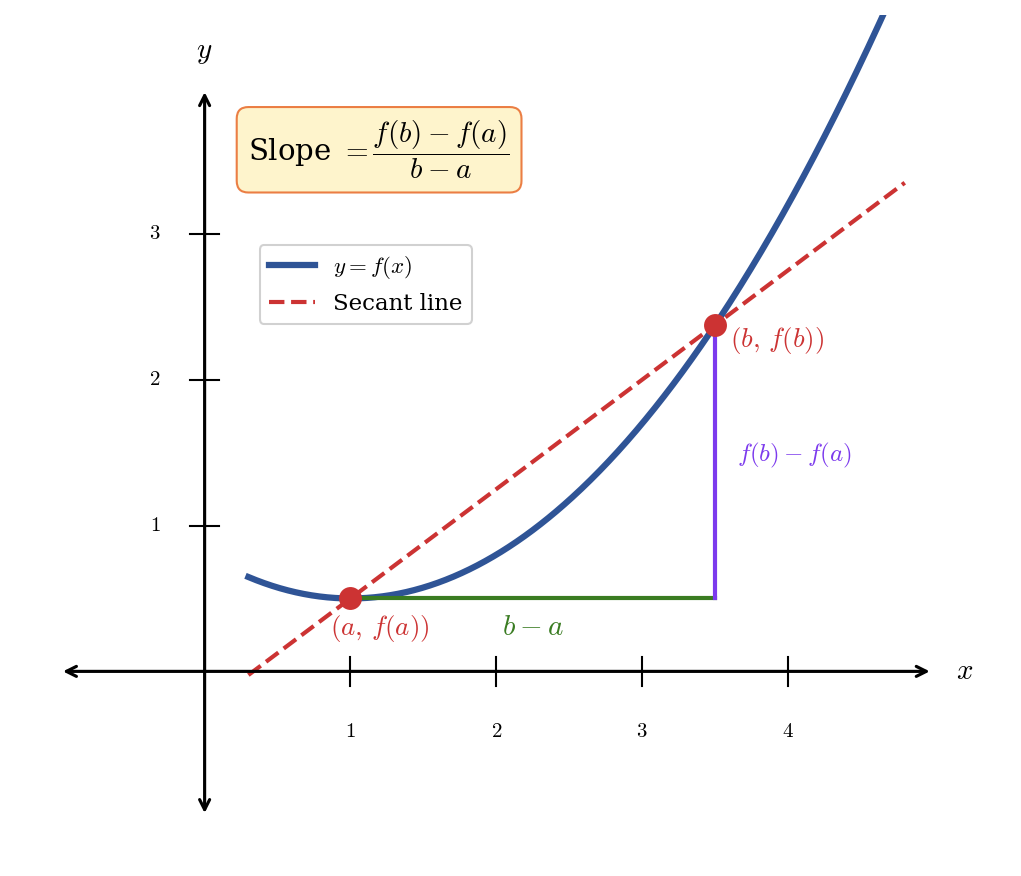
Figure 1.2.3: The secant line connecting \((a, f(a))\) and \((b, f(b))\) on the graph of \(f\).
The average rate of change tells us how the function behaves on average between two points—but it doesn’t tell us what’s happening at any specific instant. Think of driving \(150\) miles in \(3\) hours: your average speed was \(50\) mph, even if you were sometimes going \(70\) mph and sometimes crawling through a school zone at \(10\).
1.2.2 The Difference Quotient
When studying rates of change, we often want to examine what happens near a particular input value \(x\). Instead of using two separate variables \(a\) and \(b\), we use \(x\) for our starting point and \(x + h\) for a nearby point, where \(h\) represents a small horizontal shift.
With this notation, \(b - a\) becomes \((x + h) - x = h\), and the average rate of change formula transforms into the difference quotient.
Let’s break down what this expression means:
- \(f(x)\) is the output of our function at some starting point \(x\)
- \(f(x + h)\) is the output at a nearby point, where \(h\) represents a small horizontal shift
- The numerator \(f(x + h) - f(x)\) measures how much the output changed
- Dividing by \(h\) tells us the change in output per unit of input
Geometrically, the difference quotient gives the slope of the secant line connecting the points \((x, f(x))\) and \((x + h, f(x + h))\) on the graph of \(f\), as shown in Figure 1.2.5.
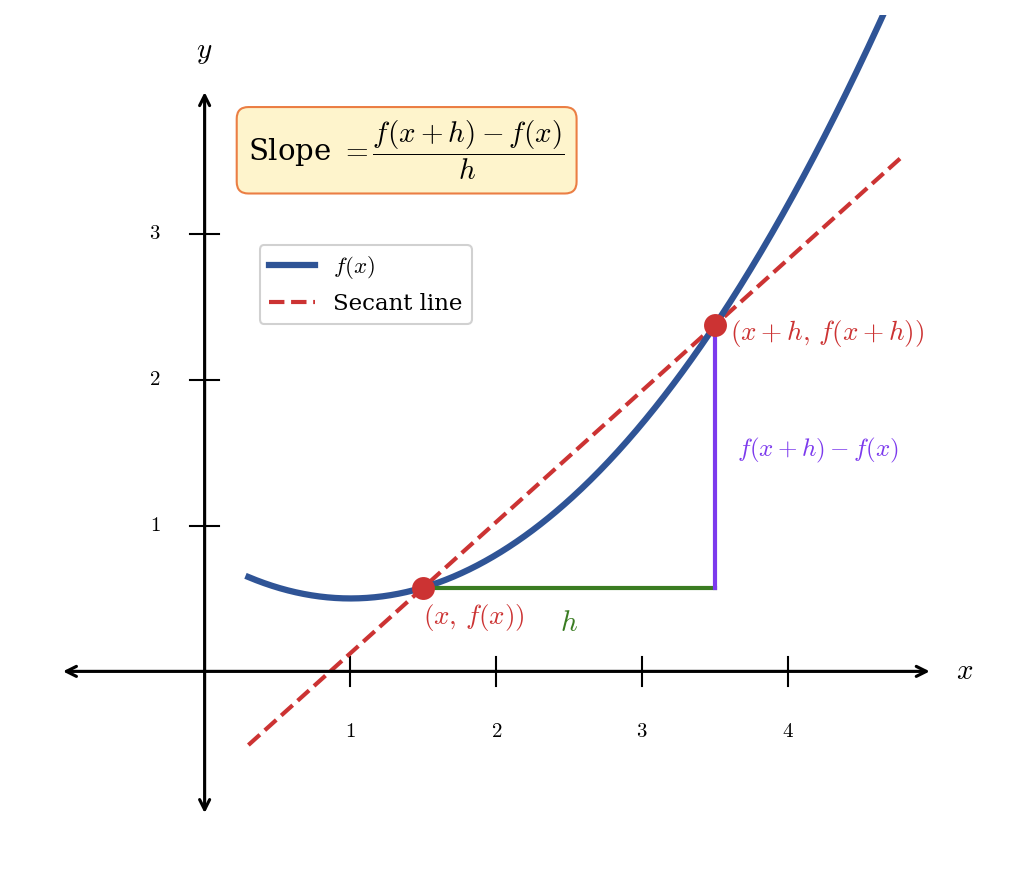
Figure 1.2.5: The difference quotient as the slope of a secant line through \((x, f(x))\) and \((x + h, f(x + h))\).
Why Does This Matter?
The difference quotient appears throughout science and engineering:
- Physics: Average velocity is the difference quotient of position with respect to time.
- Economics: Marginal cost approximations use difference quotients to estimate how costs change with production levels.
- Biology: Population growth rates are computed as difference quotients of population size over time.
In calculus, you’ll take the limit of the difference quotient as \(h\) approaches zero, which gives the instantaneous rate of change—the derivative. Mastering the algebraic techniques in this section will prepare you for that transition.
1.2.3 Computing Difference Quotients
Computing a difference quotient is a three-step process: find \(f(x + h)\), compute \(f(x + h) - f(x)\), and divide by \(h\) and simplify. The algebra varies depending on the type of function. Let’s work through the main cases.
Compute the difference quotient for \(f(x) = 2x^2 + x - 5\).
Solution.
Step 1: Find \(f(x + h)\) by replacing every \(x\) with \((x + h)\):
\[ f(x + h) = 2(x + h)^2 + (x + h) - 5 \]
Expand \((x + h)^2 = x^2 + 2xh + h^2\):
\[ f(x + h) = 2(x^2 + 2xh + h^2) + x + h - 5 = 2x^2 + 4xh + 2h^2 + x + h - 5 \]
Step 2: Compute \(f(x + h) - f(x)\):
\[ f(x + h) - f(x) = (2x^2 + 4xh + 2h^2 + x + h - 5) - (2x^2 + x - 5) = 4xh + 2h^2 + h \]
Step 3: Divide by \(h\):
\[ \frac{f(x + h) - f(x)}{h} = \frac{4xh + 2h^2 + h}{h} = \frac{h(4x + 2h + 1)}{h} = 4x + 2h + 1 \]
Result: The difference quotient is \(4x + 2h + 1\).
Figure 1.2.7 illustrates this example with specific values \(x = 1\) and \(h = 1\), giving a secant line with slope \(4(1) + 2(1) + 1 = 7\).
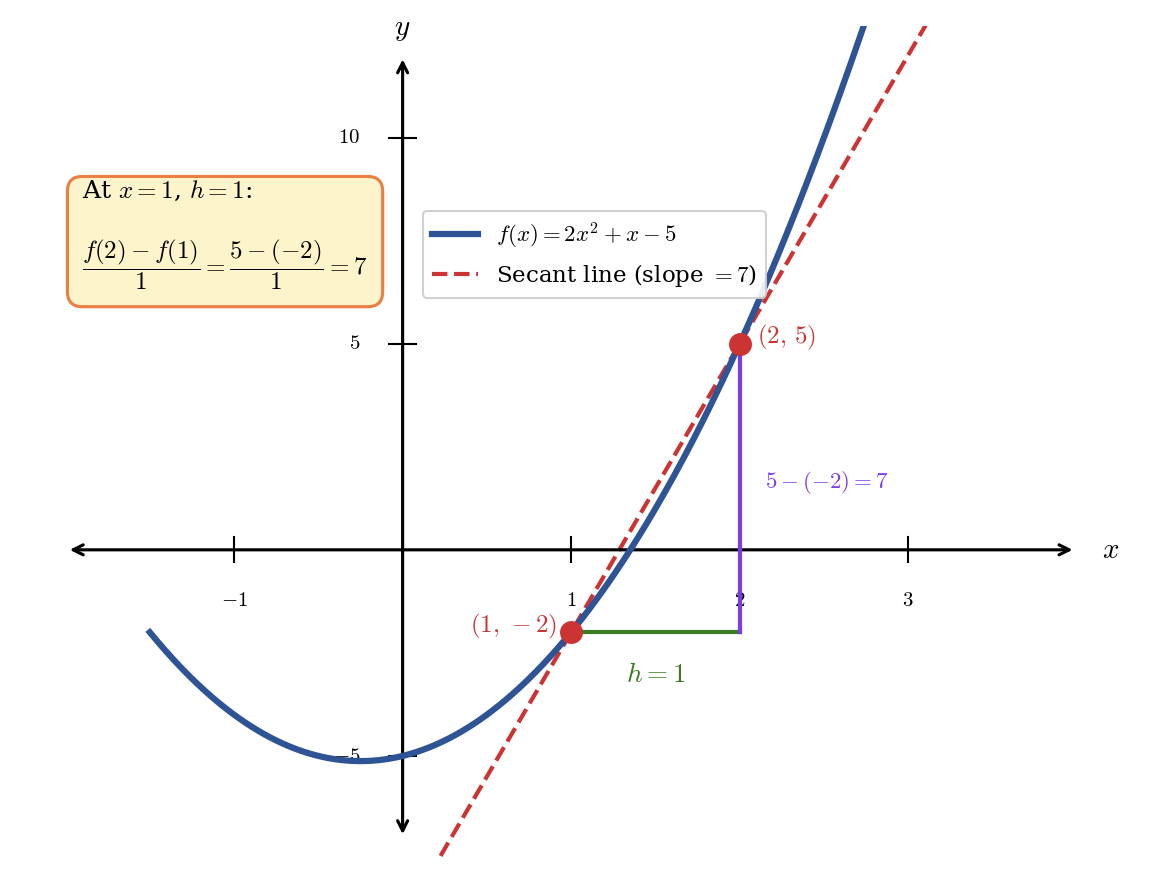
Figure 1.2.7: The secant line for \(f(x) = 2x^2 + x - 5\) with \(x = 1\) and \(h = 1\), showing slope \(= 7\).
Notice that as \(h\) gets smaller, this expression approaches \(4x + 1\)—which, as you’ll learn in calculus, is the derivative of \(f(x) = 2x^2 + x - 5\).
1.2.4 Summary
- Secant line: A line that intersects the graph of a function at two distinct points.
- Average rate of change of \(f\) over \([a, b]\): \(\displaystyle\frac{f(b) - f(a)}{b - a}\)
- Difference quotient: \(\displaystyle\frac{f(x + h) - f(x)}{h}\) measures the average rate of change near a point \(x\).
- Computing difference quotients requires careful algebra:
- For polynomial functions, expand, subtract, and factor out \(h\).
- For rational functions, find common denominators before simplifying.
- For radical functions, rationalize the numerator using conjugates.
These techniques will serve you well not only in this course but as essential preparation for calculus.
1.3 Shifting, Stretching, Reflecting: Transformations of Functions
Open a photo on your phone and play with the editing tools. Slide the brightness up, and the whole image gets lighter — the content doesn’t change, just how bright it appears. Flip the photo horizontally, and your selfie becomes a mirror image. Crop and reposition, and the same scene sits in a different spot on the screen. In every case, you’re transforming the image without changing what’s actually in it.
Functions work the same way. Starting from a small collection of basic shapes — parabolas, square roots, absolute values — we can shift them up, down, left, or right; stretch or compress them; and flip them across an axis. These transformations let us build an enormous variety of functions from just a handful of building blocks. Mastering them means you can look at a complicated formula like \(g(x) = -2|x - 3| + 4\) and immediately picture its graph, without plotting a single point.
1.3.1 Parent Functions
Every family of functions has a simplest member, called the parent function. These are the building blocks we’ll transform throughout this section.
Figure 1.3.2 displays six parent functions you’ll encounter repeatedly in this course. Becoming familiar with their shapes is essential — when you see a transformed version, you’ll want to recognize which parent it came from.
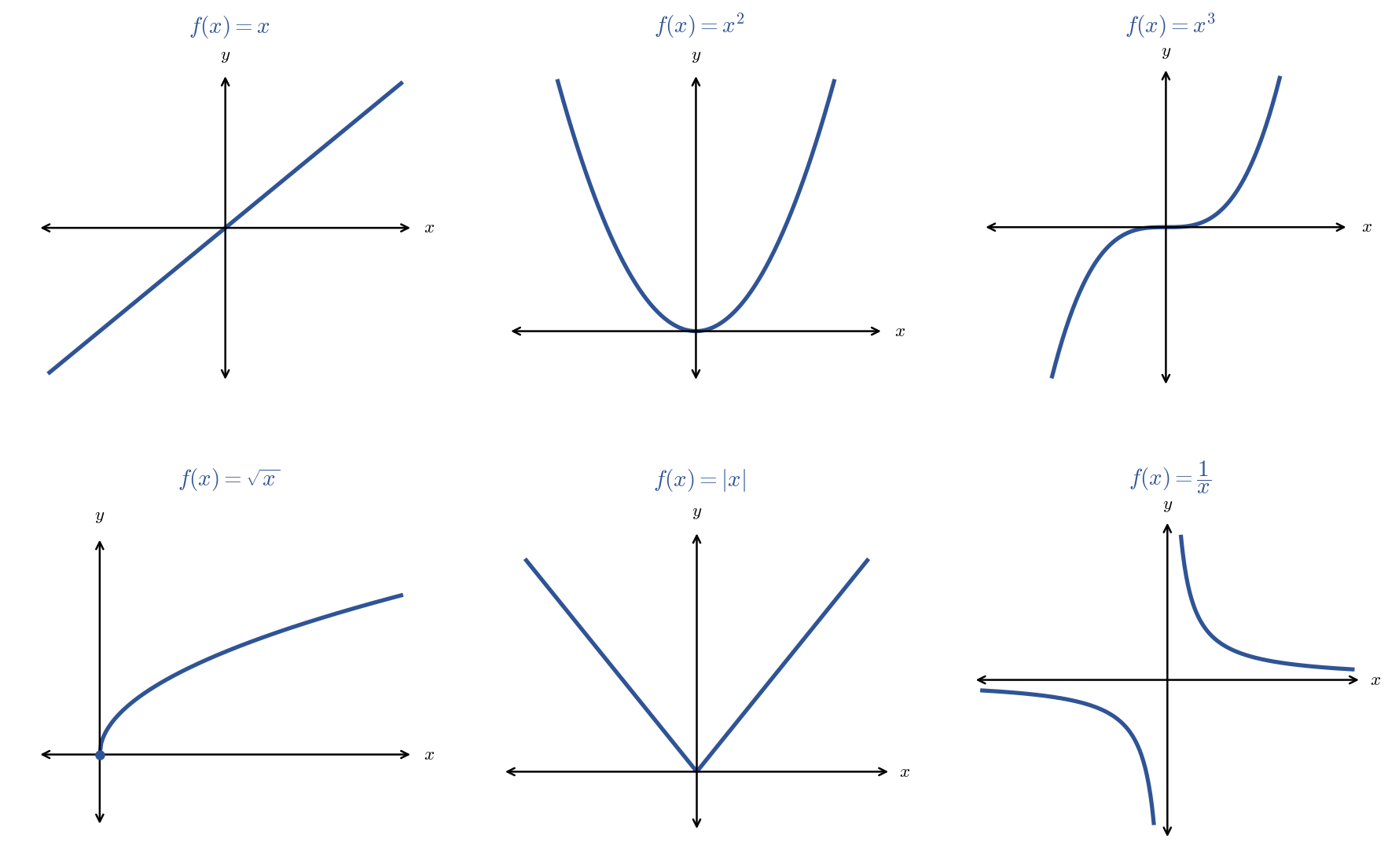
Figure 1.3.2: The six parent functions: identity, quadratic, cubic, square root, absolute value, and reciprocal.
1.3.2 Vertical and Horizontal Shifts
The simplest transformations move a graph without changing its shape.
Vertical shifts are intuitive: adding a constant to every output moves every point on the graph up or down by the same amount. Figure 1.3.5 shows \(f(x) = x^2\) alongside \(g(x) = x^2 + 3\) (shifted up \(3\)) and \(h(x) = x^2 - 2\) (shifted down \(2\)).
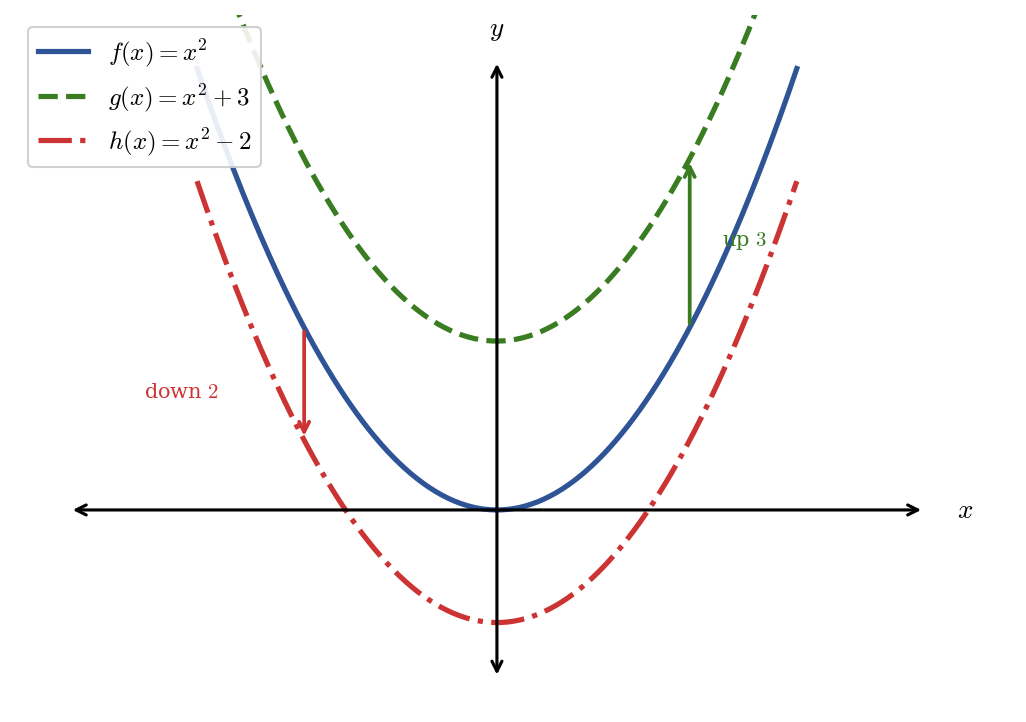
Figure 1.3.5: Vertical shifts of \(f(x) = x^2\).
Horizontal shifts are trickier. Notice the opposite sign pattern: \(f(x - 2)\) shifts the graph right (not left), and \(f(x + 3)\) shifts it left (not right). Why? To get the same output that \(f\) originally produced at \(x = 0\), you now need to input \(x = 2\) in \(f(x - 2)\), because \(f(2 - 2) = f(0)\). Every point on the graph must move \(2\) units to the right to compensate. Figure 1.3.6 illustrates this with \(g(x) = (x - 2)^2\) and \(h(x) = (x + 3)^2\).
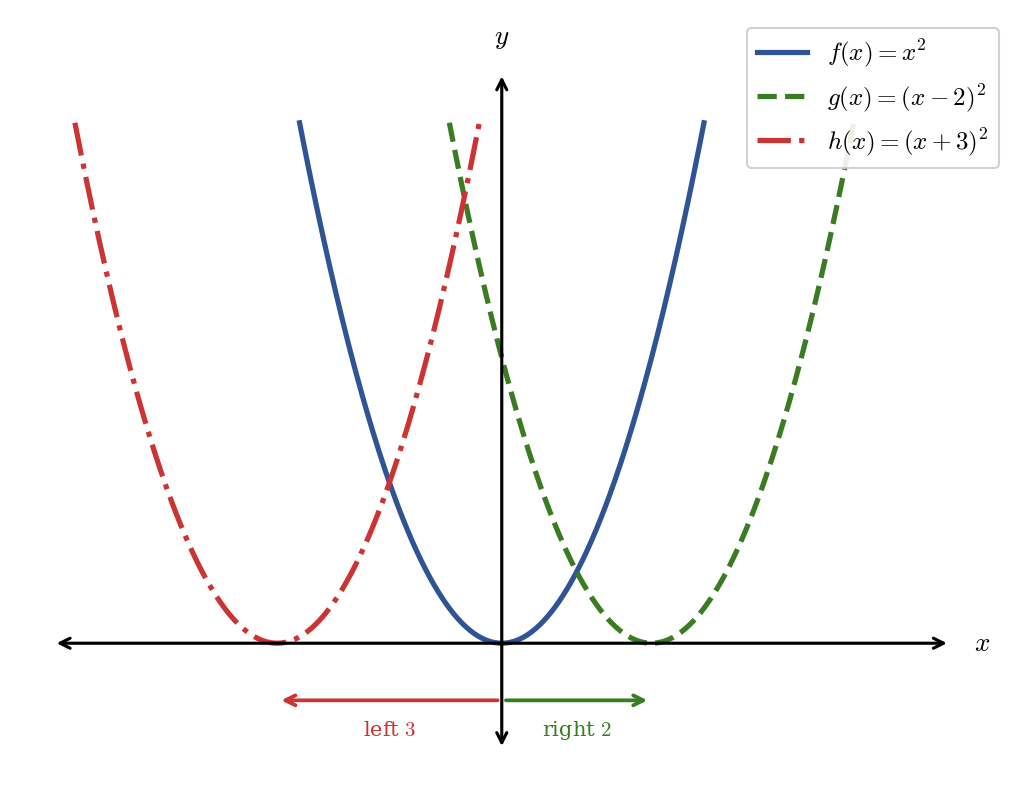
Figure 1.3.6: Horizontal shifts of \(f(x) = x^2\).
1.3.3 Reflections
A reflection flips a graph across an axis, producing a mirror image.
Figure 1.3.10 shows both reflections applied to \(f(x) = \sqrt{x}\). The \(x\)-axis reflection \(g(x) = -\sqrt{x}\) flips the curve downward, while the \(y\)-axis reflection \(h(x) = \sqrt{-x}\) flips it to the left.
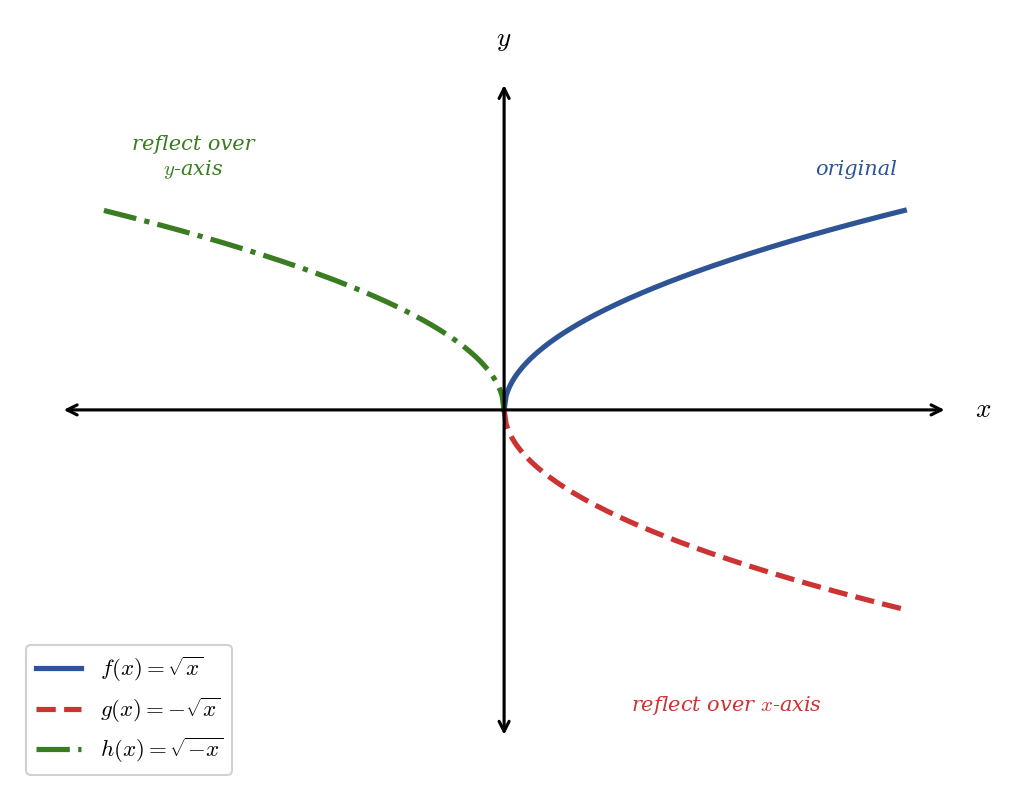
Figure 1.3.10: Reflections of \(f(x) = \sqrt{x}\) across the \(x\)-axis and \(y\)-axis.
1.3.4 Vertical and Horizontal Stretches and Compressions
Stretches and compressions change the scale of a graph — making it taller, shorter, wider, or narrower — without changing its basic shape.
Figure 1.3.14 compares \(f(x) = x^2\) with \(g(x) = 2x^2\) (stretched — steeper, narrower appearance) and \(h(x) = \frac{1}{2}x^2\) (compressed — flatter, wider appearance).
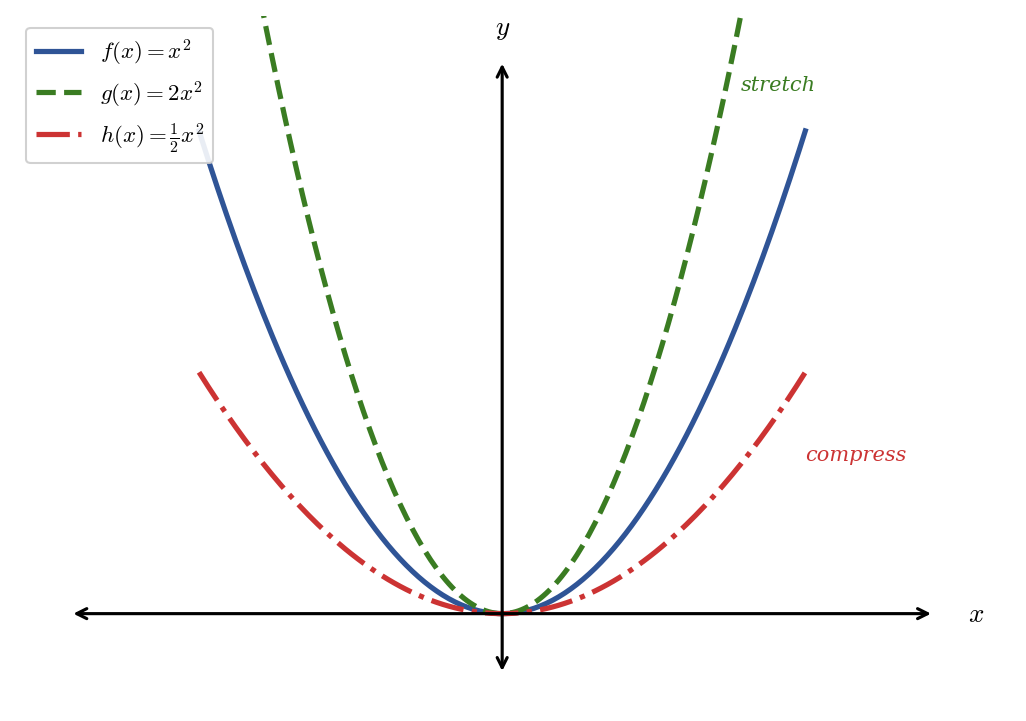
Figure 1.3.14: Vertical stretch and compression of \(f(x) = x^2\).
Just as with horizontal shifts, the horizontal direction is counterintuitive: multiplying the input by \(2\) makes the graph narrower (not wider), because each output value is reached at half the original \(x\)-value. Figure 1.3.15 illustrates this.
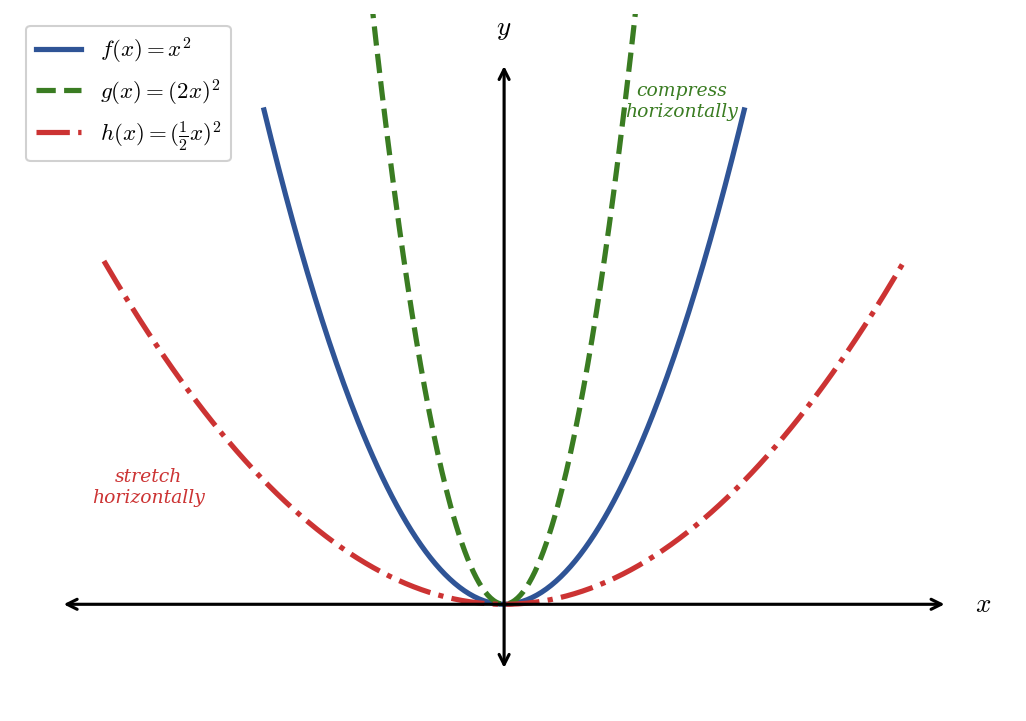
Figure 1.3.15: Horizontal stretch and compression of \(f(x) = x^2\).
1.3.5 Combining Transformations
In practice, functions often involve several transformations applied to a parent. The key is to apply them in the right order:
- Horizontal shifts and stretches/compressions (inside the function)
- Reflections
- Vertical stretches/compressions (outside the function)
- Vertical shifts (outside the function)
A useful way to remember: work from the inside out. Transformations that modify the input (horizontal) come first; transformations that modify the output (vertical) come second.
Starting from \(f(x) = |x|\), graph \(g(x) = -2|x - 3| + 4\) by applying transformations one at a time.
Solution.
We can write \(g(x) = -2 \cdot f(x - 3) + 4\). Reading off the transformations:
Step 1: Start with \(f(x) = |x|\), the standard V-shape with vertex at the origin.
Step 2: Replace \(x\) with \(x - 3\) to get \(|x - 3|\). This shifts the graph right \(3\) units. The vertex moves to \((3, 0)\).
Step 3: Multiply by \(-2\) to get \(-2|x - 3|\). The factor of \(2\) stretches the graph vertically by a factor of \(2\), making it steeper. The negative sign reflects it across the \(x\)-axis, flipping the V upside down. The vertex remains at \((3, 0)\).
Step 4: Add \(4\) to get \(-2|x - 3| + 4\). This shifts the graph up \(4\) units. The vertex moves to \((3, 4)\).
The final graph is an inverted V with vertex at \((3, 4)\), opening downward, with slopes of \(-2\) and \(2\) on either side. Figure 1.3.19 shows each step.
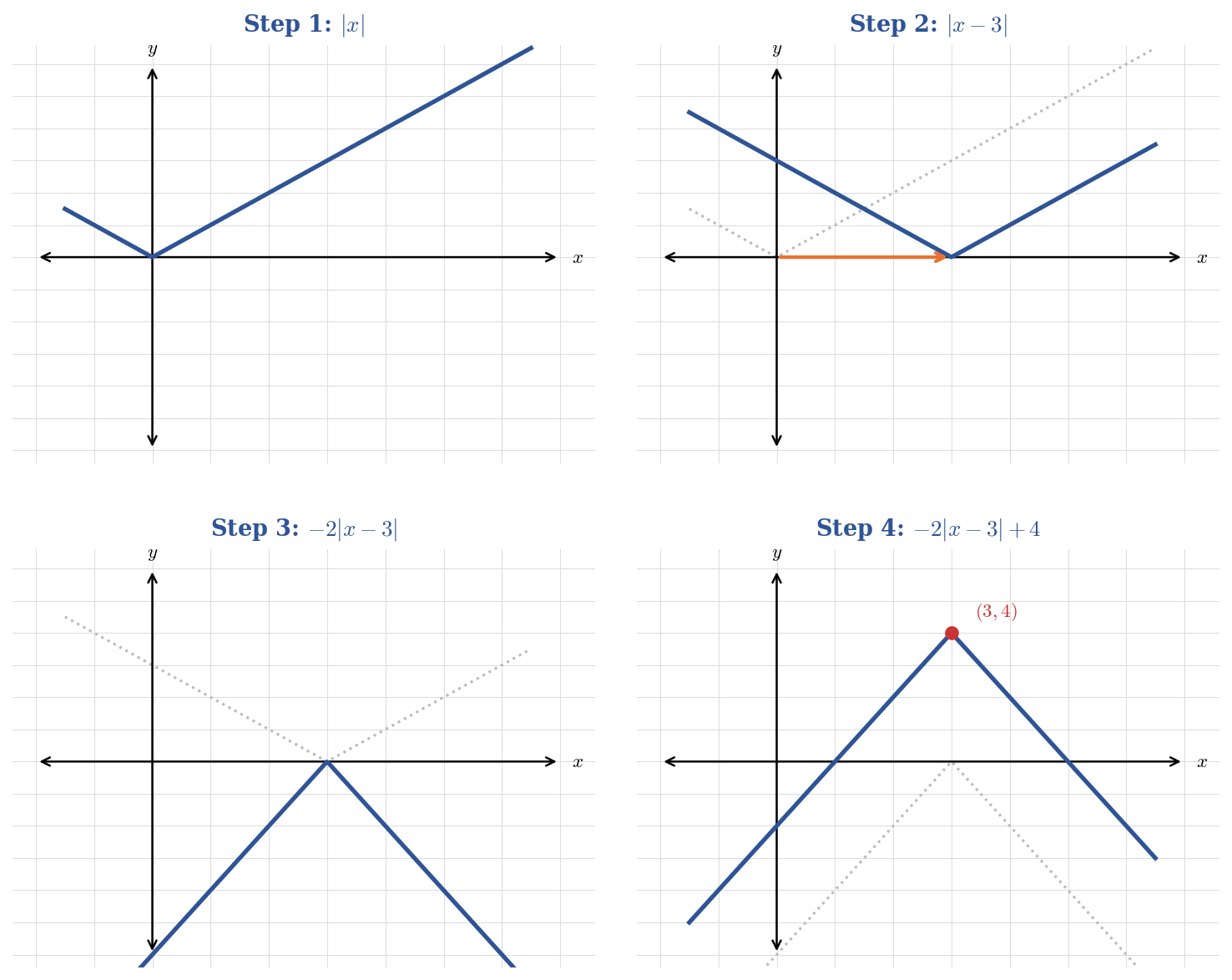
Figure 1.3.19: Building \(g(x) = -2|x - 3| + 4\) from \(f(x) = |x|\) in four steps.
1.3.6 Even and Odd Functions
Some functions have built-in symmetry that simplifies graphing and analysis. These symmetries are closely related to reflections.
Figure 1.3.23 illustrates both types. The parabola \(f(x) = x^2\) is even: the left half is a mirror image of the right half. The cubic \(f(x) = x^3\) is odd: rotating the graph \(180°\) about the origin produces the same curve.
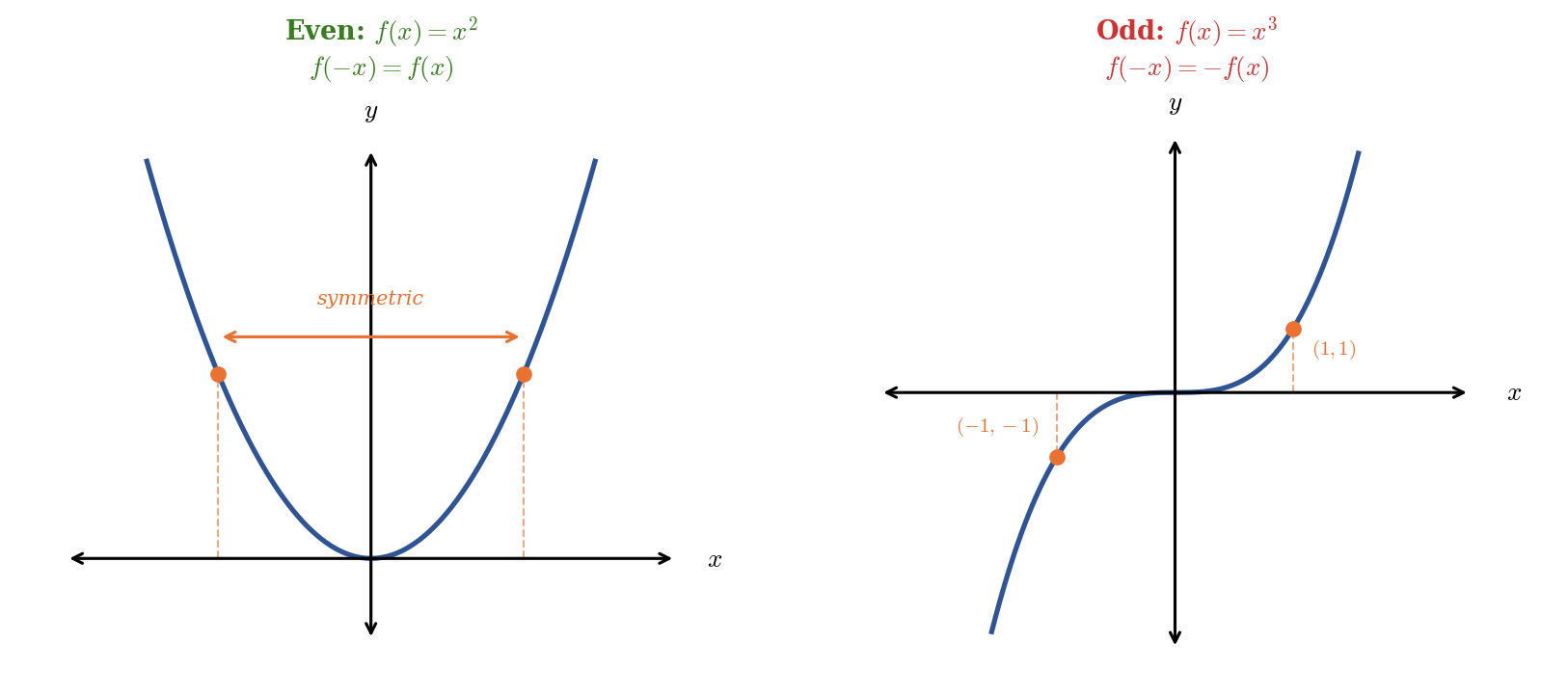
Figure 1.3.23: An even function (\(x^2\), symmetric about the \(y\)-axis) and an odd function (\(x^3\), symmetric about the origin).
1.3.7 Summary
- Parent functions (\(x\), \(x^2\), \(x^3\), \(\sqrt{x}\), \(|x|\), \(1/x\)) are the building blocks from which other functions are constructed through transformations.
- Vertical shifts: \(f(x) + k\) moves up; \(f(x) - k\) moves down.
- Horizontal shifts: \(f(x - h)\) moves right; \(f(x + h)\) moves left. Note the opposite sign.
- Reflections: \(-f(x)\) reflects across the \(x\)-axis; \(f(-x)\) reflects across the \(y\)-axis.
- Vertical stretch/compression: \(a \cdot f(x)\) stretches if \(a > 1\), compresses if \(0 < a < 1\).
- Horizontal stretch/compression: \(f(bx)\) compresses horizontally if \(b > 1\), stretches if \(0 < b < 1\).
- When combining transformations, work inside out: horizontal changes first, then vertical changes.
- A function is even if \(f(-x) = f(x)\) (symmetric about the \(y\)-axis) and odd if \(f(-x) = -f(x)\) (symmetric about the origin).
1.4 Building New Functions: Combinations and Composition
This section is under development.
1.5 Reversing the Process: Inverse Functions
This section is under development.
1.6 Format Preview Section
This is only a preview section to delete later. The boxes below are style previews for each environment type.
1.6.1 Sample Subsection
Some introductory text before the first box…
More text between boxes…
More text…
More text…
More text…
More text…